Cathedral of the Immaculate Conception

Springfield, IL

  • About
    • Contact Us
    • History of the Cathedral
    • Liturgical Schedules
    • Parish Staff
    • Register with Cathedral
    • Subscribe to the Cathedral eWeekly
  • Sacraments
    • Baptism
    • Becoming Catholic
    • Matrimony
    • Vocations
  • Ministry List
    • Adult Faith Formation
    • Cathedral Meal Train
    • Cathedral Online Prayer Wall
    • Cathedral Concerts
    • Family of Faith
    • Grief Share
    • Health and Wellness
    • Spiritual Resources
  • Stewardship
    • Stewardship: A Disciple’s Response
    • Stewardship Form
  • Support
    • E-Giving Frequently Asked Questions
    • Give Online
  • Sunday News
    • Announcements
    • Cathedral Weekly
    • Livestream Feed
    • Submit a Mass Intention Request
    • Weekly or Announcement Submission

Pope Francis on the Communion of Saints (pt. 1)

In light of Our Holy Father Pope Francis’ serious sickness (as I write this article), I wanted to bring something of his words to you this week and next. On April 7, 2021, while doing an ongoing catechesis on prayer, he spoke on how our prayer brings us into union with the saints. They are prescient words as we embark on deeper and more consistent prayer during this season of Lent. Perhaps one of the ways we can do this is simply to unite and pray with those saints that are especially close to us. They have learned the work, and received the gift, of prayer perfectly; they can be a great help to us!

I was also moved especially by his reflection on prayer in time of suffering, especially as he himself has been carrying a heavy burden on that front these past weeks. Again and again, he has thanked the world for holding him in prayer, AND while hospitalized has given his signature for the further steps towards canonization of multiple saints! (Naming as venerable Fr. Emil Kapaun, military chaplain from Kansas; Italian layman Salvo D’Acquisto; Michele Maura Montaner, a 19th-century Spanish priest; Italian priest Didaco Bessi; and Kunegunda Siwiec, a Polish laywoman who died in 1955.) He is living out the teaching he gave those 4 years ago!

Dear Brothers and Sisters, good morning!

Today, I would like to reflect on the connection between prayer and the communion of saints. In fact, when we pray, we never do so alone: even if we do not think about it, we are immersed in a majestic river of invocations that precedes us and proceeds after us.

Contained in the prayers we find in the Bible, that often resound in the liturgy, are the traces of ancient stories, of prodigious liberations, of deportations and sad exiles, of emotional returns, of praise ringing out before the wonders of creation… And thus, these voices are passed on from generation to generation, in a continual intertwining between personal experience and that of the people and the humanity to which we belong. No one can separate themselves from their own history, the history of their own people. We always carry this inheritance in our attitudes, and also in prayer. In the prayers of praise, especially those that blossom from the hearts of the little ones and the humble, echo parts of the Magnificat that Mary lifted up to God in front of her relative Elizabeth; or of the exclamation of the elderly Simeon who, taking Baby Jesus in his arms, said: “Lord, now lettest thou thy servant depart in peace, according to thy word” (Lk 2:29). 

Prayers — those that are good — are “expansive”, they propagate themselves continuously, with or without being posted on social media: from hospital wards, from moments of festive gatherings to those in which we suffer silently… The suffering of each is the suffering of all, and one’s happiness is transmitted to someone else’s soul. Suffering and happiness are part of a single history: they are stories that create history in one’s own life. This history is relived in one’s own words, but the experience is the same. 

Prayer is always born again: each time we join our hands and open our hearts to God, we find ourselves in the company of anonymous saints and recognized saints who pray with us and who intercede for us as older brothers and sisters who have preceded us on this same human adventure. In the Church there is no grief that is borne in solitude, there are no tears shed in oblivion, because everyone breathes and participates in one common grace. It is no coincidence that in the ancient church people were buried in gardens surrounding a sacred building, as if to say that, in some way, the multitude who preceded us participate in every Eucharist. Our parents and grandparents are there, our godfathers and godmothers are there, our catechists and other teachers are there… That faith that was passed on, transmitted, that we received. Along with faith, the way of praying and prayer were also transmitted.

– Fr. Dominic 
Prayer Wall – 03/03/2025

Rick my store manager Zach told me if I made a mistake on the Marquis he was going to fire me i need prayer for mercy and protection and righteous justice here also open doors for another job thank you and God bless you 🙏

Prayer Wall – 02/28/2025

Please pray for the repose of the soul of David Starrett.

A New Basis for Life

In the next paragraph, the Holy Father returns to the word which he spent time unpacking in the previous paragraph.  I noted that the popular English translations for hypostasis from Hebrews 11:1 are ‘realization’, ‘assurance’, or ‘guarantee.’  But Pope Benedict prefers the more technical and philosophical translation of ‘substance’.  The pope connects his treatment of this passage with one from the previous chapter in the Letter to the Hebrews, which reads: “You even joined in the sufferings of those in prison and joyfully accepted the confiscation of your property, knowing that you had a better and lasting possession.” (Heb. 10:34) The Greek word for possession here has the same root as substance from Heb. 11:1, thus offering even more insights into its usage in this letter, especially as it relates to the topic of hope.

When considering the word ‘possession’, the Holy Father notes that this property “constitutes the means of support, indeed the basis, the ‘substance’ for life, what we depend upon.” (SS 8) As the pope points out, however, “[t]his ‘substance’, life’s normal source of security, has been taken away from Christians in the course of persecution.” (ibid) But being deprived of this earthly support, they stood firm because they realized that they had something far more valuable and long lasting than material support.  Through their faith, “they had found a better ‘basis’ for their existence—a basis that abides, that no one can take away.” (ibid) Commenting on this new basis for life that faith offers us, the pope writes:

Faith gives life a new basis, a new foundation on which we can stand, one which relativizes the habitual foundation, the reliability of material income. A new freedom is created with regard to this habitual foundation of life, which only appears to be capable of providing support, although this is obviously not to deny its normal meaning. (ibid)

As a way of demonstrating the “proof” for this statement, the Holy Father points out the example of how this has been lived out in a compelling way throughout the life of the Church:

Above all, it is seen in the great acts of renunciation, from the monks of ancient times to Saint Francis of Assisi and those of our contemporaries who enter modern religious Institutes and movements and leave everything for love of Christ, so as to bring to men and women the faith and love of Christ, and to help those who are suffering in body and spirit. In their case, the new “substance” has proved to be a genuine “substance”; (ibid)

The pope explains how “from the hope of these people who have been touched by Christ, hope has arisen for others who were living in darkness and without hope.” (ibid) In other words, their example that one can be at peace and joyful despite a lack of worldly possession shows us that the same is possible for us as well.

Most of us are not called to this more radical form of earthly poverty, but all of us are called to the poverty of spirit as seen in the First Beatitude: “blessed are the poor in spirit.” (Mt. 5:3) Another word for ‘blessed’ in the Beatitudes is ‘happy’, or ‘fortunate’.  This state of blessedness is something which we already possess through that poverty of spirit, and Jesus adds the promise of how that blessedness is directed toward the fulfillment of hope that that experience brings: “for theirs is the kingdom of heaven.” (ibid)

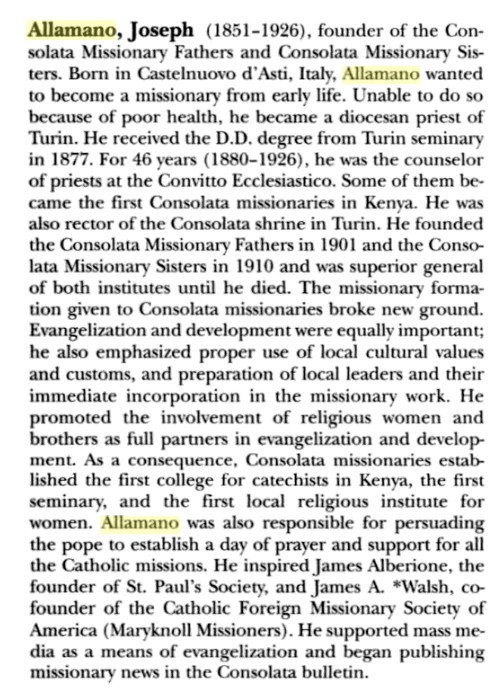
St. Giuseppe Allamano

Feast Day: February 16th

(We finally get to the saint behind the miraculous healing of Sorino Yanomami.) Giuseppe Ottavio Allamano was born in Asti, Italy, in 1851. His uncle was actually the wonderful “saint of the gallows”, Fr. Joseph Cafasso, and in his youth Giuseppe attended the oratory under St. John Bosco in Valdocco. These were influences towards his own entry into seminary in 1866, though at that time he was not at all certain that the Lord was calling him to be a priest, “The Lord is calling me today … I don’t know if he will call me again in two or three years.” So began his lifelong growth in learning to discern God’s will, happily including his ordination as a priest in 1873 for the Diocese of Turin. His first years of priesthood were as a spiritual director in the seminary, and completing his doctorate in theology. In 1876, he was made the rector of the seminary and a few years later (at the age of 29!) the rector of the Sanctuary della Maria della Consolazione (commonly simply called “La Consolata”). It was an ancient site of worship, and the spiritual heart of Turin, and Fr. Allamano was determined to be part of its renewal. He constructed additional chapels, restored the ceiling, and also worked on spiritual initiatives to build up the faith of the city including starting a monthly Catholic newspaper, La Consolata in 1899.

But it was his own brush with death in 1891 that brought him to discern that God was asking him even further off the standard path of a diocesan priest: to found a religious order dedicated to the missions. He had never been on mission, and would never even travel outside of Italy because of his poor health, but he found it “unnatural that in his Church, fertile with so many  charity institutions, one solely dedicated to the missions was lacking”. And so, on January 29th, 1901, the Istituto Missioni Consolata was established. “Not having been able to be a missionary myself, I want those souls who wish to follow that path not to be hindered”. Yet, thinking again it seems, he also said ”the vocation to the missions is essentially the vocation of every holy Priest. All it takes is a greater love for our Lord Jesus Christ, which urges one to make him known and loved by those who do not yet know him and love him.”

It had taken 10 years to get the order off the ground – as he would also say, dioceses were willing to give money, but not men, for the missions. It was another decade later, with his brothers and fathers on mission all over the world, that he realized something deeply lacking in their efforts without women also carrying the Gospel to all those places. He needed not just spiritual fathers, but also mothers, to care for the poor and unevangelized around the world. He met, and received the approval of Pope Pius X to found a female branch of the Institute of the Consolata Missionaries in 1910 … and was not done yet. In 1912 he met the pope again, this time begging him to establish an annual day to proclaim the importance of mission to the whole church. Yes, to encourage those called to be missionaries, but also anticipating by decades the Second Vatican Council’s proclamation of the universal missionary vocation of the whole church.

Then war broke out in the Balkans, and Archduke Franz Ferdinand was assassinated in 1914, and World War I engulfed Europe. Pope Pius X was consumed by the horrors of war, and Fr. Allamano spent his time caring for his order abroad, and the many refugees and draftees from the war in the area around Turin. He died in February 1926. BUT, the great missionary zeal which had marked his life was not to be snuffed out! In 1927, Pope Pius XI instituted World Mission Sunday, which continues to our day to be celebrated every year in October. We happily already have Pope Francis’ words for this upcoming one of October 19, 2025 where he speaks to missionaries, like the Consolata fathers and sisters, and then to all of us:

I thank you most heartily! Your lives are a clear response to the command of the risen Christ, who sent his disciples to evangelize all peoples (cf. Mt 28:18-20). In this way, you are signs of the universal vocation of the baptized to become, by the power of the Spirit and daily effort, missionaries among all peoples and witnesses to the great hope given us by the Lord Jesus.

– Fr. Dominic is amazed at how impactful one diocesan priest can be all over the world a century after his death. Not only the many conversions, but now also the miraculous cure of Sorino Yanomami and the radical openness in the local tribes that was only possible after such a divine intervention.

Prayer Wall – 02/24/2025

Please pray for Dave who is in the ICU in critical condition, with flu, pneumonia, and throat cancer.

Prayer Wall – 02/19/2025

Hallelujah Gratitude Grateful shalama Kadish Shal

Prayer Wall – 02/19/2025

I am financially secure, and my wealth supports those I love wealth nurtures me and love ones financial abundance brings emotional peace It be nice to live each day to the fullest with love ones thank you!

Prayer Wall – 02/19/2025

Hallelujah Gratitude Grateful I could really use more than one miracle right now Be nice to get at least a couple more good years with my Grandpa thank you!

Already but Not Yet

When Pope Benedict was elected to the papacy in 2005, there was some fear that as he assumed a more prominent role in the Church, his writing might be difficult for some to grasp.  Prior to his becoming pope, Joseph Ratzinger (his name before becoming pope) had written extensively.  He had served as a professor of theology for many years and also spent almost 25 years as the Prefect of the Congregation for the Doctrine of the Faith.  Both of these positions often required him to write on difficult topics of the faith, and trying to read those writings was sometimes a little difficult, despite the clarity and order with which he wrote.

Just a few months after his election, Pope Benedict issued his first encyclical, Deus caritas est (God is love).  Many were surprised to see how easy it was to read this document.  Though still packed with profound theological insights, he was able to express his ideas in ways that were generally easily understood and greatly appreciated.  I say all of that as a way of preparing us for the next paragraph in Spe Salvi, in which the pope delves into some more technical language about the relationship between faith and hope, specifically as it is expressed in the first verse of the eleventh chapter of the Letter to the Hebrews.  As I read through this paragraph again, I found myself struggling a little more than with other paragraphs as the Holy Father offers a short exegesis on this passage which offers the classic definition of faith in the New Testament.  He quotes the passage, leaving the word in question untranslated: “Faith is the hypostasis of things hoped for; the proof of things not seen.”(Heb. 11:1) (FYI – the English word used for hypostasis is ‘realization’, ‘assurance’, or ‘guarantee’) The rest of the paragraph unpacks that word hypostasis, considering it’s meaning in Greek, in Latin, and how Martin Luther and biblical scholars (both Catholic and Protestant) have understood it, and how he resolves those various views to express the Catholic interpretation of this important passage.

Feel free to read the paragraph for yourself, but the conclusion that the Holy Father arrives at is insightful and much easier to understand in comparison to the steps leading to that conclusion.  He concludes with the following:

Faith is not merely a personal reaching out towards things to come that are still totally absent: it gives us something. It gives us even now something of the reality we are waiting for, and this present reality constitutes for us a “proof” of the things that are still unseen. Faith draws the future into the present, so that it is no longer simply a “not yet”. The fact that this future exists changes the present; the present is touched by the future reality, and thus the things of the future spill over into those of the present and those of the present into those of the future. (SS 7)

My somewhat feeble attempt to distill this paragraph is that through faith, which is a gift of God’s grace, a seed is planted within our souls, such that what we hope for in eternal life, is already present in us.  It is not something we make up, something we hope to see in the future, but it is an objective reality of life with God, for the beginning of the fullness of that life is already in us through grace, which is a sharing in very Christ’s life.  This is an “already” that is present within us, not just a wishful longing for what is “not yet.”  It is not either/or, but rather both/and. 

« Previous Page
Next Page »

Liturgy

Sunday Masses (unless noted differently in weekly bulletin)
Saturday Evening Vigil – 4:00PM
Sunday – 7:00AM, 10:00AM and 5:00PM

Weekday Masses (unless noted differently in weekly bulletin)
Monday thru Friday – 7:00AM and 5:15PM
Saturday – 8:00AM

Reconciliation (Confessions)
Monday thru Friday – 4:15PM to 5:00PM
Saturday – 9:00AM to 10:00AM and 2:30PM to 3:30PM
Sunday – 4:00PM to 4:45PM

Adoration
Tuesdays and Thursdays – 4:00PM to 5:00PM


CatholicMassTime.org

Parish Information

Parish Address
524 East Lawrence Avenue
Springfield, Illinois 62703

Parish Office Hours
Monday thru Thursday – 8:00AM to 4:00PM
Fridays – CLOSED

Parish Phone
(217) 522-3342

Parish Fax
(217) 210-0136

Parish Staff

Contact Us

Contact Us

Copyright © 2026 · Log in