Cathedral of the Immaculate Conception

Springfield, IL

  • About
    • Contact Us
    • History of the Cathedral
    • Liturgical Schedules
    • Parish Staff
    • Register with Cathedral
    • Subscribe to the Cathedral eWeekly
  • Sacraments
    • Baptism
    • Becoming Catholic
    • Matrimony
    • Vocations
  • Ministry List
    • Adult Faith Formation
    • Cathedral Meal Train
    • Cathedral Online Prayer Wall
    • Cathedral Concerts
    • Family of Faith
    • Grief Share
    • Health and Wellness
    • Spiritual Resources
  • Stewardship
    • Stewardship: A Disciple’s Response
    • Stewardship Form
  • Support
    • E-Giving Frequently Asked Questions
    • Give Online
  • Sunday News
    • Announcements
    • Cathedral Weekly
    • Livestream Feed
    • Submit a Mass Intention Request
    • Weekly or Announcement Submission

Sacramental Bonanza

This past Sunday, Divine Mercy Sunday, the priests of the Cathedral sat down for a late dinner after the end of a packed day.  We all reflected on how much had taken place on that day, including:

  1. Regular Sunday Masses
  2. Reception into Full Communion of the Catholic Church of one of our RCIA candidates
  3. Baptism of the youngest daughter of the young woman received in #2
  4. Baptism / Confirmation Party for #2 and #3
  5. Divine Mercy Service, during which MANY confessions were heard
  6. More Confessions before the 5:00 pm Mass
  7. Family of Faith Teaching Meeting

While there was hardly a moment to take a breather in between all of these event, we all agreed how life-giving that day was because all of the events of the day were connected to our identity and mission as priests, a mission we are so privileged to share with all of you here at the Cathedral.

The Sacrament of Holy Orders (which bishops, priests, and deacons receive) falls under a category of sacraments known as Sacraments at the Service of Communion.  The Catechism describes this sacrament, as well as Holy Matrimony, in this way:

Two other sacraments, Holy Orders and Matrimony, are directed towards the salvation of others; if they contribute as well to personal salvation, it is through service to others that they do so. They confer a particular mission in the Church and serve to build up the People of God. (CCC 1534)

As I said, it is our privilege to minister to all of your needs, for we know that doing so helps to strengthen your communion with God and the Church, especially in the celebration of the sacraments.  We are very much aware that our ministry is at the service of your salvation, and we want you to know that we take that very seriously.  And as the Catechism suggests, it is through our service to you that we ourselves will be saved.  In other words, if we are serious about wanting to get to Heave, the only hope we have is to spend ourselves in the service of your salvation.  I think this point was demonstrated well in a brief conversation we had with one of our parishioners at the end of that long, yet joy-filled day.  This parishioner said something like:  “We cannot do it without you”, to which one of the priests responded: “Nor can we do it without you!”  

During this Easter Season, we are all (clergy and laity alike) invited to recognize that none of us can be saved apart from Jesus Christ, whose Resurrection makes possible our salvation.  May we thank Him for His gift of salvation as we all work together to help one another on our journey toward full communion with Him forever in His Kingdom.

Father Alford     
Celibacy as Spiritual Fatherhood

One of the most striking things about the priesthood, especially to non-Catholics, is the priestly witness of celibacy. Celibacy is sometimes misunderstood as a spiritual practice in the Church. Since the earliest days of Christianity, followers of Jesus have given up marriage and family to more fully imitate Jesus and his state in life. In Judaism, celibacy was not a common practice. Jesus is the one who brought full meaning to both marriage and celibacy as signs of the kingdom of God. The primary reason that priests are celibate is in imitation of Jesus, who is espoused to the Church. Some mistakenly think that priests are not married because they are too busy to have a family. While it is true that it does make sense for priests to give their time to their parishioners, this is only a good which is allowed for by the primary reason of dedicating our whole selves to Christ and his Church. Since priests are “married” to the Church, priests give their lives in service to her. 

It is true that there are married priests in the Church, especially in the Eastern (non-Latin) Churches. We even have a married priest in our own diocese here in Springfield. However, even in the Eastern Churches, their monks and their bishops are celibate, and they clearly esteem this practice also. Having some married priests in the Church does not take away the symbolic and spiritual value of celibacy among many of the clergy and men and women religious. 

It is beautiful that in our culture, we call priests by the title “Father.” As priests, we give up physical marriage and children for the sake of bearing spiritual fruit. It is not always common to think of Jesus as a spiritual father because we often hear in the Gospels that he is the Son of the Father. However, in his ministry, Jesus exercised a spiritual fatherhood with his disciples by showing them the love of his own Father. One of the funny and interesting things about being a young priest is being called “father” by parishioners who are (much) older than me. In many ways, these parishioners are my spiritual fathers and mothers, as they are helping me to grow in holiness by their guidance and encouragement. However, when I minister as a priest, especially during the Mass and Reconciliation, I am acting as a spiritual father to those who are present. 

As I grow older as a priest, I hope to always grow into my identity as a spiritual father. The best way to do this is to continue to grow in my identity as a son of God. Jesus could be a father to his disciples because he received his identity from his heavenly Father. By our baptism, we are also sons and daughters of God, like Jesus. The Church is immensely blessed by the witness and ministry of older priests in our parishes. There is a certain joy which comes with being a new, young priest. However, there is also a certain joy which comes with being an old, experienced, and wise priest. There are many older priests who exercise a very clear spiritual fatherhood (or spiritual grandfatherhood) with their parishioners. This is made much more clear by their witness of celibacy and their sacrifice of kids and grandkids for the sake of their spiritual children. 

Celibacy is a gift from God. Jesus said that not everyone can accept this practice (Matthew 19:12), nor does he ask us all to do so. He obviously wants us to be fruitful and multiply! However, for those who are called to imitate Jesus by remaining celibate, it is a joy! 

Saint Anselm of Canterbury: Philosophy, Politics, Prudence, and a whole lot of Prayer

Feast Day: April 21st

These past weeks, as we have continued to celebrate Easter, we have also begun to examine the sacrament of Holy Orders.  As it turned out, we started with the young man who fled Jesus’ agony in the garden in shame, but astonishingly reappears at the tomb, now splendid, and bearing a message of hope.  Priests are not much different: somewhere deep in the heart of the priesthood is that spectacular truth that God calls men, sinners still so much in need of His mercy, yet then He literally clothes them in white for the celebration of the Mass, a sign of the Lord’s grace at work in the priest’s hands, and words, and love.

Last week we found ourselves watching the drama unfold around Pope Martin I, as he struggled to stay faithful to His Lord and Savior as errors, emperors, assassins, and intrigue pummeled him from all sides.  In his life we have another facet of priesthood: not the sinner-supernaturalized but the shepherd-suffering, scorned, and surrounded.  How did that grace of ordination cascade through his life?  I see it in Martin’s divine doggedness in the face of horrific attacks upon him, his papacy, and his Divine Master.

First Poverty.  Then Perseverance.  This week: Prayer.  (Next week: Preaching)

And for this third pillar of what it means to be a priest, to be someone immersed in prayer, a pray-er, a mediator, an intercessor – someone who stands before God and communicates to Him the weaknesses and worship of His people, and communicates to the people the Word and wealth of God – we turn to St. Anselm of Canterbury.  Of course, I choose him because his feast day will occur on April 21st, the day he died in 1109 in Canterbury England.  He was a philosopher, an abbot, and a bishop, and found himself immersed in the chaos and challenges of his day in all those roles (all of which, at first, he was forced into, and yet from all of them he learned the characteristics of prudence, patience, and prayerfulness that would make up his sanctity)… but we catch a glimpse of him as a priest … simply a priest … in his most famous writing, the Proslogium.  Most people read it because there he is the first one to describe an ontological argument for God’s existence, but the work is truly at its heart a prayer.  Here is how Anselm begins:

Come on now little man, get away from your worldly occupations for a while, escape from your tumultuous thoughts. Lay aside your burdensome cares and put off your laborious exertions. Give yourself over to God for a little while, and rest for a while in Him. Enter into the cell of your mind, shut out everything except God and whatever helps you to seek Him once the door is shut. Speak now, my heart, and say to God, “I seek your face; your face, Lord, I seek.” – St. Anselm of Canterbury, Proslogion, Chapter 1.

Might I invite you into that place of silence and prayer as well?  Can you and I say those same words: “I seek Your face.”  Anselm tends through philosophy, theology, scripture, and much more in the course of his great philosophical work, but at the end, he reminds us that it is really a great prayerful work:

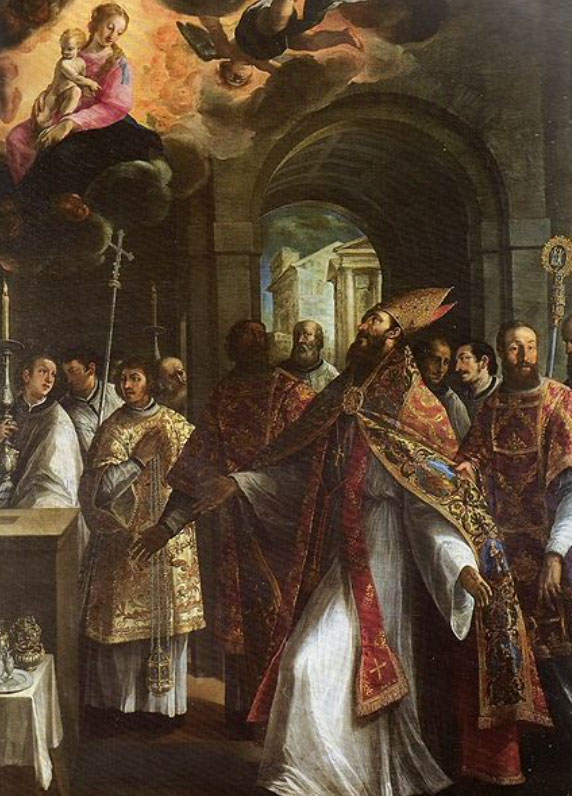
Sant’Anselmo che benedice la chiesa di San Paolo, Francesco Borgani, around 1600.  Located in the Francesco Gonzaga Museum, Mantua Italy. 

God, I pray, let me know and love You, so that I may rejoice in You. And if I cannot in this life [know, love, and rejoice in You] fully, at least let me advance day by day until the point of fullness comes. Let knowledge of You progress in me here and be made full [in me] there. Let love for You grow [in me here] and be [made] full [in me] there, so that here my joy may be great with expectancy and there may be full in realization. O Lord, You command—or, rather, You counsel—[us] to ask through Your Son; and You promise [that we shall] receive, so that our joy may be full. O Lord, I ask for what You counsel through our marvelous Counselor; may I receive what You promise through Your Truth, so that my joy may be full. O God of Truth, I ask; may I receive, so that my joy may be full. Until then, may my mind meditate upon [what You have promised]; may my tongue speak of it. May my heart love it; may my mouth proclaim it. May my soul hunger for it; may my flesh thirst for [it]; may my whole substance desire [it] until such time as I enter into the joy. St. Anselm of Canterbury, Proslogion, Chapter 26.

Anselm’s writing, and life, and ministry, began and ended in prayer, can ours do so as well?  Can our thirst for joy, peace, love, and meaning finds its answer in the Lord?

Fr. Dominic Rankin begins every day with an hour of prayer.  It is not usually filled with mystical moments or felt phenomenon, more than anything it is a conversation that often begins and ends with “I seek you face”, and that challenging yet thrilling continued yearning for God’s love, for myself and all those entrusted to my care.  This is Christ’s priesthood too.

Mass Intentions

Monday, April 19

7am – Mary Ann Midden
(William Midden)

5:15pm – Special Intentions forTammy Pritchett
(Family)

Tuesday, April 20

7am – Anna Eleyidath
(Augustine Eleyidath)

5:15pm – Frank Coffey
(Family)

Wednesday, April 21

7am – Repose of the Soul of Averil Rossiter
(Jane Fornoff)

5:15pm – Catherine Ponce
(Bill & Sara Metcalf)

Thursday, April 22

7am – Special Intention for Laura Fjelstul
(Chris Sommer)

5:15pm – Joseh Kohlrus
(Augustine Eleyidath)

Friday, April 23

7am – John Montgomery
(John Busciacco)

5:15pm – Diana J. Schumacher
(Daniel Schumacher)

Saturday, April 24

8am – Jack Ely
(Wife)

4pm – For the People 

Sunday, April 25

7am – Herman & Helen Koester Families,
(Living & Deceased)

10am – Richard Shaughnessy
(Mr. & Mrs. Shaughnessy & Family)

5pm – John & Edith Bakalar
(John Busciacco)

Prayer Wall – 04/09/2021

Prayers for Jeff who is 59 and was just diagnosed with Parkinson’s

Divine Mercy Sunday

On this Octave Day (8th day) of Easter, the Church celebrates Divine Mercy Sunday.  This feast was instituted for the Universal Church by Pope St. John Paul II in 2000 at the Canonization Mass for St. Faustina Kowalska, a Polish nun who received a series of revelations from Jesus about the great gift of Divine Mercy He offers to His children.  In her famous Diary, she recorded the following words from our Lord Himself about the feast day He intended to be celebrated on the Second Sunday of Easter:

My daughter, tell the whole world about My inconceivable mercy. I desire that the Feast of Mercy be a refuge and shelter for all souls, and especially for poor sinners. On that day the very depths of My tender mercy are open. I pour out a whole ocean of graces upon those souls who approach the fount of My mercy. The soul that will go to Confession and receive Holy Communion shall obtain complete forgiveness of sins and punishment. On that day all the divine floodgates through which graces flow are opened. Let no soul fear to draw near to Me, even though its sins be as scarlet. My mercy is so great that no mind, be it of man or of angel, will be able to fathom it throughout all eternity. Everything that exists has come forth from the very depths of My most tender mercy. Every soul in its relation to Me will contemplate My love and mercy throughout eternity. The Feast of Mercy emerged from My very depths of tenderness. It is My desire that it be solemnly celebrated on the first Sunday after Easter. Mankind will not have peace until it turns to the Fount of My Mercy. (Diary, #699)

Those final words stand out to me, for we hear the promise of peace that comes from turning to the Divine Mercy.  In nearly 10 years as a priest, I count my time in the confessional as some of the most fruitful ministry I have done.  I am constantly moved by the peace a penitent experiences as they encounter the gift of Divine Mercy in the Sacrament of Reconciliation.  Our sins deprive us of peace, but God’s mercy restores it in a powerful way that encourages us to not give up, but to begin again in our following the Lord, renewing our experience of the newness of life given on the day of our Baptism, and restored each time we encounter the Divine Mercy.

It is fitting that our topic for Family of Faith this month is the Sacrament of Holy Orders.  Ordination incorporates men into the ministry of Jesus Christ Himself.  Each degree of Holy Orders (Bishop, Priest, Deacon) participates in this ministry of Christ in different ways, but all of them share the common trait of being directed toward the salvation of others.  And since we cannot be saved apart from the Divine Mercy, all those called to serve the Church in Holy Orders have the special task of being instruments of Divine Mercy in various ways through service (primary role of deacons) and the celebration of the sacraments, especially Reconciliation and the Eucharist (primary role of bishops and priests).

Please pray for the clergy of our Cathedral Parish, that we may be ever mindful of the duty entrusted to us to share the message of Divine Mercy in word and in deed, so that many may approach the Divine Mercy, especially in the Sacrament of Mercy, and experience the peace His Mercy bestows in this life as a preparation for the fullness of peace that awaits us in Heaven.

Father Alford     

The Three Degrees of Holy Orders

The Sacrament of Holy Orders is unique among the seven sacraments, in that it has three distinct but related “degrees” or levels. Other sacraments can be repeated, such as Eucharist and Penance, but the Church does not really speak about “repeating” the sacrament of Holy Orders. Rather, a man receives ordination, which confers another degree of the sacrament. The three degrees of Holy Orders are the diaconate, the priesthood, and the episcopacy. Men in the episcopacy are called “bishops.” 

The first degree of Holy Orders is known as the order of deacons, or the diaconate. Deacons are usually married men who have full-time careers, but are ordained to official ministry in the Church in both the liturgy and in parish life. The word “deacon” comes from the Greek word for “service.” In the Acts of the Apostles, the deacons were entrusted with the burden of the administration of food and money when it became overwhelming for the apostles. Today, deacons assist the priest at Mass, preach, celebrate baptisms and weddings, visit the sick, among many of forms of service to God’s people.

Priests are celibate men (although there are some married priests) who have been called by Christ to continue his ministry on earth through the celebration of the Sacraments, especially the Eucharist and Penance. Priests remain celibate in imitation of Jesus himself, who was unmarried in order to more clearly be the image of the Bridegroom, wedded to the Catholic Church. Priests usually spend a year in ministry as a deacon before being ordained priests. However, they never cease to be deacons sacramentally.

Bishops receive the fullness of the sacrament of Holy Orders. There are provisions laid out in Canon Law for the process of choosing priests to become bishops. Every few years, a bishop of a diocese submits a list of names of priests to the pope’s delegate. In the bishop’s judgment, these priests would be good candidates to become a bishop. When a bishop dies or retires, the pope’s delegate will begin the search for a new bishop from the names of priests which have been submitted. Confidential questionnaires may be sent out to people who know these candidates so that a full profile can be submitted to the Vatican. From there, a committee of bishops will put forth the three best candidates for the pope to choose a new bishop for the diocese. This entire process is extremely confidential, and a priest may not know he is under consideration until he gets a phone call, asking him to become a bishop. In the past, the practice of careerism, or priests jockeying to become a bishop, has been a problem. The Church clearly wants to avoid any careerism or even an appearance of careerism. In fact, it seems that the opposite has become true today. 

It is widely known among priests that being a bishop is an extremely difficult calling and a very heavy burden to carry. Even St. Paul, as one of the first bishops, said, “there is the daily pressure upon me of my anxiety for all the churches” (2 Corinthians 11:28). Imagine having the responsibility for the salvation of hundreds of thousands, sometimes even millions, of both Catholics and non-Catholics in your diocese. Being the chief shepherd of a diocese is certainly a huge responsibility. I have heard being a bishop described as a “living crucifixion” because of the constant criticism which inevitably comes from the media, priests, and parishioners. Because of this, some priests turn down the request to become a bishop. However, as with any calling that comes from God, we can trust that God will sustain those who are faithful to him. Faithfulness to God is a source of a great joy that even the heaviest burdens cannot take away. Those who have received the sacrament of Holy Orders are set apart for a special service of God’s people. Let us keep our bishop, priests, and deacons in our prayers so that they may remain faithful to Christ, who called them to share in his ministry. 

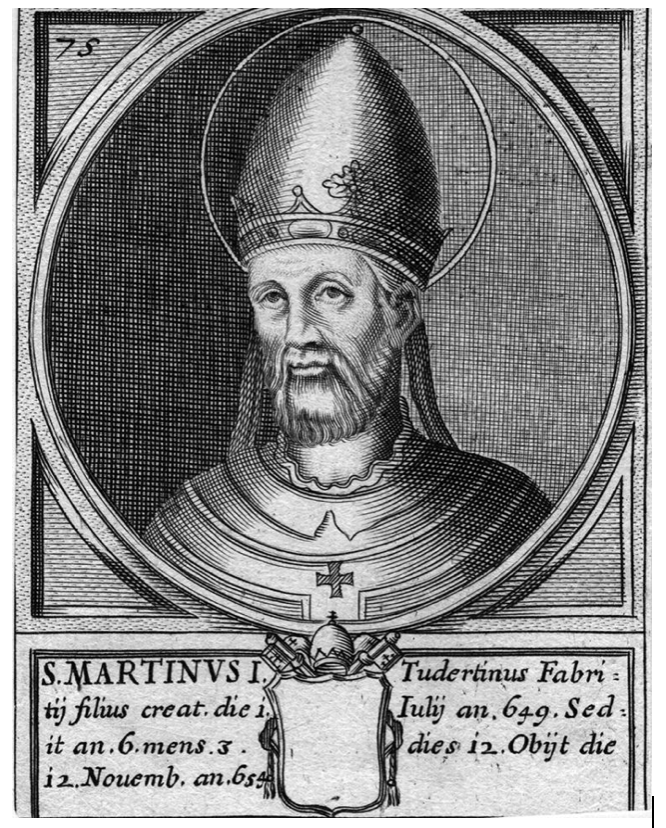
Pope Saint Martin I

Feast Day: April 13th

Intriguingly, one article I read about Pope Martin said that he was the last pope to be martyred when he was exiled to starvation on the island of Cherson (in the Crimea) in 655.  A little bit of research indicated that he is truly the last pope acclaimed as a martyr, though there have been plenty of successors to St. Peter in these intervening 1400 years who have been strangled, poisoned, maltreated, or starved until their demises … but are not acclaimed as martyrs because their death was not out of hatred for the Christian faith.  

Pope Martin’s death was … and yet he was killed by Christians. How? Why? … We should probably rewind the story a bit.

Martin was born in Italy, and blessed with a honorable family and an intelligent mind.  The haze of history obscures his early years, but by the time he is in his 40s, he is an abbot of a monastery of St. Basil and is being sent by Pope John IV to Dalmatia (nowadays Crete) with money to aid the inhabitants there who were suffering from ruinous invasions.  Martin had been known for his generosity, but would soon be known also for his diplomacy, because Pope Theodore (another two popes down the line from John IV) tapped Martin to be his apocrysiary (basically a legate/envoy) to Constantinople.  

This would not turn out to be a cushy assignment.  

The Council of Chalcedon was now 2 centuries in the past, but the truth that the Church had pronounced then – that Christ had two natures: human and divine – was now apparently up for debate again, at least the court of Constantinople (an impossible to discern jumble political and religious leaders, with emperor and patriarch contending for authority and admiration) where the latest twist on the ancient Christological heresies was to say that Christ did have two natures but only one will.  Pope Honorius I had feebly avoided controversy and let the falsehood fester, and now his successors were dealing with the consequences as the Eastern lung of the Church threatened to slide into denying the full humanity of their Savior.  Ambiguity, heresy, avoiding hard decisions, stubbornness, recalcitrancy… none of it is new!

Martin would be elected Pope in 649 and one of the first things he did was call an ecumenical council to be held at the Lateran Basilica in Rome.  One of the first things he did not do was ask for the Emperor of Constantinople (Constans II) to ratify his election as Pope.  He ruffled plenty of feathers with both actions.  105 bishops from around the Christian world rejected as heresy the claim that Christ had only one (divine) will, and notwithstanding the threats of force, coercion, and attempted assassination against Martin, the saintly pope wrote of this truth in an encyclical and had the translated decrees sent as well over to Constantinople.

Constans ordered the Pope arrested, which would take place in that same Lateran Basilica a few years later, after which Martin was brutally transported to Constantinople, marched through the frozen streets stripped, bloodied, and hobbling, and condemned to death, though, in the end, he would be merely banished to the pagan island of Cherson in 655.  Every conceivable political crime had been heaped upon him, but it was his refusal to sign off on heresy that sent him to his death.

His words, perhaps more than mine, should inspire us all: “It is now forty-seven days since I have been permitted to wash myself either in cold or warm water. I am quite wasted and chilled, and have had no respite either upon sea or land from the flux which I suffer. My body is broken and spent, and, when I would take any nourishment, I want such kind of food as is necessary to support me; and have a perfect aversion and loathing to what I have. But I hope that God, who knows all things, when he shall have taken me out of this world, will bring my persecutors to repentance.”

– Fr. Dominic Rankin often prays for the grace of perseverance (and repentance!).  It is hard enough to stay faithful through an average day’s duties, much less the brutality, deprivation, and scorn suffered by Pope St. Martin.  Yet the truth he gave his life to defend – that Christ has a human will, one united with His Divine Will – was one that the saintly pope also lived out. “Not My will, but Yours, be done” were words spoken by Our Lord, but they have been repeated by every saint since, whether in word or deed.  May we have the grace to do the same.

Mass Intentions – Week of April 12

Monday, April 12

7am – Anna A. Eleyidath
(Augustine Eleyidath)

5:15pm – Pius Onyejiaju Chineke
(The Anselment Family)

Tuesday, April 13

7am – Michael Poggi
(Family)

5:15pm – Grace Forlano
(John Busciacco) 

Wednesday, April 14

7am – Repose of the Soul of Averil Rossiter
(Jane Fornoff)

5:15pm – Jean Reno Greenwald
(Larry & Betsy Heman)

Thursday, April 15

7am – Leroy Lowry, Sr.
(Billy LeCrone)

5:15pm – William F. & Shirley Logan
(Lisa Logan & Lori LoganMotyka)

Friday, April 16

7am – Catherine Ponce
(Bill & Sara Metcalf)

5:15pm – Special Intention for Bianca
(D.A. Drago)

Saturday, April 17

8am – Janet Smith
(Lou Ann & Carl Corrigan)

4pm – Betty & Gene Barish
(Family)

Sunday, April 18

7am – Sophia Bartoletti
(Bartoletti Family)

10am – For the People

5pm – Jean Reno Greenwald
(Joan M. Miller)

Alleluia! He is Risen!

“Do not be afraid!” (Mt 28:5)  These are the first words the angel announced to the women who came to the tomb on Easter morning.  The tomb was empty, and there must have been a sense of fear that the body of Jesus had been taken, but the angel assures them: “I know that you are seeking Jesus the crucified.  He is not here, for he has been raised just as he said.” (Mt 28:5-6)

Just a year ago, we faced the unthinkable on Easter morning.  We had to celebrate Easter Mass virtually with nobody able to attend Mass in person due to the fear of spreading COVID-19.  While our hearts tried to rejoice at the victory of the Resurrection, we still had many fears about the uncertainties of what would follow.  At that time, few of us actually knew anybody close to us who had contracted the virus.  But within a few months, few of us did not know somebody close to us who had contracted the virus, some of whom, sadly, died as a result of getting sick.

With the number of cases going down and many people getting vaccinated, many of the fears that paralyzed us are slowly lifting.  An encouraging sign of that is the announcement from our Bishop a couple of weeks ago about the modification of the dispensation from attending Mass on Sundays and Holy Days of Obligation effective next weekend, Divine Mercy Sunday.  No longer is there need for a general dispensation for everybody.  It is time for us to take seriously the invitation to return to Mass, especially if we have been away for some time, or if we have used the dispensation as rationale for not coming to Mass regularly.

There are many of us who are greeting this modification with gratitude and joy.  But we must also acknowledge those whose reaction is not so enthusiastic.  In fact, for some, this news has resulted in their having more fear.  “Does not this create a more dangerous situation?”, some may ask.  The Bishop has accounted for those who might have a legitimate reason for fear when it comes to returning to Mass, as seen in his maintaining a particular dispensation for the following cases:

  1. Those 65 years of age or older;
  2. Those at risk for severe illness due to underlying medical conditions as described by the Centers for Disease Control and Prevention;
  3. Those who care for the sick, homebound, or infirmed;
  4. Those women who are pregnant;
  5. Those who cannot be accommodated at Mass because the church was at safe-distancing capacity.

It is also helpful to remind Catholics that certain situations do not require a dispensation at all to miss Mass.  Here are those situations in which we would be excused and expected not to attend for the good of others:

  1. Those who are currently ill; 
  2. Those who have a fever or exhibit flu-like symptoms; 
  3. Those who have good reason to think they might be asymptomatic of a contagious illness ( e.g., those who were in recent contact with someone who tested positive for a contagious illness such as COVID or influenza). 

For more information about the modification of the dispensation, please go to dio.org/backtomass

In light of the above points, there may be very legitimate reasons for not coming back to Mass yet, but for many of us, there is no reason not to return.  The words of the angel to the women at the tomb on Easter morning is spoken to us as well: “Do not be afraid!”  We have nothing to lose, but everything to gain!

So if you have been away, I invite you back to Mass.  If you have been coming, I invite you to invite somebody you know who has been away, encouraging them to not be afraid, but to rejoice in the opportunity to return to the feast of victory that Christ has made possible for us through His Passion, death, and Resurrection.  

Father Alford     

« Previous Page
Next Page »

Liturgy

Sunday Masses (unless noted differently in weekly bulletin)
Saturday Evening Vigil – 4:00PM
Sunday – 7:00AM, 10:00AM and 5:00PM

Weekday Masses (unless noted differently in weekly bulletin)
Monday thru Friday – 7:00AM and 5:15PM
Saturday – 8:00AM

Reconciliation (Confessions)
Monday thru Friday – 4:15PM to 5:00PM
Saturday – 9:00AM to 10:00AM and 2:30PM to 3:30PM
Sunday – 4:00PM to 4:45PM

Adoration
Tuesdays and Thursdays – 4:00PM to 5:00PM


CatholicMassTime.org

Parish Information

Parish Address
524 East Lawrence Avenue
Springfield, Illinois 62703

Parish Office Hours
Monday thru Thursday – 8:00AM to 4:00PM
Fridays – CLOSED

Parish Phone
(217) 522-3342

Parish Fax
(217) 210-0136

Parish Staff

Contact Us

Contact Us

Copyright © 2026 · Log in