Cathedral of the Immaculate Conception

Springfield, IL

  • About
    • Contact Us
    • History of the Cathedral
    • Liturgical Schedules
    • Parish Staff
    • Register with Cathedral
    • Subscribe to the Cathedral eWeekly
  • Sacraments
    • Baptism
    • Becoming Catholic
    • Matrimony
    • Vocations
  • Ministry List
    • Adult Faith Formation
    • Cathedral Meal Train
    • Cathedral Online Prayer Wall
    • Cathedral Concerts
    • Family of Faith
    • Grief Share
    • Health and Wellness
    • Spiritual Resources
  • Stewardship
    • Stewardship: A Disciple’s Response
    • Stewardship Form
  • Support
    • E-Giving Frequently Asked Questions
    • Give Online
  • Sunday News
    • Announcements
    • Cathedral Weekly
    • Livestream Feed
    • Submit a Mass Intention Request
    • Weekly or Announcement Submission

Holy Orders in Scripture

Happy and joyous Easter to all our parishioners! This year, our bulletin articles have been focusing on the theme of the seven sacraments to correspond with our Family of Faith formation program. The final two sacraments that we are going to reflect on are the two sacraments at the service of communion: Holy Orders and Matrimony. These two sacraments are for the building up of the Church. And while those individuals in each of these vocations certainly become holier through fidelity to these sacraments, the primary reason these sacraments exist is for the good of others. 

Easter is a very appropriate time to reflect on Holy Orders. The time surrounding the Passover was when Jesus chose to institute several of the sacraments: Holy Orders and Eucharist on Holy Thursday, and Penance on Easter Sunday. In fact, the Mass of the Lord’s Supper on Holy Thursday focuses almost exclusively in its prayers on the gifts of the Eucharist and the Priesthood.

Jesus began the sacraments of the Eucharist and Holy Orders on the same evening because they are so closely interconnected. The Church has always believed that the Eucharist can only be consecrated by a priest, whose authority has been passed down through the generations, from Christ and the Apostles, to the present day. At the Last Supper, Jesus gave the Apostles the Eucharist and commanded them to repeat this action in memory of him. It is not a coincidence that Jesus said this only to his twelve apostles at the Last Supper, and not to all of his disciples, when he taught them for three years during his ministry. Here is Luke’s account of this event: “Then he took the bread, said the blessing, broke it, and gave it to them, saying, ‘This is my body, which will be given up for you; do this in memory of me.’ And likewise the cup after they had eaten, saying, ‘This cup is the new covenant in my blood, which will be shed for you’” (Luke 22:19-20). Jesus could only command them to “do this in memory of me” if they had the power to do so. 

Another gift that Jesus gave his apostles on the night of the Last Supper was an example of humble service. The authority of the priesthood is not to be lorded over others, and Jesus made this clear when he washed the feet of his apostles before the Last Supper: “[Jesus] poured water into a basin and began to wash the disciples’ feet and dry them with the towel around his waist…When he had washed their feet and put his garments back on and reclined at table again, he said to them, ‘Do you realize what I have done for you? You call me “teacher” and “master,” and rightly so, for indeed I am. If I therefore, the master and teacher, have washed your feet, you ought to wash one another’s feet. I have given you a model to follow, so that as I have done for you, you should also do” (John 13:5, 12-15). 

Later in the scriptures, we see the Apostles already passing on the authority they received from Jesus. Shortly after Pentecost, the Apostles were moved by the Holy Spirit to find a replacement for Judas, and Matthias was then counted as the twelfth apostle (Acts 1:15-26). A short time later, the first seven deacons were chosen to help with the practical administration of the Church: “They presented these men to the apostles who prayed and laid hands on them” (Acts 6:6). In 2 Timothy 1:6, Paul encouraged Timothy, “I remind you to stir into flame the gift of God that you have through the imposition of my hands.” 

All of these are example of the Apostles handing on the ministry that they received from Jesus. This sacrament is known as Holy Orders. 
Neaniskos
Celebrated with the Resurrection, so every day of Eternity

“Neaniskos” is not the name of a saintly somebody you should get to know.  Nope, that is the Greek word for “young man” that St. Mark used when describing a minor incident that occurred during Our Lord’s arrest in the Garden of Gethsemane.  

And they all deserted him and fled. And a young man followed him, with nothing but a linen cloth about his body; and they seized him, but he left the linen cloth and ran away naked.
[Mark 14:50-52]

Scholars, of course, have debated who this might be.  It is one of those funny little details that St. Mark’s gospel is peppered with, and seems so particular and precise that some have conjectured that it is a young Mark himself.  Who else would have been paying enough attention at that moment to notice?  And yet, there is more here than even just a minor intriguing minutiae that adds color and depth to the scene we know so well.  St. Mark will use that word one more time in his Gospel:

And looking up, they saw that the stone was rolled back; for it was very large. And entering the tomb, they saw a young man sitting on the right side, dressed in a white robe; and they were amazed. And he said to them, “Do not be amazed; you seek Jesus of Nazareth, who was crucified. He has risen, he is not here; see the place where they laid him. But go, tell his disciples and Peter that he is going before you to Galilee; there you will see him, as he told you.” And they went out and fled from the tomb; for trembling and astonishment had come upon them; and they said nothing to any one, for they were afraid.
[Mark 16:4-8]

Everything about the passage indicates that this is, of course, an angel: right side, white robe, the women’s amazement, the angel’s “be not afraid” and communication of direction from God … and yet Mark uses again that term “neaniskos”, “young man”. Why?

Why?  Because that young man stands in for each one of us, and we will not be standing next to Christ’s empty, triumphant, tomb, and we will not be clothed in His resurrection and glory, if we have not first acknowledged that we have previously fled in fear and disgrace from His agony and passion.  It is so easy to consider the paschal mystery – Christ’s freely chosen passion and death, and freely offered resurrection – as something far from us.  So easy to consider it something we simply recall on occasion, a story that moves us for a week or two and then we get on with our lives!  

But, Christ’s death and resurrection go together, and they are received together, or not at all.  If our lives are not marked and changed by His cross, they will not be marked and transformed by His resurrection.  If we do not surrender to Him our sins, He has no way to offer us salvation.  If we are not bold enough to come to Him with hands empty, hearts broken, and the human nature He gave us wretched and shamed and divested of everything, He cannot redeem it, and us.

But everything changes when we give Jesus our brokenness.  That young man fled.  He left everything behind and didn’t follow Jesus.  We have abandoned Christ too.  That has to be our humble claim: “I am a sinner.”  “I have chosen death, not life; myself, not Christ; my truth, rather than His truth; my comfort, not His cross.”  I have nothing left, not even the appearance of grace and sufficiency.

And at that moment, when we have fallen so low, but have come back with nothing to give Our Lord.  Then He can clothe us again in His life, and His love, and His glory.  And we can find hope, and courage, and strength, and wonder in seeing His resurrection in our used-to-be-broken humanity!

Fear not, you will not be put to shame!  Leave all of yourself at the feet of Christ!  Trust that He can carry you through sin and death and darkness and fear, and bring you into His resurrection.  There is no greater gift than our sins that we can give God, because for nothing less than winning us back from sin did He endure His cross, and offer us His resurrection.

He is Risen.  He wants nothing less for us.  Let us receive that greatest of gifts!

Fr. Dominic Rankin is a sinner, and a priest.  It is a hard gift to receive when I know myself so unworthy of it.  And yet aren’t all God’s gifts to us more than we could ever hope or imagine?  Let us boldly take up His gift, and put down our sins, and simply trust that He can carry us through that tomb!

Mass Intentions Week of April 5

Monday, April 5

7am – Rose Crispi
(John Busciacco)

5:15pm – Repose of the Soul ofAnna A. Eleyidath
(AugustineEleyidath)

Tuesday, April 6

7am – Jean Reno Greenwald
(Phillipa Porter)

5:15pm – Thomas Rapps
(Family)

Wednesday, April 7

7am – Betty & Gene Barish
(Family)

5:15pm – Eugene Nalesnik
(Fr. Augustine Tolton Council#16126) 

Thursday, April 8

7am – Anna A. Eleyidath
(Augustine Eleyidath)

5:15pm – Jerry Allan Smith
(The Bentel Family)

Friday, April 9

7am – Jean Reno (Greenwald)
(Robert & Anne Schroeder)

5:15pm – NO MASS

Saturday, April 10

8am -Patrick Michael LeCrone
(Billy LeCrone)

4pm – John Montgomery
(John Busciacco)

Sunday, April 11

7am – For the People

10am – Jean Reno (Greenwald) 
(The Sordyl Family)

5pm – Goldie Lowry
(Billy LeCrone)

Holy Week

At the beginning of Lent, I invited us to reflect on the difference between being a true follower of Christ or simply an admirer.  How we have undertaken our Lenten journey will give a good indication of the camp to which we belong.  The question we can pose to ourselves is simple:  after this Lenten journey, is it evident that I love God more than at the beginning of Lent?  And by extension, do I love others more than at the beginning of Lent?  Those are the questions that are most important for us to ask ourselves, not how successful we have been with our Lenten practices, for if they have not resulted in this increase in love for God and neighbor, they have been ineffective, at least according to what the Church expects of us from our Lenten observances.  Being the so-called “best version of ourselves” must always be seen through the lens of the Gospel, not through the lens the world which focuses just on self-perfection and self-love.  The true follower of Jesus comes to the beginning of Holy Week with greater love in their hearts.  Admirers, however, have remained largely unchanged in their hearts, despite checking all of the boxes of Lent. 

As I share these challenging words, I do not intend for them to make us as feel discouraged if we find ourselves in the admirer camp.  The fact of the matter is, we all likely have a mix in our hearts of being both a follower and an admirer.  But there is good news for us, even if we feel that we have not lived this Lent well.  There is still time for us to make good use of the season, even if there are only a few days left.  Just look to the example of the Good Thief who, in the final moments of the Passion of Jesus, turned to Him with that moving request: “Jesus, remember me when you come into your kingdom”, to which Jesus responded: “Amen, I say to you, today you will be with me in Paradise.” (Luke 23:42-43)

It is not too late for us to make that intentional decision to live as a follower of Jesus Christ, asking for His grace to overcome those areas of our hearts which still only admire Him from a distance, unwilling to make the sacrifices necessary to be more completely His.  A week may not seem like enough time for this type of conversion, but this is no ordinary week!  The love of Christ is on full display for us this Holy Week as we recount the gift that He won for all of us through His suffering and death.

May I suggest a final Lenten practice for each of us this week?  Find a crucifix and keep it visible to you throughout the week.  Look at it regularly, and as you do, make many acts of reparation for your many sins, and follow them up with acts of thanksgiving and love for the sacrifice He offered for each of us.  Even if you have struggled with your Lenten disciplines, this simple practice of adoring our Lord’s Cross during this week can bear great fruit that can redeem your entire Lenten journey and so prepare you to celebrate Easter in the way the Church intends, as a follower, no longer just an admirer.

Father Alford     

The Oil of the Sick

When a priest receives a call to celebrate the Anointing of the Sick, he always brings several items along with him: the Oil of the Sick (usually in a very small vial or oil stock), a small prayer book, and a stole. In case of an emergency, the priest really only needs the Oil of the Sick, but it is good when possible to also wear a stole and pray the prayers from the book which surround the Anointing of the Sick. 

The Oil of the Sick is olive oil which receives a special blessing at the Chrism Mass, which our diocese celebrates on Tuesday evening of Holy Week. Nothing is physically added to this oil when it is blessed. I was surprised to learn recently that our oil simply comes from the grocery store before it is blessed. I had never really thought about where the oil comes from until I came to the Cathedral, and our staff here is responsible for purchasing this oil every year. 

God uses simple physical means in all of his sacraments: oil, water, bread, wine, and simple words spoken. However, after the oil is blessed, it is no longer regular olive oil, but instead becomes an instrument of God’s healing grace. Here is the prayer of blessing which the Bishop prays over the oil. 

O God, Father of all consolation, who willed to heal the infirmities of the weak through your Son, listen favorably to the prayer of faith: send forth from the heavens, we pray, your Holy Spirit, the Paraclete, upon this oil in all its richness, which you have graciously brought forth from the verdant tree to restore the body, so that by your blessing, everyone anointed with this oil as a safeguard for body, soul, and spirit, may be freed from all pain, all infirmity, and all sickness. May your holy oil, O Lord, be blessed by you for our sake, in the name of Jesus Christ our Lord. 

Most priests keep a small oil stock in the glovebox of their car, and some even keep a very small vial in their pocket. We do not want to be in a situation where somebody needs the Anointing, but we are not able to offer it because we forgot to bring the oil with us. In cases of emergency, a priest can bless some oil himself (using the prayer from the book) instead of going to retrieve the oil that has been blessed by the Bishop.

The Anointing of the Sick typically involves three anointings on the body. First the priest traces the sign of the cross on the patient’s forehead while saying, “Through this holy anointing, may the Lord in his love and mercy help you with the grace of the Holy Spirit.” Then, the priest traces the sign of the cross on the palms of each of the patient’s hands while saying, “May the Lord who frees you from sin save you and raise you up.” There are some situations where a person’s hands or head may be bandaged after an accident, and in that case, the priest may anoint only one part of the body or even the part of the body which needs healing. 

This concludes our parish’s reflections on the Anointing of the Sick. If you remember one thing, just remember that when a Catholic is near death or seriously ill, do not hesitate to call a priest and ask for the Anointing of the Sick! 

The Characters of Calvary

Celebrated whenever Our Lord Jesus Christ’s Passion is Told

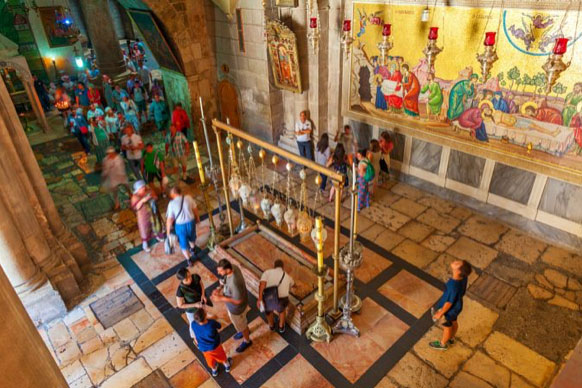
Just inside the door of the Basilica of the Holy Sepulcher – the gigantic, ancient, Church in Jerusalem that sits on top of the locations for Jesus’ Passion and Resurrection – you come across a strange sight (amongst many found in that Church, at least to us Western Catholics, who over the centuries have developed a different variety of liturgical and devotional traditions and accoutrements than the Coptic, Armenian, Russian, Greek, and Ethiopian (Orthodox) Christians, which form the most prevalent other groups visiting and praying in this tremendous Basilica).  That sight is a stone slab elevated just a bit off of the uneven stone floor, flanked by large candles and situated under a rank of 8 large, glass, oil lamps.  Unless you walked in just as the giant doors opened in the morning (around 5am), there is probably a crowd of pilgrims crouched and reverencing this particular stone, and bemused tourists standing around with cameras.  The air around you smells of oldness and oil, the sound of the markets and streets outside has been replaced by the reverent bustle and busy-ness that saturates this beautiful, profound, mystifying place.  You are standing before the Stone of Anointing long held to be where Jesus was washed, anointed, and wrapped in linen before His burial.

After this Joseph of Arimathea, who was a disciple of Jesus, but secretly, for fear of the Jews, asked Pilate that he might take away the body of Jesus, and Pilate gave him leave. So he came and took away his body. Nicodemus also, who had at first come to him by night, came bringing a mixture of myrrh and aloes, about a hundred pounds’ weight. They took the body of Jesus, and bound it in linen cloths with the spices, as is the burial custom of the Jews. Now in the place where he was crucified there was a garden, and in the garden a new tomb where no one had ever been laid. So because of the Jewish day of Preparation, as the tomb was close at hand, they laid Jesus there. – John 19:38-42

I had never considered the fact that all of the scenes we know so well of Jesus’ crucifixion, passion, death, burial, and resurrection all happened within a handful of yards of each other.  Of course, all four evangelists indicate that Jesus was buried once Joseph had asked for His body, and that the tomb was not far away because they had to act quickly to be done before the Sabbath started.  So perhaps I should not have been surprised to find this anointing stone only a handful of yards from Golgotha, and a similar distance to the sepulcher where Jesus was buried.

Still, not only does this Basilica put in perspective the distance and reality of all those locations, it also brings us close to the characters that were present at those places, on that terrible but wonderful, horrible but good Friday.  His mother, and the disciple whom He loved.  Mary of Magdala, Mary the mother of James and Joses, and Mary of Clopas. Salome, and the other women. Joseph of Arimathea and Nicodemus.  The Centurion, soldiers, Simon, and the Chief Priests.  They stood around these same places, but they held in their heart very different perspectives on the scenes unfolding before their eyes.  Last week I put us in the shoes of Ciaphas – not exactly a saint in these scenes! – yet it is helpful to put us in the shoes of all the different characters who had the grace to be present before Christ upon the cross.  Some chose to believe.  Some chose to run.  Some chose to deny, decry, or despair.  Some chose the puzzling path of asking for Jesus’ body and preparing it for burial.  

We get to choose our place as well.  Will we act in our day, as the saints did then?  The Sanhedrin?  The spectators?  The sorrowers?  The soldiers?  The sinners?  

– Fr. Dominic Rankin has had the chance to visit the Church of the Holy Sepulcher.  He will (hopefully) never forget a long night spent in prayer in the dark and locked church.  It was chilling physically, but transformative spiritually.  A place like none on earth: where God laid down His life, and took it up again.

Tourists around Stone of Anointing, in the Church of the Resurrection, by Rostislav Glinsky

Mass Intentions Week of March 29

Monday, March 29

7am – Eugene Nalesnik
(Fr. Augustine Tolton Council#16126)

12:05pm – Joseph A. DelGiorno
(Lisa Duffey)

5:15pm – Carolyn Boyle Norbits
(Billy LeCrone)

Tuesday, March 30

7am – Kyle Buckman
(Mom)

12:05pm – Joseph Kohlrus
(LouAnn & Carl Corrigan)

5:15pm – NO MASS

Wednesday, March 31

7am – Anna A. Eleyidath
(Augustine Eleyidath)

12:05pm – Catherine Ponce
(Bill & Sara Metcalf)

5:15pm – Joseph Kohlrus, Sr.
(Augustine Eleyidath)

Thursday, April 1

6:30pm – Jean Reno Greenwald
(Robert & Ann Schroeder III)

Friday, April 2

3pm – NO INTENTION; GOOD FRIDAY SERVICE

Saturday, April 3

8pm – Janet Smith
(LouAnn & Carl Corrigan)

Sunday, April 4

7am – Mary Ann Midden
(William Midden)

9am – Charles & Mercedes Nesbitt
(Kathy Frank)

11am – For the People

Prayer Wall – 03/23/2021

Pray for successful hip surgery for April on 4/2.

Prayer Wall – 03/22/2021

Please pray for Carol who is having gall bladder surgery on March 25.

Prayer Wall – 03/21/2021

Please pray for Aaron B. who has stage 4 cancer. He is a husband and the father of 2 young children.

« Previous Page
Next Page »

Liturgy

Sunday Masses (unless noted differently in weekly bulletin)
Saturday Evening Vigil – 4:00PM
Sunday – 7:00AM, 10:00AM and 5:00PM

Weekday Masses (unless noted differently in weekly bulletin)
Monday thru Friday – 7:00AM and 5:15PM
Saturday – 8:00AM

Reconciliation (Confessions)
Monday thru Friday – 4:15PM to 5:00PM
Saturday – 9:00AM to 10:00AM and 2:30PM to 3:30PM
Sunday – 4:00PM to 4:45PM

Adoration
Tuesdays and Thursdays – 4:00PM to 5:00PM


CatholicMassTime.org

Parish Information

Parish Address
524 East Lawrence Avenue
Springfield, Illinois 62703

Parish Office Hours
Monday thru Thursday – 8:00AM to 4:00PM
Fridays – CLOSED

Parish Phone
(217) 522-3342

Parish Fax
(217) 210-0136

Parish Staff

Contact Us

Contact Us

Copyright © 2026 · Log in