Cathedral of the Immaculate Conception

Springfield, IL

  • About
    • Contact Us
    • History of the Cathedral
    • Liturgical Schedules
    • Parish Staff
    • Register with Cathedral
    • Subscribe to the Cathedral eWeekly
  • Sacraments
    • Baptism
    • Becoming Catholic
    • Matrimony
    • Vocations
  • Ministry List
    • Adult Faith Formation
    • Cathedral Meal Train
    • Cathedral Online Prayer Wall
    • Cathedral Concerts
    • Family of Faith
    • Grief Share
    • Health and Wellness
    • Spiritual Resources
  • Stewardship
    • Stewardship: A Disciple’s Response
    • Stewardship Form
  • Support
    • E-Giving Frequently Asked Questions
    • Give Online
  • Sunday News
    • Announcements
    • Cathedral Weekly
    • Livestream Feed
    • Submit a Mass Intention Request
    • Weekly or Announcement Submission

Where is the Sacrament of Penance in Scripture?

In this month of February, we will be turning our attention to many people’s least favorite sacrament: the Sacrament of Penance. This sacrament is also known as Reconciliation or Confession. Each title for this sacrament emphasizes a different aspect of the sacrament itself. However, in the official books, the sacrament is called “Penance.” I describe Penance as many people’s least favorite because of the hesitation and anxiety that can accompany the confession of one’s sins to Jesus through the priest. Sin is a dark and shameful thing, but it is good to bring it to the light so that Jesus can heal it. While challenging at times, this sacrament is a part of Jesus’ plan for his Church which we can see in the Scriptures. 

We believe that Jesus began the Sacrament of Penance on the evening of Easter Sunday. Here is the passage found in John 20:19-23.

On the evening of that first day of the week, when the doors were locked, where the disciples were, for fear of the Jews, Jesus came and stood in their midst and said to them, “Peace be with you.” When he had said this, he showed them his hands and his side. The disciples rejoiced when they saw the Lord. Jesus said to them again, “Peace be with you. As the Father has sent me, so I send you.” And when he had said this, he breathed on them and said to them, “Receive the Holy Spirit. Whose sins you forgive are forgiven them, and whose sins you retain are retained.” 

Isn’t it amazing that the sacrament of Penance is a gift that Jesus gave to his Church on Easter Sunday? This was not an accident. Jesus solemnly declares to his disciples that when they forgive sins, they are truly forgiven. This was the first encounter that Jesus had with his disciples after his Resurrection. While I’m sure they were bewildered at seeing Jesus alive (they had already heard from Mary Magdalene that Jesus was alive, and Peter and John had seen the empty tomb), there must have been some shame and fear in their hearts too. The last time they saw Jesus alive was when he was arrested in the Garden of Gethsemane, and while he hung dying on the cross, only John was by his side. In Jesus’ moment of need, his friends had given in to fear and abandoned him. However, Jesus brought forgiveness on Easter Sunday, not only for his closest friends, but for the entire Church! 

There are a few other references to Penance in the Bible, though not as explicit as the first reference. In the letter of James, he wrote, “Confess your sins to one another and pray for one another, that you may be healed” (James 5:16). Jesus also gave authority to the Apostles when he said, “Whatever you bind on earth shall be bound in heaven, and whatever you loose on earth shall be loosed in heaven (Matthew 18:18). Confessing our sins is a normal part of the Christian life. Our Christian tradition understands this to mean that we confess our sins to an ordained priest. While we are always fighting against temptation and sin, God has mercifully given us a way to be reconciled to him even when we sin after baptism. 

The Gospel passage from John 20 quoted above is the gospel reading proclaimed at Mass on Divine Mercy Sunday, one week after Easter Sunday. The sacrament of Penance is one of the main ways that Jesus’ mercy is communicated to his Church, and it is part of Jesus’ plan for our salvation. 

Fear of Confession

“Be not afraid.”  These are words that we hear spoken by the Lord in various ways and on several occasions through the Scriptures.  Fear can be paralyzing, and we can miss out of many things in life because our fear prevents us from moving forward.  In response to this phenomenon, our diocese has been working on an effort to address the fears we often face in life, confronting those fears through the eyes of our Catholic faith.  If you would like to explore some of the topics, check out the website:  https://benotafraid.dio.org/ 

As the team was preparing content, I was asked to do a video on the topic of the fear that many people face when it comes to going to Confession.  I consider myself to be uniquely equipped to answer this topic for two reasons.  First of all, I have the privilege of hearing many confessions here at the Cathedral.  Second, I know what it is like to be afraid to go to confession.  I remember vividly the fear that I had when I returned to the sacrament after having been away from it for a long time, maybe as many as ten years, if not more!  I was so terrified to go, but I pushed through the fear and went, and it truly was once of the best moments of my life.  It marked a new beginning in my life with Christ and His Church and I have no doubt that it was the beginning of my discernment of my vocation to the priesthood.

In the video, I started by saying that one of the biggest fears that we have when it comes to going to confession is the fear of admitting that we actually need to go to confession.  In other words, we are afraid to admit that we are sinners.  We might acknowledge that we are wounded, that we are broken, that we are in need of healing, but it is easier for us to point to other people as the cause for our brokenness.  And while we cannot downplay what others have done to hurt us, we as Christians are called to humbly admit the brokenness and woundedness that we introduce into our lives because of the decisions that we make.  This is what sin is – our freely choosing to hurt ourselves, though our intention may not always be so explicit when we do those things, but we know it to be true as we suffer the consequences.

Jesus knew how we would struggle with sin in our lives.  Wanting us to be free, to be at peace, He left the Church a great gift in the Sacrament of Reconciliation, by which the Lord heals our wounds and makes us whole again through the gift of this mercy.  He waits eagerly to give us this gift, and if we could see the look on His face as we enter the confessional, and the delight He has in granting us forgiveness, all our fears would melt as we are overcome by the power of His love for us, His children.  So the next time you experience that fear when you think about going to confession, the fear of admitting that you are a sinner, take a moment and close your eyes, picture Jesus looking at you with the most loving gaze you can imagine.  Then, run to His arms as He waits to embrace you in the confessional.  Your being there will bring Him great joy, and you will set off a great celebration in Heaven, for He Himself tells us: “there will be more joy in Heaven over one sinner who repents than over ninety-nine righteous people who have no need of repentance.” (Luke 15:7) 

Father Alford     

St. Jerome Emiliani: Captured by Charity

Feast Day: February 8th  

In fourteen-hundred-ninety-two – you all know the phrase – Columbus sailed the Ocean Blue.  As that news made its way around Europe, surely it must have created waves in the city of Venice.  For centuries, the Italian power had held mastery of the sea.  Its galleys, sailors, captains, and system of ports had given it a powerful trade network crisscrossing the Mediterranean and beyond, but never into the unknown of the Atlantic Ocean.  Now, someone had, and the Venetian lion was not unfurled atop the Niño, Pinto, and Santa María. 

I spent far too much time trying to find whichflag did … maybe it was Portuguese, with its shields and castles?  But Columbus was financed by Spain!  Maybe the Spanish lion and castle?  But Spain was not yet united, so that flag was probably years in the future.  So maybe it was the royal, white flag of Ferdinand and Isabella, with its green cross?  That flew at least when he landed upon San Salvador.  …  perhaps this digression reveals the chaos of those days … but, regardless, it was not the flag of Venice!  And so, an eleven year old boy in that great maritime city, Gerolomo Emiliani, must have felt both exhilaration, and dread at the news of the new world, as would have everyone in the city, who depended for their security, and sustenance, upon their command of the sea, well, now, the seas.  

And that was not the only crisis sailing over the horizon.  

San Girolamo Emiliani presenta gli orfani alla Madonna [St. Jerome Emiliani presents the orphans to the Madonna], Traverso Mattia, 1943.  All rights reserved.

It is useful, and offers us a bit of perspective and wisdom, to every so often glance back in history and realize that things are not as bad today as they have been in the past.  Not only were their days controlling the seas dwindling fast, Venice was soon engulfed in what might as well be remembered as the World War of the 1500s.  Technically the “War of the League of Cambrai” or the “War of the Holy League”, this decade of battling across Italy, though primarily between France, the Papal States, and Venice, ended up with every other power in Europe at the time – Spain, the Holy Roman Empire, England, Milan, Florence, Ferrara, and Switzerland – jumping into the fray, making various alliances (and switching alliances), and destroying a lot of cities, and lives, in the process.  But, to make it all worse, there is the Pope (perhaps first Alexander VI, but then, of course, Julius II) in the middle of everything, scheming, battling, and back-stabbing like the best of them.  And, our young Gerolomo, loses his father, runs off to the army at 15, eventually rises to become a captain of a fortress in the mountains of Treviso, but disaster continues to follow him: the fortress is captured, and he is imprisoned and shackled.  

In the midst of the ugliness, pain, and horrors of his day; in the face of his own helplessness, failure, and grief, he finally prays – everybody wasn’t pious in the 1500s either – and finds himself miraculously able to escape.  He gives his chains, literally, to Our Blessed Mother, returns to Venice in 1518, becomes a priest despite the horrific leadership and politicking in the Church, and as the horrors of the black plague envelop Europe (it only gets worse!), he becomes a saint.  He nurses the sick and dying, builds hospitals, cares for the orphans, gives a new life to the prostitutes, and founds a congregation to join his charitable labors.  He poured his life out for the plague victims, and succumbed to it himself in 1537.   

The chains, chaos, and corruption of our own day need not control us.  Can we surrender to God our dreams, and chains?  Can we repent of our sins, finding freedom in Confession?  Can we give our lives to charity?  Can we face the storms, and yet remain calm?  Saints can.  So can we.

– Fr. Dominic Rankin has not defended fortresses from rampaging Papal armies, and prays that he will never have to.  He has tried to care for plague victims, with little success given current hospital protocols, and has contracted said disease, with nothing like the terrible consequences faced by most in our own day, or certainly by Fr. Jerome Emiliani.  But, if in all those ways he cannot follow in Jerome’s footsteps, he can, at least, surrender his chains to Mary, and his life to Love.  Pray for him.  He prays for you.

Mass Intentions

Monday, February 8

7am – Anna A. Eleyidath
(Augustine Eleyidath)

5:15pm – Sophia Bartoletti
(Bartoletti Family)

Tuesday, February 9

7am – Special Intention for Sheree Graves
(Sheree Graves)

5:15pm – Richard McFadden
(Linda Pierceall)

Wednesday, February 10

7am – Special Intention for Brother Anthony McCoy
(Friend)

5:15pm – Pius Onyejiaju Chineke
(Jim & Sandy Bloom)

Thursday, February 11

7am – John Montgomery
(John Busciacco)

5:15pm – Special Intention for Barbara Ozanic
(Chris Sommer)

Friday, February 12

7am – Dannie Roe
(Rebecca & Walter Woodhull)

5:15pm – Special Intention for Bianca
(D. A. Drago)

Saturday, February 13

8am – Angeline Sherman
(Warren Sherman)

4pm – For the People

Sunday, February 14

7am – Mary Ann Midden
(William Midden)

10am – Valeria Shaughnessy
(Mr. & Mrs. Michael Shaughnessy& Family)

5pm – Mary & Stanley Posnack
(Becky & Woody Woodhull)

Eucharistic Fast

For the past month, our 10 am Sunday Mass has been celebrated ad orientem, which means “toward the East.”  In his column for the December 13, 2020 edition of the Catholic Times, Bishop Paprocki did a great job of explaining the theology of symbolism of celebrating Mass this way.  I want to highlight one line from his column that will be important for my reflection today.  Bishop Paprocki wrote:

While celebrating Mass facing the people became popular after the Second Vatican Council, there is actually no document from the Second Vatican Council that calls for Mass to be celebrated facing the people.

This point highlights a device that is often employed to justify changes in recent decades.  People point to the Second Vatican Council as making changes that it did not actually call for.  For example, you may hear people saying that the Council did away with meatless Fridays outside of Lent.  The fact of the matter is, that still remains the expectation in the Universal Church, though here in the United States, permission has been granted to replace abstinence from meat on Friday with some other penitential practice.  

Another discipline that people sometimes credit the Council for removing is the fast required before receiving the Eucharist.  I have heard countless stories of people who acknowledged how difficult it was to fast from midnight on before receiving Holy Communion the following morning.  In 1957, the fast was shortened to three hours, and in 1964, Pope St. Paul VI shortened the fast further to be just one hour, and now we have the following that remains the current law: “One who is to receive the Most Holy Eucharist is to abstain from any food or drink, with the exception of water and medicine, for at least the period of one hour before Holy Communion.” (Code of Canon Law, can. 919)

I find it a little surprising that many people are unaware of the Eucharistic fast, either having never heard that it ever existed, or that it is a practice that has been abandoned, done away with by the Second Vatican Council.  In one of his writings early in his pontificate, Pope St. John Paul II reflected on how the faithful can become lax in their being properly disposed to receive the Eucharist, which includes observing the Eucharistic fast.  He writes the following:

In fact, what one finds most often is not so much a feeling of unworthiness as a certain lack of interior willingness, if one may use this expression, a lack of Eucharistic ‘hunger’ and ‘thirst,’ which is also a sign of lack of adequate sensitivity towards the great sacrament of love and a lack of understanding of its nature.

May we all take this opportunity to examine how much we hunger and thirst for the Eucharist, expressed very tangibly in how we observe the Eucharistic fast, short as it may be, but necessary for our worthy and fruitful reception of this great gift.

Father Alford     

St. Don Bosco: The Pillars of the Church

Feast Day: January 31st  

The words that follow are not my own, but from the saint we celebrate this week, Fr. Don Bosco, on May 30th, 1862, who told the following to his beloved sons in the Salesian Order (which he had founded):

I want to tell you a dream. It is true that he who is dreaming is not reasoning, anyway I—who would even tell you my sins if I were not afraid that they would make you all run away and make the house tumble down—will tell you this for your spiritual profit. I had the dream some days ago.

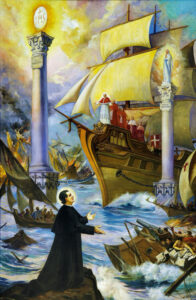
Imagine yourselves to be with me on the seashore, or bet­ter, on an isolated rock and not to see any patch of land other than what is under your feet. On the whole of that vast sheet of water you see an innumerable fleet of ships in battle array. The prows of the ships are formed into sharp, spearlike points so that wherever they are thrust they pierce and completely destroy. These ships are armed with cannons, with lots of rifles, with incendiary materials, with other arms of all kinds, and also with books, and they advance against a ship very much bigger and higher than themselves and try to dash against it with the prows or to burn it or in some way to do it every possible harm.

As escorts to that majestic fully equipped ship, there are many smaller ships, which receive commands by signal from it and carry out movements to defend themselves from the opposing fleet.  In the midst of the immense expanse of sea, two mighty columns of great height arise a little distance, the one from the other. On the top of one, there is the statue of the Immaculate Virgin, from whose feet hangs a large placard with this inscription: Auxilium Christianorum – “Help of Christians”, on the other, which is much higher and bigger, stands a Host of great size proportionate to the column and beneath is another placard with the words: Salus Credentium – “Salvation of the Faithful.”

The supreme commander on the big ship is the Sovereign Pontiff. He, on seeing the fury of the enemies and the evils among which his faithful find themselves, determines to summon around himself the captains of the smaller ships to hold a council and decide on what is to be done.  All the captains come aboard and gather around the Pope. They hold a meeting, but meanwhile the wind and the waves gather in storm, so they are sent back to control their own ships.  There comes a short lull. For a second time the Pope gathers the captains together around him, while the flagship goes on its course. But the frightful storm returns.  The Pope stands at the helm and all his energies are directed to steering the ship towards those two columns, from the top of which and from every side of which are hanging numer­ous anchors and big hooks, fastened to chains.  All the enemy ships move to attack it, and they try in every way to stop it and to sink it. Some with writings or books or inflammable materials, of which they are full, others with guns, with rifles and with rams. The battle rages ever more relentlessly.

The enemy prows (battering rams on the front of the ships) thrust violently, but their efforts and impact prove useless. They make attempts in vain and waste all their labor and ammunition, the big ship goes safely and smoothly on its way. Sometimes it happens that, struck by formidable blows, it gets large, deep gaps in its sides, but no sooner is the harm done than a gentle breeze blows from the two columns and the cracks close up and the gaps are stopped immediately.  Meanwhile, the guns of the assailants are blown up, the rifles and other arms and prows are broken, many ships are shattered and sink into the sea. Then, the frenzied enemies strive to fight hand to hand, with fists, with blows, with blas­phemy and with curses.

All at once, the Pope falls gravely wounded. Immediately, those who are with him run to help him and they lift him up. A second time the Pope is struck, he falls again and dies. A shout of victory and of joy rings out amongst the enemies, from their ships an unspeakable mockery arises.  But hardly is the Pontiff dead than another Pope takes his place. The pilots, having met together, have elected the Pope so promptly that the news of the death of the Pope coincides with the news of the election of the successor. The adver­saries begin to lose courage.  The new Pope, putting the enemy to rout and overcoming every obstacle, guides the ship right up to the two columns and comes to rest between them. He makes it fast with a light chain that hangs from the bow to an anchor of the column on which stands the Host, and with another light chain which hangs from the stern, he fastens it at the opposite end to another anchor hanging from the column on which stands the Immaculate Virgin.

Then a great convulsion takes place. All the ships that until then had fought against the Pope’s ship are scattered, they flee away, collide and break to pieces one against another. Some sink and try to sink others. Several small ships that had fought gallantly for the Pope race to be the first to bind themselves to those two columns.  Many other ships, having retreated through fear of the battle, cautiously watch from far away the wrecks of the bro­ken ships having been scattered in the whirlpools of the sea, they in their turn sail in good earnest to those two columns, and, having reached them, they make themselves fast to the hooks hanging down from them and there they remain safe, together with the principal ship, on which is the Pope. Over the sea there reigns a great calm.

Don Bosco’s Dream of the Two Pillars, (M. Barberis, 1939?)  All Rights Reserved.  Retrieved from http://www.donboscowest.org/saints/donbosco, 2021.01.18.

Fr. Bosco asked Don Rua, “What do you think of the story?” and the other priest offered this evaluation: “It seems to me that the Pope’s ship might mean the Church, of which he is the head. The ships, men, the sea, this world. Those who defend the big ship are the good, lovingly attached to the Holy See. The others are her enemies, who try with every kind of weapon to annihilate her. The two columns of salvation seem to be devotion to Mary Most Holy and to the Blessed Sacrament of the Eucharist.”

“You are right!” our saint replied, “Only I ought to correct one expression. The enemy ships are persecutions. The most serious trials for the Church are near at hand. That which has been so far is almost nothing in the face of that which must befall. Her enemies are represented by the ships that tried to sink the principal ship if they could.  Only two means are left to save her amidst so much confusion: DEVOTION TO MARY MOST HOLY and FREQUENT COMMUNION, making use of every means and doing our best to practice them and having them practiced everywhere and by everybody.”

– Fr. Dominic Rankin has often seen a minor version of the Eucharistic miracle given to Don Bosco.  The saint was offering Mass for 360 boys in 1848 and realized that he only had 8 consecrated hosts in the tabernacle (rather than the hundreds they had expected).  He calmly took the ciborium, began to distribute Jesus to all, and never fell short!  His server, Guiseppe Buzzetti, testified to the miracle.  I have never had that much of a shortfall, but it is uncommonly often that it appears that we will never have enough hosts at Mass, and yet there is always enough.  Praise God!

Adoro Te Devote – A Eucharistic Hymn

Since January this year has five Sundays, we get a sort of bonus Sunday to reflect on the Eucharist! Because the Eucharist is the central liturgy of the Catholic Church, many hymns have been written in honor of this Most Blessed Sacrament. One of the most famous Eucharistic hymns was written by St. Thomas Aquinas (1225-1274) in honor of the new feast day of the Body and Blood of Jesus (Corpus Christi). There is a beautiful poetic English translation by Fr. Gerard Manley Hopkins, SJ, and the English text of this translation is below. It is also a great resource for personal prayer.

Godhead here in hiding, whom I do adore,
 Masked by these bare shadows, shape and nothing more,
 See, Lord, at Thy service low lies here a heart
 Lost, all lost in wonder at the God thou art.

Seeing, touching, tasting are in thee deceived:
 How says trusty hearing? that shall be believed;
 What God’s Son has told me, take for truth I do;
 Truth Himself speaks truly or there’s nothing true.

On the cross Thy godhead made no sign to men,
 Here Thy very manhood steals from human ken:
 Both are my confession, both are my belief,
 And I pray the prayer of the dying thief.

I am not like Thomas, wounds I cannot see,
 But can plainly call thee Lord and God as he;
 Let me to a deeper faith daily nearer move,
 Daily make me harder hope and dearer love.

O thou our reminder of Christ crucified,
 Living Bread, the life of us for whom he died,
 Lend this life to me then: feed and feast my mind,
 There be thou the sweetness man was meant to find.

Bring the tender tale true of the Pelican;
 Bathe me, Jesu Lord, in what Thy bosom ran
 Blood whereof a single drop has power to win
 All the world forgiveness of its world of sin.

Jesu, whom I look at shrouded here below,
 I beseech thee send me what I thirst for so,
 Some day to gaze on thee face to face in light
 And be blest for ever with Thy glory’s sight. Amen.

I recommend reading along with this text while listening to it sung at the same time. Scan the below QR link for a listen! I hope that you have found this month of reflection and study on the Eucharist to be helpful for your faith and spiritual life. Fr. Alford, Fr. Rankin, and I hope that these weekly columns are not only informative but also help to nourish your faith life. This is why I’m including this beautiful prayer resource to conclude our reflection on the Eucharist. The Eucharist is so much more than a topic for academic study. In the Eucharist, Jesus gives the Church all of his love and his entire self.

Jesus is always waiting for us in the tabernacle at Church. Whenever you pass by a Church, make the sign of the cross to acknowledge his presence. I am always inspired by how many visitors we have during the day at the Cathedral. Many people, both local and travelers passing through, stop at the Cathedral to light a votive candle for a special intention or pray for a few moments before continuing their day. Such visits can lighten the load on our weary hearts and give us encouragement to stay faithful to our responsibilities for another day.

May we one day be with God forever in heaven, not only hidden in the Eucharist, but unveiled for our eyes to see his glory.

Mass Intentions for the Week of February 1

Monday, February 1

7am – Special Intention for Steve Roach
(Chris Sommer)

5:15pm – Sophia Bartoletti
(Bartoletti Family)

Tuesday, February 2

7am – Jean Reno (Greenwald)
(Phillipa Porter)

5:15pm – Norma Bartoletti
(Carl & Lou Ann Corrigan)

Wednesday, February 3

7am – Lawrence Jaros
(Emily Walton & Family)

5:15pm – Valeria Shaughnessy
(Mr. & Mrs. Michael Shaughnessyand Family)

Thursday, February 4

7am – Anna A. Eleyidath
(Augustine Eleyidath)

5:15pm – Pius Onyejiaju Chineke
(Rob & Jan Sgambelluri)

Friday, February 5

7am – John Piccinino
(John Busciacco)

5:15pm – William F. & Shirley Logan
(Lisa Logan & Lori LoganMotyka)

Saturday, February 6

8am – For the People

4pm – Deceased Members of theMcGee, Schweska, & Kaufman Families
(Susan Ochoa)

Sunday, February 7

7am – Russell Steil, Sr.
(Steil Family)

10am – Charles & Mercedes Nesbitt
(Kathy Frank)

5pm – Mary Rita DesMarteau
(Criscione Family)

Prayer Wall – 01/22/2021

Please pray for Carol Morgan as she undergoes testing and procedures for on-going medical issues.

Prayer Wall – 01/21/2021

Please Dear Blessed Mother protect my Crisra, always & forever will I love her and care for her, Please keep us safe from all spiritual attack
and cleanse us all etheric malice. Thank you Michael, Raphael & Christ / YHVH.

« Previous Page
Next Page »

Liturgy

Sunday Masses (unless noted differently in weekly bulletin)
Saturday Evening Vigil – 4:00PM
Sunday – 7:00AM, 10:00AM and 5:00PM

Weekday Masses (unless noted differently in weekly bulletin)
Monday thru Friday – 7:00AM and 5:15PM
Saturday – 8:00AM

Reconciliation (Confessions)
Monday thru Friday – 4:15PM to 5:00PM
Saturday – 9:00AM to 10:00AM and 2:30PM to 3:30PM
Sunday – 4:00PM to 4:45PM

Adoration
Tuesdays and Thursdays – 4:00PM to 5:00PM


CatholicMassTime.org

Parish Information

Parish Address
524 East Lawrence Avenue
Springfield, Illinois 62703

Parish Office Hours
Monday thru Thursday – 8:00AM to 4:00PM
Fridays – CLOSED

Parish Phone
(217) 522-3342

Parish Fax
(217) 210-0136

Parish Staff

Contact Us

Contact Us

Copyright © 2026 · Log in