Cathedral of the Immaculate Conception

Springfield, IL

  • About
    • Contact Us
    • History of the Cathedral
    • Liturgical Schedules
    • Parish Staff
    • Register with Cathedral
    • Subscribe to the Cathedral eWeekly
  • Sacraments
    • Baptism
    • Becoming Catholic
    • Matrimony
    • Vocations
  • Ministry List
    • Adult Faith Formation
    • Cathedral Meal Train
    • Cathedral Online Prayer Wall
    • Cathedral Concerts
    • Family of Faith
    • Grief Share
    • Health and Wellness
    • Spiritual Resources
  • Stewardship
    • Stewardship: A Disciple’s Response
    • Stewardship Form
  • Support
    • E-Giving Frequently Asked Questions
    • Give Online
  • Sunday News
    • Announcements
    • Cathedral Weekly
    • Livestream Feed
    • Submit a Mass Intention Request
    • Weekly or Announcement Submission

Mass Intentions for Week of January 18

Monday, January 18

7am – NO MASS

5:15pm – Sophia E. Bartoletti
(Bartoletti Family)

Tuesday, January 19

7am – NO MASS

5:15pm – John Montgomery
(John Busciacco)

Wednesday, January 20

7am – NO MASS

5:15pm – Cheryl Broughton
(Carl & Lou Ann Corrigan)

Thursday, January 21

7am – NO MASS

5:15pm – Diana J. Schumacher
(Daniel J. Schumacher)

Friday, January 22

7am – NO MASS

5:15pm – Dorothy Huber
(The Huber Family)

Saturday, January 23

8am – Catherine Ponce 
(Linda Sabol)

4pm – For the People

Sunday, January 24

7am – Mary Ann Midden
(William Midden)

10am – Pius Onyejiaju Chineke
(The Anselment Family)

5pm – Frank Orris, Jr.
(Phil & Celeste Furmanek)
Prayer Wall – 01/08/2021

Tony’s dad, Joe DelGiorno, has Covid-induced renal failure and is entering hospice in our home.

The Symbol of the Dove

In the Gospel account for this Sunday’s Feast of the Baptism of the Lord, we hear the following words immediately after John baptized Jesus in the Jordan:

On coming up out of the water he saw the heavens being torn open and the Spirit, like a dove, descending upon him. (Mark 1:10)

The symbol of the dove is very interesting, and it has been interpreted in various ways throughout the history of the Church, especially by the Church Fathers (those who wrote much closer to the time of the life of Jesus).  One summary from a modern commentary describes the symbol of the dove in this way:

The Fathers usually interpret the dove as a symbol of peace and reconciliation between God and men. It first appears in the account of the flood (Gen 8:10–11) as a sign that God’s punishment of mankind has come to an end. Its presence at the beginning of Christ’s public ministry symbolizes the peace and reconciliation he will bring.   –Saint Mark’s Gospel , The Navarre Bible (Dublin; New York: Four Courts Press; Scepter Publishers, 2005), 53–54.

Another explanation can be found in the writings of St. Bede the Venerable, who comments on the nature of the dove and how it applies to how we should live in imitation of Christ whose life we share through Baptism:

The image of a dove is placed before us by God so that we may learn the simplicity favored by him. So let us meditate on the nature of the dove, that from each one of its features of innocence we may learn the principles of a more becoming life. The dove is a stranger to malice. So may all bitterness, anger and indignation be taken away from us, together with all malice. The dove injures nothing with its mouth or talons, nor does it nourish itself or its young on tiny mice or grubs, as do almost all smaller birds. Let us see that our teeth are not weapons and arrows. -St. Bede the Venerable, Homilies on the Gospels

A final interesting interpretation concerns the numbers associated with the Greek letters for the dove.  The following summary expresses the view proposed by St. Irenaeus:

One possible reason for the use of the word ‘dove’ to describe how the Holy Spirit descended on Jesus has to do with gematria – the assignment of numerical equivalents to letters.  The letters of this word, ‘dove’ in Greek form the numerical sum of 801.  801 is also the numerical sum of the Greek letters alpha and omega.  Therefore the description of the dove could mean that the one on whom the dove descends was the Alpha and the Omega – an identification the Bible ascribes to Jesus (Rev. 1:8; 21:6; 22:13)  -Michael S. Heiser article in Bible Study Magazine, Nov / Dec 2017, 9

Is there one absolutely correct way of understanding the symbol of the dove?  Probably not, but what they all have in common is that they all point to Christ.  As we come to the end of the Christmas Season, let us pray that when people study our lives, they will see that everything that we say and do points to Christ and reflects the gift of His life that He has given to us through the sacraments.

Father Alford     

How can Jesus give us his flesh to eat?!

Last week, I gave some examples of when Jesus “instituted” (started or began) the celebration of the Eucharist in the Scriptures. I mentioned that the Gospel of John does not show Jesus doing this at the last Supper, but the entirely of John Chapter 6 is devoted to Jesus’ extensive teaching on and explanation of the Eucharist. This was something that was hard for many of his followers to accept; so hard, in fact, that many of Jesus’ disciples no longer followed him and went back to their former way of life. These disciples who left Jesus seem to ask a legitimate question: “How can this man give us his flesh to eat?” (John 6:52). Jesus had not yet revealed exactly what he would do at the Last Supper, although he hinted strongly when he said, “I am the Bread of Life” (John 6:35). 

These people who heard Jesus at Capernaum must have wrongly thought that Jesus was encouraging some sort of cannibalism in which Jesus’ body would be destroyed. However, the Eucharist is the furthest thing from cannibalism because the Eucharist is the living and glorious body of Jesus. After his Resurrection, Jesus’ body was not just the same as it was before the Crucifixion. Afterwards, Jesus could walk through walls, and now his body is seated at the right hand of the Father in heaven. At the same time, Jesus is present in the Eucharist at every Mass and in every Catholic tabernacle around the world. 

The Church has always firmly believed that the consecrated Bread and Wine at Mass are truly the Body and Blood of Jesus Christ. There have been those who have doubted this truth from the time of Jesus until today, and it is true that many have walked away and returned to their former way of life, just as some of Jesus’ disciples did in John 6. This is a great tragedy, but one that happens frequently, sometimes because no one has ever fully explained this teaching to many Catholics! 

Last year, a widely-publicized Pew research study announced that only one out of three Catholics in the United States believe the Church’s teaching that the bread and wine are changed into the Body and Blood of Jesus. While I’m skeptical of Pew’s questioning methods (it’s hard for a non-believer to make an accurate survey about a technical religious question), I was honestly not surprised at this statistic. In the United States, only 10-20% of Catholics attend Mass on Sundays. In some other parts of the world, it’s below 5%. If 95% of a  population never or rarely attends Mass, it only makes sense that they have no idea what is going on at Mass. Why would somebody want to sit through an hour-long ceremony every week if they think nothing meaningful is happening during it? On the other hand, if somebody understands that Jesus Christ, the Creator of the Universe and Eternal Source of all Existence and Life, is physically present at every Mass around the world, how could they stay away? 

This belief that Jesus is physically present under the appearance of bread and wine is called the Real Presence. Our belief in the Real Presence is why we can say that we worship the Eucharist, because the Eucharist is God Himself. This is why we are so careful and respectful of the Eucharist at Mass after the Consecration. When a consecrated host falls to the ground (which happens not infrequently by accident), we must do all we can to ensure that any particles that may have broken off are cleaned up, because that is Jesus physically present in those particles. 

We have a lot of work to do to spread the Good News of the Eucharist to the world. We can start with ourselves! Let’s commit to occasionally visiting Jesus in the tabernacle whenever we pass by a church. One of the best ways we can share our belief in the Eucharist is by living a Eucharistic life: centering our lives of faith around Sunday Mass and prayer before Jesus in the Blessed Sacrament. 

St. Raymond of Peñafort: Daring Discipling

Feast Day: January 7th  

“And God blessed them, and God said to them, “Be fruitful and multiply and fill the earth and subdue it” [Genesis 1:28] … and many years later, though in much the same galaxy … Jesus, “lifting up his hands he blessed them” [Luke 24:50] and said “Go therefore and make disciples of all nations, baptizing them in the name of the Father and of the Son and of the Holy Spirit, teaching them to observe all that I have commanded you.” [Matthew 28:19-20]

The wonderful sight of many families and children at our Masses here (both on weekends and weekdays!) shows that some of you are very clearly multiplying, and discipling.  Thank you, for fulfilling that part of God’s first command, and Jesus’ final one!  But God also speaks of “subduing”, and Jesus calls His followers to “baptize” and “teach”, and I think these tasks are much more difficult than “multiplying” and “making disciples”.  It’s one thing to home-grow disciples, but there “in the world”, it is a darker, murkier, crazier place, and people are doing their own thing and not really mindful of us, much less the Gospel we are called to preach to them.  

Furthermore, there is a general feeling these days that it is not your or my place to impose our faith on someone else.  Faith is a personal thing, not meant to be foisted on someone!  So, how do we strike that right balance, not imposing but proposing (as St. Pope John Paul II would say)?  How do we find the courage to proclaim properly the Gospel that is our source of joy (as Pope Francis so beautiful describes it in Evangelii Gaudium)?  We need the example and intercession of St. Raymond of Peñafort! 

I neglect many other facts of his life, to just say that this scholar and priest became a Dominican at the age of 47, after 2 decades teaching and writing canon law.  He could have stayed in the solid and prosperous position he held at the university, but instead he becomes a friar of the Order of Preachers.  In the middle of his life, he chose to double-down on the primary vocation we all have: become a saint, and produce other saints.  How did he engage this daunting task?

For one, he helped found the order of Mercedarians, a group of friars who would turn themselves in as captives, to replace a Christian who had been captured by the Moors and were at risk of losing their faith.  The group still exists, and still vows to “give up our lives, as Christ gave his life for us, should it be necessary, in order to save those Christians who find themselves in extreme danger of losing their faith by new forms of captivity.”

Raymond also wrote a book to train priests to be good confessors (this was not just a list of sins and suggested penances; it tied in doctrine and Church practices, distinguishing for the good of priest and penitent such things as self-defense vs. violence done for vengeance or anger.)  The book’s clarity and foundation in charity allowed generations of Christians to better know how to return, and stay, in God’s grace.

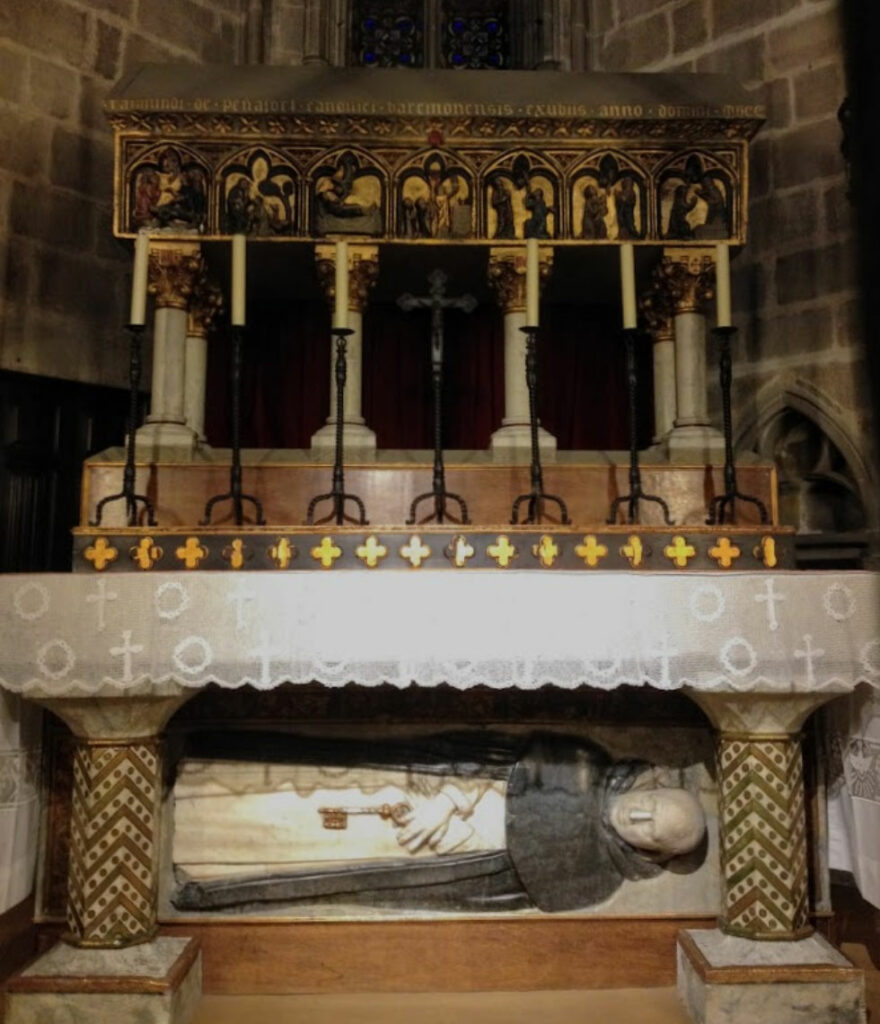
The Sepulcher of St. Ramon de Penyafort (Raymond of Peñafort) in Barcelona, Spain.  It was fashioned from polychromous marble in the 14th century by an anonymous sculptor and depicts in the small reliefs above the altar miracles, and scenes of his life. Visited in February, 2017.

Raymond learned Hebrew and Arabic to preach the Gospel to Jews and Arabs, who formed the non-Christians of his own day.  He established priories in non-Christian strongholds.  He convinced King James of Aragon to have a respectful debate between a Moshe ben Nahman (a Jewish rabbi of Girona) and Paulus Christiani (a Jewish man of Montpellier, who had converted and became a Dominican), to speak clearly, and freely, about the identity of the Messiah. 

Oh, and he floated on his own cloak back from the island of Majorca because King James had angrily forbade any ship to take him home after the good saint had challenged the royal-sinner to dismiss his concubine.

Teaching, preaching, challenging, debating, ransoming, pardoning, pacifying … all situations were places to preach the Gospel, and Raymond did not hesitate to do so.

– Fr. Dominic Rankin has only baptized two (little) people.  That’s barely addition, much less multiplication.  Of course, currently, my assignment as Bishop Paprocki’s MC, and in the Diocesan offices does not offer many opportunities to directly create disciples, and it also offers surprisingly few opportunities to preach the Gospel to those who have not already heard it.  But, this all means that I need to look more diligently, more creatively, more constantly, for ways to do just that, because God’s grace is there, and the call is there, and there are plenty of people who still need Jesus, myself most of all! 

Mass Intentions for the Week of Monday, January 11

Monday, January 11

7am – Tony Forlano, Sr.
(John Busicacco)

5:15pm – Richard Judd
(Carl & LouAnn Corrigan)

Tuesday, January 12

7am – Anna A. Eleyidath
(Augustine Eleyidath)

5:15pm – Florence Travis
(Lou Ann Mack Corrigan)

Wednesday, January 13

7am – Repose of the Soul of AverilRossiter
(Jane Fornoff)

5:15pm – Special Intention for Richard and Kay King
(Kathy Howard) 

Thursday, January 14

7am – Sophia E. Bartoletti
(Bartoletti Family)

5:15pm – Lawrence Jaros
(Katie Konsky & Family)

Friday, January 15

7am – Bonnie Donnals
(Roberts Family)

5:15pm – Frank Orris, Jr.
(Phil & Celeste Furmanek)
Saturday, January 16

8am – Diana Schumacher
(Daniel Schumacher)

4pm – Deceased Members of theMcGee, Sheweska, & KaufmanFamilies (Susan Ochoa)

Sunday, January 17

7am – Deceased Members of theBee Family
(Mark & Sharon Price)

10am – For the People

5pm – Special Intention for CarlosKhairallah
(Carlos Khairallah)

At the Manger with the Magi

In my homily for Christmas, I mentioned that I had recently purchased a Christmas gift for myself, a Nativity Set that I have in my personal quarters in the Cathedral Rectory.  When agonizing over which set to purchase, one of the final conditions I had was that I wanted the set to include the Magi, as they completed the scene of the birth of Jesus.

Over the past couple of weeks, I have been re-reading Pope Benedict’s third volume on Jesus of Nazareth which focuses on the Infancy Narratives.  When he gets to the section on the question of who the Magi are, he offers a helpful description which I would like to share:

Just as the Church’s tradition read the Christmas story quite spontaneously in the light of Is 1:3, with the result that the ox and the ass found their way into the crib, so too the Magi story was read in conjunction with Ps 72:10 and Is 60. Hence the wise men from the East became kings, and with them camels and dromedaries were added to the crib. 

While the prophetic content of these texts expands the provenance of these figures to include the extreme west (Tarshish = Tartessos in Spain), tradition has further developed this idea of universality by conceiving them as kings from all three known continents: Africa, Asia, and Europe. The black king is part and parcel of this: in the kingdom of Jesus Christ there are no distinctions of race and origin. In him and through him, humanity is united, yet without losing any of the richness of variety. 

Later, the three kings came to be associated with the phases of human life—youth, maturity, and old age. This too makes good sense, highlighting the fact that each of the various stages of human life finds its true meaning and its inner unity in companionship with Jesus. 

The key point is this: the wise men from the east are a new beginning. They represent the journeying of humanity toward Christ. They initiate a procession that continues throughout history. Not only do they represent the people who have found the way to Christ: they represent the inner aspiration of the human spirit, the dynamism of religions and human reason toward him. 

(Pope Benedict XVI, Jesus of Nazareth – The Infancy Narratives, p. 96-97)

These Magi serve as a beautiful reminder of what we experience when we come to Mass.  When we come to this church, we come to Bethlehem (which translated means house of bread).  We come as being one family, without distinction, while retraining our variety.  We come at every stage of our lives.  We come to encounter Christ, to encounter a new beginning in our loving Him and others more and more as He feeds us with the gift of His life in the Eucharist.

Father Alford     

Where is the Eucharist in Scripture?

As we begin this new year of blessings from the Lord, it is fitting that we turn our attention to the Holy Eucharist. As I wrote a few months ago, the Eucharist is the “best” sacrament because it is God himself! The other sacraments communicate the love of God, but only the Eucharist gives the body, blood, soul, and divinity of Christ himself. I always enjoy seeing the sacraments in the scriptures, and it’s a helpful place to start, so this month I’m going to start with where we find the Eucharist in scripture. 

We hear at every Mass the account of when Jesus took the bread and wine at the Last Supper and gave them to his disciples. He also commanded them to repeat that action in memory of him. We see four very clear accounts of this moment in the scriptures. The first is found in Matthew: “While they were eating, Jesus took bread, said the blessing, broke it, and giving it to his disciples said, ‘Take and eat; this is my body.’ Then he took the cup, gave thanks, and gave it to them saying, ‘Drink from it, all of you, for this is my blood of the covenant, which will be shed on behalf of many for the forgiveness of sins’” (Matthew 26:26-28). 

A second account is found in the Gospel of Mark: “While they were eating, he took bread, said the blessing, broke it, and gave it to them, and said, ‘Take it; this is my body.’ Then he took a cup, gave thanks, and gave it to them, and they all drank from it. He said to them, ‘This is my blood of the covenant, which will be shed for many.’ The Gospel of Luke describes it like this: “Then he took the bread, said the blessing, broke it, and gave it to them saying, ‘This is my body, which will be given for you; di this in memory of me.’ And likewise the cup after they had eaten, saying, ‘This cup is the new covenant in my blood, which will be shed for you.’” 

The Gospel of John does not contain an explicit Institution Narrative, although the entirely of John 6 is devoted to Jesus’ description of the Eucharist as his true flesh and blood. The fourth narrative is found in St. Paul’s letter to the Corinthians. He wrote, “For I received from the Lord what I also handed on to you, that the Lord Jesus, on the night he was handed over, took bread, and, after he had given thanks, broke it and said, ‘This is my body that is for you. Do this in remembrance of me.’ For as often as you eat this bread and drink the cup, you proclaim the death of the Lord until he comes. Therefore whoever eats the bread or drinks the cup unworthily will have to answer for the body and blood of the Lord.” 

St. Paul was not present at the Last Supper with the Twelve Apostles. But it seems to me that this adds even more credibility to his account and the traditional Christian celebration of the Eucharist. He is clear that this story was handed on to him, and he in turn had handed it on to the Corinthians. The celebration of the Eucharistic meal was not invented by the Apostles or by Christians later in history. It has been handed on from the men who were present with Jesus at the last supper, fulfilling his command to remember him through the breaking of the bread and the sharing of the cup. Of course, this celebration is no mere remembering or empty ceremony. As Jesus himself said, the Bread and the Wine are truly his Body and Blood, which were broken and poured out for us on the cross. The Eucharist is clearly described in the scriptures as a sacrament which was instituted by Christ himself. 

St. Andre Bessette: Trust and Tiny-ness

Feast Day: January 6th

January 6th is the liturgical date of the feast of the Epiphany, concluding the highest, central part of our Christmas season, our this feast celebrating Our Lord’s revelation to the gentiles can be moved to one of the Sundays between January 2nd-8th if (as in our country) it is not a Holy Day of Obligation.  So, we will celebrate the Epiphany this year on Sunday, January 3rd…  Which means I can focus this article on St. Andre Bessette because we will be celebrating his feast day this Wednesday, on January 6th.  I get the feeling that Andre doesn’t mind often being overshadowed by Christ … I suppose most saints don’t, that’s probably why they are saints!

Andre, born Alfred, had been born 40 miles southeast of Montreal, Quebec, grew up in poverty, spent several years in Connecticut trying to work in the textile mills, and then, at the age of 25 walked up to the door of the Congregation of the Holy Cross.  His health was frail, he had struggled to hold down a job, he was trying to join an order of teachers but couldn’t read and write.  His resume was ridiculously short, but he had a note from his parish priest to the superior that said all that mattered: “I am sending you a saint.”

What was it that made him a saint?  For the next 40 years, assigned as the porter – the brother at the door – of the Congregation’s Notre Dame boy’s school, he showed us all that it came down to trust.  When he didn’t have the strength or the mind for religious life, he went anyway, trusting that God would open the way.  When he found himself assigned to menial jobs for practically his entire life, he trusted that the Lord would do His work all the same through that.  When he was called to visit the sick, amid a pandemic no less, he simply prayed with those afflicted, anointed them with oil from the chapel, and told them to pray to St. Joseph2.  And, with copious trust, they were all cured, and they began to flock to him as a healer and miracle-worker.  In the same way that Our Lord had attracted crowds 1900 years before, reams of people came with their sicknesses and broken hearts to Br. Andre, and he simply pointed them to God, and to St. Joseph.

pastedGraphic.png
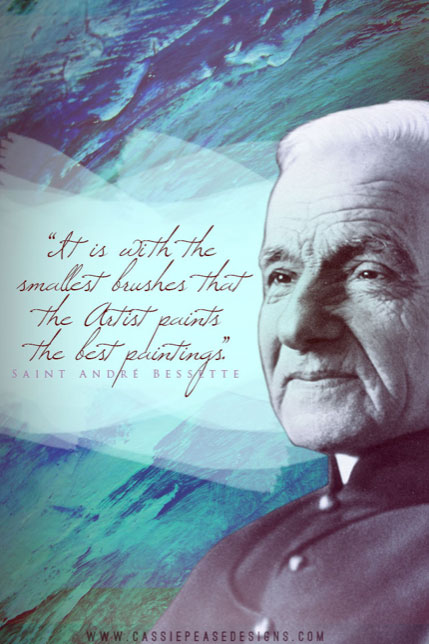
St. André Bessette Mobile Wallpaper, Cassie Pease, 2014, https://cassiepeasedesigns.com/project/st-andre-bessette-mobile-wallpaper/

And that is a final lesson of trust that he teaches us: in 1904, a few years after taking his vows and being assigned as porter, he asked the bishop if he could build a shrine to his favorite saint on the hill overlooking the college.  The bishop gave him permission, as long as he did not have to borrow any money.  With a whole lot of trust, Br. Andre started colleting nickels and dimes that he earned by giving haircuts to the boys, and gradually a windbreak, then a little shed, and then a small chapel arose upon the hill.  It would be 20 years before construction began on what is now a Basilica, called St. Joseph’s Oratory.  13 years later, the simple doorman died, and one million people came to his funeral.

Trust, it is the mark of every saint.  In St. Andre it was trust in the powerful intercession of St. Joseph.  As we plunge into this year of St. Joseph, in what area of your life can you practice trust?  Caution: it might mean trusting for decades, but it might also be the source of millions of miracles in your life and in the lives of those you love.

– Fr. Dominic Rankin enters and exits doors approximately 100 times each day.  If every one of those were turned into an act of trust in God, he would be as saintly as St. Andre Bessette, St. John Masias, Bl. Josep Tarrats Comaposada, or Bl. Solanas Casey, all of whom were doorkeepers at their monasteries, and became a saint because of it. 

Week of January 4, 2021 Mass Intentions

Monday, January 4

7am – Anna A. Eleyidath
(Augustine Eleyidath)

5:15pm – Mae Stribling
(LouAnn Mack Corrigan)

Tuesday, January 5

7am – Special Intention for Sheree Graves
(Sheree Graves)

5:15pm – William F. & ShirleyLogan
(Lisa Logan & Lori LoganMotyka)

Wednesday, January 6

7am – Edward F. Dombrowski
(John Busciacco)

5:15pm – William F. & Shirley Logan
(Lisa Logan & Lori LoganMotyka)

Thursday, January 7

7am – Michael Poggi
(Family)

5:15pm – Special Intention for the Homeless
(Linda Pierceall)

Friday, January 8

7am – Repose of the Soul of Averil Rossiter
(Jane Fornoff)

5:15pm – Special Intention for Bianca
(D. A. Drago)

Saturday, January 9

8am – Angeline Sherman
(Warren Sherman)

4pm – Pat Mathews 
(Stanley & Thelma Rhodes)

Sunday, January 10

7am – Deceased Members of the Price Family
(Mark & SharonPrice)

10am – Joseph Wichmann
(Catholic Conference)

5pm – For the People

« Previous Page
Next Page »

Liturgy

Sunday Masses (unless noted differently in weekly bulletin)
Saturday Evening Vigil – 4:00PM
Sunday – 7:00AM, 10:00AM and 5:00PM

Weekday Masses (unless noted differently in weekly bulletin)
Monday thru Friday – 7:00AM and 5:15PM
Saturday – 8:00AM

Reconciliation (Confessions)
Monday thru Friday – 4:15PM to 5:00PM
Saturday – 9:00AM to 10:00AM and 2:30PM to 3:30PM
Sunday – 4:00PM to 4:45PM

Adoration
Tuesdays and Thursdays – 4:00PM to 5:00PM


CatholicMassTime.org

Parish Information

Parish Address
524 East Lawrence Avenue
Springfield, Illinois 62703

Parish Office Hours
Monday thru Thursday – 8:00AM to 4:00PM
Fridays – CLOSED

Parish Phone
(217) 522-3342

Parish Fax
(217) 210-0136

Parish Staff

Contact Us

Contact Us

Copyright © 2026 · Log in