Cathedral of the Immaculate Conception

Springfield, IL

  • About
    • Contact Us
    • History of the Cathedral
    • Liturgical Schedules
    • Parish Staff
    • Register with Cathedral
    • Subscribe to the Cathedral eWeekly
  • Sacraments
    • Baptism
    • Becoming Catholic
    • Matrimony
    • Vocations
  • Ministry List
    • Adult Faith Formation
    • Cathedral Meal Train
    • Cathedral Online Prayer Wall
    • Cathedral Concerts
    • Family of Faith
    • Grief Share
    • Health and Wellness
    • Spiritual Resources
  • Stewardship
    • Stewardship: A Disciple’s Response
    • Stewardship Form
  • Support
    • E-Giving Frequently Asked Questions
    • Give Online
  • Sunday News
    • Announcements
    • Cathedral Weekly
    • Livestream Feed
    • Submit a Mass Intention Request
    • Weekly or Announcement Submission

Lessons from Nazareth

Merry Christmas!  As you are probably aware, the Merry Christmas greeting is a victim of our predominantly secular culture.  We use this greeting for weeks leading up to Christmas, but as soon as we close our eyes at the end of our Christmas Day festivities, we all but forget about this greeting, packing it in the closet until next year.  But in the Church, the greeting of Merry Christmas is something that continues throughout the Christmas Season, which concludes this year on January 10 with the celebration of the Baptism of the Lord.

During the Christmas Season, we celebrate the Feast of the Holy Family of Jesus, Mary, and Joseph.  Since Jesus chose to enter into our world in the context of the family, the Church wants to draw special attention to this family as she invites us to “imitate them in practicing the virtues of family life and in the bonds of charity.” (Roman Missal, Collect for Feast of the Holy Family).  

On this day, in the Office of Readings from the Liturgy of the Hours, the Church provides a reflection given by Pope St. Paul VI when he visited Nazareth, the home of the Holy Family.  He describes Nazareth as “a kind of school where we may begin to discover what Christ’s life was like and even to understand his Gospel.”  We might hear these words a little differently this year as many of our young people have had the home serve as a school, at least virtually, due to the COVID-19 challenges that we have faced.  Hopefully those experiences have not soured us to the prospect of learning in our homes, as the home of Nazareth offers us many lessons upon which to reflect.

In his meditation on Nazareth, the Holy Father proposes three lessons, and I would like to quote the second one, which focuses on what we can learn about family life:

May Nazareth serve as a model of what the family should be. May it show us the family’s holy and enduring character and exemplify its basic function in society: a community of love and sharing, beautiful for the problems it poses and the rewards it brings, in sum, the perfect setting for rearing children – and for this there is no substitute.

Striking is a phrase he uses about family life: “beautiful for the problems it poses.”  You do not need me to tell you that family life is often difficult.  But can we see that even these problems can be beautiful?  We can if we look at them as the Holy Family did, with the eyes of faith, trusting that “all things work for good for those who love God.” (Romans 8:28).

As we conclude our month of reflections related to the Sacrament of Confirmation, we thank God for the Gifts of the Holy Spirit which are increased in the reception of this sacrament.  All of these gifts can be at the service of our families in imitating the Holy Family and seeing even the challenges as blessings.  Once again, Merry Christmas!

Father Alford     

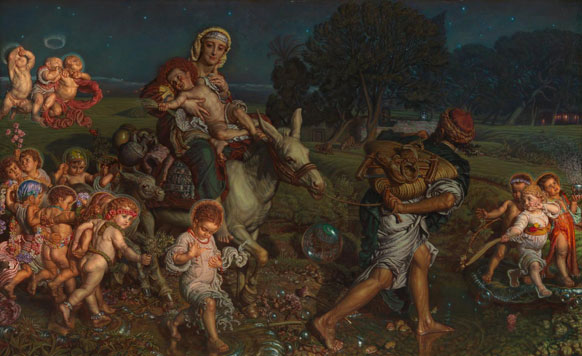
The Holy Innocents: True Christian Triumph

Feast Day: December 28th     

Parents with newborns know the sacrifice of waking up in the middle of the night to care for their children, but St. Joseph, shortly after the birth of his Son, had a very different abrupt awakening.

an angel of the Lord appeared to Joseph in a dream and said, “Rise, take the child and his mother, and flee to Egypt, and remain there till I tell you; for Herod is about to search for the child, to destroy him.”
[Matthew 2:13]

He obeys the word from God, but before we learn of their sojourn in Egypt, or their return to Nazareth, Matthew tells us of the terrible onslaught that came upon Bethlehem with Herod’s anger and jealousy.

Herod, when he saw that he had been tricked by the Wise Men, was in a furious rage, and he sent and killed all the male children in Bethlehem and in all that region who were two years old or under, according to the time which he had ascertained from the Wise Men.
[Matthew 2:16]

Some scholars claim that this event is apocryphal (not historical) because it is not mentioned by historical records of the time, but if we realize both that Herod became horrifically violent and uncontrolled especially in his final years of his reign, and that there were probably only 10 or 15 little boys in Bethlehem given the size of that village at the time of Christ, it seems that an event of this sort would not be remembered by the larger world.  

The question for us then is why do we celebrate this feast just three days after Christmas?  Obviously, these martyrs are connected in time with the infant Jesus.  They perished within two years of his own birth, and because Herod could not stand the idea of his power being usurped (by a baby?!)  Yet most saints are exemplars for us of some virtue, disposition, set of accomplishments they did following God’s will, yet these little boys did not know Christ, nor that their deaths were suffered in lieu of Him.  Their families probably did not know the rationale behind Herod’s brutality, nor did Herod really hate Christ personally, he just did not want somebody else claiming royal authority (because his was so tenuous).

Matthew assists our reflection by quoting Jeremiah 31:15:

Then was fulfilled what was spoken by the prophet Jeremiah: “A voice was heard in Ramah, wailing and loud lamentation, Rachel weeping for her children; she refused to be consoled, because they were no more.””
[Matthew 2:17-18]

If we knew the Old Testament inside and out we would know that Jeremiah continues: 

“Keep your voice from weeping, and your eyes from tears; for your work shall be rewarded, says the LORD, and they shall come back from the land of the enemy. There is hope for your future, says the LORD, and your children shall come back to their own country.”
[Jeramiah 31:16-17]

This scriptural insight offers us a way to see this day aright.  Rachel, the wife of Jacob all the way back in Genesis 29, of course was the mother of Joseph and Benjamin, but Jeremiah transposed her weeping forward to the Israelites killed during the wars and exiles of his day, and Matthew, knowing her to have been buried in Bethlehem, can see the final fulfilment of that prophecy in the children murdered in Christ’s place.  

Those Holy Innocents stand now for us as an icon of every child of God killed for jealousy, anger, misunderstanding, or hatred, or lost tragically in any other way but they also force the Christian to recall that – Christ having taken on the ramifications of sin, all the way to death – all those deaths can still be victories in the end.  The eternal life that Our Lord wants to give us is far more precious than the physical life we cherish, and though the worst of worldly evils is the callous loss of human life, it can also be the moment that Christ’s redemption is accomplished, and His promise kept: “your children shall come back to their own country.”

– Fr. Dominic Rankin has only done a handful of funerals as a priest, but knows that they are both one of the hardest things a priest gets to do, and also the most grace-filled.  Miraculously, amid grief and loss, Christ’s victory is continued.  The shadow of the cross does fall over the crèche, but so does the light of Easter.

The Triumph of the Innocents, William Holman Hunt, 1883, Tate Collection.  Creative Common License.

Can sacraments be repeated?

As practicing Catholics, we (hopefully!) receive two of the sacraments regularly: Penance and the Holy Eucharist. There are some sacraments that we receive only once in life. As we continue to reflect on the sacrament of Confirmation during December, I thought it would be helpful to see what our Catechism says about sacraments that can be received only once. 

Paragraph 1304 of the Catechism of the Catholic Church reads, “Like Baptism which it completes, Confirmation is given only once, for it too imprints on the soul an indelible spiritual mark, the ‘character,’ which is the sign that Jesus Christ has marked a Christian with the seal of his Spirit by clothing him with power from on high so that he may be his witness.”

Baptism and Confirmation change a Christian forever and can only be received once. Regarding these sacraments, you might here a theologian or a priest mention the “character” of each sacrament. As the Catechism said, the character is a spiritual mark imprinted on the soul. It is hard to image a spiritual mark – spiritual things, like our souls, are invisible, so they cannot be marked in a physical way. Speaking about a mark is simply a way to help us understand the reality of what takes place when a sacrament is celebrated. I have also heard sacramental character likened to a tattoo or a seal, such as when a king would seal a letter with his insignia. The character of a sacrament claims us for Christ and permanently marks us out (invisibly) as Christians! 

The character, or invisible mark, of Baptism is a way in which the divine life is channeled to our souls from God. Any time we commit a mortal sin, we lose this grace of divine life and are separated from the love of God. This can only be restored through repentance, ordinarily expressed in the sacrament of Penance. However, throughout all of this, the character of Baptism is never erased. The same is true for Confirmation. Even if a Confirmed Catholic commits a serious sin or is not in the practice of the faith, they are still a true Catholic, even though the grace of God may not be alive in their heart. 

The Catholic Church does not believe in “re-baptizing” Christians. Baptism can only truly be received one time. In cases where it is doubtful whether Baptism was received or not, somebody may be conditionally baptized just to be sure that he or she has received this gift from God. However, even if somebody were to be “re-baptized” or “re-confirmed” in another church or religious group, we believe that nothing is taking place. It is simply a simulation of a sacrament that had already been received. 

As I’m writing this, I realize that this is a pretty technical piece of Church teaching, but this teaching has been a great source of comfort for many people over the years. Imagine somebody who was baptized and confirmed in childhood, but for the next 50 years of their life, did not practice the faith. Oftentimes nearing the end of life is a reason to turn to God and return to the faith they practiced long ago. For a person in this situation, all that is needed is the reception of the sacrament of Penance, and they are once again a Catholic in good standing, alive with God’s grace! The sacraments of Baptism and Confirmation are truly a stable and enduring gift of God’s love, offering us the chance to return to the faith no matter how many twists and turns we take in our spiritual life. 

Mass Intentions for the Week of Monday, December 28

Monday, December 28

7am – John & Edith Bakalar
(John Busciacco)

5:15pm – Richiusa & Leo Families
(Family)

Tuesday, December 29

7am – Anna A. Eleyidath
(Augustine Eleyidath)

5:15pm – Carl Venvertloh
(Mr. & Mrs. Rico Johnson)

Wednesday, December 30

7am – Fred Rovey
(Tom Steil & Sharon Oldfield)

5:15pm – Dr. Eugene Stonikas
(William & Debra Stonikas)

Thursday, December 31

7am – John Kaufman
(Mike McGee)

5:15pm – Nancy Shea
(Jim & Barb Stelte)

Friday, January 1

9am – Barbara McGee
(Tom McGee)

Saturday, January 2

8am – Lawrence Jaros
(Katie Konsky & Family)

4pm – For the People 

Sunday, January 3

7am – Mary Ann Midden
(William Midden)

10am – Joseph Wichmann
(Casey Wichmann)

5pm – Mary Rita DesMarteau
(Criscione Family)

Prayer Wall – 12/21/2020

Please pray for healing and recovery for Beverly Shymanski.

Slowing Down

This past week, I had the opportunity to make my annual retreat.  I had hoped to take it at two different times earlier in the year, but the circumstances demanded that I cancel.  I can see the Providence in all of this, though, as Advent can be a very special time for making a retreat, as it is a great way to prepare for Christmas.  For the first two years of my priesthood, I took my annual retreat right after Christmas, which enabled me to slow down and rest in the beauty of the season.  Having had those fruitful experiences, I had no doubt that being on retreat before Christmas would likewise be fruitful. 

Harkening back to those first two retreats, I recall vividly the location that I chose, the Shrine of the Most Blessed Sacrament in Hanceville, Alabama.  You may be more familiar with this location as the place where Mother Angelica, founder of EWTN, lived for the final several years of her life.  She had a great devotion to the Divino Niño, the Divine Child, which you could see throughout the shrine.  It was always a wonderful thing to meditate there on the littleness of the child Jesus and His desire to be near to us.  

Several years ago, I came across a little meditation that Mother Angelica composed about the Birth of Christ.  And even if you are not able to make a retreat before Christmas, maybe you can use this meditation and take some time in silence, possibly before a Nativity scene, and make your final preparations to welcome Christ more deeply into your hearts this Christmas:

The Birth of Christ
(A Meditation by Mother Angelica)

“…Suddenly the whole cave is filled with the most brilliant light:
beautiful and soft.  At the end of the cave is Mary.  She is kneeling
and she has the most lovely infant in her arms.  My heart begins
to pound with joy and I say to her, ‘May I touch him?’  She says,
‘Yes.  Don’t be afraid.  This is why He came so that you would see
your God in the flesh and never be afraid again.’  I go to grasp His
hand and instead He clasps my little finger and holds it so tight.
I realize how much God loves me – that He would come in such
tiny form to such a cold, simple place.  That He would consent to be
so dependent on His creatures: Mary and Joseph to give Him food
and drink and to care for Him.  This God who created the whole
universe is dependent upon two creatures, all out of love for me.” 

On behalf of the entire Cathedral clergy and staff, I wish all of you many blessings as you prepare to remember the Birth of our Savior on Christmas!

Father Alford     

Where is Confirmation in the Scriptures?

One of the trademarks of the seven sacraments is that they were all “instituted by Christ.” This is a fancy way of saying that Jesus began all of the seven sacraments, and they were not a later development of the Church. The Church has developed many forms of devotion over the centuries such as the Rosary and the different expressions of our liturgy. Even our frequency of the celebration of the seven sacraments has changed, but the sacraments themselves have been the same since the beginning. 

Since we are studying the sacrament of Confirmation during December, I thought it would be helpful to look into the scriptural foundations of this sacrament of the Holy Spirit. Admittedly, Jesus’ institution of Confirmation is not as clear as his institution of baptism. However, the Church has always seen Jesus’ promise to send the Holy Spirit as the institution of Confirmation. He said, “I will ask the Father, and he will give you another Advocate, to be with you always, the Spirit of truth, which the world cannot accept, because it neither sees nor knows it.” This promise was fulfilled on the day of Pentecost, when the small but mighty Church received the gift of the Holy Spirit to be sent out on mission. 

The Apostles clearly understood the necessity of administering Confirmation after a Christian was baptized. During a persecution of Christians in Jerusalem, Philip (one of the original seven deacons), found himself in Samaria and began to preach the Gospel of Jesus Christ. Great crowds of people were converted, and Philip the Deacon baptized many of them. However, when the Apostles heard about the success of Philip’s preaching, they sent Peter and John to pray that the new Christians would receive the Holy Spirit. We read in the Acts of the Apostles, “Peter and John went down and prayed for them, that they might receive the Holy Spirit, for it had not yet fallen upon any of them; they had only been baptized in the name of the Lord Jesus. Then they laid hands on them and they received the Holy Spirit” (Acts 8:15-17). 

It’s a bit odd to think that these Christians were baptized in the name of the Father, and of the Son, and of the Holy Spirit, yet our scriptures say that they had not yet received the Holy Spirit! This needs to be properly understood, because we know that when we receive the gift of baptism, the Holy Trinity begins to dwell within us through the gift of sanctifying grace. Baptism is only a beginning, whereas Confirmation is a sacrament of Christian maturity and the gift of the fullness of the Holy Spirit. Christian life is all about growing in God’s love, and until we die, our goal should be to receive more and more of this love every day! Confirmation gives an increase of God’s love and a strengthening of his gifts within us so that we can more effectively practice our charisms to build up the Church and use the seven gifts of the Holy Spirit to grow in holiness. Let us lean on the strength of God, knowing that he has strengthened us in Confirmation! 

St. John of Kenty

Feast Day: December 23rd   

Today we take ourselves back more than 600 years ago to the village of Kenty, in southern Poland (actually, only a handful of miles from where St. John Paul II grew up, though also very near to where the Nazi’s would establish the Auschwitz concentration camp).  It is one of the oldest established cities in Poland, tracing its founding back to 1277, but a century later, when Jan (John) was born, it was still a fairly small place, with little to indicate all that would come from the new little boy.  

As always, perhaps the first thing that strikes us about any saint is the famous things they did or characteristics that marked them.  John was an intelligent young man, and ended up attending university at the Academy of Krakow (later to become the Jagiellonian University), which is the second oldest university in Europe, and would over the course of 6+ centuries of teaching, graduate countless prestigious alumni.  A few highlights include figures such as Nicolas Copernicus (discovered heliocentrism), St. Stanislaus Kazimierz (tremendous, saintly priest), King John Sobieski (who is depicted in one of our stained glass windows in the Cathedral), Karol Wojtyla (who became Pope John Paul II), as well as our own Bishop Paprocki.

Back to Jan though, he showed his mettle as a student in philosophy, theology, scripture, spirituality, and all the sorts of things you might expect a soon-to-be-ordained young man to.  He also became known for his generosity and compassion towards the poor, especially, as he became a professor soon at that same university, for the students who attended his classes, for their spiritual, academic, and physical needs.  His patience and holiness were shown in a different light when he was jealously ousted from the university and sent off to be a parish priest, where the famous scholar happily cared for a little flock until restored to his place at the Jagiellonian.  And, of course, a bit of poverty and simplicity also marked his life: he was known to eat very simply, went on pilgrimage to Rome and Jerusalem (carrying everything he needed on his back, though he didn’t have a whole lot since he gave away most of his possessions to those who needed them more than he.)  He’s, not surprisingly, the patron Saint of Teachers, Students, Priests and Pilgrims, which means he’s a patron for almost all of us!

But I want to direct our attention here to a different interest of his life: he helped develop further Fr. Jean Buridan’s theory of impetus.  Now, I suspect none of us have heard of Kenty, perhaps not John of Kenty either, and most probably not Jean Buridan and his theory of impetus.  But, this philosopher and physicist and priest developed a revision of the long-held Aristotelian understanding of motion (which assumed that the air/atmosphere somehow kept things moving because something had to), and instead proposed that an object’s motion is imparted to it by some mover, and is proportional to the speed, and mass, that the object has (minus the resistance that air imparts).  John of Kenty (I should mention, also known as St. John Cantius, the patron of the order of priests who are our nearest neighbors over at Sacred Heart), a priest, a pilgrim, a professor, and a pauper, was also a physicist, and made significant contributions to a theory that would later develop into Newton’s understanding of inertia, and all the way into the classical physics we all learn in school.

What’s the takeaway?  Holiness doesn’t mean you have to be boring.  The interests, ideas, inspirations, and other things that fill your heart have a place in heaven.  Give thanks to the giver of those gifts today, and use them for His glory!

– Fr. Dominic Rankin spent a lot of hours growing up with lego’s, erector sets, k’nex, and other such construction/mechanical-creation sorts of toys.  He does not have as much time as then to tinker with things, but continues to be entranced by physics, astronomy, aeronautics, electricity, robotics, etc.   He hasn’t yet made a major scientific breakthrough, but wouldn’t mind if that became a small part of his walk towards holiness one day.

Week of Dec. 21 Mass Intentions

Monday, December 21

7am – Mary Kay Buller Harrelson
(Bev & Larry Hoffman)

5:15pm – Richiua & Leo Families

Tuesday, December 22

7am – Helene O’Shea
(Bud O’Shea)

5:15pm – Margaret Graham
(Tom McGee)

Wednesday, December 23

7am – Deceased Members of theCCCW
(CCCW)

5:15pm – Kristin King
(Dick & Kay King)

Thursday, December 24

4pm – John D. Sullivan
(Jan Norris)

7pm – Rita DesMarteau
(Family)

9pm – Diana J. Schumacher
(Daniel J. Schumacher)

Friday, December 25

12am – John Montgomery
(John Busciacco)

7am – Sophia E. Bartoletti
(Family)

9am – Barbara McGee
(Tom McGee)

Saturday, December 26

8am – Irene Doellman
(Blessed Sacrament Parish)

4pm – Thomas Rapps
(Carolyn Yoggerst)

Sunday, December 27

7am – Honor of the Holy Family
(John Busciacco)

10am – George Zeigler
(William & Debra Stonikas)

5pm – For the People

Prayer Wall – 12/11/2020

Please pray for my 2 year old grandson who was a NICU baby, who recently received a life-changing diagnosis.

« Previous Page
Next Page »

Liturgy

Sunday Masses (unless noted differently in weekly bulletin)
Saturday Evening Vigil – 4:00PM
Sunday – 7:00AM, 10:00AM and 5:00PM

Weekday Masses (unless noted differently in weekly bulletin)
Monday thru Friday – 7:00AM and 5:15PM
Saturday – 8:00AM

Reconciliation (Confessions)
Monday thru Friday – 4:15PM to 5:00PM
Saturday – 9:00AM to 10:00AM and 2:30PM to 3:30PM
Sunday – 4:00PM to 4:45PM

Adoration
Tuesdays and Thursdays – 4:00PM to 5:00PM


CatholicMassTime.org

Parish Information

Parish Address
524 East Lawrence Avenue
Springfield, Illinois 62703

Parish Office Hours
Monday thru Thursday – 8:00AM to 4:00PM
Fridays – CLOSED

Parish Phone
(217) 522-3342

Parish Fax
(217) 210-0136

Parish Staff

Contact Us

Contact Us

Copyright © 2026 · Log in