Cathedral of the Immaculate Conception

Springfield, IL

  • About
    • Contact Us
    • History of the Cathedral
    • Liturgical Schedules
    • Parish Staff
    • Register with Cathedral
    • Subscribe to the Cathedral eWeekly
  • Sacraments
    • Baptism
    • Becoming Catholic
    • Matrimony
    • Vocations
  • Ministry List
    • Adult Faith Formation
    • Cathedral Meal Train
    • Cathedral Online Prayer Wall
    • Cathedral Concerts
    • Family of Faith
    • Grief Share
    • Health and Wellness
    • Spiritual Resources
  • Stewardship
    • Stewardship: A Disciple’s Response
    • Stewardship Form
  • Support
    • E-Giving Frequently Asked Questions
    • Give Online
  • Sunday News
    • Announcements
    • Cathedral Weekly
    • Livestream Feed
    • Submit a Mass Intention Request
    • Weekly or Announcement Submission

Come, Lord Jesus

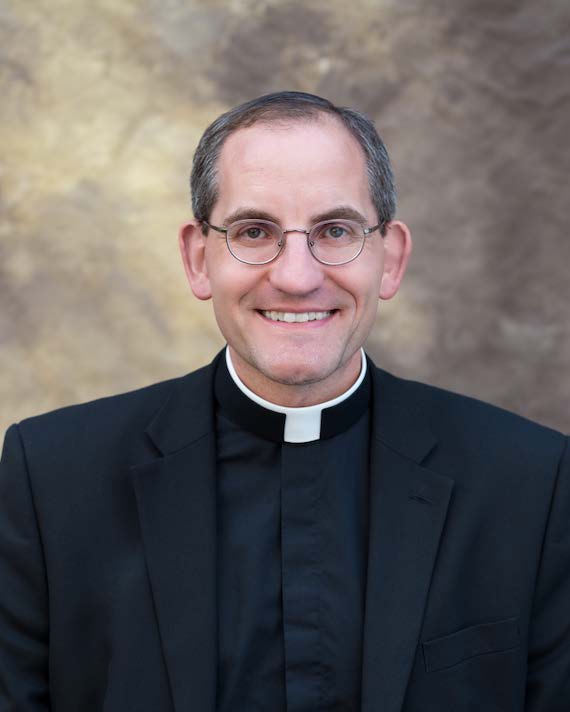
Happy New Year!  I always look forward to sharing this greeting with fellow Catholics at the beginning of Advent, which marks the beginning of a new liturgical year for us.  With this greeting, whether we do it now or with the rest of society at the beginning of January, it is expressed with hope.  With the new year just beginning, we express our hope that it will be a good year ahead.  I think it is safe to say that this past year has not exactly been what we had hoped.  Is there any reason to think that the coming year will be any better?

As Christians, our answer to that question is an overwhelming “yes.”  Why?  Because the hope that we hold onto is a hope that is different from the worldly hope that always seems to come up short.  I was recently reading Pope Benedict’s encyclical on hope (Spe salvi), and he commented on the traditional dialog that takes place between the minister and the parents at the beginning of the Sacrament of Baptism.  Here is how the dialog goes:

  • Minister:  What do you ask of the Church?
  • Parents: Faith
  • Minister: And what does faith give you?
  • Parents: Eternal life

And so from the very beginning of our lives in Christ, we have planted within us, through the gift of faith, the hope for eternal life.  With each passing day and each passing year, we take one step closer to the realization of that hope.  

The Season of Advent is a great time to renew that sense of hope within us.  This season invites us to be joyful as we remember the coming of Christ in history nearly 2000 years ago.  His birth brought hope to a people who had been walking in darkness for generations.  His birth was a preparation for His death, when He destroyed death forever and unlocked the gates of Heaven to believers.  That victory is the reason for our hope.  Advent therefore is also a time to look forward in hope to Christ’s return when all who are in communion with Him in life and in death will share in His victory fully.

In the meantime, however, Advent invites us to recall that Jesus comes to us here and now in the mystery of His grace, present to us in a special way in the sacraments.  He brings light to us in the midst of the darkness that surrounds us, reminding us that we are not alone.  He is near to us, renewing our hope that at the end of this earthly journey, no matter how bumpy that journey may be, our hope in eternal life, given on the day of our Baptism, will be fulfilled.

May I therefore encourage you to pray the following traditional Advent prayer regularly: “Come, Lord Jesus.”  We pray for His coming in glory at the end of time, but we pray for Him to come in mystery into our lives anew in this new year, so that no matter what this year may bring, our hope in Him will not waver, and as St. Paul reminds us, this “hope does not disappoint.” (Rom 5:5)

Father Alford     
Week of Nov. 20

Monday, November 30

7am – Anna A. Eleyidath
(Augustine Eleyidath)

5:15pm – Cynthia Crispi
(John Busciacco)

Tuesday, December 1

7am – Barbara J. McGrath
(Family & Friends)

5:15pm – Delia Sinn
(Genny Severino)

Wednesday, December 2

7am – Special Intention for Sheree Graves
(Sheree Graves)

5:15pm – Barbara Hansen
(Family & Friends)

Thursday, December 3

7am – Irene Doellman
(Blessed Sacrament Parish)

5:15pm – Puring Garde
(Family)

Friday, December 4

7am – Mary Priester
(Family)

5:15pm – Andrew McGee
(Tom McGee)

Saturday, December 5

8am – Dr. Eugene Stonikas
(William & Debra Stonikas)

4pm – For the People

Sunday, December 6

7am – Mary Ann Midden
(William Midden)

10am – Charles & Mercedes
Nesbitt (Kathy Frank)

5pm – Deceased Members of the CCCW
(CCCW)

New Beginnings

It’s hard to believe that we are already into the season of Advent. We can all agree that time flies too quickly, and each year just seems to go by more quickly. Advent is the beginning of our new liturgical year, and fittingly so as we prepare for the celebration of Christmas. 

This Sunday concludes our reflections on the sacrament of baptism. I wanted to dive into a very special baptism that can be found in our gospels – the baptism of Jesus himself. This baptism was the beginning of his public ministry, when it was manifested to the world that he was the Son of God. Let’s take a look at Matthew 3:13-17: “Then Jesus came from Galilee to John at the Jordan to be baptized by him. John tried to prevent him, saying, ‘I need to be baptized by you, and yet you are coming to me?’ Jesus said to him in reply, ‘Allow it now, for thus it is fitting for us to fulfill all righteousness.’ Then he allowed him. After Jesus was baptized, he came up from the water and behold, the heavens were opened for him, and he saw the spirit of God descending like a dove and coming upon him. And a voice came from the heavens, saying, ‘This is my beloved Son, with whom I am well pleased.’”

The baptism of Jesus has baffled many throughout the centuries, first of all John the Baptist himself! John states the obvious when he says that it should be the other way around, with Jesus baptizing him, and he’s right! At the time of Jesus, before baptism was a sacrament of the New Covenant, the Jews had many ritual washings as part of their religious practice. Ritual washings were used to regain ritual purity as the body experienced things that were “unclean.” This is a somewhat hard concept for us to grasp, because unclean did not necessarily mean immoral or sinful. For example, after a woman gave birth, she was considered unclean for several weeks, although there was clearly no sin involved in having a baby! Similarly, soldiers would undergo a ritual washing after battle, and priests would undergo a washing before offering sacrifice. We can see how Jesus used the Jewish concept of ritual washing as a foundation for his institution of the sacrament of baptism. 

John was baptizing people in the Jordan in response to his call to conversion. He apparently had a successful following of people who understood the need for repentance and expressed this through the reception of a baptism in the river. Jesus had no need for this, which both he and John both recognized. However, we understand that Jesus was baptized for our sake. Jesus said that it is fitting for him to be baptized. In doing so, he sets the model for all of us and undergoes the same treatment as everyone else. This follows the pattern of Jesus always offering himself for our sake. 

Jesus’ baptism was a sort of reversal of roles. Typically, the water is clean and would wash the body of the unclean person. However, with Jesus it was opposite. Since Jesus is God himself and the source of all holiness, when he was baptized, he in turn sanctified the waters for our baptism. In Jesus’ baptism, he was revealed to the world as the Son of God, when God the Father spoke from the heavens saying, “This is my beloved Son, with whom I am well pleased.” God the Father spoke the same words to us in each of our baptisms, and what a beautiful beginning we each had! May our Advent season be filled with the graces of our baptism as we prepare to once again receive the Son of God into our hearts. 

St. Francis Xavier: A Madman for Christ

Feast Day: December 3rd 

We have one more saint to meet during our investigation of baptism.  This week we celebrate the saint who was baptized Francisco, and grew up in Javier [Xavier] of the Kingdom of Navarre (nowadays in North East Spain), with a prosperous farmer for a father and a mother claiming noble blood.  The prosperity was tenuous at best, his homeland being invaded by King Ferdinand of Aragon (who you might know as the husband of Isabella, and sponsor of Christopher Columbus) when Francisco was 6.  During the next 18 years of war, Francisco would lose his father, and most of his family’s castle would be demolished.

Still, at the age of 19, he was able to begin his studies at the University of Paris, where, in God’s good providence, he fell in with Pierre Favre (a long time friend) and Ignatius of Loyola (a new friend, and far older than both other men, himself a convert-by-cannonball, which is a story for another day…).  These friends sought to convince the vivacious Francisco that to follow God would offer him a far more exciting life than to spend his life seeking worldly fame.  As he studied philosophy (and then taught it), and then studied theology, Xavier gradually was won over by the earnest Ignatius and in 1534, chose with 5 other men to go through the Spiritual Exercises and definitively join together in poverty, chastity, and obedience (specifically, individually, in service to the Pope) and to go on pilgrimage to Jerusalem to see where God wanted them to offer their labors for the salvation of souls.  Not dissimilar from 11 apostles 1500 years before, the 10 men (as it grew to a year later), praying in a nondescript chapel on a hill of Paris, would bear fruit far beyond their human abilities.

Francisco offered his services as secretary of the new order, daringly named the Society of Jesus, though Francis’ role would remain mundane for 6 more years.  But then, in 1540, Pope Paul III (the one who called the Council of Trent first supported Michelangelo’s efforts as an artist, and also given the go ahead for the Jesuits to form) now requested that they offer their services as missionaries to the new Portuguese discoveries in the East Indies.  Two other early Jesuits were tapped for the (presumably one-way) trip, but one came down sick just before they were to leave, and Ignatius asked Francis to take his spot.  

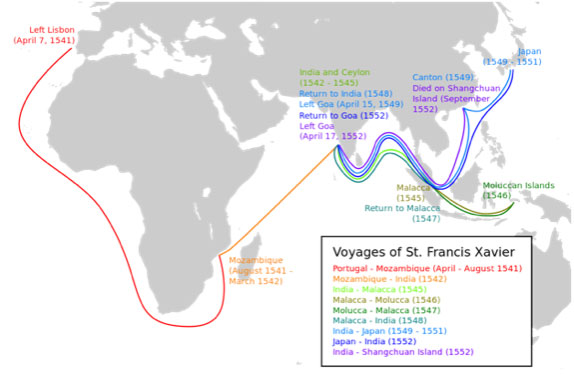
The eager 34-year-old left Rome in March, arrived in Portugal in June, and spent 8 months preparing for the voyage.  The pair departed Europe in April of 1541, arrived in Mozambique in August, and Goa, India, by May, 1542.  The following three years would be packed with caring for the natives of Southern India, building and working in hospitals, educating the peasant population, and baptizing tens of thousands every month.  He repeated this feat in Malacca (now Malaysia, in 1545), Maluku (now Indonesia, in 1546), Japan (in 1549), and China (in 1551, dying just before arriving on the mainland) facing countless deprivations, immense struggle to learn the native languages, and hostility by the cultic leaders who had previously sustained themselves off the lesser castes.  His body was returned to Goa, India, where it remains to this day, though, as only Catholic are apt to do, his arm, the same one that baptized hundreds of thousands, was eventually taken all the way back to the Jesuit headquarters in Rome, where it has stayed ever since (except a few excursions “on tour” around Canada, Australia, and other countries that even this legendary missionary couldn’t reach in this life).  

Perhaps what we are meant to learn from this saint is a simple truth: Christianity is an incarnate religion.  Everything we believe is founded upon our God becoming man.  Continuing this humility: today God depends on human lips, and limbs, and learning to preach, and baptize, and teach for Him.  And, for the very same reason, it is Christianity, and Christian saints, that relentlessly cherish the incarnate persons we encounter in every culture the world over, and none the less, desire ardently to bring them that incarnate love given to the Church in her scripture and sacraments.  May we have the gumption to do the same!

Many, many people hereabouts are not becoming Christians for one reason: there is nobody to make them Christians. Again and again I have thought of going round the universities of Europe, especially Paris, and everywhere crying out like a madman. Riveting the attention of those with more learning than charity: What a tragedy:  how many souls are being shut out of heaven and falling into hell, thanks to you!

– Fr. Dominic Rankin keeps waiting for the growth spurt that is sure to send him above his current height of 5’6” (on a good day), but he was happy to realize that sanctity does not depend on stature, for Francis Xavier never surpassed 5’4”, yet his youthful skill at running and high-jumping were surpassed one-hundred-fold by the grace with which he ran the Christian race and reached the heights of glorifying God.

Thousands of miles, and millions encountered.  You and I will do the same in our lives.  But do we as strongly desire to bring Christ to every parsec, and every person?. 

Prayer Wall – 11/19/2020

Please pray for my 38 yr old son Billy he’s addicted to alcohol just got his 3rd dwi also is bi polar very depressed lost job needs rehab pray for God’s deliverance from alcohol

Christ, Our King

I recently completed reading the book Conversion: Spiritual Insights into an Essential Encounter with God by Father Donald Haggerty, a priest of the Archdiocese of New York.  As I read it, I called to mind the many conversions I have undergone in my life, large and small.  But I was also challenged to see that the Lord invites me to continue to follow the path of conversion each and every day so that I can be a better instrument in His hands as I serve the people of God.

This call to continual conversion is one that the Church invites all Christians to embrace.  When addressing the role of the laity in the Church, the fathers of the Second Vatican Council wrote the following words about the laity:

They conduct themselves as children of the promise, and thus strong in faith and in hope they make the most of the present, and with patience await the glory that is to come. Let them not, then, hide this hope in the depths of their hearts, but even in the program of their secular life let them express it by a continual conversion and by wrestling “against the world-rulers of this darkness, against the spiritual forces of wickedness.”(Eph. 6:12)   Lumen Gentium, 35.

Notice the mention of the wrestling against the world-rulers of this darkness, referring not so much to human opponents, but our spiritual opponent the devil and his minions.  On the day of our Baptism, while the Heavens rejoiced at the gift of a new soul claimed for the Kingdom, our enemy lamented at his loss.  He is a sore loser, so he will not cease to try to tempt us to take our attention away from following Christ, our King.  The enemy tries to attract us by artificial lights that promise peace and fulfillment, but they only lead to darkness.  In the end, the enemy is a liar, and he will do everything possible to try to convince us of the truth of his lies.  Only by following Christ, who alone is “the way, and the truth, and the life” (Jn 14:6) can we be assured of final victory, of true peace and true happiness.  And because of our Baptism, we are God’s dearly beloved children, and He will never cease to fight on our behalf, so long as we give Him permission by submitting ourselves to His rule.

As the Church comes to the end of the liturgical year, this can be a good time to thank Christ, our King, for the areas of darkness in our lives that He has conquered through our acceptance of His reign.  But we are all well aware that there remain areas where we still need to let Him reign.  We pray that we may not resist Him when He comes and invites us to that next conversion.  While it may be uncomfortable, and even downright painful, we submit ourselves with humble trust, knowing that His reign in our souls is never one that brings slavery, but always leads to freedom.  

Father Alford     

Baptism Foreshadowed by the Exodus

In my column last week, I explored how the story of Noah’s Ark prefigured the sacrament of Baptism. St. Peter was the first one to make this connection explicit in one of his scriptural letters. Another clear image of Baptism from the Old Testament is the Exodus story. The “Exodus” is the term used to refer to the Hebrews’ miraculous escape from the enslaving Egyptians.  The  Exodus was the foundational event for the nation of the Hebrews. Abraham was the first one called by God, and after a couple generations, there were several dozen members of his family. Abraham’s great-grandson Joseph was sold to slavers and made his way to Egypt. This story of Joseph takes up a good portion of the book of Genesis and is one of the most wonderful stories in the Bible. However, this story is only building up to the foundational event of the Exodus. 

Joseph was able to save the nation of Egypt and eventually his own family through the prudent storage of food before a famine. Joseph brought his whole family to Egypt where they lived in prosperity for a number of years. However, the Hebrews were such strong people that the Egyptians began to fear them and thus made them slaves. For 430 years, the Hebrews worked under the Egyptians, but their family which was so small was still becoming a great nation. The stage was set for the most dramatic event in history up to that point, when God called Moses to lead his chosen people out of slavery into freedom. In this event, the evil of the Egyptians was destroyed when they were drowned by the sea closing in on them. And here we have a great connection to Baptism. Baptism frees us from the slavery of sin into the freedom of God’s love. The evil oppressors, sin and the devil, are cast off and destroyed. (The devil still exists after baptism but he no longer has authority over God’s people.)

In crossing the Red Sea, God miraculously led his people out of oppression, through water, towards the Promised Land. It took forty years of wandering before God finally led the Hebrews to the “land of milk and honey,” as it was called. The Exodus was only the beginning of freedom from slavery. In the same way, Baptism is only the beginning for a Christian. Baptism is the doorway, and thankfully we have six other sacraments to help us along as we also wander in the desert. During the Hebrews’ wandering, God taught them and gave them the law through the Ten Commandments and other laws such as those found in the book of Leviticus. 

The celebration of the Easter Vigil wonderfully dives into the mystery of Baptism through the Exodus. It is required that the story of the Exodus be read at the Easter Vigil, and those who are baptized are saved by passing through the water. If you have never attended an Easter Vigil, I highly encourage you to do so this year! It is sometimes called the “Mother of All Vigils” because it is the most solemn celebration of the entire church year. Simply experiencing this celebration can be a great way to come to a better appreciation of baptism, which is a great gift of freedom from God! 

Bl. Miguel Pro, a Knight in Heavenly Armor

November 23rd

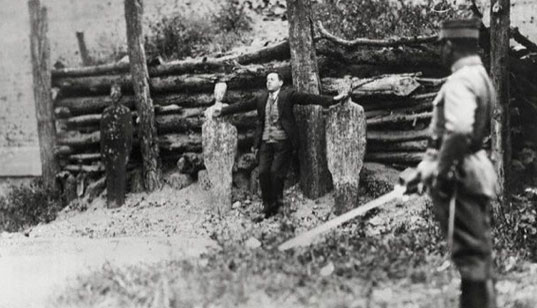
Our story this week follows a little boy nicknamed Cocol, growing up as the 1800s became the 1900s, right at the center of Mexico, in the city of Guadalupe, Zacatecas, in a mining family.  He joined the Society of Jesus at the age of 20, but just 3 years into his formation, his tremendously Catholic homeland, in 1914, after a rigged election, and subsequent power struggle, decended into revolution, and the new government supressed and then persecuted the Catholic Church.  First, no Catholic schools, then no religious orders, then the Church couldn’t have property at all, and finally, priests were told not to wear their clerical garb, could no longer vote, and were forbidden to speak about the political situation … or else death.  Miguel and his classmates were forced to flee the country to continue their formation and when he was ordained far from home (in Belgium at that point), he could not even offer his first blessings to his family, who remained in Mexico, persecuted and hiding, but could only beg God’s grace down upon the photographs that he cherished of them.

Fr. Pro surrepticiously returned to Mexico one year later.  His life emulated so many thousands of priests down through the Church’s history who endured persercution and risked death to bring the sacraments to the faithful: from the persecutions of the 200s in Rome, the 700s in Arabia, the 1500s in England, the 1600s in Japan, the 1900s in Europe, … to those currently in North Korea, Afganistan, India, Colombia and so many other countries.  Within 3 months, a warrant was out for his arrest, and by the fall of 1927, he was captured, and then executed without trial.  It was crime enough that he was a priest.

So much for God’s Kingdom coming, huh?

But then the voice of Christ resounds down through the ages: “My Kingdom is not of this world.”  Our Lord spoke that truth, beleagered and beaten and berefit of any power or influence before the might of the Roman Empire, and was promptly crucified and killed outside the city meant to be the place where God reigned … but as Miguel extended his arms in the shape of the cross, the firing squad raised their rifles, and the priest shouted “Viva Christo Rey!”, Christ’s Kingdom won another victory, because one more life had been captured by their carrying the cross after Him.

Padre Cocol, as he humbly signed his letters, received the martyr’s crown that day, but lest we think that his death was still a loss for everybody else, perhaps even earthly results can give us an indication of the fruit born by his sacrifice.  President Calles ordered the photographs capturing Pro’s execution distributed around the country to cow any remaining Christians.  But, as always, “the blood of the martyrs is the seed of the Church”, and those very images – an icon of the thousands of lives lost in those years, and during the continued persecutions in spots that lasted until the anti-Catholic laws were taken off the books in the 1990s – only invigorated and inspired the remaining followers of Christ to stay faithful to Him.  60,000 of those Christians came to Fr. Pro’s funeral!

We are not, right now, torn from our family and friends, to follow God’s call, but when the day comes, will we be willing to “sell everything” in order to purchase the Kingdom of God?  We are not, yet, destined for the firing-squad by professing that our King is Christ, but if we are not willing today to “suffer for the sake of the Name”, when that price is put on our faith, will we be willing to pay it?  We were traced with the sign of the cross at our baptism, and most of the time it doesn’t hurt too much, but do we act now in such a way to make that sign evident?  If not, will we have the courage when our last day comes to extend our own arms, and still profess Jesus’ victory within our own death?

Bl. Miguel Pro, Photograph of his martyrdom, as He holds crucifix, and rosary, and shouts “Viva Christo Rey!” 

“Cocol” is actually a simple, sweet bread found around Mexico, and loved by Miguel Pro.  Perhaps it is a fitting image for his own life – the wheat flour, mixed with a little salt, a little sugar, butter, yeast, eggs, and anise – all very normal ingredients, but transformed into something wonderful by grinding and kneading and baking.  Our lives are captured for Christ’s Kingdom, when we allow His cross to be imprinted on us … when we allow ourselves to be ground, and kneaded, and baked by the trials of this life, in order to become God’s holy bread as we join His victory in the next.

– Fr. Dominic Rankin has celebrated approximately 1000 Masses as this goes to print.  That is probably more than Bl. Miguel Pro would have celebrated in his short 2 years of priesthood, yet he was ready for martyrdom when the time came.  Do we allow ourselves to be conformed to Christ, crucified, when we receive His Body and Blood poured out at the Mass?

Week of Nov. 23

Monday, November 23

7am – Ralph Walter, Sr.
(Jean Moss)

5:15pm – Dave Loebach
(Rebecca & Woody Woodhull)

Tuesday, November 24

7am – Anna A. Eleyidath
(Augustine Eleyidath)

5:15pm – Norman & Eileen Rovey
(Family)

Wednesday, November 25

7am – Bernice Lauduskie
(Jim & Sandy Bloom)

5:15pm – Polly Keen
(Rob & Jan Sgambelluri)

Thursday, November 26

9am – John & Edith Bakalar
(John Busciacco)

Friday, November 27

7am – Deceased Members of the CCCW
(CCCW)

5:15pm – NO MASS

Saturday, November 28

8am – Richiusa & Leo Families
(Family)

4pm – George Zeigler
(William & Debra Stonikas)

Sunday, November 29

7am – Patricia Craig
(Family)

10am – For the People

5pm – Victoria Selburg
(Bernie Ely)

Our Citizenship is in Heaven

For the past several weeks, as we have experienced the roller coaster of the recent elections, the words of St. Paul have been ever present in my mind: “our citizenship is in Heaven, and from it we also await a savior, the Lord Jesus Christ.” (Phil 3:20)  Those words have brought me great peace in the midst of the uncertainty of what lies ahead for our country.  Because of our baptism, we have been made members of the Body of Christ, the Church, which makes us citizens of His Heavenly city, the New Jerusalem.  As opposed to the uncertainty we will always face when we focus on our earthly journey, there is no uncertainty or worry about what lies ahead for us as citizens of Heaven.  As St. Paul reminds us, the hope for the final, eternal, perfect peace of Heaven will never leave us disappointed.  (cf Rom. 5:5)   On the contrary, when our hope is placed here, we are bound to be disappointed.

Please do not hear in the above words something I am not saying.  Just because we are bound to be disappointed here on earth does not mean that we are not concerned about our lives here and our citizenship in the country and society in which we find ourselves.  In that regard, I came across a helpful commentary on this passage that I would like to share:

The Christian community, too, included both citizens and noncitizens. Therefore, when Paul asserts that the citizenship of Christians truly is in heaven, he is not saying they do not have a life in Philippi, but rather that the source of their security and identity is the risen Messiah, whom they worship as Lord and Savior. If Jesus is Lord and Savior in the most absolute sense, then Caesar is not. So the point is not that the Philippian Christians are in exile but that, as members of the church, they live as a colony of heaven, not of the Roman Empire; their ultimate allegiance is to the Lord Christ, not to Lord Caesar. And they await a visitation not from the Roman savior but from the Savior Christ.

Dennis Hamm, Philippians, Colossians, Philemon, ed. Peter S. Williamson and Mary Healy, Catholic Commentary on Sacred Scripture (Grand Rapids, MI: Baker Academic, 2013), 136.

Jesus never told us to withdraw from society, burying our heads in the sand.  No, He uses images such as “salt”, “light”, and “leaven” to speak of the effect that we should have in the world around us.  We are called to be instruments who draw people to Christ and His truth, so that they too can see in Him the sole hope for peace and lasting happiness.  Again, because of our baptism, we can live with a real sense of joy, knowing that our security lies in Christ the King, who has already won the victory and we know that if we persevere in our faith in Him, we will share fully in that victory as well in Heaven.  Let us recommit ourselves to being good citizens of Heaven, even here as we await the final victory that awaits.

Father Alford     

« Previous Page
Next Page »

Liturgy

Sunday Masses (unless noted differently in weekly bulletin)
Saturday Evening Vigil – 4:00PM
Sunday – 7:00AM, 10:00AM and 5:00PM

Weekday Masses (unless noted differently in weekly bulletin)
Monday thru Friday – 7:00AM and 5:15PM
Saturday – 8:00AM

Reconciliation (Confessions)
Monday thru Friday – 4:15PM to 5:00PM
Saturday – 9:00AM to 10:00AM and 2:30PM to 3:30PM
Sunday – 4:00PM to 4:45PM

Adoration
Tuesdays and Thursdays – 4:00PM to 5:00PM


CatholicMassTime.org

Parish Information

Parish Address
524 East Lawrence Avenue
Springfield, Illinois 62703

Parish Office Hours
Monday thru Thursday – 8:00AM to 4:00PM
Fridays – CLOSED

Parish Phone
(217) 522-3342

Parish Fax
(217) 210-0136

Parish Staff

Contact Us

Contact Us

Copyright © 2026 · Log in