Cathedral of the Immaculate Conception

Springfield, IL

  • About
    • Contact Us
    • History of the Cathedral
    • Liturgical Schedules
    • Parish Staff
    • Register with Cathedral
    • Subscribe to the Cathedral eWeekly
  • Sacraments
    • Baptism
    • Becoming Catholic
    • Matrimony
    • Vocations
  • Ministry List
    • Adult Faith Formation
    • Cathedral Meal Train
    • Cathedral Online Prayer Wall
    • Cathedral Concerts
    • Family of Faith
    • Grief Share
    • Health and Wellness
    • Spiritual Resources
  • Stewardship
    • Stewardship: A Disciple’s Response
    • Stewardship Form
  • Support
    • E-Giving Frequently Asked Questions
    • Give Online
  • Sunday News
    • Announcements
    • Cathedral Weekly
    • Livestream Feed
    • Submit a Mass Intention Request
    • Weekly or Announcement Submission

State of the Parish

A few weeks ago, I had the opportunity to attend a Pastor Workshop hosted by the Institute for Ongoing Clergy Formation out of St. Paul Seminary in St. Paul, Minnesota.  It was a very helpful week, and there are many takeaways that I hope to implement in the coming year in my role as the Rector here.

One of my immediate takeaways came from one of the priest presenters who shared with us about how and when he does his annual State of the Parish address.  My initial response to his comments was one of regret.  I was reminded of how I have really dropped the ball in that regard.  In the four-and-a-half years here, I have never done anything like this.  We have published a financial summary in the past, and perhaps I have written briefly about it in a bulletin article, but I have yet to dedicate an entire weekend to sharing with all of you the state of our parish.  For that, I apologize, but missed opportunities in the past do not define what the future will be, so I am happy to announce that I do indeed plan to do a State of the Parish address!

The priest who presented this topic to us shared that he does his State of the Parish address each year the Sunday before Thanksgiving, which I found extremely fitting.  There is so much for us to be thankful for here at our parish, so highlighting some of those things on that weekend will be a great way for us as a parish family to give thanks to God for the many blessings we have experienced over the past year.  It is also liturgically fitting, as Thanksgiving always comes at the very end of the liturgical year, so doing a State of the Parish address then will be a good way to close out one year, setting us up to enter into a new year of grace in a posture of gratitude and joyful expectation of what the Lord has in store for is in the year ahead.

I would therefore highly encourage you to make every effort to make it to one of our Sunday masses on November 23-24, as I will preach at all of the masses that weekend, working the State of the Parish address into the homily.  One of the topics will obviously be about our financial stewardship here at the parish, with some numbers that show how we are doing in that regard.  I will also give an update on where we stand with our debt, since I have heard that questions have been asked about it, and I owe it to you all to share updates on that key piece of information.  I will also speak about some stats regarding our Mass attendance, sacraments celebrated over the past years, as well as other pieces of information that I hope will give you a feel for how we are doing as a parish.

Since I will be situating this in the context of gratitude for God’s blessings over the past year, I could use your help in making the address more complete.  I would love to hear from you about any of the ways in which you have been blessed by your experience here at the Cathedral over the past year.  I certainly have my own perspective of what I see the Lord doing, but I know He is touching all of us in different ways.  There is information later in the bulletin, as well as in our eWeekly, about how to submit your responses.  I would be most grateful if you would take a moment to share your thoughts.

In the next two weeks, I would humbly ask for your forgiveness for my not making such an address a priority in the past.  At the same time, not dwelling on the past, I ask for your prayers for me now as I prepare for this address, which is something new for me.  This is something you deserve because of your faithful dedication to our parish, and it is something I am excited to offer as your spiritual father.

Father Alford     
Prayer Wall – 11/02/2024

Please pray legal proceedings stop immediately, that my marriage is saved and that my husband comes home to me and our 3 year old daughter. Thank you so much.

Prayer Wall – 10/31/2024

Please pray for Marie Fleck who is having surgery tomorrow, November 1st.
Please pray for normal healthy babies and pregnancies for Sarah and Cameron.

surgery

Praying for the Dead

Last week, we covered the final of the four pillars of Discipleship and Stewardship, and in that article, I mentioned that there are various ways in which to practice the corporal and spiritual works of mercy.  There is one that I would like to focus on in particular this week, which is the spiritual work of praying for the living and the dead.  Now that we are in the month of November, we are invited to pray in a more concerted way for the dead.

Prayers for the faithful departed is one of the greatest works of charity we can offer, for by doing so, we are contributing to the purification that the Lord does for those souls in Purgatory as they continue their journey to their final destination of Heaven.  They rely greatly on the prayers we, as their brothers and sisters, offer for them from our place here on earth.  The Church has such a great love for these souls and a desire that their need for prayers never be forgotten that she has an entire day dedicated to praying for them, which is All Souls Day (November 2).  Only in Heaven will we truly appreciate how much of a gift this day is to so many souls, and we ourselves will likely be beneficiaries of those prayers when we die.  Not content with keeping our attention on these souls for just one day, the Church has designated the entire month of November as a time for praying for these souls.  Finally, during the first week of November, from November 1-8, the Church offers a plenary indulgence to be applied exclusively to the souls in Purgatory.  

I would therefore like to strongly encourage us all to undertake this great work of charity over the next few days.  Sometimes we lament that we do not do enough to help the poor, well here is an amazing opportunity in which I hope we call all join.  Here is how to gain the indulgence – and just so you know, an indulgence can be gained each day during this time, so be generous!

  1. Pray at a cemetery – just stop by any cemetery and offer a prayer for the souls who are there.  This prayer can take a variety of forms, perhaps the most simple being the traditional prayer we offer for the faithful departed: “Eternal rest grant unto them, O Lord, and let perpetual light shine upon them.  May their souls and the souls of all the faithful departed, through the mercy of God, rest in peace.  Amen.” You call also go online and look up Order for Visiting a Cemetery.  There is a nice order that one can use alone or with a group.  Finally, a perk of our Cathedral is that our sanctuary inside the church is actually a cemetery, as there are four bodies buried there!  The State of Illinois recognizes it as a cemetery, so I think it counts!
  2. Pray for the Intentions of the Pope – this can be as simple as praying an Our Father and a Hail Mary with the intention that they be for the Holy Father’s intentions.  This needs to be done each time we visit a cemetery, preferably the same day as the visit, and it can be done at the cemetery itself.
  3. Go to Holy Communion – you will need to receive Holy Communion for each indulgence you seek to gain, and that should preferably be done the day you visit a cemetery, if at all possible.
  4. Go to confession – you only need to go to Confession once for it to apply for any indulgences you are seeking to gain during a period of time.  The timing for confession can be any time before or after this week, preferably a week or two on either side.  So if you just went to confession, you’re probably good.

For a plenary indulgence, we should be detached from all sin, which is often a little more difficult to quantify and explain, but we need not be overly scrupulous as we consider that point.  If any of these requirements are not completed, the Church can still grant a partial indulgence, which is not insignificant by any means, and it might be just enough for one soul to be finally ready for Heaven!

Father Alford     

St. Malachy

Feast Day: November 3rd  

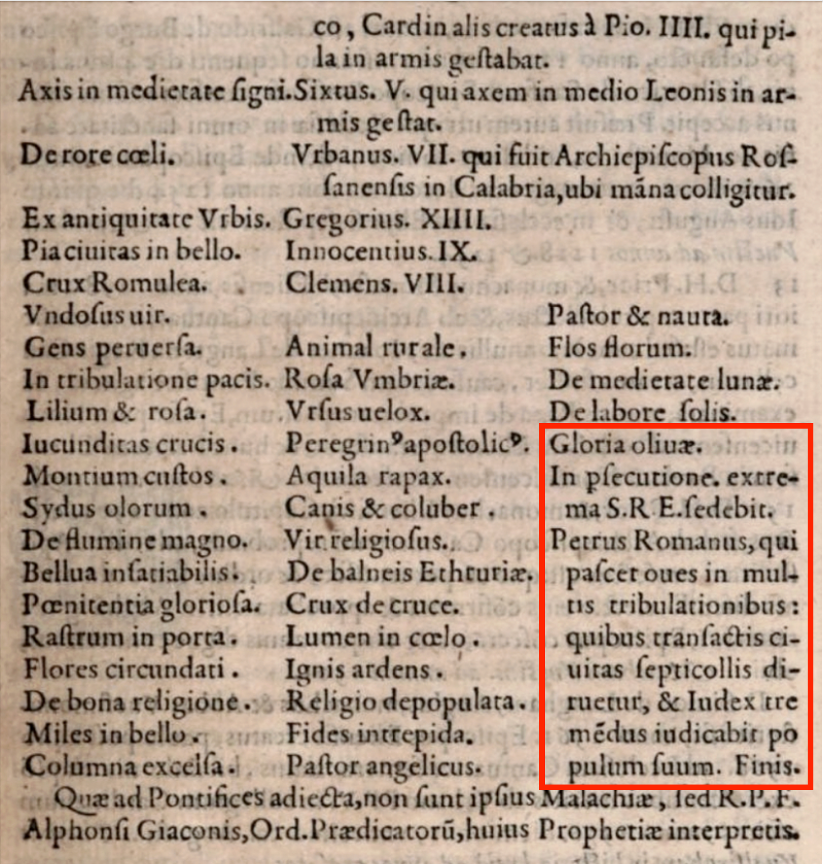
Around 1590 a Benedictine Monk, Arnold de Wion, published a grand text on the history of the Order of St. Benedict, his “Lignum Vitae”. You probably have never heard of him, or his book, but you may have heard of a few pages found within it. Page 311 is included here, and the text inside that red box can be translated:

The Glory of the Olive
In the final persecution of the Holy Roman Church, there will sit [i.e., as bishop]. 

Peter the Roman, who will pasture his sheep in many tribulations, and when these things are finished, the city of seven hills will be destroyed, and the dreadful judge will judge his people. The End.

This, my friends, is St. Malachy’s famous “Prophecy of the Popes”, a list of 112 cryptic Latin phrases penned, it is claimed, by the 11th century Irish Bishop, referring to 112 Holy Fathers, beginning with Celestine II … and if you count forward 112 popes to this final “Peter the Roman”, you find that this final line would refer to our very own Holy Father Pope Francis.

The story goes that St. Malachy traveled from Ireland to Rome in 1139 to retrieve the pallium (actually two) for the Archbishoprics of Armagh and Cashel. He had grown up near Armagh, in Northern Ireland, having spent the latter years of his young life living with a hermit, Imhar O’Hagan after his parents had both died, though not before they had raised him in the faith.  The labors and conversions of St. Patrick had been forgotten in the intervening several centuries, with some in Ireland returning to paganism, and many now only nominally Christian, not knowing the faith or trying to life a life like Jesus. Malachy dedicated his life to changing that, beginning with his own holiness as a disciple of O’Hagan, and later working industriously as a bishop especially for the holiness and training of his priests.

It was a crazy age. Vikings periodically invaded and different clans battled each other to put their sons on the episcopal throne. In 1129, Archbishop Celsus, knowing his saintliness, named Malachy his successor as Archbishop of Armagh. The custom being at that time that the title should have been given to a member of his family, the Celsus clan instead installed Murtagh on the throne, and then Niall when Murtagh died a few years later. The scene may be humorous to us now: Niall stealing the golden crozier and Book of the Gospels stretching back to St. Patrick from the Cathedral and roiling the crowds into defending his right to the office. Malachy refused to engage his clan in battle staying far away from the church outside of town. Then the Celsus clan invites Malachy to a “meeting”, intending to do him harm, but instead they are moved by his humility and kindness and boot out Murtagh to give the see to its rightful bishop (though they did charge Malachy the cost to get back those relics… so much for Christian charity…)

In any case, it meant that in 1139 St. Malachy was bringing his report to Pope Innocent II in Rome, and there, the tale is told (this from Abbé Cucherat in the 1700s), that the holy bishop had a vision of the future of the Church and gave it to the Holy Father, that long list of enigmatic characteristics of future popes. And then it was placed it in a Roman archive and forgotten for 400 years.

Only one problem: even St. Bernard of Clairvaux, who St. Malachy stopped to visit on his way back from Rome, (and in whose arms St. Malachy would die on a later trip back to Rome in 1148), and who wrote a biography of St. Malachy a few years after his death, does not mention this prophecy at all. Nobody knew about this famous list until it conveniently appears right before a Papal Conclave in 1592. There having been a couple of back-to-back conclaves, tensions were high, and with this prophecy showing up right then, St. Malachy handily offered a ‘prophecy’ (Pope #75) that endorsed Arnold de Wion’s favorite candidate, Cd. Simoncelli. Also interesting to note: it is easy to apply the characteristics to each pope up to 1590, and strained for most in the years since.

– Fr. Dominic finds this a fascinating old document. But if we’re looking for drama and intrigue and actions that impact the future, St. Malachy’s hardiness in toil, humility in leadership, self-sacrifice for the good of the Gospel, and friendship with St. Bernard all matter more to the Church today than a cryptic document ascribed to him. And if Pope Francis is our final Holy Father, then we’d be better off preparing our souls, and our world, to meet Christ, then any time spent scouring old archives, or diving down any other interesting rabbit holes.

Prayer Wall – 10/25/2024

Please pray for Springfield Deanery President Kathy Sheary. She is undergoing cancer treatment in Houston.

Pillar of Service

The fourth pillar of Discipleship and Stewardship is Service.  The Synod describes this pillar with the following words:

Service – to serve each other, especially those in need, by practicing charity and justice.

I find that one of the most challenging passages in the Gospel is found in Matthew 25:31-46, sometimes called The Judgement of the Nations.  In Matthew’s Gospel, this is Jesus’s final teaching before the Passion Narrative, and it addresses one the most pressing topics – what is expected of us with regards to our salvation.  Jesus first commends those who have served those who were in need, explaining: “whatever you did for one of these least brothers of mine, you did for me. (Mt 25:40) But, to those who did not serve those who were in need, they are condemned with the following words: “what you did not do for one of these least ones, you did not do for me.” (Mt 25:45)

The reason this passage is so challenging is that it forces me to humbly acknowledge the many times when I have failed to recognize Christ in others and failed to be of service to them.  Sure, I am aware of the many times that I have offered charity to those in need, but there are many times where I fail in this.  I suspect this is something with which many, if not most of us, struggle in our lives.

Although the Gospel I just referenced gives some specific ways of serving those in need (known as the corporal works of mercy), there are many ways in which we can serve others.  In fact, even among those traditional works of mercy, there can be a wide variety of ways in which they are practiced.  A great resource on creative ways of practicing the works of mercy (both corporal and spiritual) is the book You Did It to Me: A Practical Guide to Mercy in Action by Father Michel Gaitley, MIC.  

The first work of mercy Jesus mentions is feeding the hungry.  Here at our parish, there are different opportunities for doing this.  A couple of months ago, we hosted a Stuff the Truck event, which provided needed food for Catholic Charities here in town.  Some of our parishioners have been involved in preparing meals for the Helping Hands shelter in the past.  It is not uncommon for us to encounter unhoused people on and around our campus.  Knowing that you might encounter such people, it can be a good practice to bring along some food that you can give to them, as I know some of you have done.

Speaking of our brothers and sisters who may be unhouse or experiencing other challenges in life, I know that it can be difficult to know what to do.  Each one of us should use our conscience to discern what might be the right thing to do.  Just because somebody is asking for money does not mean that that is the most appropriate thing to give to them.  One thing we should not do is simply ignore them.  By this I mean that we should not be afraid to greet them, give them a smile, and perhaps even ask their name.  So many go out of their way even to avoid eye contact.  But acknowledging somebody with a smile, their name, such that they know that they are seen, can go so much farther than we realize.  Always remember those words of Jesus, that when we offer even this seemingly small act of charity, not only do we do it out of love for them, but we do it out of love for Him.

Father Alford     

St. Frumentius

Feast Day: October 27th 

In the year 300s A.D., trade had been happening between Rome and India for four centuries. even before the domination of Rome, trade networks over land had existed between Persia and India, and then Alexander the Great’s Hellenic empire and India. But caravans across the mountains and deserts of Afghanistan were slow, difficult, and easy prey for robbers and brigands. By the time of Augustus, with his conquering of Egypt in 30 B.C., a much easier, and more lucrative, trade route had appeared using ships going up the Nile (south through Egypt and Sudan) or down the Red Sea (south along those countries’ coasts), and then using the monsoon winds to carry them back and forth across what they called the Erythraean Sea (now called the Arabian Sea). 

Silk and spices and animals flowed into Rome at the rate of 120 ships a year, and gold and silver flowed out. Pliny, writing right around the time of Our Lord, recounts:

India, China and the Arabian peninsula take one hundred million sesterces from our empire per annum at a conservative estimate: that is what our luxuries and women cost us. For what fraction of these imports is intended for sacrifices to the gods or the spirits of the dead? – Pliny, Historia Naturae 12.41.84.

Now, a sesterce, literally “two and a half”, was a quarter of a Roman denarius, “ten”, both of them originally referring to donkeys, so a denarius could buy you 10 donkeys, a sesterces only 2 and a half, and one hundred million sesterces could buy you 100,000,000 donkeys … or an awful lot of silk and spices and interesting Indian animals. 

Now, by the 300s and the age of Constantine, they weren’t using the Roman Republic’s denarius anymore, having adopted different coinage over those intervening centuries. In 324 A.D., Constantine with victories at Adrianople and Chrysopolis, secured his reign over both Western and Eastern Rome, and decided on two major projects to unify his empire. Firstly, he introduced a new coin, the solidus, weighing less than the prior aureus. Secondarily, he called for the Christian church to hold a council, coming to agreement around our understanding of Christ, this being the famous Council of Nicaea of 325 A.D (firmly rejecting Arianism, that Jesus was not fully divine). And here’s the fascinating thing: both these changes impacted not just Rome, but every other culture they were connected to! Up and down Rome’s trade networks we see a change in the weight of their coins, and a prospering of Christian Churches too as persecutions ceased and doctrinal unity spread.

And so we finally meet our saint this week. Frumentius, in the year 324, was an adviser to the King in Axum, Ethiopia, that king named Ezana. This was a rather surprising twist of fate. Frumentius had been born to a mercantile family in Tyre, Phoenecia, around 300 A.D., but it wasn’t his family’s business that carried him and his brother, Aedesius, down to the famous trading post midway between Rome and India, but rather that they had been captured, and sold there as slaves. Christianity had trickled down to Ethiopia (first of all by the baptized Ethiopian Eunuch of Acts 8!), but had not made many converts. However, Frumentius and Aedesius were the nephews of a Christian philosopher from Tyre, so they knew the Christian faith well, and now they providentially gained the trust of their new master, the King of Axum, who left these two trusted servants as tutors and advisers to his own son, Ezana.

And so it was that by the 320s, Frumentius had the permission of Ezana to encourage the small Christian community around Axum to practice their faith openly, and as they began to build churches and practice works of mercy, the city took notice. They had seen every religion under the sun – eastern Buddhism, Egyptian cults, Roman paganism, Judaism – but Christianity outstripped all of them. And so in 324, when King Ezana reformed his currency to match the new weights instituted by Constantine in Rome, for the first time in the whole world, he stamped not his own visage, or motto, or some other symbol on them, but the cross of Christ. 

Four years later, Frumentius traveled up to Alexandria to meet with Bishop Athanasius, the 20th patriarch of Alexandria (Christianity in Africa is ancient!) Athanasius did not send back someone else to evangelize Ethiopia, he consecrated Frumentius himself a bishop and sent him back. Around the same time, Ethiopia became the second country in the world to name Christianity its official religion (25 years after Armenia, 52 years before that would happen in Rome). Just one final page in his story: In 356 A.D., the Roman Emperor Constantius II, wrote to Ezana, telling him to replace Bp. Frumentius with Theophilos the Indian. Constantius was a proponent of Arianism and wanted a bishop who agreed with him. Ezana refused, and the great fight for Christ’s divinity that was still raging in Rome and Constantinople and Alexandria continued there in a bustling city in Ethiopia.

– Fr. Dominic will be carrying one particular detail from St. Frumentius through this week. By his beloved flock he was nicknamed “abuna”, “our father” (notice the similarities with “abba”). I also get to be called “father”, not because I have children of my own, but because I have been called by God to “father” His flock, to encourage them, and protect them from heresies and temptations. It’s a precious title, and I pray to St. Frumentius that I could live up to it. 

Feast Day: October 27th 

In the year 300s A.D., trade had been happening between Rome and India for four centuries. even before the domination of Rome, trade networks over land had existed between Persia and India, and then Alexander the Great’s Hellenic empire and India. But caravans across the mountains and deserts of Afghanistan were slow, difficult, and easy prey for robbers and brigands. By the time of Augustus, with his conquering of Egypt in 30 B.C., a much easier, and more lucrative, trade route had appeared using ships going up the Nile (south through Egypt and Sudan) or down the Red Sea (south along those countries’ coasts), and then using the monsoon winds to carry them back and forth across what they called the Erythraean Sea (now called the Arabian Sea). 

Silk and spices and animals flowed into Rome at the rate of 120 ships a year, and gold and silver flowed out. Pliny, writing right around the time of Our Lord, recounts:

India, China and the Arabian peninsula take one hundred million sesterces from our empire per annum at a conservative estimate: that is what our luxuries and women cost us. For what fraction of these imports is intended for sacrifices to the gods or the spirits of the dead? – Pliny, Historia Naturae 12.41.84.

Now, a sesterce, literally “two and a half”, was a quarter of a Roman denarius, “ten”, both of them originally referring to donkeys, so a denarius could buy you 10 donkeys, a sesterces only 2 and a half, and one hundred million sesterces could buy you 100,000,000 donkeys … or an awful lot of silk and spices and interesting Indian animals. 

Now, by the 300s and the age of Constantine, they weren’t using the Roman Republic’s denarius anymore, having adopted different coinage over those intervening centuries. In 324 A.D., Constantine with victories at Adrianople and Chrysopolis, secured his reign over both Western and Eastern Rome, and decided on two major projects to unify his empire. Firstly, he introduced a new coin, the solidus, weighing less than the prior aureus. Secondarily, he called for the Christian church to hold a council, coming to agreement around our understanding of Christ, this being the famous Council of Nicaea of 325 A.D (firmly rejecting Arianism, that Jesus was not fully divine). And here’s the fascinating thing: both these changes impacted not just Rome, but every other culture they were connected to! Up and down Rome’s trade networks we see a change in the weight of their coins, and a prospering of Christian Churches too as persecutions ceased and doctrinal unity spread.

And so we finally meet our saint this week. Frumentius, in the year 324, was an adviser to the King in Axum, Ethiopia, that king named Ezana. This was a rather surprising twist of fate. Frumentius had been born to a mercantile family in Tyre, Phoenecia, around 300 A.D., but it wasn’t his family’s business that carried him and his brother, Aedesius, down to the famous trading post midway between Rome and India, but rather that they had been captured, and sold there as slaves. Christianity had trickled down to Ethiopia (first of all by the baptized Ethiopian Eunuch of Acts 8!), but had not made many converts. However, Frumentius and Aedesius were the nephews of a Christian philosopher from Tyre, so they knew the Christian faith well, and now they providentially gained the trust of their new master, the King of Axum, who left these two trusted servants as tutors and advisers to his own son, Ezana.

And so it was that by the 320s, Frumentius had the permission of Ezana to encourage the small Christian community around Axum to practice their faith openly, and as they began to build churches and practice works of mercy, the city took notice. They had seen every religion under the sun – eastern Buddhism, Egyptian cults, Roman paganism, Judaism – but Christianity outstripped all of them. And so in 324, when King Ezana reformed his currency to match the new weights instituted by Constantine in Rome, for the first time in the whole world, he stamped not his own visage, or motto, or some other symbol on them, but the cross of Christ. 

Four years later, Frumentius traveled up to Alexandria to meet with Bishop Athanasius, the 20th patriarch of Alexandria (Christianity in Africa is ancient!) Athanasius did not send back someone else to evangelize Ethiopia, he consecrated Frumentius himself a bishop and sent him back. Around the same time, Ethiopia became the second country in the world to name Christianity its official religion (25 years after Armenia, 52 years before that would happen in Rome). Just one final page in his story: In 356 A.D., the Roman Emperor Constantius II, wrote to Ezana, telling him to replace Bp. Frumentius with Theophilos the Indian. Constantius was a proponent of Arianism and wanted a bishop who agreed with him. Ezana refused, and the great fight for Christ’s divinity that was still raging in Rome and Constantinople and Alexandria continued there in a bustling city in Ethiopia.

– Fr. Dominic will be carrying one particular detail from St. Frumentius through this week. By his beloved flock he was nicknamed “abuna”, “our father” (notice the similarities with “abba”). I also get to be called “father”, not because I have children of my own, but because I have been called by God to “father” His flock, to encourage them, and protect them from heresies and temptations. It’s a precious title, and I pray to St. Frumentius that I could live up to it. 

Prayer Wall – 10/19/2024

Please pray for Preston Utley, a 17 yr. Old boy who was electrocuted and lost his arm. He has several internal injuries and his mother just had a baby. Please pray for his family.

Pillar of Formation

The third pillar of Discipleship and Stewardship is Formation.  The Synod describes this pillar with the following words:

            Formation – to study the Bible and learn more about Jesus and our Catholic faith;

Having worked with seminarians for most of my time as a priest, I have come to appreciate the Church’s broad view of the term ‘formation.’  In the short definition given by Synod, one might think that formation is just another word for study, especially since the definition uses those two words of study and learn.

When the Church speaks about formation, however, she does so in a more all-encompassing way.  When we look at the word formation, we think about the process of creating something, like an artist forming some raw material into a piece of art.  There is a development and a transformation that is taking place.  This is the same when we speak about formation in our faith.  Though it is important to learn facts about our Catholic belief, that is only a part of what formation aims at.  Under the Lord’s guidance, we desire to be formed to be more and more like Him, which entails the transformation of our entire lives, not just our minds.

The definition given by the Synod explicitly references the Bible, as the Sacred Scriptures are a special means by which this transformation is effected in us.  We learn more about who Jesus is through our study of the Word of God, and that learning is at the service of our entering into a deeper relationship with Him, a relationship of friendship.  A true friend would never be content just knowing facts about another person.  No, a true friend seeks to spend time with the other, sharing on a deeper level their hopes and desires.  As is usually the case, the more time we spend with a friend, the more we begin to direct our lives based on that friendship – how we spend our time, what excites us , what saddens us, what we think about, and how we act. 

Any formation, therefore, that takes place here at the parish should have that in mind, namely fostering a deeper relationship with the person of Jesus.  As mentioned, studying the Bible is an important means for that, and we have a few different Bible studies that are taking place in our parish, thanks be to God.  As you likely know, our parish has a subscription to the online formation platform called FORMED.  There are a variety of programs available for every level, in addition to offering audiobooks, talks from Catholic speakers, and Catholic movies.  Among the topics included are some series on prayer, which is another form of formation.  By spending time with the Lord in prayer, our hearts will be formed to be more and more like His.

As you can see, formation is meant to be understood in a broad way, as anything that serves to help us deepen our relationship with Jesus and His Church, so that, with the grace of the Holy Spirit, we can be transformed to live in greater likeness to Him, who has called us to friendship.  Perhaps the words of St. Paul best express what we hope to accomplish through this pillar of formation: “I have been crucified with Christ; it is no longer I who live, but Christ who lives in me; and the life I now live in the flesh I live by faith in the Son of God, who loved me and gave himself for me.” (Gal 2:20)

Father Alford    

« Previous Page
Next Page »

Liturgy

Sunday Masses (unless noted differently in weekly bulletin)
Saturday Evening Vigil – 4:00PM
Sunday – 7:00AM, 10:00AM and 5:00PM

Weekday Masses (unless noted differently in weekly bulletin)
Monday thru Friday – 7:00AM and 5:15PM
Saturday – 8:00AM

Reconciliation (Confessions)
Monday thru Friday – 4:15PM to 5:00PM
Saturday – 9:00AM to 10:00AM and 2:30PM to 3:30PM
Sunday – 4:00PM to 4:45PM

Adoration
Tuesdays and Thursdays – 4:00PM to 5:00PM


CatholicMassTime.org

Parish Information

Parish Address
524 East Lawrence Avenue
Springfield, Illinois 62703

Parish Office Hours
Monday thru Thursday – 8:00AM to 4:00PM
Fridays – CLOSED

Parish Phone
(217) 522-3342

Parish Fax
(217) 210-0136

Parish Staff

Contact Us

Contact Us

Copyright © 2026 · Log in