Cathedral of the Immaculate Conception

Springfield, IL

  • About
    • Contact Us
    • History of the Cathedral
    • Liturgical Schedules
    • Parish Staff
    • Register with Cathedral
    • Subscribe to the Cathedral eWeekly
  • Sacraments
    • Baptism
    • Becoming Catholic
    • Matrimony
    • Vocations
  • Ministry List
    • Adult Faith Formation
    • Cathedral Meal Train
    • Cathedral Online Prayer Wall
    • Cathedral Concerts
    • Family of Faith
    • Grief Share
    • Health and Wellness
    • Spiritual Resources
  • Stewardship
    • Stewardship: A Disciple’s Response
    • Stewardship Form
  • Support
    • E-Giving Frequently Asked Questions
    • Give Online
  • Sunday News
    • Announcements
    • Cathedral Weekly
    • Livestream Feed
    • Submit a Mass Intention Request
    • Weekly or Announcement Submission

Rejoice!

As we celebrate this Fourth Sunday of Lent, we are now closer to Easter than we are to Ash Wednesday.  This is one of the reasons that the Church invites us to rejoice on this day.  We call this Laetare Sunday, getting its name from the first word in Latin of the Entrance Antiphon for Mass: “Rejoice (Laetare), Jerusalem!” (Is 66:10)  We visibly express this joy with the rose vestments that clergy have the option of wearing this Sunday.

The notion of rejoicing does not strike us as very Lenten.  Lent feels more like a time to be subdued, to be more sober, to focus more on sacrifice than celebration.  But let us recall the words from St. Paul: “Rejoice in the Lord always. I shall say it again: rejoice!” (Phil 4:4) Yes, even in Lent!  As Christians, we should always be joyful because of the victory that Christ has already won in His Resurrection, that victory which He shares with us through our Baptism.  However, during this season of repentance, we spend time looking at our lives, noticing where we are in need of conversion.  Seeing those weaknesses and faults, we can get pretty down on ourselves, and our first thought is not to rejoice, but rather to be discouraged about ourselves.

This leads me to the challenge I would like to offer for this week:

Challenge:  Fast from negative self-talk
Fruit:  Fostering a Christian spirit of joy

It strikes me how powerful negative self-talk can be in our lives.  We begin to believe that we are defined by our sins and weaknesses.  For example, if we struggle with procrastination, we will say: I am a procrastinator.  If we struggle with patience, we will say: I am an impatient person.  You know what those labels are in your life, and many of them are likely not something about which you rejoice.  To be sure, it is good for us to know where we need to grow, but we do not want that to turn into a feeling of failure or defeat.  As a Christian, we should look at those areas with a spirit of hope, seeing in them places where the Lord wants to win His next victory in our lives.  As His beloved children, He never stops inviting us to welcome Him in to heal us and renew us.  In that regard, I find the following words of Pope St. John Paul II very encouraging: “We are not the sum of our weaknesses and failures; we are the sum of the Father’s love for us and our real capacity to become the image of his Son.”

So let’s try our best this week to stop the negative self-talk.  As an added challenge, if you notice that you are beginning to fall into that negativity spiral about yourself, break the cycle with an affirmation that is true: “I am a beloved son/daughter of the Father!”  What a wonderful cause for rejoicing when we call that to mind.  One of the beautiful “side effects” of stopping this negative self-talk is that we will likely begin to see others through the same lens with which we are learning to look at ourselves.  We will less frequently fall into judgments and criticisms of others and begin to see them as brothers and sisters, rejoicing in the gift they too have been given as beloved sons and daughters.

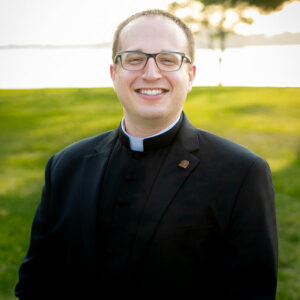
Father Alford     

Halfway Through the Lent

We will be about halfway through this year’s Lenten season this week. At the beginning of the lent, some of us decided to abstain from certain foods or activities. Others resolved to add some foods to their diets or activities to their daily routines. Still, many people choose to consolidate some additions or subtractions that they already have. Many of us simply have been doing something since the beginning of our Lenten journey.

Where are we now? Have we stopped with our Lenten observances? Have we forsaken Jesus in the wilderness? Have we forgotten that he is still in the desert preparing himself for the ultimate price of our salvation? A price that must involve severe tortures, persecution, beatings, whipping, spitting, and individual and public condemnations? Have we quickly forgotten that he is still in the wilderness, lonely, hungry, thirsty, weak, and isolated? Lent is just halfway. It is not over yet.

The whole idea of making Lenten observances is to deepen our relationship with Christ, to unite ourselves in fraternal solicitude to the suffering Christ. His sufferings and all the hardships he endured are to free us from our sins and show us how to embrace suffering for salvific reasons. The scripture puts it better when it says:

For to this you have been called, because Christ also suffered for you, leaving you an example that you should follow in his footsteps. “He committed no sin, and no deceit was found in his mouth.”When he was insulted, he returned no insult; when he suffered, he did not threaten; instead, he handed himself over to the one who judges justly. He himself bore our sins in his body upon the cross, so that, free from sin, we might live for righteousness. By his wounds you have been healed. For you had gone astray like sheep, but you have now returned to the shepherd and guardian of your souls.

1 Peter 2:21-25.

As we continue our Lenten journey, let us increase efforts to stay firm in our Lenten observances. Let us remember that those sacrifices and mortifications must be geared towards bringing us closer to Jesus Christ. Because of this noble reason, we must not entertain any distraction or discouragement in fulfilling our Lenten resolutions. 

The Church encourages us to ensure that whatever we are doing to make a good Lent, we should pay special attention to prayer, fasting, and almsgiving. Some activities and lifestyles we have embarked upon during this Lent may express less direct connections to these Lenten virtues (prayer, fasting, and almsgiving). When this happens, one should not be discouraged. The important thing is that we must all be doing something to deepen our relationship with Christ this Lent. He continues to endure bodily and emotional torments in the wilderness of our sins. So, let us not back down from our Lenten observances now that we are only halfway through the Lenten season.

May God continue to bless our efforts with more courage and desire to persevere in our Lenten resolutions. Amen.

St. Francis of Paula

Feast Day: April 2nd 

My guess is that no one who reads this article is currently a consecrated hermit.  (If someone is, my thanks for your self-gift to the Lord!  And, please pray for us who carry more evidently the cross of living in the world but not of the world!)  And yet, I think the saint we celebrate, and call upon, this week – St. Francis of Paula – a hermit, and founder of the Order of Minims, is still abundantly applicable to each in the 21st century.  Born in 1416, in the region of Calabria in Italy (famous now for its lemons, olives, and spicy red peppercino’s… as well as being the toe of the Italian boot), Francis’ story begins before his conception.

His parents, themselves a devoted and prayerful couple, were unable to conceive, and like so many couples now who carry that troubling and lonely cross of infertility, could only go to God with their longing for children and put their hope in Him.  Praying to St. Francis of Assisi, the Poverello from further north in Italy brought their prayers to the Lord, and they finally conceived.  They were delighted to name their little son Francisco. 

Any mother or father reading this, though, knows that conception is only the first of many chances to trust that a child brings to their parents.  As a baby, Francis had an enigmatic swelling around one of his eyes.  Uncertainty, doubt, fear, and worry crashed upon the young couple as their little boy’s eyesight was threatened.  They turned again, continuously, to God, beseeching again St. Francis’ prayers, even promising that when he was older, if their little Francisco was cured, they would let him spend a year with the Franciscans.  This was not a small promise for a poor family, especially before knowing that they would be blessed with two other children in the years to come.  Yet their faithful prayers were rewarded: Francisco was immediately healed.

He would grow into taking for himself the devotion and prayerfulness of his parents, and, to no one’s surprise, and his parents’ pride and sanctification, would in fact spend that year in a Franciscan friary as a young man.  Returning home, they went on a pilgrimage of thanksgiving to Assisi and Rome after his year of obedience, humility, chastity, and poverty under the rule of St. Francis.  Treasuring that experience, but not feeling the Lord’s directing him to continue with the Order of Friars Minor, the young man found a cave on his family farm and began to live a life of intense prayer and poverty to discern who the Lord was beckoning him to be.  His parents and he both must have found their hearts stretched by the Lord’s silent Love, simply asking all of them to put their trust in Him. The months, and then years, rolled past, and Francis found himself at peace in embracing the life of a hermit.  

Two other men would join him, somehow coming to know of Francis’ holiness and love for God and wanting it for themselves.  More years past and our saint-in-the-making now found himself building a monastery and church in Cosenza (several miles east of Paula). Francis of Assisi so many years before had singlehandedly rebuilt the chapel of the portiuncula, enduring the insults and flung rocks from his previous compadres, but now a new Francis had the help and love of the noblemen, who themselves carried stones to build this Church growing up around the intense poverty of their beloved hermit.  Francis and his followers would embrace a life of complete poverty, chastity, obedience, as well as abstinence from all animal products (meat, cheese, butter, eggs, etc.) 

He was a vegan hermit! How many millennials (and others) have embraced a similar lifestyle in our own say?! Of course, we might fruitfully ask whether that dietary restriction was directed by the Lord … and yet, as I smile at this line of thought, doesn’t this mean that Francis of Paula once again connects to us today?  Are you abstaining from meat for Lent?  Are you unable to eat foods with lactose?  Have you chosen (or been forced into) a vegan diet?  Instead of just enduring it, do it for the sake of God, to be united with Jesus’ simplicity of life.  Instead of changing your diet for mere physical health, do so for your supernatural health!

– Fr. Dominic Rankin will soon be preparing to MC for all the liturgies of Holy Week. It will be a hectic, but heavenly, commemoration of all that Jesus has won for us!  If, like St. Francis of Paula, the Lord calls me home to Himself during the recitation of the Passion of St. John on Good Friday, I’d ask that one of the priests would give me Anointing and Communion, and perhaps Fr. Alford could step in as MC so that the liturgy could continue…  

Almsgiving

Our first two Lenten challenges have addressed prayer (praying for our enemies) and fasting (fasting from our Snooze button).  Let us now turn to the third Lenten discipline of almsgiving.  All of our Lenten practices have as their goal making us less focused on ourselves so that we can focus more on loving God and our neighbor.  But our prayer and fasting can sometimes be done with somewhat selfish motives, seeing how they can help us personally in our lives.  I am not saying that it is bad for us to grow personally – Jesus commands us to become holy, as He is holy.  But our holiness will never be complete until it bears the fruit of extending loving mercy to others.  In the judgement scene from St. Matthew’s Gospel (Mt. 25:31-46), Jesus makes it quite clear that our salvation depends in large part on our willingness to serve Him in our brothers and sisters, especially the least among us.  It is from this passage that we get the Corporal Works of Mercy.  The practice of almsgiving that the Church invites us to engage in can be understood in a broad sense as undertaking these Corporal Works of Mercy, not simply giving alms to the poor, though that is in fact important.  

This week’s challenge is going to be a little more abstract, but nevertheless fruitful if you choose to accept it:

Challenge:  Learn about the Corporal Works of Mercy then make a specific resolution to perform one of these works during Lent
Fruit:  Continuing to grow more merciful

A simple Google search will bring up many resources on the Corporal Works of Mercy.  You can also open the Catechism to paragraphs 2544-2547 on Love for the Poor.  The USCCB has a webpage with the works listed along with some suggestions on how to practice those works (just search “USCCB Corporal Works of Mercy” and it should be at the top of the list).

Getting back to the point I was making at the beginning of this article, the Lenten discipline of almsgiving really moves us in the direction of turning away from selfish motives to motives of mercy toward others.  However, even almsgiving can be done for self-centered reasons.  Some people practice generosity for the tax advantages.  Some people practice generosity to feel better about themselves.  Some (sadly) practice generosity so that they can be seen by others as being generous.  All of those things may be true, but they cannot be our primary motive when performing works of mercy.  Jesus’s strong words on Ash Wednesday speak to that:

When you give alms, do not blow a trumpet before you, as the hypocrites do in the synagogues and in the streets to win the praise of others. Amen, I say to you, they have received their reward. But when you give alms, do not let your left hand know what your right is doing, so that your almsgiving may be secret. And your Father who sees in secret will repay you.” (Mt 6:2–4)

With that in mind, as you form your resolution to practice some work of mercy, it can be helpful to ask yourself this question: “Am I doing this for me?  Or am I doing it for my neighbor?”

Father Alford     

They Were Catholic, And Proud of It.

Last March 17, we celebrated the very famous Saint Patrick’s Day. This feast is traditionally Catholic and still is. But it has become more of a secular and cultural fiesta for many Americans of Irish descent and lovers of everything Irish. Today, wholly Irish Americans may be less than ten percent of the entire United States population. But this feast of St. Patrick has remained one of the most celebrated fiestas in the United States mainly because many people in the United States are Irish in various ways. Some are Irish by ancestral lineage. Others are Irish by marriage or identifications with institutions and organizations that are Irish by foundation and tradition.

Recently, I encountered a gentleman who claimed he is one hundred percent Irish. He not only argued to be fully Irish, but he was also very proud of it. This gentleman, a devout Catholic and a great fan of the Notre Dame football team, the fighting Irish, told me incredible stories about Irish immigrants. Particularly dear to him was how they survived and thrived in the United States amidst the many prejudices they endured as poor immigrants. That was during a protracted period of waves of Irish immigration. I tried to understand what he believed was why the Irish immigrants survived and flourished in their new country and would become a critical part of the making of America.

His answer was simple and clear. “They were Catholic and proud of it.” What got my attention was not the Irish immigrants being Catholics. But that they were proud of it. When ethnic churches existed, Irish immigrants had the highest number and most vibrant churches. Many of their young men and women pursued religious and priestly vocations. They would have enough to make up a more significant percentage of the clergy and religious men and women in the country for a long time. One of her young priests in the early 1880s’ would establish an organization that would help take care of helpless Irish immigrant widows and children. That organization would grow to become the most prominent Catholic lay men’s organization in the world today. It is the Knights of Columbus.

These giant strides were possible because the Irish immigrants and their children were proud of their catholic faith. This was even as anti-Catholic sentiments and ethnic chauvinisms were the order of the day.

Today, many of us are concerned about our children and grandchildren not practicing the faith. We worry about the fast disappearance of those social, spiritual, and moral values that we hold dear as Catholics. Some of us are even doubting the possibility of Catholicism in our world by the next fifty years. Well, all these are legitimate concerns. But what are we doing to remedy the situation?

Are we still Catholics? If we are, are we proud of it? The faith of our fathers, this holy faith, let us be proud of it. Only in being proud of it are we able to live it out, fight for it, and hand it down like our ancestors in the faith.

St. Turibius of Mogrovejo

Feast Day: March 23rd 

I wonder if resentment is one of the things that most strongly holds us back from greater, and more Christ-like, charity? Isn’t it easier to chalk our lack of charity up to fears or a lack of courage; or perhaps our busy-ness and a lack of prudence in scheduling things; or the direct attack of the Evil One???  Looking in myself, I find that sometimes this lack is the less-glamorous, less-acceptable, vice of resentment. To respond to someone’s request, or need, or to anticipate how I should love them – to share myself with them – requires me to put their need above my own, to put their life ahead of mine, to put their schedule on my calendar before my own preferences go on there. And I resent it when my needs go second!

As I write this in a coffeeshop, a gentleman just asked if I’d buy him a sandwich.  I procrastinated in my charity towards him, why?  Not because I don’t have money, not because it will cost me time I don’t have, not because he’s going to mis-use a sandwich, not because Satan shook his pitchfork at me …  but because I resented Kenny’s reliance on me, his expectation that I would help, his asking that I would love Him like Jesus loves him.  Whew, that hurts to say that! I want to love, I desire to be more generous, I hope to see in myself Jesus’ kindness and mercy and care … but the ugly tendency to resent holds me back. 

I realized this as I meditated today on the life of St. Turibius of Mogrovejo.  He was a canon lawyer in Spain, in fact the Grand Inquisitor of that country (growing up in his namesake town of Mogrovejo) a studious and intelligent young man, who had been asked by King Philip II to hold that estimable position. The same monarch in 1578 would nominate the pious and productive Turibio as a candidate for the Episcopacy, to fill the See of Lima, Peru, though he was not yet even ordained!  Of course, he protested that he was not ready or desirous of that vocation, but, in the end at the age of 41 or 42, he accepted the King’s request, and Pope’s confirmation, was ordained a deacon, priest, and then bishop, and set sail for the New World.

If I had to slog through mosquito infested, ferociously humid jungles and mountains, I would have resented King Philip … If I had to sleep in the open because nobody had thought to prepare a place for me to stay, I would probably have resented the Pope’s go ahead…  If I was called to prepare, baptize, and confirm 500,000 individuals, I would have certainly resented the lazy and corrupt priests that were already there and not doing diddlysquat… (Remarkable fact: he confirmed three future canonized saints among those: St. Rose of Lima, St. Martin de Porres, and St. Juan Masías). As I caught fever after fever in the horrendous conditions, and knew that it would be the death of me (Turibius was given the knowledge, and grace, of knowing precisely when he would die), especially that last march, dragging myself 50 miles from Pacasmayo to Zaña to receive Extreme Unction and Viaticum, I would have resented even/especially God Who had demanded from me such efforts and such a dismal death.

But Turibius, evidently, did not let resentment corrupt those requests for charity  He endured the hardships of his unexpected vocation, and preached again and again that “Time is not our own and we must give a strict account of it.”  He did not consider his time, energy, love, or life to be his, and so he did not resent when he was asked to share it. His final words, after receiving those final sacraments, on Holy Thursday of 1606, were those of Jesus: “Lord, into Thy hands I commend my spirit.” May his intercession help us to be similarly generous with our own lives, and defend us against the clutch of resentment!

– Fr. Dominic Rankin, as the Master of Ceremonies for Bishop Paprocki, is assisting currently with our own bishop’s pastoral visits around the diocese, as well as his giving the sacraments of Confirmation and 1st Communion, here at the Cathedral. With the help and example of St. Turibius, he prays that all these occasions where duty asks him to help in various ways may also be occasions of authentic charity and self-gift.

x

Feast Day: March 23rd 

I wonder if resentment is one of the things that most strongly holds us back from greater, and more Christ-like, charity? Isn’t it easier to chalk our lack of charity up to fears or a lack of courage; or perhaps our busy-ness and a lack of prudence in scheduling things; or the direct attack of the Evil One???  Looking in myself, I find that sometimes this lack is the less-glamorous, less-acceptable, vice of resentment. To respond to someone’s request, or need, or to anticipate how I should love them – to share myself with them – requires me to put their need above my own, to put their life ahead of mine, to put their schedule on my calendar before my own preferences go on there. And I resent it when my needs go second!

As I write this in a coffeeshop, a gentleman just asked if I’d buy him a sandwich.  I procrastinated in my charity towards him, why?  Not because I don’t have money, not because it will cost me time I don’t have, not because he’s going to mis-use a sandwich, not because Satan shook his pitchfork at me …  but because I resented Kenny’s reliance on me, his expectation that I would help, his asking that I would love Him like Jesus loves him.  Whew, that hurts to say that! I want to love, I desire to be more generous, I hope to see in myself Jesus’ kindness and mercy and care … but the ugly tendency to resent holds me back. 

I realized this as I meditated today on the life of St. Turibius of Mogrovejo.  He was a canon lawyer in Spain, in fact the Grand Inquisitor of that country (growing up in his namesake town of Mogrovejo) a studious and intelligent young man, who had been asked by King Philip II to hold that estimable position. The same monarch in 1578 would nominate the pious and productive Turibio as a candidate for the Episcopacy, to fill the See of Lima, Peru, though he was not yet even ordained!  Of course, he protested that he was not ready or desirous of that vocation, but, in the end at the age of 41 or 42, he accepted the King’s request, and Pope’s confirmation, was ordained a deacon, priest, and then bishop, and set sail for the New World.

If I had to slog through mosquito infested, ferociously humid jungles and mountains, I would have resented King Philip … If I had to sleep in the open because nobody had thought to prepare a place for me to stay, I would probably have resented the Pope’s go ahead…  If I was called to prepare, baptize, and confirm 500,000 individuals, I would have certainly resented the lazy and corrupt priests that were already there and not doing diddlysquat… (Remarkable fact: he confirmed three future canonized saints among those: St. Rose of Lima, St. Martin de Porres, and St. Juan Masías). As I caught fever after fever in the horrendous conditions, and knew that it would be the death of me (Turibius was given the knowledge, and grace, of knowing precisely when he would die), especially that last march, dragging myself 50 miles from Pacasmayo to Zaña to receive Extreme Unction and Viaticum, I would have resented even/especially God Who had demanded from me such efforts and such a dismal death.

But Turibius, evidently, did not let resentment corrupt those requests for charity  He endured the hardships of his unexpected vocation, and preached again and again that “Time is not our own and we must give a strict account of it.”  He did not consider his time, energy, love, or life to be his, and so he did not resent when he was asked to share it. His final words, after receiving those final sacraments, on Holy Thursday of 1606, were those of Jesus: “Lord, into Thy hands I commend my spirit.” May his intercession help us to be similarly generous with our own lives, and defend us against the clutch of resentment!

– Fr. Dominic Rankin, as the Master of Ceremonies for Bishop Paprocki, is assisting currently with our own bishop’s pastoral visits around the diocese, as well as his giving the sacraments of Confirmation and 1st Communion, here at the Cathedral. With the help and example of St. Turibius, he prays that all these occasions where duty asks him to help in various ways may also be occasions of authentic charity and self-gift.

Works of Mercy

I realize last week’s challenge of not hitting your Snooze button on your alarm might have been a challenge, but I commend you if you were willing to accept the challenge.  I often use the analogy of weight training when considering our growing in virtue.  If you want to build muscle, you need to have resistance.  So to with virtue – we need to encounter resistance in our lives which gives us the opportunity to practice virtue and so be strengthened.

For this week’s challenge, I would like to turn to our March Family of Faith topic:  The New Commandment, the Works of Mercy, and the First through Fourth Beatitudes.  This is a broad topic, so let’s just focus on the Works of Mercy.  The Church offers us two categories when it comes to the Works of Mercy – corporal and spiritual.  I came across a quote the other day which sums up these works well: “Mercy is the form love takes when it encounters misery.”  Lent calls this reality to mind as we consider the mercy of God who sent His Son to die for our sins – the greatest act of mercy to alleviate the misery of our fallen condition due to sin.  The challenge for this week is a combination of a couple of the spiritual works of mercy – bearing wrongs patiently and praying for the living and the dead:

Challenge:  Pray for your enemies
Fruit:  Growing more merciful

We heard in the Gospel a few Sundays ago where Jesus said: “love your enemies, do good to those who hate you, bless those who curse you, pray for those who mistreat you.” (Lk 6:27-28)  I want you to think of a person that you really find it hard to love.  That could be somebody close to you or just somebody you know about.  Once you have thought of that person, instead of listing off all of the reasons why you do not like / love them, say a prayer for them.  Say something like this: “Lord, you love this person.  You want them to become a saint.  I find it hard to see the good you see in them, but I want, more than anything, for your will to be done.  So I pray for them, that you will bless them, and give them what they need in order to become a saint.”

Say a prayer like that every day.  I realize it might be hard, but it is not impossible, because Jesus does not command the impossible.  There is a big difference between can’t and won’t.  And if we are unwilling to do this, well, then we will have a very hard time trying to make the case that we are a true follower of Jesus Christ.

As an added challenge (I read this from a reflection from Bishop Barron), at the end of the week, list off all of the negative things you can think about that person, then go before the Lord and ask forgiveness for when you yourself have been guilty of those same things.  That gives new weight to the words of Jesus from another recent Gospel: “Remove the wooden beam from your eye first; then you will see clearly to remove the splinter in your brother’s eye.” (Lk 6:42)

Speaking of mercy, I would like to also take this opportunity to invite you to another very important spiritual practice that is key to growing in holiness – going to confession to encounter God’s mercy toward us.  If you have not been in a while, Lent is a great time to go.  Nothing (apart from the Eucharist) is more conducive to our growing in holiness than having the misery of our sins lifted.  Let me be so bold to say that if it has been more than a month since your last confession, it would be a good idea to go this Lent.  Let me be even more bold in saying that if this is the only extra thing you do this Lent, it will have been a fruitful Lent.  As a reminder, one of the priests of the Cathedral is waiting to welcome you to the sacrament of God’s mercy every day (note our normal confession times in the bulletin) and we will have extended hours for confession this coming Friday and Saturday.  Confessions on Friday are from 12:30 pm until 7:00 pm, then on Saturday from 9:00 am until 4:00 pm.  As an extra credit bonus challenge – invite a family member of friend to join you when you come to confession!

Father Alford    

My glass of whisky

Earlier this week, I was out of town giving a parish retreat somewhere in the eastern part of our diocese. During this time, I had the opportunity to visit several homebound parishioners during the day when I had some free time. These visits, like in Springfield, are among the most fulfilling parts of pastoral ministry for me. Because, beyond administering the sacraments to people who truly desire them, those visits are beautiful opportunities to listen to stories and histories that one may never hear elsewhere. Also, such visits provide amazing prospects for encounters with folks who have lived multiple decades of their lives growing with and in the Church they love and serve.

One of my visits was to a lady in her late nineties. For privacy reasons, I will call her Bema here. Bema was sharp and strong mentally and spiritually. Her physical strength is failing and limits her abilities to stand and walk. So she is homebound. But her limited mobility has not stopped Bema from keeping up with political and Church news, with her prayer life and daily Mass attendance online.

When I asked Bema what her secret was for being so sharp even with her vision and hearing, she laughed and said she loves her whiskey. She strongly believes that her glass of whisky every morning for way more than half a century is responsible for her good health. She went ahead to convince me that it works and that I should try it. We both laughed as I asked her what she was doing for Lent.

The question of what Bema is doing for Lent brought an answer that provoked a deeper understanding of the word “sacrifice” in me. First, she told me she gives up her daily glass of whisky every Lent. According to Bema, giving up her daily glass of whisky is the most significant sacrifice for her. That nothing else can cause her enough anguish than giving up something she treasures the most, which she can still do without.

Also, Bema said something else that I have been talking about in my homilies since the beginning of Lent. She explained that she donates the cost of a bottle of her choicest whisky to her favorite charity at the end of Lent every year. Again, I asked why she thinks it is important to do such. Bema told me that if she only gives up her daily glass of whiskey every Lent without making that donation, she would just be saving her whiskey. THAT IS TRUE!

Two lessons from my visit with Bema

  1. If we must journey with Christ in the wilderness this Lent by fasting from something, it must be something we truly cherish. We must fast from something that doing without it is capable of causing us some real distress.
  2. We must allow our fasting to benefit someone else. For example, suppose I must fast from meat this lent. In that case, I have to check the average cost of my monthly meat consumption and donate it to a person or organization that needs it.

May our Lenten sacrifices bring us closer to Jesus Christ. Amen.

Issuing a Challenge

Many years ago, I heard some advice about Lent that has always stuck with me.  The advice was that the best sacrifices to offer up are those we do not choose for ourselves.  If we are honest with ourselves, don’t we sometimes choose things to do or give up for Lent that we are pretty confident we can be successful at?  I am not saying that is necessarily bad, but a true sign of our willingness to make sacrifices is to accept something we have not chosen.

With that though in mind, I tried something with the parish where I served as Pastor before coming to the Cathedral.  Each week during Lent, I would offer a challenge for the parish to consider undertaking.  I was very encouraged with the response from the parish as they appreciated the challenge.  I think there was something else that made the practice successful – we were all trying to undertake the challenge together.  With that in mind, I would like to introduce these weekly Lenten challenges as a way for all of us to be in union with one another this Lent.  This will also give us a chance to offer something up which we have not specifically chosen, providing variety to our spiritual lives as well as an opportunity to practice different virtues which will help us to grow in holiness.  Each week, I’ll provide the challenge, list one of the fruits of undertaking that challenge, and some commentary on the challenge.  So, are you up for the challenge(s)?  Here we go, then…

Challenge:  Give up hitting the snooze button
Fruit:  Conquering your will

For full transparency here – this is a repeat challenge that I offered to my previous parish.  A lot of people spoke about how hard it was, so I thought it would be a good place to start!  One of the great promoters of this practice is a fairly modern saint, Saint Josemaría Escrivá.  He calls this practice “the Heroic Minute” and describes it with these words:

Conquer yourself each day from the very first moment, getting up on the dot, at a fixed time, without yielding a single minute to laziness. If, with God’s help, you conquer yourself, you will be well ahead for the rest of the day. (The Way, 191) … The heroic minute. It is the time fixed for getting up. Without hesitation: a supernatural reflection and… up! The heroic minute: here you have a mortification that strengthens your will and does no harm to your body. (The Way, 206)

Give it a shot, and feel free to share your experience with me next Sunday as you walk out of Mass.  And don’t worry, see these challenges as opportunities, not obligations.  I’m not requiring anybody to do anything, just inviting.  And if you stumble in the challenge, don’t beat yourself up.  Get back up, ask for God’s help, and try again!

Also, this could be a good opportunity to recommit (or begin) the challenge we offered at the beginning of the year to pray Three Hail Mary’s each day for our parish – one for the clergy of the parish, one for yourself, and one for the entire parish.

Finally, if you have an ideas for a challenge that I can invite the parish to consider for a week, I am open to suggestions!

Father Alford     

“We Have Given Up Everything and Followed You.”

This years’ Lenten season has just begun. A 40-days special period in the Church’s calendar when Christians, who seek a more intimate relationship with Jesus Christ, choose to journey with him in the wilderness. Christ suffered hunger, thirstiness, loneliness, slander, and persecution in this wilderness. Above all, he reflected continuously on his upcoming passion and death on the cross during this time. He prayed relentlessly that God’s will be done. In all these, Christ did not complain or curse. Instead, he gave up everything and embraced his sufferings for the greater glory of God and the redemption of sinful humanity.

By giving up everything, Jesus received everything from the Father. These include the salvation of the broken human race whom he condescended to their likeness, suffered for, and died to redeem.

During his ministry on earth with his disciples, Jesus constantly emphasized the need to live a detached life. He preached this in both words and actions. Attachment to the things of this world, he believes, is an obstacle to the salvation that he (Christ) suffered and died on the Cross to gain for humanity. There is no mention of Jesus owning houses, vehicles, electronics, gadgets, or similar things throughout the gospels. No one ever told of Jesus going on vacation with his parents or friends. And he commanded large followership, but Jesus never abused his power or used it for his selfish interests.

While he does not condemn material things, Jesus strongly urges us to live our lives detached from them. Because when we are detached from our earthly possessions, skills, and powers, we are better able to use them for the glory of God and the good of humanity. We read in the gospels about Jesus feeding groups of people on various occasions, hanging out with strangers, the poor, and sick people. Jesus preached love and repentance to his friends and enemies, the rich and the poor, the powerful and the commoners alike.

Jesus, on one occasion, while with his disciples, received a rich man who came to him and explained how he had lived an upright life since his youth. Jesus commended the rich man and asked him to do one more thing. The one more thing was to detach himself from his earthly possessions and ratify his relationship with God. Unfortunately, that was too much for the rich man.

Moved by the incident, Peter reminded Jesus of how they (the disciples) have given up everything to follow him (Jesus). Jesus assured Peter that they, who have left everything to follow him, will not regret it.

As Christians, this Lent is another privileged opportunity to enter the wilderness with Christ! Peter and his fellow disciples entered the wilderness by giving up family and material possessions to closely follow Christ. While we may not give up family and possessions the same way they did, there are too many ways to accomplish this goal. We can give up or take up things as sacrificial ways of following Christ more closely. When we give or take something up this Lent, let us remember to do those with sincere intentions to detach ourselves from our excessive attachments to the things of this world. May this Lenten season bring us closer to Jesus Christ in word and action. Amen.

« Previous Page
Next Page »

Liturgy

Sunday Masses (unless noted differently in weekly bulletin)
Saturday Evening Vigil – 4:00PM
Sunday – 7:00AM, 10:00AM and 5:00PM

Weekday Masses (unless noted differently in weekly bulletin)
Monday thru Friday – 7:00AM and 5:15PM
Saturday – 8:00AM

Reconciliation (Confessions)
Monday thru Friday – 4:15PM to 5:00PM
Saturday – 9:00AM to 10:00AM and 2:30PM to 3:30PM
Sunday – 4:00PM to 4:45PM

Adoration
Tuesdays and Thursdays – 4:00PM to 5:00PM


CatholicMassTime.org

Parish Information

Parish Address
524 East Lawrence Avenue
Springfield, Illinois 62703

Parish Office Hours
Monday thru Thursday – 8:00AM to 4:00PM
Fridays – CLOSED

Parish Phone
(217) 522-3342

Parish Fax
(217) 210-0136

Parish Staff

Contact Us

Contact Us

Copyright © 2025 · Log in