Cathedral of the Immaculate Conception

Springfield, IL

  • About
    • Contact Us
    • History of the Cathedral
    • Liturgical Schedules
    • Parish Staff
    • Register with Cathedral
    • Subscribe to the Cathedral eWeekly
  • Sacraments
    • Baptism
    • Becoming Catholic
    • Matrimony
    • Vocations
  • Ministry List
    • Adult Faith Formation
    • Cathedral Meal Train
    • Cathedral Online Prayer Wall
    • Cathedral Concerts
    • Family of Faith
    • Grief Share
    • Health and Wellness
    • Spiritual Resources
  • Stewardship
    • Stewardship: A Disciple’s Response
    • Stewardship Form
  • Support
    • E-Giving Frequently Asked Questions
    • Give Online
  • Sunday News
    • Announcements
    • Cathedral Weekly
    • Livestream Feed
    • Submit a Mass Intention Request
    • Weekly or Announcement Submission

Why There Are Sacraments

As we spend this year reflecting on the seven sacraments and their role in our faith, it may be helpful to look into why we have sacraments at all. One reason we have the seven sacraments in our church is because God is the source of all life. God created the entire universe out of nothing, and the dimensions of our universe are truly mind-blowing! However, the pinnacle of God’s creation is not massive stars and galaxies, but life here on earth. Specifically, men and women are the pinnacle of God’s creation because we are made in his image and likeness and share in the life of the Holy Trinity. This life that God shares with us is called grace. And this is the reason sacraments exist! The seven sacraments are the primary way that God desires to share his life with us when we live on earth. (Of course, God can and does give grace outside of the seven sacraments.) This sharing in divine life begins at baptism when Original Sin is washed away and the fire of God’s love is lit in the soul of the newly baptized baby. This is symbolized by the baptismal candle being lit from the Easter candle. 

The Catechism of the Catholic Church says, “Grace is favor, the free and undeserved help that God gives us to respond to his call to become children of God, adoptive sons, partakers of the divine nature and of eternal life. Grace is a participation in the life of God. It introduces us into the intimacy of Trinitarian life” (1996-1997). Grace is both the help that God gives us and a sharing in the divine life of God. The sacraments are an effective visible sign of an invisible grace which God has given us to become more united with him and to share more fully in his love. 

It is possible to fall away from baptismal grace through serious sin, which is called a mortal sin. It is called “mortal” because it kills the life of grace within our souls. The Church teaches that if somebody dies in the state of unrepented mortal sin, their eternal life will be spent apart from God. This may seem harsh, but it is really a free choice of each individual to accept the free gift of God’s grace or reject it and live in sin. The Sacrament of Reconciliation restores the life of grace if we do fall into serious sin after baptism. The other sacraments all work to increase the life of grace within us. 

In the past century, there has been a great amount of study into genetics and how all life on earth is connected biologically through DNA. Specifically, our bodies are made of the same building blocks as other animals. However, I think we can say that we are more closely related to angels than we are to other primates. Human beings and angels are the two groups of beings that share in God’s divine life. In eternal life in heaven, we will look more like the angels than we do like other animals! On September 29, we celebrated the feast day of three archangels: Michael, Gabriel, and Raphael. On October 2, we celebrated the memorial of the holy guardian angels. We honor the angels that God created because they play such an important role in the history of our salvation and even in the current practice of our faith. May God increase our desire to share in his sanctifying grace – his own life within us! 

St. Francis: Sign of God’s Love

Feast Day: October 4th

St. Francis would be pleased; October 4th is always his Feast, but this year it is trumped by a Solemnity, namely Sunday.  Every week our Sunday celebration of Mass displaces every other feast because Christ’s resurrection is the most important day of history, way more important than a day associated with even the greatest of saints.  Men and women are only saints because, at the end of their lives, they were united with Christ in His death, and thus, His resurrection.

We probably have already heard the story: Franceso grows up rich, popular, and charismatic, but gave all of that up, because one amazing day, his life having fallen apart, Christ stepped into that emptiness and said “Francis, rebuild my church.”  Out the window went the dreams of being famous or victorious; his life was now God’s to direct.  Francis gave everything away, even his earthly father, and began to rebuild that little church where the Crucified One spoke to him.  Many thought him a crazy beggar as he lived in his little hut and nursed lepers, but a few were crazy enough to join him, and a year or two later (it’s now 1209) they walked to Rome to see if Pope Innocent III would approve their rule.  It was not a long-winded document, actually it was only one line: “To follow the teachings of our Lord Jesus Christ and to walk in his footsteps.” 

But that is precisely what Francis and his followers were radically about.  The order was approved, women joined too, becoming the Poor Clares, and Francis began wandering the countryside, preaching the Gospel wherever people would listen (and when they wouldn’t, he would just speak it to the birds and fish).  He would try to go to Morocco, but would only get to Spain; He wanted to preach throughout France, but was told to stay in Italy; and in 1219, though he was able to meet with the Sultan of Egypt during the 5th crusade, many would consider it another failure since the crusade continued and the Sultan didn’t convert.  

I think they’re wrong.

Maybe the Muslim camp did not receive the Gospel, but the Franciscans did become custodians of the most beloved sites in the Holy Land for the 800 years since.  And, we need to be clear, Francis was not looking for success, he was just looking to keep speaking about Jesus Christ.  And so, though worldly standards would be horrified that we are already at the end of his life, even (and especially) in death he was still accomplishing that mission!  In 1224, as he lost his eyesight, he gained the wounds of Christ (just like Padre Pio he had the stigmata!)  And, as his health dwindled, he asked to be carried from town to town, unable to preach, unable to stand, but still a beacon of poverty, humility, and charity, and that is all that God ever asks of anyone.

As I said, I suspect St. Francis is happy with his feast being trumped this year because as he died on that evening of October 3rd, 1226, he asked to be moved to the floor and instructed his followers to not build him an impressive tomb (they conceded the first wish, but not the second…)  More insightful, his last prayer was from Psalm 142: “I cry to you, O Lord; I say, You are my refuge, my portion in the land of the living.”  It was a fitting conclusion to his life, which for all those years had been a model of total trust in the Lord.

Giotto, Legend of St Francis: Sermon
to the Birds, 1297, Basilica of St.
Francis in Assisi

All this is why he is the perfect man to open our discussion this month of the sacraments.  A sacrament, the Catechism says, is “an efficacious sign of grace, instituted by Christ and entrusted to the Church, by which divine life is dispensed to us through the work of the Holy Spirit.”  We only refer to the 7 sacraments as sacraments specifically, but in a larger sense, every place we glimpse God is a sacrament of sorts.  St. Francis was that above everything else, a glimmer of God!  He was canonized after only 2 years, and a giant basilica was built in his honor after another 2 because everyoneknew him to be an alter Christus, another Christ.  Francis had his Lord’s wounds, His suffered his Savior’s rejection, He endured Jesus’ poverty, and He shone forth the grace of God in his life.  That’s our call too.  

St. Francis, pray for us, that we might become signs and sacraments of God’s love in the world!   

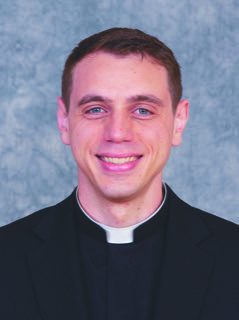
– Fr. Dominic Rankin has preached the Gospel ever since he was ordained a deacon, like St. Francis, 3 years and 6 days ago.  He prays that his preaching might be as bold as the humble hermit of Assisi.

Teach Us To Pray

When I meet with couples preparing for marriage, I usually ask them about their prayer life together.  Most couples find this question difficult to answer, apart from responding that they might go to Mass together or that they pray a prayer before meals.  I remember one couple in particular who, after struggling to respond, asked me for some advice on how they might approach the practice of praying together as a couple.  I was delighted at the question, and it made me think of the request from the disciples of Jesus: “Lord, each us to pray.” (Luke 11:1).  It was that request that led to His teaching them the Lord’s Prayer (though a slightly different form than we are used to, which comes from Matthew’s Gospel).  So I would like to offer a few simple ideas on how to pray together – as a couple, as a family, or in some other group.

My first suggestion is to let the Lord begin the conversation.  By this I mean turning to the Scriptures.  Reading a passage out loud together is already praying!  Even if that is the only thing you do, you have begun.  You could take it a step further and spend some time sharing some thoughts about what struck you by the passage.  Not sure where to start with in the Bible?  Consider turning to one of the Gospels, or using the readings for the day or the upcoming Sunday.

My next suggestion is to pray the Rosary together.  Even if a full five decades seems too much, start with at least one decade.  Have one person say the first part of the Hail Mary, and the other person can complete it.  Consider rotating who leads each decade.  To step it up, maybe invite those who are praying together to voice some intentions to bring to the prayer.  When I taught a combined 7th / 8th grade PSR class last year, I often started class this way and it was a wonderful beginning to the evening and I could tell that the students got something out of praying together, and they usually had no problems voicing an intention for which they wanted the class to pray.

My final suggestion gets a little more advanced.  Try praying with your own words.  Now, I know that sounds intimidating.  But let me share a simple formula that can help you to pray like a pro.  Remember these four words: “You, who, do, through”  They are easy to remember because they rhyme.  These four words are the basic structure to many of the prayers we hear at Mass.  Here’s what I mean:

  • You – begin by addressing the prayer to God the Father in some manner (Heavenly Father, Almighty God, Good and gracious Lord, etc…)
  • Who – say something about God, such as something He has done, or something about who He is (who are all good and loving, who never fail to come to our aid, etc…)
  • Do – ask the Lord for something (watch over our family this night, bring healing to our loved ones who suffer, help us during these difficult times)
  • Through – conclude by offering your prayer through Christ (through Christ our Lord, through your Son, Jesus, who lives and reigns forever and ever, etc…)

Why not give this formula a shot and you will be surprised at how you too can pray with confidence with your own words.  And never forget that when you pray, it does not all depend on you.  The Lord will do His part, as St. Paul reminds us: “the Spirit too comes to the aid of our weakness; for we do not know how to pray as we ought.” (Rom 8:26)

Father Alford    

The Importance of Fostering Vocations

“What do you want to be when you grow up?” Anytime we ask a child this question, we could get a variety of responses, ranging from ridiculous to serious. Little boys often want to be firefighters, astronauts, cowboys, and train conductors, while little girls have aspirations of being doctors, veterinarians, or teachers. A different way of asking this question is asking a high school senior, “What will you major in when you go to college?” 

The aspirations we have for the future of our young people are and should be a common conversation we have in our schools and in our families. Parents play a key role in shaping their children’s hopes and dreams for the future. It is very common to see children following in the footsteps of their parents through helping with the family business or pursuing the career that is a family tradition, such as becoming a nurse, teacher, or lawyer. This is why parents play a key role in fostering vocations to consecrated religious life and the priesthood. In Lumen Gentium, the Church’s document from Vatican II on the Church, this key role of parents is expressed beautifully: “The family is, so to speak, the domestic church. In it parents should, by their word and example, be the first preachers of the faith to the children; they should encourage them in the vocation which is proper to each of them, fostering with special care the vocation to the sacred state” (§11). 

Mothers and fathers do not need to talk about the possibility of a religious or priestly vocation every day at the dinner table. Instead, through their loving witness and interactions with priests and religious, they indicate to their children that these are beautiful vocations and the result of true calls from God. When children grow up in a Catholic family, a consideration of pursuing the priesthood or religious life should be a very natural instinct. Statistically, God calls most of His children to the married vocation, but He still calls a significant minority to give their lives to Him through the witness of celibacy. Because our families tend to be smaller than they were in previous generations, some adult children feel pressure, either explicit or implicit, to get married and have a family. You might be surprised to hear how many seminarians I have spoken to whose parents were disappointed when they learned of their son’s discernment of the priesthood. This is almost always because the seminarian’s parents expected him to have grandkids for them! But parents come to understand and embrace their son’s call over time when they see him joyfully grow in holiness and happiness during his time in the seminary.  

The family is really the first seminary for any man who becomes a priest. In his family, the priest was formed in how to be a loving son and brother, which is why priests receive seminary formation. Priests are first of all beloved sons of God the Father, having been called to share in the Son’s priesthood in a new way. Priests are also sons of the Blessed Mother and sons of Holy Mother Church. If a man grew up as part of a loving family, he is well on his way to being a well-formed man. One of the biggest responsibilities of parents is to help their children discover their vocational call from God, so that one day, we can all be together in the Kingdom of Heaven. 

Guardian Angels: Champions, Not Just Cherubs

Feast Day: October 2nd.

Growing up, we had a handful of prayers that we said as a family each day.  We prayed grace before meals, a quick morning offering before starting school each day, the family rosary most evenings, the scriptural readings of the major characters of salvation history during Advent, and we also said that simple prayer each night to our guardian angels: Angel of God, my guardian dear, to whom God’s love commits me here, ever this day be at my side, to light and guard, to rule and guide.

How does one tell the story of the guardian angels?  Well, we gotta start at the very beginning (they say it’s a very good place to start …)  Genesis tells us “In the beginning God created the heavens and the earth.” (Genesis 1:1)  It’s a phrase that indicates not just all that territory (if heaven can be construed in terrestrial terms), but everything and everyone in it.  The story of Job tells us that “there was a day when the sons of God came to present themselves before the Lord.” (Job 1:6)  The setting is not on earth, so these are not humans, and as the story unfolds and we find Satan also before God, asking to tempt Job, we realize that we’ve been given a view into the choirs of angels (fallen, and unfallen, at this point).  

The glimpse is widened as we contemplate the rest of the great saga of Scripture.  Before entering the promised land, “When Joshua was by Jericho, he lifted up his eyes and looked, and behold, a man stood before him with his drawn sword in his hand; and Joshua went to him and said to him, “Are you for us, or for our adversaries?” And he said, “No; but as commander of the army of the Lord I have now come.” (Joshua 5:13-14)  Later, before the time of the Kings of Israel, “the angel of the Lord appeared to him [the Judge, Gideon] and said to him, “The Lord is with you, you mighty man of valor.” And Gideon said to him, “Please, sir, if the Lord is with us, why then has all this befallen us?” (Judges 1:12-13)  Centuries later, as Daniel suffers the Babylonian captivity, he is promised that: “At that time shall arise Michael, the great prince who has charge of your people. And there shall be a time of trouble, such as never has been since there was a nation till that time; but at that time your people shall be delivered.” (Daniel 12:1) 

Notice that every time we catch a glimpse of an angel, the visionary falls on his face in awe before a being of such power and splendor, but notice also that the angels are always both messengers and defenders.  They announce a word from God, and they also announce the victory of God.  They carry swords, trumpets, armor, and herald tremendous strife, but eventual triumph.  St. John sees what this means for the story’s ending:

Now war arose in heaven, Michael and his angels fighting against the dragon; and the dragon and his angels fought, but they were defeated and there was no longer any place for them in heaven. And the great dragon was thrown down, that ancient serpent, who is called the Devil and Satan, the deceiver of the whole world—he was thrown down to the earth, and his angels were thrown down with him. And I heard a loud voice in heaven, saying, “Now the salvation and the power and the kingdom of our God and the authority of his Christ have come, for the accuser of our brethren has been thrown down, who accuses them day and night before our God. And they have conquered him by the blood of the Lamb.

(Revelation 12:7-11)

“To light and guard, to rule and guide.”  These spectacular, powerful beings, flame with the very fire of God’s love, and in humility and love, defend us every moment of our lives.  The promise given in the psalms “For he will give his angels charge of you” (Psalm 91:11) is fulfilled as Our Lord reiterates: “in heaven their angels always behold the face of my Father who is in heaven” (Matthew 18:10).

Dear parents, if you are worried about your children, renew your trust in these incredible protectors that God has given to them.  Pray to your own guardian angel, and those of your children; teach them to keep them in mind, to call upon their aid, to thank them for their protection, and to let them lead them to God!  We face principalities and powers, as well as the pressures and pains of daily life, but none stand a chance with angels at our side.  

Fr. Dominic Rankin’s guardian angel has watched over him for more than 10,000 days, has increased his worship at Mass more than 7000 times, and has kept him safe (if not comfortable) for more than 5000 miles of running.

Do you clearly understand what you are undertaking?

This past Sunday, I had the opportunity to celebrate a Baptism for a family I have know for a few years.  At the very beginning of the Rite, after asking the name of the child and the intention of the parents to have their child baptized, I said the following words:

You have asked to have your child baptized.  In doing so you are accepting the responsibility of training him (her) in the practice of the faith.  It will be your duty to bring him (her) up to keep God’s commandments as Christ taught us, by loving God and our neighbor.  Do you clearly understand what you are undertaking?

As I reflect on those words, it strikes me how significant this moment is, not just in the Rite of Baptism, but in the lives of the parents as they present their child for baptism.  Notice the dynamic of the parents turning to the Church to bring new life to the child, but how the Church, for her part, reminds the parents of the role that they play in nurturing this new gift.  The Church always sees the training of children in the faith as collaboration.  The Church can never replace the role that parents play, thus the words that she gives to them on the occasion of the baptism of their children.

A good priest friend of mine has told the story about his own father and how he has said that when he dies, the very first question the Lord will ask him is this: “Where are your children and your wife in their faith because of you?”  That is a powerful thought to ponder, to be reminded that the Lord will ask us to account for the stewardship we have practiced with regards to the gift of our family that He has entrusted to us.  Therefore, the question posed by the Church on the day of a child’s baptism is a question parents need to be reminded of often: “Do you clearly understand what you are undertaking?”

Do not be ashamed if your answer to this question is “no”, or “I’m not sure.” Keep in mind what I wrote above that this task is one of collaboration with the Church.  We stand ready and willing to assist you in your role of helping our families live this mission of growing in discipleship.  Our Family of Faith and our Adult Faith Formation programs are just two pieces of that assistance.  But you may have other questions about various circumstances and challenges you face as you undertake this task, and it can seem overwhelming at times.  Know that you are not alone!  Please reach out to one of us here at the parish (one of the priests or deacons, or Vicki Compton) and we will be more than happy to lend some support to assist you in this demanding, yet incredibly rewarding duty of bringing your family closer to Christ.

For all of our parents (regardless of whether your children are at home or have moved out), I invite you this week to reflect on that question about your role of training your families in the faith: “Do you clearly understand what you are undertaking?”  

Father Alford     

The Gift of Godparents

One of the beautiful liturgies that the Church gives to us is the liturgy of baptism. This ceremony, in which the newborn baby is spiritually adopted as a child of God, also gives expression to the expectation of the parents to raise their children in the faith. In fact, this can even be seen in the Sacrament of Matrimony, when the priest asks the couple, “Are you prepared to accept children lovingly from God and to bring them up according to the law of Christ and his Church?” This commitment to teach children the faith and evangelize them is expressed at this moment of great love in the wedding ceremony. The vow to love one’s spouse unconditionally expresses what kind of family in which children should be nurtured.

The liturgy of baptism makes this even more explicit, when the baptizing minister says to the parents, “In asking for Baptism for your child, you are undertaking the responsibility of raising him/her in the faith, so that, keeping God’s commandments, he/she may love the Lord and his/her neighbor as Christ taught us. Do you understand this responsibility?” In addition, the minister asks the Godparents, “Are you ready to help the parents of this child in their duty?” In some ways, the role of Godparent has become simply a ceremonial or honorary role in our culture, like being a bridesmaid at a wedding. It is true that it is a great honor to be a godparent to a newly baptized member of the Church. However, the Church envisions that Godparents play a vital role in the upbringing of our little Catholics in the faith. 

Godparents can support the parents in encouraging them to bring aspects of faith into their home life and in their travels. When children get to adolescence, it can be hard for them to receive formation in the faith from their parents, because of the stage of life that they are in. However, Godparents can play a crucial role in this time of formation. Being a little more removed from the immediate family, they can continue to foster the life of faith even when the relationship between parents and children is not perfect. Godparents should be included in events celebrating milestones in a child’s life of faith, especially Confirmation, first Eucharist, one’s wedding day, and even milestones like birthdays and graduations. The Church knows that young Christians need as much support from family and friends as they can get. Godparents witnessing to the life of faith is a great way of making this a reality. 

St. Padre Pio: The Power of Prayer & Poverty

Feast day: September 23rd

A few weeks ago I wrote an article for our Catholic Times diocesan newspaper on patron saints for grandparents.  In some ways it gave me the thought of telling the stories of the saints that led to this weekly column for our bulletin here at the Cathedral.  As it turns out, that article gave me in a roundabout way the specific saint that I want to write on this week: Fr. Pio of Pietrelcina.  One grandfather who read my selection of six patron saints for grandparents called me up and asked why I hadn’t said a word about Padre Pio.  I was a bit perplexed since he was not a grandfather, nor a particular patron for grandparents, but as the man explained the story of this great saint, and then told me about his own personal encounter with the saintly capuchin priest while he served in World War II, I was convinced I needed to do some more digging.

Francesco, his baptismal name, was born in 1887 in the insignificant town of Pietrelcina, Italy.  He had one brother and three sisters (and two siblings who died as infants).  He grew up working on the family farm, but early in his life found his call from the Lord as a Capuchin, entering the novitiate at the age of 15.  Struggling through bouts of sickness, he made it through the years of preparation for his vows and then on to priesthood ordination, but by then was given permission to return home with the hopes that he would recover.  After some months at home, he was assigned to the little friary at San Giovanni Rotondo where he would remain for most of the rest of his life, and become famous for his holiness, piety, insight in the confessional, and numerous miracles.  

I do not mean here though to focus on the marvels God’s grace worked in his life.  Nor the crowds that grew over the decades, flocking to a man widely known for his closeness to Christ, manifested even by a visible stigmata, bearing in his own body the wounds of Christ.  Nor even his suffering-humility when the Church asked him to cease all his public ministry for years, asking his obedience more than his miracles.  

No, today I want to focus on what allowed all of that to happen through him and in him.  It started very simply: his family was devoted in their attendance at Mass and recited the rosary daily, meditating on their own participation in the mysteries of Christ’s life.  And, because they were generous in having kids, and limited in their earthly means, they lived simply.  Prayer, and poverty, combined in the all-too-normal life of a family. There is nothing magical about it.  But those are the normal, humble, ways that God has sanctified His world since the beginning.  It was those basic realities that marked the passing on of His covenant and blessings through so much of the Old Testament, and it was precisely those things that marked the life of Joseph and Mary as the were entrusted for their own child the Son of God.

What has Padre Pio to do with raising our children Catholic?  Well, if you need a miracle, or a spiritual father, you know who to talk to.  And, if you’re looking for a simple way to holiness, look to the foundations of his sanctity: generous parents, humble means, simple prayers, and God did the rest.

– Fr. Dominic Rankin has a twin sister and a younger brother.  A threesome was not as exciting as his cousins, who were from a family of 12, but it was the perfect number to say the family rosary.  Dad led the opening bits, each member of the family got one decade, and then it was a battle to see who could lead the concluding prayers.  Mystical contemplation did not happen every time, but the seeds of God’s Word were sown little by little, and He did the rest.

The Plague of Gossip

Earlier this week, I came across a quote from Pope Francis which came during his most recent Sunday Angelus address in St. Peter’s Square. Commenting on the Sunday Gospel, he noted how easy it can be for us, when noticing the faults of others, to tell others about it. He then issued this very strong statement: “Please, brothers and sisters, let’s make an effort not to gossip. Gossiping is a plague worse than COVID.”

The Holy Father was not intending to downplay the significance of the current pandemic and the legitimate damage it has done, but he wants us to know how destructive gossip is to our relationships with one another and to the Church. When we speak poorly of others, the virus spreads to the person to whom we share our words, which often results in their forming a negative opinion of others. Left unchecked, a person’s reputation can easily be ruined because of gossip.

You may have heard the story that has been told about St. Philip Neri, of how he responded to a person who had confessed the sin of gossip. As a penance, he told the penitent to take a feather pillow to the top of a bell tower, rip it open, and let the feathers loose over the city of Rome. The saint then told the penitent to go and pick up all of the feathers. In exasperation, the penitent said that trying to find every feather was impossible! St. Philip used that example to demonstrate the serious nature of gossip, how once we let those uncharitable words leave our mouth, they can scatter about and it will be impossible for us to take back what has been said.

The theme we are focusing on this month is the role of parents in education. One of the documents of the Second Vatican Council points out one of the most important lessons to be imparted by parents to children: “In the family parents have the task of training their children from childhood on to recognize God’s love for all men.” (Decree on the Apostolate of the Laity, 30). An important way of transmitting this lesson is to set the example of never gossiping about people but speaking of others in a way that respects their dignity. Even though we may be painfully aware of the weakness of somebody, we can use that as an opportunity to pray for them, that the Lord will touch their lives and bring them to a place of conversion.

While this lesson is particularly important for parents, it really applies to all of us. We all probably know people who are good about fighting back gossip. There is something attractive about those types of people and they really challenge us to try to imitate their charity when it comes to speaking of others. May we all pray for the grace to be the type of people whose words about others are always used to build up and never to tear down. When we do this, we make a substantial contribution in slowing the spread of the deadly virus that is gossip and building a culture in which all come to recognize God’s love for His people.

Father Alford is the Rector of the Cathedral and serves in the diocesan curia as the Vicar for Clergy, Consecrated Life, and Vocations.

Shema!

“Hear, O Israel! The Lord is our God, the Lord alone! Therefore, you shall love the Lord, your God, with all your heart, and with all your soul, and with all your strength. Take to heart these words which I enjoin on you today. Drill them into your children. Speak of them at home and abroad, whether you are busy or at rest. Bind them at your wrist as a sign and let them be as a pendant on your forehead. Write them on the doorposts of your houses and on your gates.”

(Deuteronomy 6:4-9 NAB)

“Drill them into your children,” as it is rendered in the New American Bible, is quite the forceful phrase! This section of scripture, commonly called the “Shema” (meaning “hear” in Hebrew), is one of the keystones of the Hebrew Scriptures. This instruction to “drill” God’s words into one’s children speaks to the importance of passing on what God has spoken to us and previous generations.

The main message that children need to receive about God is the same one they receive from their parents – that they are loved! God’s story of how he loves us is found all through the Scriptures. This passage from Deuteronomy is in the context of reflecting on the Exodus from Egypt, and the receiving of the Law from God after this great event. We are called to return this great love from God by following the commandments he has given us.

There is a false understanding floating around our society that has caused a great deal of harm regarding religious education. This myth is that young children should not be given any guidance in religion so that they can make an unbiased choice when they are older. This logic does not hold up if we see religion as a living relationship with God and the Church. When a child is born, we give him or her both a first and last name, a home address, and before too long, enroll him or her in school. It would be absurd to wait until they were older to ask if they want to be a part of the family – that’s just who they are! In the same way, we do not need to hesitate to bring children into a living relationship with our loving Father in heaven and the family of the Church.

Father Dominic Vahling is a newly ordained priest. He serves as parochial vicar at the Cathedral of the Immaculate Conception and as co-chaplain of Sacred Heart-Griffin High School.

« Previous Page
Next Page »

Liturgy

Sunday Masses (unless noted differently in weekly bulletin)
Saturday Evening Vigil – 4:00PM
Sunday – 7:00AM, 10:00AM and 5:00PM

Weekday Masses (unless noted differently in weekly bulletin)
Monday thru Friday – 7:00AM and 5:15PM
Saturday – 8:00AM

Reconciliation (Confessions)
Monday thru Friday – 4:15PM to 5:00PM
Saturday – 9:00AM to 10:00AM and 2:30PM to 3:30PM
Sunday – 4:00PM to 4:45PM

Adoration
Tuesdays and Thursdays – 4:00PM to 5:00PM


CatholicMassTime.org

Parish Information

Parish Address
524 East Lawrence Avenue
Springfield, Illinois 62703

Parish Office Hours
Monday thru Thursday – 8:00AM to 4:00PM
Fridays – CLOSED

Parish Phone
(217) 522-3342

Parish Fax
(217) 210-0136

Parish Staff

Contact Us

Contact Us

Copyright © 2026 · Log in