“[F]or my house shall be called a house of prayer for all peoples.”
(Is. 56:7)
These are the words we hear at the conclusion of our First Reading for this Sunday’s Mass. In the Old Testament, the Temple was the central place of worship, of it was there where God’s presence dwelled in a special way (cf. CCC 576). As Catholics, we also read this passage with the awareness that these words also apply to our churches, which serve as the central place of our prayer and worship of God. And God is present in a special way in our churches, even more than in the Temple of Jerusalem, for He is present in His Body, Blood, Soul and Divinity in the Eucharist in our tabernacles.
With that in mind, it is sometimes surprising to me that our churches remain largely empty for the vast majority of time throughout the week. Sure, we have masses when people gather together to pray, but what about the rest of the hours? Jesus makes Himself a prisoner in the tabernacle, patiently waiting for us to come to pay Him a visit, spending some time in prayerful adoration in the place where He dwells in a special way. And while it is true that we can (and should) pray anywhere, there is nowhere more special to pray than in a Catholic church.
If you have never taken the opportunity to stop into our Cathedral church during the day to pray, I highly encourage you to do so. The peace that we experience when we step into the silence of this temple can be a profound experience. And since it is a house of prayer, spend some time in prayer in the presence of our Eucharistic Lord. You could spend some time in prayerful thanksgiving for the blessings you have received. You could offer prayers for the various intentions for which family and friends have asked you to pray. You could pray a decade (or more) of the Rosary. You could read a chapter from the Gospels. Or consider this beautiful little story shared by St. John Vianney:
Listen well to this, my children. When I first came to Ars, there was a man who never passed the church without going in. In the morning on his way to work, and in the evening on his way home, he left his spade and pick-axe in the porch, and he spent a long time in adoration before the Blessed Sacrament. Oh! how I loved to see that! I asked him once what he said to Our Lord during the long visits he made Him. Do you know what he told me? ‘Eh, Monsieur le Curé I say nothing to Him, I look at Him and He looks at me!’ How beautiful, my children, how beautiful!
Please know that this church is the Lord’s house, and He has made it a house of prayer for all peoples, especially we who are His sons and daughters. That makes this church your home, so please feel free to stop to pay a visit to the master of the house – He’s here waiting for you!
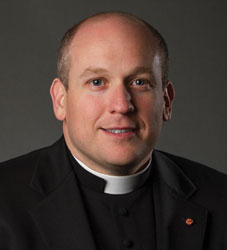
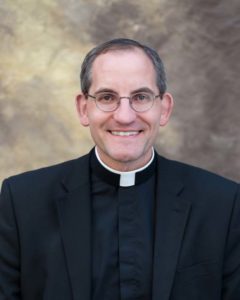
Father Alford is the Rector of the Cathedral and serves in the diocesan curia as the Vicar for Clergy, Consecrated Life, and Vocations.
 I continue to marvel at how the living Word of God in Sacred Scripture continues to speak to us with wisdom and relevance to our daily lives. In particular, the Second Readings we have been hearing from St. Paul’s Letter to the Romans have provided some much-needed encouragement for us during these challenging times. This week is no different, as we hear these words: