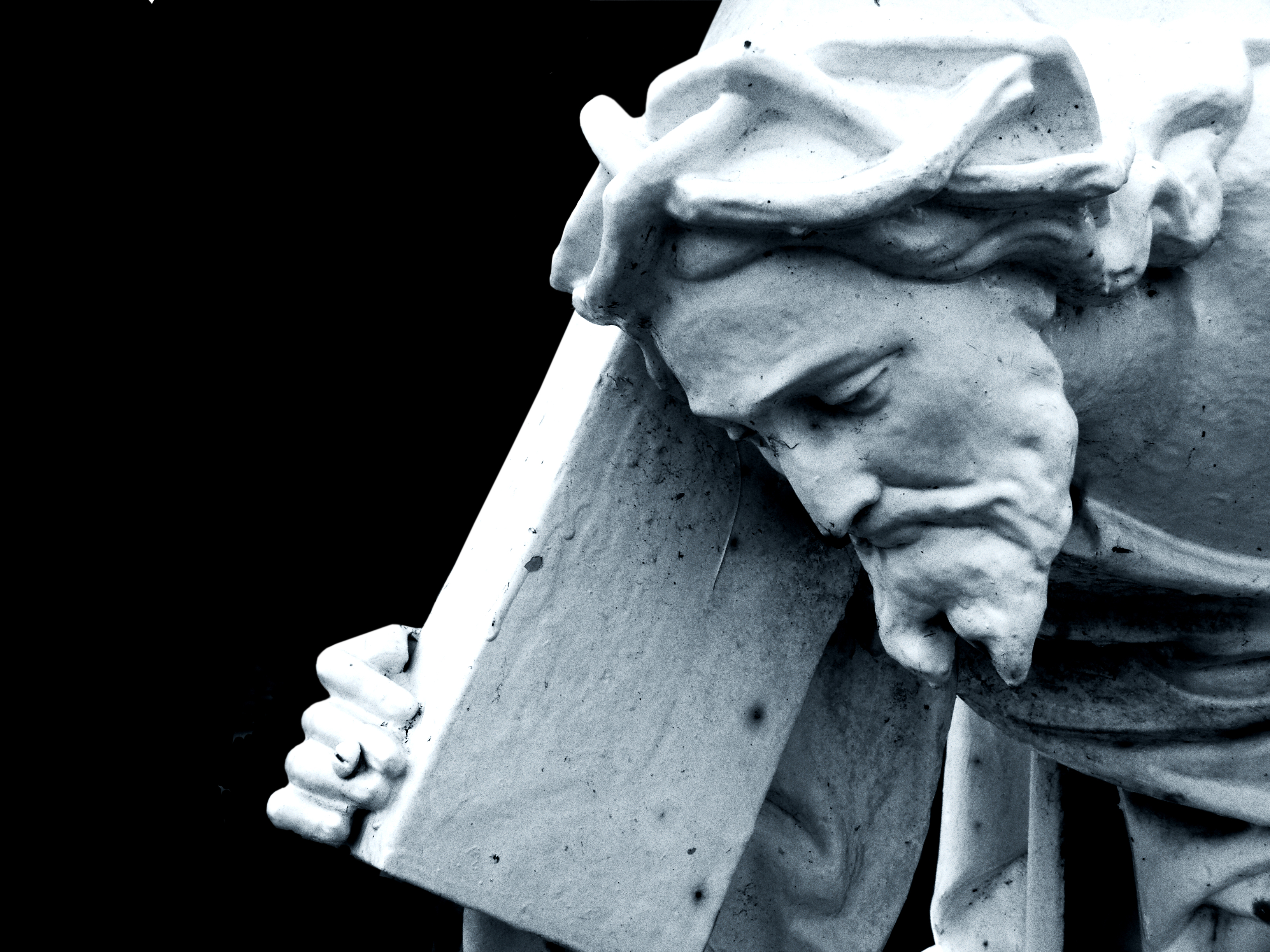
Have you seen this picture around the web? It has been shared thousands of times on social media, major news outlets, and newspapers. The story is of a little girl with her family, when they were praying the Stations of the Cross. When she saw that Jesus had fallen she said, “Oh no, Jesus needs help.” So, she proceeded to go over to the cross and with all her might, muster up the strength to help Him. Of course, she probably grew frustrated quickly with how hard that task became.
And, it is a hard task. Would we have run to Jesus to help Him with the Cross?
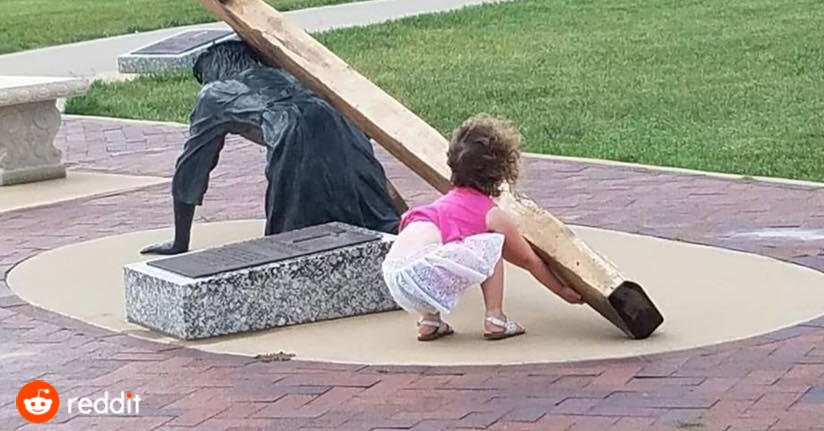
Without hesitation, the child saw Jesus in need. I would imagine if the child saw anyone else with that cross she would run to help them, as well. Jesus dying for us and resurrecting to new life is not the only lesson here. We should step up, without hesitation, to help the face of Jesus around us. When one of us is in need, we help. When one of us needs prayers, we pray. When one of us needs a collection, we give. Everyone is carrying a different cross. The Easter message challenges us to jump in and help pick up the Cross. Will you do it?
Stewardship provides us a great framework for this challenge. This may be a silly story, but my five year old daughter and I discussed tithing last week because of the show, “American Idol.” She was really fond of one particular artist named, Kai. The young singer had a beautiful voice, but she also had a story of homelessness. One could see that she had a very heavy cross. She had to make an appeal to her Church to take up a collection for her to be able to afford “Hollywood Week,” which was the next stop in her American Idol journey. On the show you see a scene of church- goers generously donating to this fund and all of them coming together around their fellow member. My daughter saw the money in a golden offering plate and said, “I do that too! Does our church send people to American Idol?” I couldn’t help but laugh, and of course explain to her that no, not necessarily. It isn’t an obligation for us to give, it is a blessing to be able too. It is a life lesson that when one of us needs help, we all are here to pitch in. Some day we may need to “withdraw” from the basket ourselves. We may need sacramental help, spiritual direction, help with a family funeral, fellowship or formation. Contributing to the basket isn’t about the money, but the Mission. Challenge yourself in the Easter season to consider three things every-time the offertory goes around: how can I pray more, give more, and serve more in order to help carry the Cross?
The Easter message for us is one of joy, excitement, and action. How will we respond to the message of the resurrection? What will you do next, now that the tomb is empty?
Katie Price is the Coordinator for Discipleship and Stewardship at the Cathedral.
 To make things simpler, it might help to look at Holy Week as a journey, one that moves from the interior to the exterior. We begin in an interior space on Palm Sunday — the traditional start of Holy Week — allowing ourselves the opportunity for both anticipation and reflection. In the account of Jesus’ entry into Jerusalem, read during the blessing of the palms at the beginning of Mass, we anticipate the events of the week to come, but in the Gospel reading later, we encounter Christ in his Passion and death.
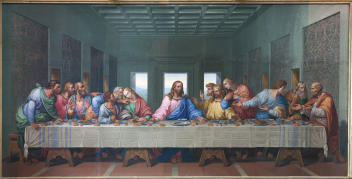 As the Body of Christ, we are called to emulate Jesus, our head, and go out into the world and be a servant for all. Our faith is a communal faith, and having spent the previous few days in reflection and quiet, we are now being awakened and called out of ourselves to serve and sacrifice as Jesus did. When the Feast concludes, and the Eucharist has been brought to the Chapel, we are given the opportunity to reflect on Jesus’ time in the Garden of Gethsemane. Jesus: alone, abandoned and afraid, in his full humanity, cannot escape the reality of suffering and sorrow, a reality that we all must live with. Holy Thursday is a time to be with Jesus in his frailty, while simultaneously recognizing our own.
 Jesus warns us in the Gospel of Matthew, “If anyone wishes to come after me, he must deny himself, take up his cross, and follow me.” It is an invitation to a way of life, and a plan that leads to holiness. But make no mistake, it is a warning as well. The cross is a sign of victory, but only in light of the Resurrection. Alone, it is a symbol of ultimate sacrifice: the sacrifice of Jesus Christ for a fallen world, and the sacrifice we are called to make to truly follow him.
 One of the most striking occurrences for me in Luke’s Passion is early on at the Last Supper, when Jesus speaks to Peter telling him that the devil had demanded to sift Peter like wheat but that Jesus had prayed for Peter’s faith. Peter quickly responds that he will never falter in his faith, in fact that he is prepared to go to prison for the Lord and to even die for him. Yet, in that same moment, Jesus tells Peter that he will deny him three times. Later that evening, the Lord’s prophecy comes to pass, just as he is being mocked by the Temple guards who tell Jesus to prophesy. When Peter denies Jesus, Luke tells us that Peter catches the Lord glancing through the crowd at him in that moment.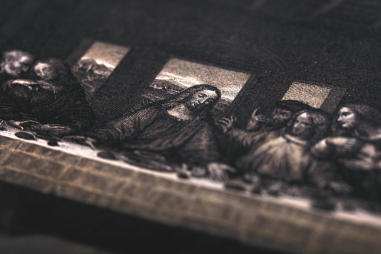
 There are two kinds of Catholic parishes in the US these days. Maintenance parishes and mission parishes. Maintenance parishes are primarily concerned with maintaining the status quo, keeping current parishioners happy and involved, and believing that “if it ain’t broke, don’t fix it”. Parishes driven by a culture of mission, on the other hand, seek to help all people, parishioners and non-parishioners, encounter and fall in love with Jesus so that their lives only make sense when fully committed to Christ. Mission parishes seek to grow disciples who understand their call to make Christ known in the world and transform the culture. Maintenance parishes are shrinking and dying Mission parishes are growing and thriving. Cathedral is a mission-focused parish.
 This Sunday marks a turn in our Lenten journey; with the coming of the Fifth Sunday of Lent we now enter into the second part of this penitential season known as Passiontide. This time is marked by our use of the custom of veiling images in the Church, which not only mark a liturgical shift but also invites us to sharpen our focus.
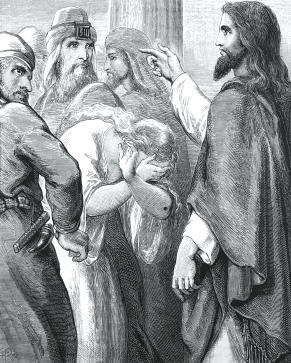 The Mosaic Law stated that such a crime was to be punished by stoning. If Jesus tells the crowd to let her go, then the authorities will say that he is subverting the law. If he tells them to follow the law and stone her, then the religious authorities can turn Jesus over to the civil authorities for inciting the crowd since the Jews could not inflict capital punishment on anyone themselves for any crime.
 In our efforts to evangelize and proclaim the Gospel, it is good to keep our focus and prayer on the goal of our work—that others will come to faith in Christ and enjoy a personal relationship with him. This intrinsic connection between faith born from evangelization begins with Jesus himself in Mark’s Gospel where his first words are: “The time has come and the kingdom of God is at hand. Repent and believe the Good News!” (1:15). For St. John in his Gospel, his entire life of preaching and writing about Christ has been at the service of faith in him: “These things have been written so that you may believe that Jesus is the Christ, the Son of God and that through your faith in him you may have life” (20:30). So what then does this faith look like? What kind of faith do we hope to be born from our efforts to evangelize?
 Right after our last child, I was recovering from the cesarean surgery and started to notice that my foot was sore. My husband is in orthopedics, so one morning over breakfast, I told him that it was hurting a bit. He promised to keep an eye on it, and we went about the day. Two days later the pain had grown worse, and by the end of the day it was swollen. We tried to treat it medicinally until I couldn’t walk on it at all. It was a Friday, and he told me to come in for an x-ray. I didn’t go. It was tough to get all the kids taken care of and make time for all of that. So the weekend came and it got progressively worse. I finally went in that Monday and got the x-ray.
 It turns out that there was an old piece of metal in my foot. I had to have it removed that week, and the diagnosis was that I had stepped on it when I was a child. After my pregnancies and other bodily changes, it festered and resurfaced. (Yes, this is all totally true. This is literally my x-ray.)