As many of us are aware, the topic of the Eucharist has been in the news quite a bit in the last couple of years. In August 2019, a new study was released by the Pew Research Center which reported that just one third of U.S. Catholics agree that the Eucharist is truly the Body, Blood, Soul, and Divinity of Jesus Christ. A few months later, as the global pandemic hit, Catholics throughout the world found themselves deprived of the Eucharist as public masses were suspended for fear of spreading the COVID-19 virus. During the most recent election cycle, the question of the reception of the Eucharist by certain Catholic politicians was raised. In their recent Spring meeting, the bishops of the United States discussed, among other things, the Eucharist. They approved an action item “to task the Committee on Doctrine to move forward with the drafting of a formal statement on the meaning of the Eucharist in the life of the Church.” They also discussed a program of Eucharistic Revival to begin next year to invite Catholics to a deeper understanding and love of the Eucharist.
Beginning next Sunday, the Gospels for the next several Sundays (except August 15 which is the Solemnity of the Assumption of the Blessed Virgin Mary) will be taken from the sixth chapter to St. John’s Gospel, known as the Bread of Life Discourse. This chapter contains some of the most important scriptural foundation for the Eucharist, which the Church teaches to be the source as summit of our lives as Catholics. With that in mind, I would like to devote the next several bulletin articles to this important topic in the hopes that all of us can get a jump start on this Eucharistic Revival to which our bishops are inviting us.
As I prayed about the best way to approach this topic, I decided to draw upon some of the Eucharistic writings from some of our recent popes. These reflections will not be presented in any particular order, other than trying, where possible, to connect the liturgical cycle with certain papal reflections. For example, in two Sundays (on August 1), I will look to Pope St. John XXIII, who wrote a beautiful document about St. John Vianney, whose Feast Day is August 4. This Patron of Priests had a great love for the Eucharist and John XXIII has some nice reflections on the Eucharistic devotion that this great saint had.
I realize that we dedicated our January bulletin articles to the Eucharist, but with a topic so near and dear to us as Catholics, it should be not problem for us to delve deeper into this great gift. I am excited to share with you some of the great insights of our popes over the next several weeks as we all strive to deepen our appreciation for the Bread of Life we are privileged to consume each Sunday, and in fact, every day if we do desire.
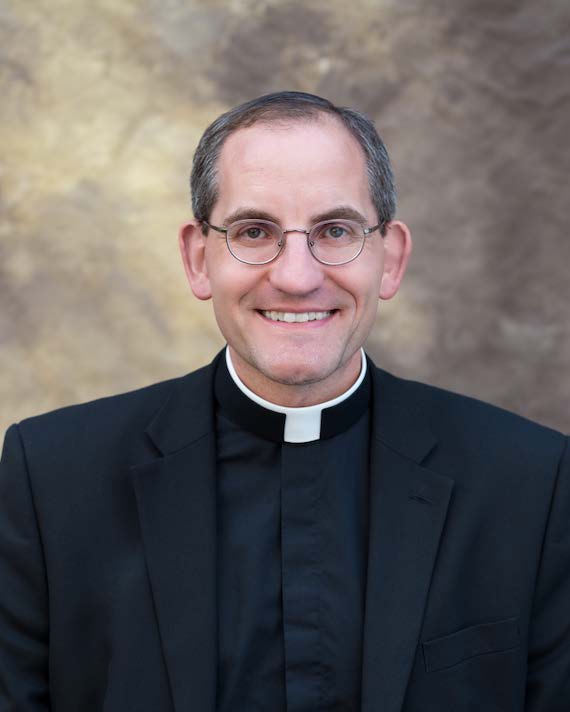
Father Alford

 Because of Jesus’ sharing of his intimate life of prayer, we know that God is Trinity. Hinted at under various guises in the Old Testament, the Trinity is spoken of in a direct way in both the Gospels and the New Testament epistles. The Church later articulated what we know about it in clear and precise terms. The Trinity, a communion of divine Persons in utter unity, unveils an eternal foundation to what we mean by saying “God is love.” Nevertheless, the Trinity cannot be fully grasped, because God is mystery, far above human comprehension.
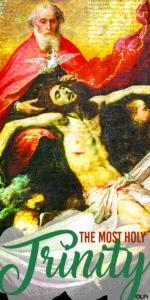 As Christians, we have learned to read Scriptures relating to the Father, Son, and Holy Spirit in light of the doctrine of the Trinity. This is an example of reading Scripture according to the analogy of faith (Catechism, no. 114). The early Christians understood the Trinity intuitively by faith, but they were not yet able to plainly articulate it. They could, however, sense heresy when something was awry in an interpretation. Out of controversies and debates and aided by the guidance of the Holy Spirit, the Church came over the course of several centuries to the full doctrine of the Trinity. Along the way, the Church even developed the term person as we use it today to speak of an individual of a rational nature. The doctrine of the Trinity states that there is one God, three distinct equal divine Persons – Father, Son, and Holy Spirit.