Cathedral of the Immaculate Conception

Springfield, IL

  • About
    • Contact Us
    • History of the Cathedral
    • Liturgical Schedules
    • Parish Staff
    • Register with Cathedral
    • Subscribe to the Cathedral eWeekly
  • Sacraments
    • Baptism
    • Becoming Catholic
    • Matrimony
    • Vocations
  • Ministry List
    • Adult Faith Formation
    • Cathedral Meal Train
    • Cathedral Online Prayer Wall
    • Cathedral Concerts
    • Family of Faith
    • Grief Share
    • Health and Wellness
    • Spiritual Resources
  • Stewardship
    • Stewardship: A Disciple’s Response
    • Stewardship Form
  • Support
    • E-Giving Frequently Asked Questions
    • Give Online
  • Sunday News
    • Announcements
    • Cathedral Weekly
    • Livestream Feed
    • Submit a Mass Intention Request
    • Weekly or Announcement Submission

St. Peter Chanel: Preaching to the End.

Feast Day: April 28th 

This week, we turn to the saints to find a final attribute or characteristic of the priest: as preacher of the Gospel.

First a step back: every Christian is united to Christ’s priesthood, and is called to poverty, perseverance, prayer, and preaching within his or her own circumstances.  Every one of us is called into priestly service, acting as intermediaries between God and His creation.  However, there is a special way that a ministerial, ordained, priest is further stamped with these particular characteristics (and mission).  

Poverty: because it is only by “the Spirit of holiness … which comes from you, O God”, that he “possess[es] this office”.  Perseverance: because the priest’s life is consecrated to be a lasting witness of fidelity, being “faithful stewards of your mysteries”.  Prayer: because he uniquely is entrusted to intercede for the Church “that your people may be renewed in the waters of rebirth and nourished from your altar; so that sinners may be reconciled and the sick raised up.”  Finally, preaching because the priest is ordained so that “through the grace of the Holy Spirit the words of the Gospel may bear fruit in human hearts and reach even to the ends of the earth.” (Above quotations from the Prayer of Ordination of Priests.)

And that brings us to the island of Futuna in the year 1837.  We are 2000 miles east of Brisbane and 2800 miles south west of Hawaii (so, not too far from Fiji, or the American Samoa).  As a small schooner, the Raiatea, approached the coast of the volcanic island in November, it had already transversed some 2000 miles since departing Tahiti, and had aboard Bishop Pompallier and a few remaining Marianist missionaries on their way to Rotuma having left Father Bataillon and Brother Joseph Xavier on the nearby island of Wallis.  

They were there to drop off an English trader, Thomas Boog, and twelve natives of Futuna who needed passage from Willis.  But things took longer than expected (it seems they did not want to repeat the near capsize they had at Willis) … and then the crew of a beached English whaleboat came hollering up … and then the natives of Futuna swarmed over the little Raiatea … and then the good bishop turned to Fr. Chanel and asked if the intrepid young priest would be willing to stay there in Futuna.  The future of the small island (its land-mass is smaller than that of Springfield), and all the souls upon it hung in the balance as the young priest considered his response.  “My Lord, I am quite willing and ready.”

Willing? Ready?

Fr. Peter Chanel did not know the king, Niuliki, who accepted him and Br. Michael into his abode after one of courageous chiefs, Maile, argued for their reception.  

He did not know that cannibalism had been practiced on the island until the beginning of Niuliki’s reign.  

He had no idea that Niuliki was the leader of the Alo tribe, in bitter conflict with the Sigave population.  

He had probably never tasted the kava that was shared with them to welcome them to the island, nor seen the kind of tree on the beach upon which he affixed a Miraculous Medal, entrusting his life and efforts to the patroness of his order.  

He would not be fluent in their language for three long years.

And yet he preached the Gospel: By his patience as the locals pillaged his garden.  By his simplicity as the king shuttled him from one (inadequate) shelter to another.  By his hunger, subsisting off the single daily meal of bananas and yams that the inhabitants enjoyed.  By his tending the wounded on both sides as the Alo and Sigave battled for control of the island.  And, by his constant efforts to tell the people of a God who loved them, and wanted them for His own, rather than the dismal spirit-world they assumed controlled their destinies and were embodied in their leaders.  
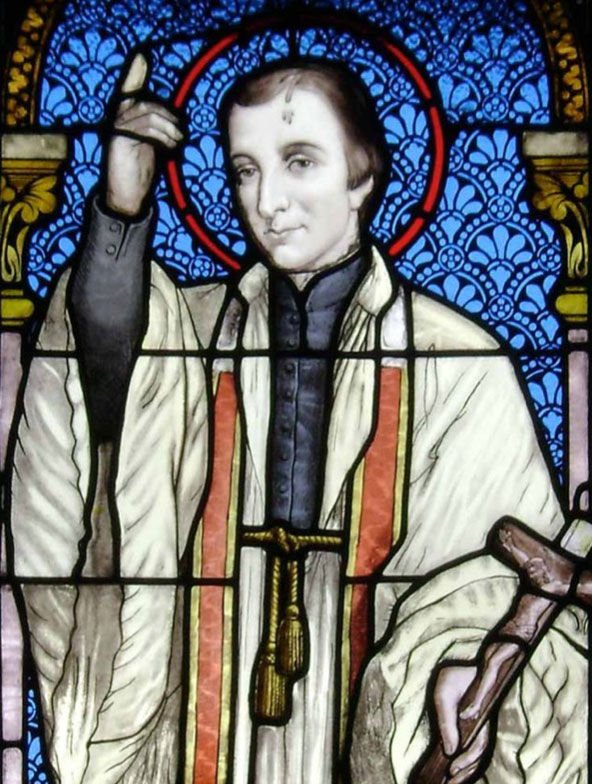
Pierre Chanel (Petelō Saineha), window of the Catholic Church of Lapaha, Tonga.  Glass-in-lead stained glass.

Yet few accepted the Father’s love.  

Maile did accept baptism, but it was slow work driving the demons from the minds and hearts of any others. After a month, for their first Christmas, Fr. Chanel celebrated his 7th Mass on the island with 15 locals attending.  After three hard years, he had still only baptized a few children and dying adults, whereas on Willis the entire island was converting.  

Finally, several locals, and the king’s son, Meitala, became catechumens, but hope would quickly fade.  On April 28, 1841, when preparing medicine for Musumusu, the (angered, un-injured) warrior attacked Fr. Chanel.  He spoke in his assailant’s language: “Malie fuai”, “it is well for me”, and yielded his life to his murderer, and into the hands of God.  

But, within 2 years, every soul on the island would be baptized and in 2021, 99% of the island remains Catholic!  He was willing and ready enough for God!

– Fr. Dominic Rankin is currently working on a series of talks on the “Tough Topics” related to our faith.  Science, sin, shame, sex … he could not think of any other parts of the Gospel more misunderstood or rejected.  Yet that is nothing compared to proclaiming that Gospel to a culture that has no concept of God’s love, and of whom you do not know the first word of their language!
Mass Intentions

Monday, April 26

7am – Patricia Scherrills
(Al & Bobbie Lewis)

5:15pm – Jean Reno Greenwald
(Joan M. Miller)

Tuesday, April 27

7am – Jim McCaslin
(Tom Steil & Sharon Oldfield)

5:15pm – Cathy Furkin
(Marlene Mulford)

Wednesday, April 28

7am – Ellen Mattox
(Mary & Jim Burrus)

5:15pm – Repose of the Soul ofJoseph Kohlrus, Sr.
(Jean Borre &Family)

Thursday, April 29

7am – Anna A. Eleyidath
(Augustine Eleyidath)

5:15pm – Blake Anderson
(Sharon Oldfield & Tom Steil)

Friday, April 30

7am – Anna A. Eleyidath
(Augustine Eleyidath)

5:15pm – Jean Reno Greenwald
(McGee Family)

Saturday, May 1

8am – Blake Anderson
(Richard & Teresa Steil)

4pm – Joseph Kohlrus, Sr.
(Augustine Eleyidath)

Sunday, May 2

7am – Mary Ann Midden 
(William Midden)

10am – Charles & Mercedes Nesbitt
(Kathy Frank)

5pm – For the People

Prayer Wall – 04/16/2021

Prayers for me, just found out I have squamous cell carcinoma on two spots in my leg.

Prayer Wall – 04/16/2021

Prayers for me, just found out I have squamous cell carcinoma on two spots in my leg.

Sacramental Bonanza

This past Sunday, Divine Mercy Sunday, the priests of the Cathedral sat down for a late dinner after the end of a packed day.  We all reflected on how much had taken place on that day, including:

  1. Regular Sunday Masses
  2. Reception into Full Communion of the Catholic Church of one of our RCIA candidates
  3. Baptism of the youngest daughter of the young woman received in #2
  4. Baptism / Confirmation Party for #2 and #3
  5. Divine Mercy Service, during which MANY confessions were heard
  6. More Confessions before the 5:00 pm Mass
  7. Family of Faith Teaching Meeting

While there was hardly a moment to take a breather in between all of these event, we all agreed how life-giving that day was because all of the events of the day were connected to our identity and mission as priests, a mission we are so privileged to share with all of you here at the Cathedral.

The Sacrament of Holy Orders (which bishops, priests, and deacons receive) falls under a category of sacraments known as Sacraments at the Service of Communion.  The Catechism describes this sacrament, as well as Holy Matrimony, in this way:

Two other sacraments, Holy Orders and Matrimony, are directed towards the salvation of others; if they contribute as well to personal salvation, it is through service to others that they do so. They confer a particular mission in the Church and serve to build up the People of God. (CCC 1534)

As I said, it is our privilege to minister to all of your needs, for we know that doing so helps to strengthen your communion with God and the Church, especially in the celebration of the sacraments.  We are very much aware that our ministry is at the service of your salvation, and we want you to know that we take that very seriously.  And as the Catechism suggests, it is through our service to you that we ourselves will be saved.  In other words, if we are serious about wanting to get to Heave, the only hope we have is to spend ourselves in the service of your salvation.  I think this point was demonstrated well in a brief conversation we had with one of our parishioners at the end of that long, yet joy-filled day.  This parishioner said something like:  “We cannot do it without you”, to which one of the priests responded: “Nor can we do it without you!”  

During this Easter Season, we are all (clergy and laity alike) invited to recognize that none of us can be saved apart from Jesus Christ, whose Resurrection makes possible our salvation.  May we thank Him for His gift of salvation as we all work together to help one another on our journey toward full communion with Him forever in His Kingdom.

Father Alford     

Celibacy as Spiritual Fatherhood

One of the most striking things about the priesthood, especially to non-Catholics, is the priestly witness of celibacy. Celibacy is sometimes misunderstood as a spiritual practice in the Church. Since the earliest days of Christianity, followers of Jesus have given up marriage and family to more fully imitate Jesus and his state in life. In Judaism, celibacy was not a common practice. Jesus is the one who brought full meaning to both marriage and celibacy as signs of the kingdom of God. The primary reason that priests are celibate is in imitation of Jesus, who is espoused to the Church. Some mistakenly think that priests are not married because they are too busy to have a family. While it is true that it does make sense for priests to give their time to their parishioners, this is only a good which is allowed for by the primary reason of dedicating our whole selves to Christ and his Church. Since priests are “married” to the Church, priests give their lives in service to her. 

It is true that there are married priests in the Church, especially in the Eastern (non-Latin) Churches. We even have a married priest in our own diocese here in Springfield. However, even in the Eastern Churches, their monks and their bishops are celibate, and they clearly esteem this practice also. Having some married priests in the Church does not take away the symbolic and spiritual value of celibacy among many of the clergy and men and women religious. 

It is beautiful that in our culture, we call priests by the title “Father.” As priests, we give up physical marriage and children for the sake of bearing spiritual fruit. It is not always common to think of Jesus as a spiritual father because we often hear in the Gospels that he is the Son of the Father. However, in his ministry, Jesus exercised a spiritual fatherhood with his disciples by showing them the love of his own Father. One of the funny and interesting things about being a young priest is being called “father” by parishioners who are (much) older than me. In many ways, these parishioners are my spiritual fathers and mothers, as they are helping me to grow in holiness by their guidance and encouragement. However, when I minister as a priest, especially during the Mass and Reconciliation, I am acting as a spiritual father to those who are present. 

As I grow older as a priest, I hope to always grow into my identity as a spiritual father. The best way to do this is to continue to grow in my identity as a son of God. Jesus could be a father to his disciples because he received his identity from his heavenly Father. By our baptism, we are also sons and daughters of God, like Jesus. The Church is immensely blessed by the witness and ministry of older priests in our parishes. There is a certain joy which comes with being a new, young priest. However, there is also a certain joy which comes with being an old, experienced, and wise priest. There are many older priests who exercise a very clear spiritual fatherhood (or spiritual grandfatherhood) with their parishioners. This is made much more clear by their witness of celibacy and their sacrifice of kids and grandkids for the sake of their spiritual children. 

Celibacy is a gift from God. Jesus said that not everyone can accept this practice (Matthew 19:12), nor does he ask us all to do so. He obviously wants us to be fruitful and multiply! However, for those who are called to imitate Jesus by remaining celibate, it is a joy! 

Saint Anselm of Canterbury: Philosophy, Politics, Prudence, and a whole lot of Prayer

Feast Day: April 21st

These past weeks, as we have continued to celebrate Easter, we have also begun to examine the sacrament of Holy Orders.  As it turned out, we started with the young man who fled Jesus’ agony in the garden in shame, but astonishingly reappears at the tomb, now splendid, and bearing a message of hope.  Priests are not much different: somewhere deep in the heart of the priesthood is that spectacular truth that God calls men, sinners still so much in need of His mercy, yet then He literally clothes them in white for the celebration of the Mass, a sign of the Lord’s grace at work in the priest’s hands, and words, and love.

Last week we found ourselves watching the drama unfold around Pope Martin I, as he struggled to stay faithful to His Lord and Savior as errors, emperors, assassins, and intrigue pummeled him from all sides.  In his life we have another facet of priesthood: not the sinner-supernaturalized but the shepherd-suffering, scorned, and surrounded.  How did that grace of ordination cascade through his life?  I see it in Martin’s divine doggedness in the face of horrific attacks upon him, his papacy, and his Divine Master.

First Poverty.  Then Perseverance.  This week: Prayer.  (Next week: Preaching)

And for this third pillar of what it means to be a priest, to be someone immersed in prayer, a pray-er, a mediator, an intercessor – someone who stands before God and communicates to Him the weaknesses and worship of His people, and communicates to the people the Word and wealth of God – we turn to St. Anselm of Canterbury.  Of course, I choose him because his feast day will occur on April 21st, the day he died in 1109 in Canterbury England.  He was a philosopher, an abbot, and a bishop, and found himself immersed in the chaos and challenges of his day in all those roles (all of which, at first, he was forced into, and yet from all of them he learned the characteristics of prudence, patience, and prayerfulness that would make up his sanctity)… but we catch a glimpse of him as a priest … simply a priest … in his most famous writing, the Proslogium.  Most people read it because there he is the first one to describe an ontological argument for God’s existence, but the work is truly at its heart a prayer.  Here is how Anselm begins:

Come on now little man, get away from your worldly occupations for a while, escape from your tumultuous thoughts. Lay aside your burdensome cares and put off your laborious exertions. Give yourself over to God for a little while, and rest for a while in Him. Enter into the cell of your mind, shut out everything except God and whatever helps you to seek Him once the door is shut. Speak now, my heart, and say to God, “I seek your face; your face, Lord, I seek.” – St. Anselm of Canterbury, Proslogion, Chapter 1.

Might I invite you into that place of silence and prayer as well?  Can you and I say those same words: “I seek Your face.”  Anselm tends through philosophy, theology, scripture, and much more in the course of his great philosophical work, but at the end, he reminds us that it is really a great prayerful work:

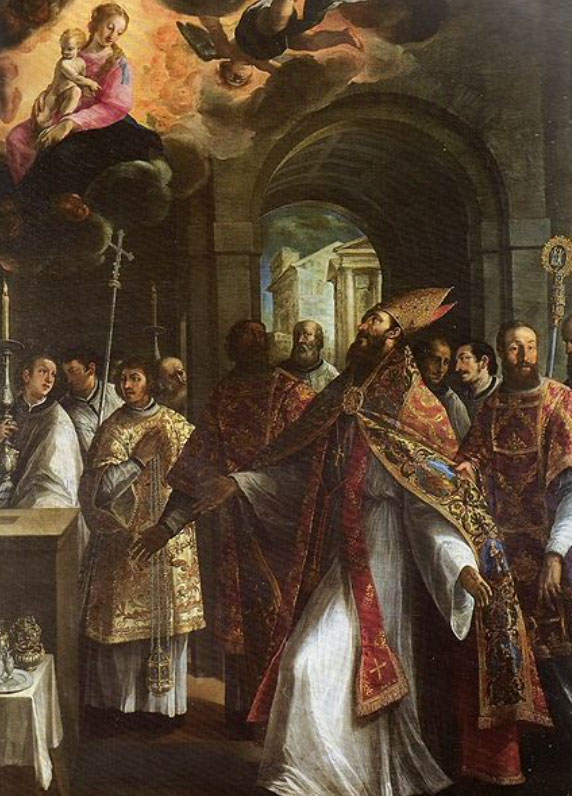
Sant’Anselmo che benedice la chiesa di San Paolo, Francesco Borgani, around 1600.  Located in the Francesco Gonzaga Museum, Mantua Italy. 

God, I pray, let me know and love You, so that I may rejoice in You. And if I cannot in this life [know, love, and rejoice in You] fully, at least let me advance day by day until the point of fullness comes. Let knowledge of You progress in me here and be made full [in me] there. Let love for You grow [in me here] and be [made] full [in me] there, so that here my joy may be great with expectancy and there may be full in realization. O Lord, You command—or, rather, You counsel—[us] to ask through Your Son; and You promise [that we shall] receive, so that our joy may be full. O Lord, I ask for what You counsel through our marvelous Counselor; may I receive what You promise through Your Truth, so that my joy may be full. O God of Truth, I ask; may I receive, so that my joy may be full. Until then, may my mind meditate upon [what You have promised]; may my tongue speak of it. May my heart love it; may my mouth proclaim it. May my soul hunger for it; may my flesh thirst for [it]; may my whole substance desire [it] until such time as I enter into the joy. St. Anselm of Canterbury, Proslogion, Chapter 26.

Anselm’s writing, and life, and ministry, began and ended in prayer, can ours do so as well?  Can our thirst for joy, peace, love, and meaning finds its answer in the Lord?

Fr. Dominic Rankin begins every day with an hour of prayer.  It is not usually filled with mystical moments or felt phenomenon, more than anything it is a conversation that often begins and ends with “I seek you face”, and that challenging yet thrilling continued yearning for God’s love, for myself and all those entrusted to my care.  This is Christ’s priesthood too.

Mass Intentions

Monday, April 19

7am – Mary Ann Midden
(William Midden)

5:15pm – Special Intentions forTammy Pritchett
(Family)

Tuesday, April 20

7am – Anna Eleyidath
(Augustine Eleyidath)

5:15pm – Frank Coffey
(Family)

Wednesday, April 21

7am – Repose of the Soul of Averil Rossiter
(Jane Fornoff)

5:15pm – Catherine Ponce
(Bill & Sara Metcalf)

Thursday, April 22

7am – Special Intention for Laura Fjelstul
(Chris Sommer)

5:15pm – Joseh Kohlrus
(Augustine Eleyidath)

Friday, April 23

7am – John Montgomery
(John Busciacco)

5:15pm – Diana J. Schumacher
(Daniel Schumacher)

Saturday, April 24

8am – Jack Ely
(Wife)

4pm – For the People 

Sunday, April 25

7am – Herman & Helen Koester Families,
(Living & Deceased)

10am – Richard Shaughnessy
(Mr. & Mrs. Shaughnessy & Family)

5pm – John & Edith Bakalar
(John Busciacco)

Prayer Wall – 04/09/2021

Prayers for Jeff who is 59 and was just diagnosed with Parkinson’s

Divine Mercy Sunday

On this Octave Day (8th day) of Easter, the Church celebrates Divine Mercy Sunday.  This feast was instituted for the Universal Church by Pope St. John Paul II in 2000 at the Canonization Mass for St. Faustina Kowalska, a Polish nun who received a series of revelations from Jesus about the great gift of Divine Mercy He offers to His children.  In her famous Diary, she recorded the following words from our Lord Himself about the feast day He intended to be celebrated on the Second Sunday of Easter:

My daughter, tell the whole world about My inconceivable mercy. I desire that the Feast of Mercy be a refuge and shelter for all souls, and especially for poor sinners. On that day the very depths of My tender mercy are open. I pour out a whole ocean of graces upon those souls who approach the fount of My mercy. The soul that will go to Confession and receive Holy Communion shall obtain complete forgiveness of sins and punishment. On that day all the divine floodgates through which graces flow are opened. Let no soul fear to draw near to Me, even though its sins be as scarlet. My mercy is so great that no mind, be it of man or of angel, will be able to fathom it throughout all eternity. Everything that exists has come forth from the very depths of My most tender mercy. Every soul in its relation to Me will contemplate My love and mercy throughout eternity. The Feast of Mercy emerged from My very depths of tenderness. It is My desire that it be solemnly celebrated on the first Sunday after Easter. Mankind will not have peace until it turns to the Fount of My Mercy. (Diary, #699)

Those final words stand out to me, for we hear the promise of peace that comes from turning to the Divine Mercy.  In nearly 10 years as a priest, I count my time in the confessional as some of the most fruitful ministry I have done.  I am constantly moved by the peace a penitent experiences as they encounter the gift of Divine Mercy in the Sacrament of Reconciliation.  Our sins deprive us of peace, but God’s mercy restores it in a powerful way that encourages us to not give up, but to begin again in our following the Lord, renewing our experience of the newness of life given on the day of our Baptism, and restored each time we encounter the Divine Mercy.

It is fitting that our topic for Family of Faith this month is the Sacrament of Holy Orders.  Ordination incorporates men into the ministry of Jesus Christ Himself.  Each degree of Holy Orders (Bishop, Priest, Deacon) participates in this ministry of Christ in different ways, but all of them share the common trait of being directed toward the salvation of others.  And since we cannot be saved apart from the Divine Mercy, all those called to serve the Church in Holy Orders have the special task of being instruments of Divine Mercy in various ways through service (primary role of deacons) and the celebration of the sacraments, especially Reconciliation and the Eucharist (primary role of bishops and priests).

Please pray for the clergy of our Cathedral Parish, that we may be ever mindful of the duty entrusted to us to share the message of Divine Mercy in word and in deed, so that many may approach the Divine Mercy, especially in the Sacrament of Mercy, and experience the peace His Mercy bestows in this life as a preparation for the fullness of peace that awaits us in Heaven.

Father Alford     

« Previous Page
Next Page »

Liturgy

Sunday Masses (unless noted differently in weekly bulletin)
Saturday Evening Vigil – 4:00PM
Sunday – 7:00AM, 10:00AM and 5:00PM

Weekday Masses (unless noted differently in weekly bulletin)
Monday thru Friday – 7:00AM and 5:15PM
Saturday – 8:00AM

Reconciliation (Confessions)
Monday thru Friday – 4:15PM to 5:00PM
Saturday – 9:00AM to 10:00AM and 2:30PM to 3:30PM
Sunday – 4:00PM to 4:45PM

Adoration
Tuesdays and Thursdays – 4:00PM to 5:00PM


CatholicMassTime.org

Parish Information

Parish Address
524 East Lawrence Avenue
Springfield, Illinois 62703

Parish Office Hours
Monday thru Thursday – 8:00AM to 4:00PM
Fridays – CLOSED

Parish Phone
(217) 522-3342

Parish Fax
(217) 210-0136

Parish Staff

Contact Us

Contact Us

Copyright © 2026 · Log in