Cathedral of the Immaculate Conception

Springfield, IL

  • About
    • Contact Us
    • History of the Cathedral
    • Liturgical Schedules
    • Parish Staff
    • Register with Cathedral
    • Subscribe to the Cathedral eWeekly
  • Sacraments
    • Baptism
    • Becoming Catholic
    • Matrimony
    • Vocations
  • Ministry List
    • Adult Faith Formation
    • Cathedral Meal Train
    • Cathedral Online Prayer Wall
    • Cathedral Concerts
    • Family of Faith
    • Grief Share
    • Health and Wellness
    • Spiritual Resources
  • Stewardship
    • Stewardship: A Disciple’s Response
    • Stewardship Form
  • Support
    • E-Giving Frequently Asked Questions
    • Give Online
  • Sunday News
    • Announcements
    • Cathedral Weekly
    • Livestream Feed
    • Submit a Mass Intention Request
    • Weekly or Announcement Submission

An Everlasting Covenant

This Sunday’s first reading from the Book of Genesis tells us of the covenant that God made with Abraham. Abraham was not the first person that God made a covenant with. Before Abraham, God made a covenant with Noah after the flood and God would later reaffirm the covenant he made with Abraham with Moses, David, and through the other prophets. So why does this particular act with Abraham stand out? As God fashions his covenant with Abraham in Genesis, he promises to make of him a great nation, but he goes further in promising Abraham that their bond will be unique and personal. A covenant is more than an agreement or a series of promises; a covenant is a sacred relationship.

The covenant that God made with the children of Israel through Abraham is not undone but rather perfected in Jesus Christ and we have been made partakers of that same covenant. This Christian covenant, the same covenant made new in Christ, is both corporate and personal and we are brought into this sacred relationship through baptism. In baptism we are chosen by God and rescued from the power of sin and death. In this wonderful sacrament the promise made to Abraham is also made to us individually: I will be your God and you will be mine.

As with any other form of agreement or contract, a covenant’s value is only as good as each party’s resolve to keep it. The good news for us is that God’s resolve is infinite which is why his covenants are everlasting. God does not relent in his love and he is forever true to his word. So that’s one half of the equation secured. What about us? What about our resolve? I doubt that any of us, if asked, would say that our resolve to maintain our relationship with the Lord is anything but resolute; our words may say that, that may be how we feel, but what do our lives say? Are we living up to our side of the covenant each day? We all know that the reality of sin in our world and in our lives can very easily derail many our best intentions.

Through the guidance of the Holy Spirit, the Church has this sacred season of Lent as a gift of God’s love. This season is an invitation from a loving and merciful Lord to examine our lives, our part of the covenant, and truly reckon with ourselves if we are living up to our part of the agreement, or maybe only somewhat, or maybe not really at all. The journey of Lent is a call to return to the grace that was given to us at baptism, when God made a covenant with us individually and thus made us corporate members of his Mystical Body, the Church. In his Letter to the Philippians, St. Paul reminds us that our citizenship is in heaven. God’s covenant with us has made us his heirs, heirs to the Kingdom. Does my life reflect that gift each day? If not then let us use the grace of these Lenten days to make the necessary changes, to be faithful to the covenant so that we may be faithful to the One whose fidelity to us is unwavering.

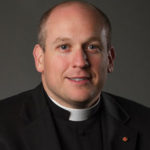
Father Christopher House is the Rector of the Cathedral and serves in various roles within the diocesan curia, namely Chancellor and Vicar Judicial.

Suffering, Group Fitness, and Unity

Seeds of the love of God are found everywhere. We encounter him in the most unexpected places. I’ve written previously about the presence of true leisure during a visit to Disney World, and how I found glimpses of him in an episode of The Flashand The Greatest Showman film. And, tonight, I found him in another unexpected place: in a group fitness class.
One of my friends roped me into going. I was late but my friend had set up my area with all the goods (weight plates, bar, some step thing). The class had already begun so I jumped right in to the routine. People came and went. There were different fitness levels in the room: the guy who clearly is a bodybuilder, the ladies who regularly take this class and it shows, the folks who keep moving when they feel like dying. Everyone was trying to get on the same rhythm, achieve the same level of ease, of difficulty, of resistance. And I was surrounded by so many glimpses of liturgy, spirituality, and evangelization.

The unified movement of the class reminded me of the liturgy of the Mass. Prayers, Mass parts…one voice. We set up our “areas” the same way (cue the sound of the kneelers hitting the ground and the rustling of missals and hymnals opening). We follow instruction. All the while, we are all on different levels. We are all bringing different “weight” with us.

There’s something about moving together that allows our hearts to open up a bit more. Like a concert, when that song that everyone knows comes on, we sway to the same beat and sing the lyrics as loud as possible. When its over, that’s the moment that we remember—when everyone was together as one. That’s how the Lord intends it to be: united community.

There’s also a great lesson in evangelization here. The person leading the fitness class is usually in incredible shape, like they stepped off of a Muscle and Fitness magazine cover just to help you get your heart rate up. Watching their enthusiasm, you have three choices: be indifferent, disdain them, or join them.

Think of St. Padre Pio. He had people that joined him on his pursuit of heaven and many skeptics of his devotion. A select few will really understand your desire for Christian perfection, and at times, an even greater few will sacrificially walk with you through it.

Often the instructor was transformed and encouraged by the very thing they teach. They took the class first, experienced positive change, and decided they could teach it and share the inspiration. Isn’t it the same way with God? Encountering him changes our lives and inspires us to share the Good News, but the gift of evangelization truly lies in having been evangelized yourself.

Then you have the person who attends. All walks of life are represented, and the reasons for their attendance are vast, but I would conclude that each of them wants to be there. Each of them desires lasting change.

Do our encounters with God often happen when we are fed up and ready to change? We allow a strict focus on what matters most because we’ve realized that nothing matters at all without him.

And the most obvious offering of the group fitness class (CrossFit, Les Mills, etc.) is our desire for communion and the gift it offers to the human heart. I’ve watched the classes dismiss, and no one actually leaves. Groups gather outside the room, and conversations erupt—much of which have nothing to do with the class. They share about their jobs, their families, their faith. It’s incredible. Friendships flourish.

St. Thomas Aquinas wrote in the Summa: “It is reckoned a sign of friendship if people ‘make choice of the same things.’” A class, fitness or not, predisposes the students to commonality, and it makes easier the process of communion.

Lastly, communion properly orders our invitation into suffering by making it not only suffering within but also the suffering without—with the other and for the other.

Even the science behind the physical suffering of “working out” mirrors the suffering of spirit. When you reach the “fight or flight” phase of a workout, it marks the threshold of muscle and stamina breakdown. The muscle is shredded or the stamina is conquered. It’s horrible and painful, but after the pain subsides, the muscle is rebuilt stronger and stamina rises. As goes spiritual suffering. We desire Christian perfection, but we do not desire the suffering; however, there is no resurrection without the cross. Thus, perfection presupposes error, failure, suffering. After the suffering subsides, the heart is stronger and the spirit higher.

Ultimately, the love of God when well-received doesn’t mean that suffering ends. With the love of God suffering is redemptive, and the most perfect response for suffering is compassion. Compatiis means to “suffer with,” requiring the presence of the other. Group fitness classes are about much more than getting in shape. We are drawn there because they also answer some of the deepest longings of our hearts: encouragement, hope, communion, and suffering.

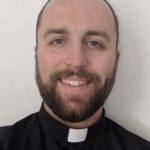
Rachel Bulman is a wife, mother of 4, speaker, and blogger. She enjoys seeking truth, finding beauty, rediscovering the goodness in all things; and answering the call to holiness through her life as a beloved daughter of God. Find more of her work at RachelBulman.com. This article appears on the Word on Fire blog at wordonfire.org. Used with permission.

Christians Need to Recover Fasting: Reorientation

So much has happened in our country lately that has been quite disorienting. Notably, New York legislated the country’s most aggressive abortion bill that viciously attacks the unborn. Internet assumptions, uncharity, and scapegoating characterized the incident between the Covington Catholic teens and Nathan Phillips. The government continues to show its disunity as it remains obstinately divided over many issues, including immigration and the southern border. And in the Church, the Pennsylvania Grand Jury Report and McCarrick scandals have shed and reshed light on some dark corners within the Church. Much has been disorienting.
When the news of the scandals broke out, a number of seminarians and priests in my diocese began a time of intentional prayer, fasting, and penance. Increasingly desperate times call for increasingly desperate, or rather heroic, measures…
For three months, two of my classmates and myself gave up alcohol, prayed a daily Divine Mercy chaplet, intentionally set aside time in our busy schedules to reflect on and share about our weekly joys and struggles, and fasted (two small meals, one regular meal) on Wednesdays and Fridays. Honestly, this was an idea that I was not super thrilled about at first, but then warmed to the idea after my classmates persuaded me.

I don’t share my practices to boast, but rather to hopefully convey some of the fruits of this time of prayer and penance. This article and its follow-up are going to be an attempt to help show the deep significance of fasting in the Christian life. The first parts will focus on how fasting helps to change us, while the second will work to show how it helps to change our world.

All of our efforts were meant to combat the specific evils, I believe, that are at the core of the Evil One’s continued assault upon the Church: the prideful desire for power and pleasure, the desire to isolate and the lack of transparency, and the absence of prayer and the lack of belief in its power. Everything diabolical, everything that causes division and confusion, comes from the Evil One.
Around the same time we started the fast, a priest friend explained to me that he shared with one of his parishioners that he too was entering into a time of fasting and penance for the Church. The parishioner’s reaction was as follows: “Fasting…what’s that going to do? What is that going to help with?”

I fear there exists a major misunderstanding about what the Church believes about the purpose of fasting. Fasting is not just a way that we Christians deprive ourselves good things in order to needlessly suffer. God created the world with inherent goodness and does not want his creation to suffer needlessly. While fasting can certainly be personally challenging, that does not make it a bad thing.

Surely, we know this by how willing we are to sacrifice and expend ourselves during hours of sport conditionings and practices. We know too how any dieting—Paleo and Keto most recently—takes a good amount of sacrifice and discipline in order to have and maintain a healthy body. It’s not that we don’t value discipline and sacrifice; we just don’t think our faith should lead us to do so. We’re tempted to believe that faith should only focus on positive, unchallenging feelings.

In truth, fasting is a practice of reorienting ourselves back to God, who is our ultimate happiness, when we have come to focus more on the world for our happiness. God created us not just to exist, but to live well, to live a life of virtue and holiness focused on him. This reorientation, this real transformation within us, can manifest on multiple levels and in different forms—physically, psychologically, and spiritually.

Without being a purely religiously beneficial endeavor, even the secular medical world has lately come to recognize and point to the value of fasting. Dozens of online articles can be found that advocate for fasting as a way to reorient the body to a place of adequate natural health. Personally, over the three-month fast, in sync with a slight increase of exercise, I lost almost fifteen pounds! The fast allowed me to cut unnecessary weight and I felt better because of it. Plus, for as much as I love a good craft beer and a good bourbon, detoxing from alcohol really left me with a clearer, more creative mind.

Yet the reorientation did not just play out physically. Psychologically, I could tell that, over the months, my cravings in general (food, entertainment, distractions) had greatly receded. At the end of the fast, my portion sizes were much smaller and I actually desired to have less. It is known that it takes about thirty days to break any habit and begin to form a new one. Imagine what three months—not even a quarter of a year—was able to accomplish. I did not so much feel like I was so much a slave of my passions. I felt reoriented.

Spiritually, fasting opens up the relationship between us and God as we begin to acknowledge him more as our continual provider. As we fast, consuming less, we actually become more thankful for what we have in front of us. This humility and thankfulness are at the core of a Christian spirituality. Throughout the fast I certainly noticed my attentiveness to the presence of God noticeably increase. I felt like God and I were much more in sync than we were before. More will be said in the second part of this reflection on the spiritual repercussions of fasting as it functions as an avenue for intercessory prayer.
As the Church approaches the Lenten season, it is the perfect time to reevaluate the practice and significance of fasting in our life. One increasingly popular program, especially amongst young Catholic men, is Exodus 90. The fast that my classmates and I entered into was loosely based on this program. Exodus 90 is not a comfortable addition to your spiritual life; it is a complete overhaul. It is a true exodus from all of the things in our life that distract us from what truly brings us peace and happiness. Importantly, this intense fast is never done alone, but always in community—the ideal for Christian living.

It may seem unreasonable to most people to do this program; it’s an overhaul of our spiritual, psychological, and physical lives. Yet sometimes drastic situations call for us to take drastic, heroic measures. As reflected on at the beginning of this piece, our world is full of disorientingly unreasonable people and situations. Maybe God in calling us to do something seemingly unreasonable in order for us to return to him.

I think fasting is an unreasonable and apparently nonsensical, yet wise practice that we Christians need to recover. Truly, fasting is a gift given to us, and it is up to us to embrace this gift for the good of the Church.

Deacon David Stavarz is a transitional deacon for the Diocese of Cleveland. He is a graduate of Borromeo College Seminary and is currently finishing his formation at St. Mary Graduate Seminary, in Cleveland, Ohio. David has a profound a love for music – especially on guitar or vinyl; he loves enjoying God’s creation through snowboarding, running, cycling, and backpacking; and he loves a conversation with a good friend and good cigar. Dc. David hopes to be a priest of the diocese in May of 2019.

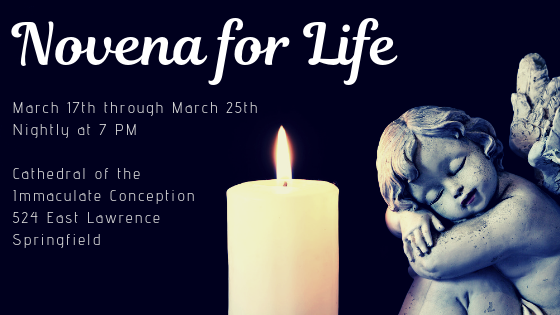
Novena for Life

Lenten journey for Friday of the first week of Lent

Lenten journey for Thursday of the first week of Lent

Lenten journey for Wednesday of the first week of Lent

Lenten journey for Tuesday of the first week of Lent

Lenten journey for Monday of the first week of Lent

Lenten journey for the First Sunday of Lent

« Previous Page
Next Page »

Liturgy

Sunday Masses (unless noted differently in weekly bulletin)
Saturday Evening Vigil – 4:00PM
Sunday – 7:00AM, 10:00AM and 5:00PM

Weekday Masses (unless noted differently in weekly bulletin)
Monday thru Friday – 7:00AM and 5:15PM
Saturday – 8:00AM

Reconciliation (Confessions)
Monday thru Friday – 4:15PM to 5:00PM
Saturday – 9:00AM to 10:00AM and 2:30PM to 3:30PM
Sunday – 4:00PM to 4:45PM

Adoration
Tuesdays and Thursdays – 4:00PM to 5:00PM


CatholicMassTime.org

Parish Information

Parish Address
524 East Lawrence Avenue
Springfield, Illinois 62703

Parish Office Hours
Monday thru Thursday – 8:00AM to 4:00PM
Fridays – CLOSED

Parish Phone
(217) 522-3342

Parish Fax
(217) 210-0136

Parish Staff

Contact Us

Contact Us

Copyright © 2026 · Log in