 The most influential chapter of any book I have ever read has to be the one entitled “The hour that makes my day” in the autobiography of Venerable Fulton Sheen, Treasure in Clay. I remember reading it over twenty-three years ago as a seminarian and being so inspired that I too resolved, from that time on, to make a holy hour before the Blessed Sacrament every day. Apart from the Mass itself, this hour of prayer remains the fulcrum of my day even still.
Recently I gave a talk to a group of promoters of Eucharistic Adoration in my diocese. These are the good folks who are involved in promoting Eucharistic adoration in parishes. During the talk, I mentioned that while it is important to encourage people to commit themselves to regularly spending a holy hour before the Blessed Sacrament, it is also important to teach and guide them how to make that holy hour. Without this deeper catechesis, we can easily become bored, begin to fidget, and lose sight of what Adoration is all about. Without the necessary spiritual direction and guidance of how to make a holy hour, we can forget that this precious time with the Lord is more about his desire to be with us than our desire to be with him. He is the one who longs for our company more than we long for him: “Could you not watch with me one hour?” (Mark 14:37). Here I offer a few guidelines of how we can make a holy hour by dividing it into three blocks of twenty minutes.
The first twenty minutes before the Lord really present in the Eucharist is a sacred time of intimacy between us and him. It is a time to just be present to our God who welcomes us and accepts us. In the words of St. John Vianney, it is a time when “I look at Him and he looks at me.” Before the Eucharist is a time when we lean on Jesus’ breast, like John did at the last supper, and allow his heart to speak to ours. This was the episcopal motto of Blessed John Henry Newman: cor ad cor loquitur (heart speaks to heart). We begin to grow in our “interior knowledge of the Lord” as we contemplate his words, his life, and his real presence before us (St. Ignatius of Loyola, Spiritual Exercises, 104). Here is the zone into which we are drawn in the first third of our holy hour, where our heart speaks to his. It is also a time when we listen to him and allow him to speak to us. This is a time when we can tell him everything about how we are and how we feel. It is a time to tell him about our day and to ask his help in ways in which we need it. Above all it is a time to thank the Lord for his presence and action in our lives and to adore him for his goodness, truth, and mercy. It is also an opportunity to present to him the things we don’t understand, our sins, failings, and the worries that burden us. In this twenty minutes of our holy hour, we bask in the light of his love that never fails us.
The second twenty minutes can be a time when we intercede for all the people we know and are part of our lives. At this stage of our prayer, we bring to the Lord all who have asked us to pray for them, our families and friends both living and dead. In this time we pray for all we have met in the past day or week, the conversations we had, the things we have said and done. Often during this time in the holy hour, some person will arise in our minds who we feel the Lord is calling us to pray for, reach out to, to contact or to visit. It is also a time to focus on what lies ahead —our next appointment, our next challenge, or perhaps a courageous conversation we need to have with someone to clear the air. In this time of prayer, our hearts are reminded that our call is to love others in Christ’s name, and that the same Lord before us in the Eucharist is the same Lord present in everyone, especially in the least of his brothers and sisters (cf. Matt 25:31ff).
The final twenty minutes can be a time when we pray for the entire human family and the whole universe. So we might pray for persecuted Christians around the world, for the victims of famine, and for an end to conflicts and wars. We might pray for the Church around the world, for the Holy Father on a foreign visit, or for all missionaries away from home. We might pray for the environment and for the care of the earth, thinking of ways to conserve more and consume less. For his beauty revealed in creation, this is a time to thank God for the sun, moon, and stars that were made through his Word present before us in the Eucharist. Finally, we can pray in this time for the peace among all nations for which Jesus lived and died—and that it might become a reality in our troubled world today.
There are many ways of praying and many ways of making a holy hour for “the Spirit blows where it wills” (John 3:8). But sometimes we need a little guidance that helps us to focus. Above is a guide for a holy hour of Adoration before the Lord, truly present in the Blessed Sacrament. It starts off with his love for us but ends with a prayer that blesses God for the whole of creation. In this way we exercise our share in Christ’s priesthood that lovingly embraces every individual but extends to the entire cosmos we inhabit.
“O sacrament most holy, O sacrament divine, all praise and all thanksgiving be every moment thine!”
Fr. Billy Swan is a priest of the Diocese of Ferns, Ireland. He served for four years as the Director of Seminary Formation at the Pontifical Irish College, Rome. He is currently based at St Aidan’s Cathedral, Enniscorthy, Co. Wexford.
 Ever since I was a kid I have had a fascination with the Magi and that fascination evolved into a religious devotion to these mysterious, sainted travelers. The Gospel of Matthew tells us little about them, and history and Tradition tell us even less. Matthew names three gifts of gold, frankincense and myrrh and so developed the tradition of three individuals who have been given the names of Caspar, Melchior, and Balthasar.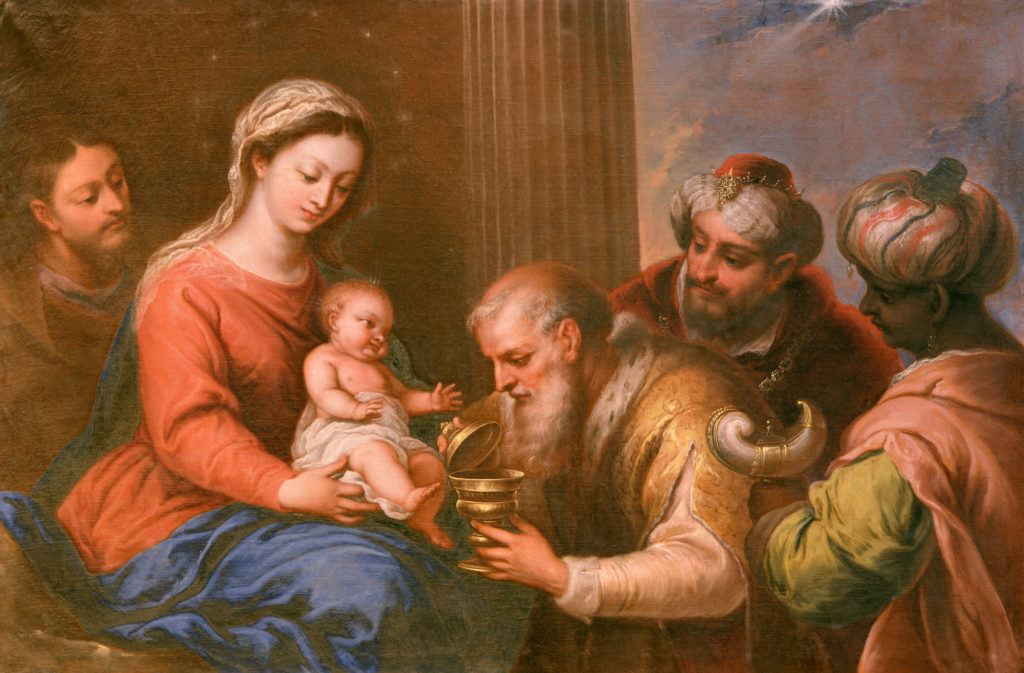
 “The Story of the Other Wise Man” by Henry Van Dyke was first published in 1895. It tells the fictional story of Artaban, a fourth wise man who began a journey to visit Jesus, the newborn King. Unlike his fellow Magi, he failed to make it there for the birth of Jesus because he kept pausing to help various people in need. In fact, it took him about 33 years of searching before his quest comes to an abrupt end when he is hit in the head with a falling roof shingle. His final breath takes place in Jerusalem near the place where Jesus is being crucified. As he lies dying, he hears the voice of Jesus telling him that the gifts he has given all along the way to “the least of these” he has actually given to Jesus himself.
 If you have never read this story or seen the made-fortelevision movie based on the tale, you really should seek it out. It is a story that reminds us of a profound truth: Jesus himself rests in the lives of all those around us in need. In the story, it was the wise man’s constant response to a stewardship call that prevented him from getting where he wanted to go. In the end, where he needed to go was more significant than where he thought he should go.
 One of the commonest observations made by opponents of religion is that we don’t need God in order to have a coherent and integral morality. Atheists and agnostics are extremely sensitive to the charge that the rejection of God will conduce automatically to moral chaos. Consequently, they argue that a robust sense of ethics can be grounded in the consensus of the human community over time or in the intuitions and sensibilities of decent people, etc.
 I confess: I’ve never been particularly successful at keeping New Year ’s resolutions because I’m more successful at finding excuses to ignore them. In years past I’ve been sidetracked by crowded gyms, the sniffles, and my general inability to resist temptation. This year, I decided I need some extra help, so I’m turning to the saints. I’m used to asking for the intercession of saints for big concerns, for example, laying my parenting woes at the feet of St. Monica, or asking for St. Peregrine’s support for a friend battling cancer. But what about intercession for life’s more mundane issues? Studies show we are more successful reaching goals when we enlist the help of a friend, and who better than our saint friends? Here are a few of my resolutions with the saints who will help me stay on track in 2018.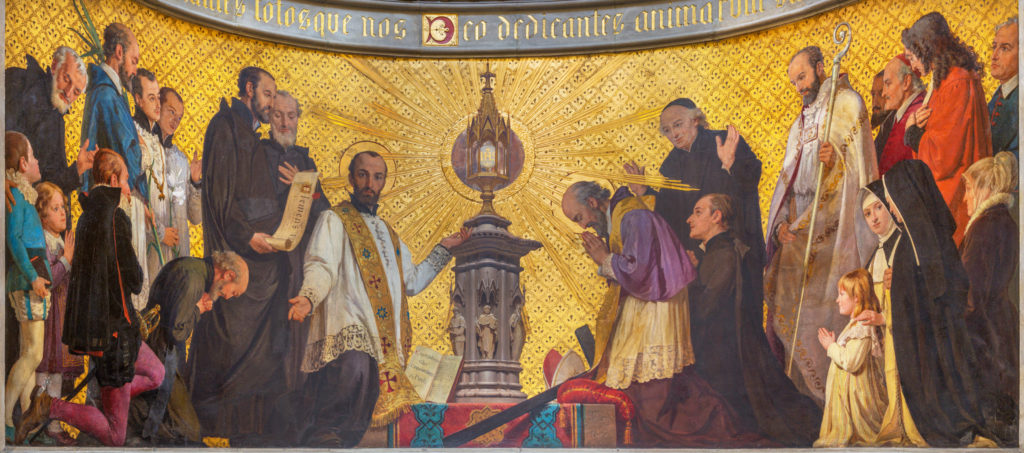
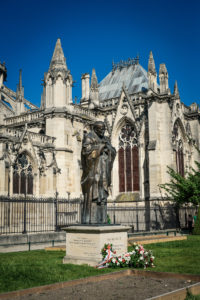 Getting more exercise is a perennial New Year’s resolution for me. I thought I’d turn to the patron of athletes, St. Sebastian, or Pope St. John Paul II, well known for his athleticism and love of the outdoors. But my gym time flailing doesn’t quite rise to the level of athleticism and John Paul II surely has more important intercessions and Sebastian is also the patron of those wishing a saintly death. (While I feel like dying when I exercise, I don’t think I’m likely to actually meet my demise and certainly not in a saintly way.) Honestly, my real issue is one of procrastination and lack of motivation. So, I think I need to turn to St. Expeditus, patron of procrastinators. In the early days of the Church, Roman soldier Expeditus, when about to convert to Christianity, was tempted by the devil (in the form of a crow) telling him to “wait until tomorrow.” Expeditus wouldn’t be swayed from his goal saying, “No. Today I will become a Christian.” That’s just the determination I need on those mornings when I’m tempted to say to myself, “Maybe I’ll just go to the gym tomorrow.”
 We are not very good at inviting. I can’t tell you how many conversations I have had with Catholics recently when that phrase came up. Why is that? Can we grow deeper in holiness by inviting?
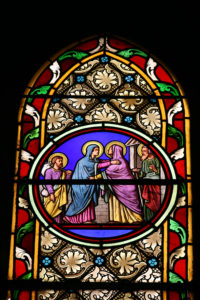 The first reading and the Gospel for this Fourth Sunday of Advent help to set the stage for our celebration of Christmas this coming week. Starting last Monday on December 17th, the focus of the season of Advent changed. We found ourselves looking forward to the return of Jesus at the end of time for the majority of the season; the tale-end of Advent, always starting on December 17th, invites us to begin to focus on the coming of Jesus as the child of Bethlehem. In the first reading we hear t h e Prophet Micah speaking of Bethlehem. The Gospel tells us of Mary’s visitation to her cousin Elizabeth where Mary finds her faith in the words of Gabriel confirmed by the fact that Elizabeth is with
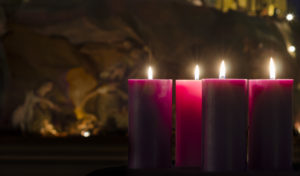 What both Bethlehem and Mary have in common is that no one would have expected either of them to have anything to do with the coming of the Messiah; Bethlehem lacked the glory of its neighbor Jerusalem, even though Bethlehem truly is “David’s city” and Mary was a girl from a non-descript family in a back-water town called Nazareth, a town of maybe two-hundred people at the time. However, with both Bethlehem and Mary we see God doing wonderful things in and through them.