Praying Kelsey is attracted to and blessed by God to meet a like minded Christian young adult male who loves the Lord and will grow a friendship, loving relationship, future marriage and children. Thank you in advance Lord for bringing the right Godly man into her life and this relationship to bring
All Things Possible
Last Sunday, I shared that my favorite passage in the Bible was found in our Second Reading from St. Paul, where he explains his unworthiness to be called an apostle, especially in comparison to all of those to whom Jesus had appeared after the Resurrection. Despite that unworthiness, though, St. Paul comes to the following conclusion: “But by the grace of God I am what I am, and His grace to me has not been ineffective.” (1 Cor 15:10) These words were an encouragement to me as I was beginning seminary formation, and they continue to be so now for me as a priest.
At the heart of this passage is the phrase: “the grace of God.” God’s grace, which is a sharing in His very life, makes all the difference in our lives. His grace enables us to do what we would otherwise not be able to do on our own. With that understanding, St. Paul is also able to say the following: “I can do all things in Him who strengthens me.” (Philippians 4:13) This passage is a very popular one, and often quoted by Christians as a sign of our faith in the power of God’s grace, despite our weakness and unworthiness. In a blog article that I recently read, I came across an explanation of this passage that really resonated with me:
This verse is so misused because many Christians interpret “all things” as “anything,” not “all the things Paul has talked about.” It’s not a blanket endorsement that God will support anything we set out to do and empower us to do whatever impossible things we can imagine. It’s an assurance that we can do whatever God calls us to do, not whatever we decide to do. (https://zondervanacademic.com/blog/philippians-4-13)
This is an important clarification. God’s grace is always sufficient to help us in accomplishing His will. A central part of that will is to follow His commandments. What He commands is never impossible, for with God’s grace, all things according to His will for us are possible.
I bring this up in particular with regards to the Church’s teaching on the 6th and 9th Commandments that deal with our human sexuality. Many in society protest that what the Church asks of her children in this area is unreasonable and, in fact, impossible. Because living a life of chastity can be so challenging in a hypersexualized world, the conclusion that our culture draws is: “You are not capable of living what the Church teaches, so we should just lower our expectations, make permissible that which the Church teaches against in the area of sexual morality.” I will admit, there is something true about this conclusion. You and I and not capable of this by our own strength. This is where St. Paul’s words come in: “I can do all things in Him who strengthens me.” It is God’s will for us to live the virtue of chastity well according to our state in life, and His grace makes it possible. The Church seems to be the only voice in our culture that tells us this is indeed possible – with the caveat that we understand that His grace will be sufficient and thus effective in our living this virtue and every other virtue His will invites us to live.
And so the question with which I leave you is this: “Do you believe this?” Perhaps we would do well to consider the scene in the Gospel of the man who brought his son to Jesus to heal him. Jesus tells the father (and us) the following: “All things are possible to him who believes.” (Mark 9:23) Let our response to the question about believing that God’s grace can make possible what seems impossible in living chastity that same response the father had to Jesus: “I do believe, help my unbelief.” (Mark 9:24)
Father Alford
St Valentine – Myth or Historical Person?
This Monday, February 14, we shall celebrate what has become one of the most widely celebrated feasts in the secular world and Christendom – St. Valentine’s Day. Some of us will be celebrating St. Valentine’s Day as a Christian fiesta, keeping in mind the stories of sacrificial love surrounding the figure of St. Valentine. Many others worldwide will be celebrating this feast as a day of appreciation and expression of romantic love.
Whichever way, the question about the origin of this feast, its historicity, and Christian authenticity has remained a matter of debate among authors, historians, and Christian theologians, especially outside of the Catholic faith. Whoever plans to celebrate this feast may want to know if the feast of St. Valentine is genuinely Christian and if the figure of St. Valentine is a myth or a historical person. Who was he if he existed in time and space like the rest of the saints? Did he die a martyr’s death out of love? What kind of love?
There are many stories and understandings of the figure of St. Valentine and his feast. After some research, I have found out that many people argue that this feast is one of those regular feasts of saints in the Catholic church – saints who truly existed in time and space. Some people who hold this opinion believe that the feast spread so widely beyond the Christian world in the late medieval times with lots of superstitious practices attached to it. One of these superstitions is the romantic love that this feast represents for many people all over the world.
Other people believe that St. Valentine’s Day is a Christian myth manufactured in medieval Europe to encourage fraternal charity and generosity to the poor among Christians. Several people who hold this opinion are indifferent about whether the figure of St. Valentine is a myth or a historical person. Some observe the feast as a Christian fiesta of sacrificial love. In contrast, others treat it as a secular feast of romantic love.
Still, people like Lisa Bitel, a history professor at the University of Southern California, have an interesting view of this feast. They believe that the feast of St. Valentine commemorates one of the three Valentines that lived in Rome, Umbria, and Africa in the third century. While this opinion argues that St. Valentine’s Day remembers one of these three early Christians, it denies that any of them is associated with the romantic love that the feast has come to represent for many people.
However, there is a common belief that the saint or saints associated with St. Valentine’s Day died as martyrs. Their association with romantic love may be a superstition or a misunderstanding of the love associated with their martyrdom. But the popular understanding of St. Valentine’s Day among Christians in many parts of the world as a commemoration of sacrificial love should be highly encouraged. This is because martyrdom is one of the highest expressions of love – that love, which is the primary vocation of every Christian. The expression of this sacrificial love should be seen in our lives and actions as Christians.
Sts. Josephine Bakhita
Feast Day: February 8th
In my research for our saint this week, I realized that Pope Benedict XVI had already written her story, weaving it into his encyclical on Christian hope. Seeing that I could do no better myself, and realizing how providential this discovery was in light of our current thirst for hope, I’ll let our Pope Emeritus do the teaching this week:
Paragraph 2: Christianity was not only “good news”—the communication of a hitherto unknown content. In our language we would say: the Christian message was not only “informative” but “performative”. That means: the Gospel is not merely a communication of things that can be known—it is one that makes things happen and is life-changing. The dark door of time, of the future, has been thrown open. The one who has hope lives differently; the one who hopes has been granted the gift of a new life. Yet at this point a question arises: in what does this hope consist which, as hope, is “redemption”? The essence of the answer is given in the phrase from the Letter to the Ephesians quoted above: the Ephesians, before their encounter with Christ, were without hope because they were “without God in the world”. To come to know God—the true God—means to receive hope. We who have always lived with the Christian concept of God, and have grown accustomed to it, have almost ceased to notice that we possess the hope that ensues from a real encounter with this God.
Paragraph 3: The example of a saint of our time can to some degree help us understand what it means to have a real encounter with this God for the first time. I am thinking of the African Josephine Bakhita, canonized by Pope John Paul II. She was born around 1869—she herself did not know the precise date—in Darfur in Sudan. At the age of nine, she was kidnapped by slave-traders, beaten till she bled, and sold five times in the slave-markets of Sudan. Eventually she found herself working as a slave for the mother and the wife of a general, and there she was flogged every day till she bled; as a result of this she bore 144 scars throughout her life. Finally, in 1882, she was bought by an Italian merchant for the Italian consul Callisto Legnani, who returned to Italy as the Mahdists advanced.
Here, after the terrifying “masters” who had owned her up to that point, Bakhita came to know a totally different kind of “master”—in Venetian dialect, which she was now learning, she used the name “paron” for the living God, the God of Jesus Christ. Up to that time she had known only masters who despised and maltreated her, or at best considered her a useful slave. Now, however, she heard that there is a “paron” above all masters, the Lord of all lords, and that this Lord is good, goodness in person. She came to know that this Lord even knew her, that he had created her—that he actually loved her. She too was loved, and by none other than the supreme “Paron”, before whom all other masters are themselves no more than lowly servants. She was known and loved and she was awaited. What is more, this master had himself accepted the destiny of being flogged and now he was waiting for her “at the Father’s right hand”.
Now she had “hope”—no longer simply the modest hope of finding masters who would be less cruel, but the great hope: “I am definitively loved and whatever happens to me—I am awaited by this Love. And so my life is good.” Through the knowledge of this hope she was “redeemed”, no longer a slave, but a free child of God. She understood what Paul meant when he reminded the Ephesians that previously they were without hope and without God in the world—without hope because without God. Hence, when she was about to be taken back to Sudan, Bakhita refused; she did not wish to be separated again from her “Paron”. On 9 January 1890, she was baptized and confirmed and received her first Holy Communion from the hands of the Patriarch of Venice.
On 8 December 1896, in Verona, she took her vows in the Congregation of the Canossian Sisters and from that time onwards, besides her work in the sacristy and in the porter’s lodge at the convent, she made several journeys round Italy in order to promote the missions: the liberation that she had received through her encounter with the God of Jesus Christ, she felt she had to extend, it had to be handed on to others, to the greatest possible number of people. The hope born in her which had “redeemed” her she could not keep to herself; this hope had to reach many, to reach everybody.
– Fr. Dominic Rankin first heard the story of St. Josephine Bakhita in a set of readers in the 2nd or 3rd grade filled with saint-stories and meant to teach reading-comprehension. This week, inspired by her example, he will practice hope by carrying sufferings with Jesus.
Mass Intentions
Monday, February 14
7am – The Vogt Family
(Bill Vogt)
5:15pm – Jean Anne Staab
(Brian & Michelle Lauer)
Tuesday, February 15
7am – Sophia Bartoletti & Family
(Estate of Sophia Bartoletti)
5:15pm – John Dunham Family
(Judith Ansell)
Wednesday, February 16
7am – Mary Celine Sestak
(Angela & Robert Williams)
5:15pm – Joseph Forestier
(LouAnn Mack & Carl Corrigan)
Thursday, February 17
7am – Intention for Brandi Borres
(Chris Sommer)
5:15pm – Amabile Bartoletti
(Estate of Norma Bartoletti)
Friday, February 18
7am – Anna A. Eleyidath
(Augustine Eleyidath)
5:15pm – Otis Huber
(Family)
Saturday, February 19
8am – Vincy John
(Ann Vadukumcherry)
4pm – Joe Forestier
(Mark & Brenda Staab)
Sunday, February 20
7am – For the People
10am – Howard Barnett
(Lisa Barnett)
5pm – Erma Bartoletti
(Estate of Norma Bartoletti)
Poison of Gossip
My first assignment as a priest involved being a part of a pastoral team of four priests serving three parishes in Effingham and Shumway. As a brand new priest, I was always impressed with how well the people remembered the priests who had served their parishes over the years. I found that most of the memories were from things that the priests had done in the parishes, and much less about what they said. So if the people remembered something a priest said many years later, it must have been very impactful. One parishioner shared a story about a homily given by one of their former priests that they remembered very clearly, and it is something I too have remembered all these years later.
The priest began his homily by talking about various types of snakes that exist in the world. In particular, he spoke about poisonous snakes. After listing off some of the more deadly species of snakes, the priest made the following point: “But of all of the poisonous snakes in the world, there is one snake that is more deadly than all – the gossip snake!” Wow! What a creative way of delivering an important message, namely, the deadly nature of gossip.
I bring this story up as we begin this month to look at the second set of the Ten Commandments. The Fifth Commandment states very succinctly: “You shall not kill.” As we know from our consideration of a few of the first four commandments, there is much more to these commandments than meets the eye. Jesus Himself addresses this commandment specifically when He says:
You have heard that it was said to your ancestors, ‘You shall not kill; and whoever kills will be liable to judgment.’ But I say to you, whoever is angry with his brother will be liable to judgment, and whoever says to his brother, ‘Raqa,’ will be answerable to the Sanhedrin, and whoever says, ‘You fool,’ will be liable to fiery Gehenna. (Matthew 5:21-22)
In his catechesis on this Commandment, Pope Francis explains how the sin of gossip can fall under the Fifth Commandment:
Therefore, not only must one not make an attempt on the life of others, but one must not even pour on him the poison of anger and hit him with slander, nor speak ill of him. And here we arrive at gossip. Gossip can also kill, because it kills the reputation of the person.
Since hearing about the idea of the “deadly gossip snake” so many years ago, I have come to see how very true this is. Gossip can be deadly and as Christians, we should be very careful about how we speak about other people, regardless of whether what we have to say is true or not. What you say about somebody in resentment, pain, or frustration may feel good in the moment, but it invites the person to whom you are speaking to take on the same attitude, thus spreading the poison. In those moments when we are tempted to gossip, we would do well to remember the advice of St. Paul: “Never let evil talk pass your lips. Say only the good things men need to hear, things that will really help them.” (Eph. 4:29) I can almost guarantee that gossip is not something others need to hear or will ever help them, so when tempted to gossip, just keep quiet and speak to the Lord about it. You may just help to save the other person’s reputation…and your soul. Father Alford
Lucy, Only Love Can Do That!
Recently, I had a meeting with a mid-aged lady – a mother and a wife. For privacy reasons, I will call her Lucy here. Lucy is a practicing Catholic. She is a convert to the Catholic faith and a woman of high moral values. But Lucy has lived for more than half a century in this world deeply embittered by a painful experience of what transpired between her and her dad when she was about nine years old. I am sure you can imagine what this could be! Lucy said she was sexually abused.
While this abuse happened, Lucy’s dad was a loving, caring, and generous man who provided lavishly for his family. So, she grew up having all she wanted in life – not just what she needed. But amid this affluence, Lucy grew up with a deep emotional wound that affected her tremendously. Her marriage and family life, including her social life and work experiences, have suffered unprecedented damage. She attributes all these to the sad experience she had with the man that God entrusted her life unto.
Lucy’s dad is advanced in years and currently lives in a nursing home with multiple health problems. Lucy abandoned him there for several years now and has refused to forgive her father for the abuse. It is not clear if her dad knows why her daughter has abandoned him for such a long time.
As I talked to Lucy, I realized that she lives in heavy grudges against her dad. She believes that that ugly experience with her dad at the age of nine is responsible for all the problems she has suffered all these years. Truly, I could tell that Lucy has known no peace of mind for a long time. But then I asked if she prefers to live in these grudges for the rest of her life, knowing very well that unforgiveness cannot right the evil that took place. Lucy explained that she did not want to see her dad anymore. She felt so terrible and wondered what she could do to be made whole again. I looked at her intently as the words of Martin Luther King Jr. flashed through my mind – Lucy, ONLY LOVE CAN DO THAT! You must forgive your dad and learn to love him again.
Many of us live in similar situations today. Some of the peoples and institutions we loved and trusted have caused us many of the brokenness we face. These people and institutions cause us this brokenness by emotional, physical, or sexual abuses, betrayals, calumnies, gossips, bullies, chastisements, denials, rejections, and refusals.
Unfortunately, darkness cannot drive out darkness. We cannot repay evil with evil. Only light can drive out darkness. Only goodness can destroy evil. Lucy cannot continue to live in grudges. For the sake of Jesus who is LOVE, Lucy must forgive her father, visit him, and try to build a good relationship with him as much as possible before his father lives this world. That is the surest and most effective means of healing for Lucy.
Sts. Cyril and Methodius
Feast Day: February 14th
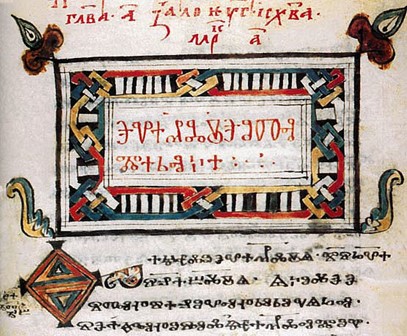
ⰵⰲⰰⰳⰳ[ⰵ]ⰾⰻⰵ ⱁⱅⱏ ⰿⰰⱃⱏⰽⰰ
Got that? If not, fear not, it is simply the familiar phrase: “The Gospel according to St. Matthew.” On the scanned page below you can see these letters, as they were written by a scholar or monk in the 10th century! (This amazing parchment manuscript contains all four Gospels and was discovered in the Zograf (a Bulgarian) Monastery on Mt. Athos, on an island off the Northeast coast of Greece. There are dozens of ancient Orthodox monasteries on the island, in 1843, this page was discovered after centuries of being protected and treasured. It now resides in the National Library of Russia, in St. Petersburg, and remains one of the oldest extant texts we have in Glagolitic.
You haven’t heard of Glagolitic? Well, I hadn’t either until I began to study our saints this week: Sts. Cyril and Methodius. You have probably heard of Cyrillic, which is an alphabet still used throughout Eastern and Southern Slavic territories (this means it is used in many different languages: including Slavic, Turkic, Mongolic, Uralic, Caucasian and Iranic-speaking countries from Eastern Europe all the way through parts of Eastern Asia). There are dozens of languages, from Russian and Macedonian, to Azerbaijani and Tatar, to Mongolian and Aleut (yes, that’d be people living on the Aleutian islands!) that use this alphabet. All those different groups read a write in a script developed from Glagolitic, which was invented by Sts. Cyril and Methodius.
Cyril and Methodius were actually baptized Constantine and Michael in Thessalonika, to a family who were movers and shakers in realms of politics and governance (to describe this a bit: their father, Leon was in charge of the military, and their uncle, Theoctistos, was in charge of international diplomacy … and the postal service). The boys would have learned Slavic and Greek growing up in the 820s and 830s, and Constantine would have learned Arabic and Hebrew during his university studies in Constantinople. With that background, these young men found themselves, almost without trying, at the intersection of politics and philosophy, diplomacy and theology. And this should be emphasized: they were not gunning for worldly influence, their dream was definitively in the spiritual realm, and yet they took the tremendous skills that they did have in the political and intellectual realm, and put it to use for the Gospel.
In 860 the brothers head to Khagan, at the behest of the Emperor (Michael III) and Patriarch of Constantinople (Photius) to offer Christianity to the Khazars. They would be asked to do the same two years later in Great Moravia, at the request of Prince Rastislav, because his people were wanting to receive the Gospel for themselves, not depending on the Germanic neighbors to the north, who would only teach and catechize in Latin. I am imagining receiving an email along these lines from one of our parishes: “Fr. Dominic, could you come and preach a parish mission for us next year? Oh, you should know, we speak a language you have never heard, and for which there is no alphabet for reading, or writing. Grateful for your yes, Prince Rastislav.” Can you imagine?! Yet that is the situation faced by Constantine and Methodius (and, I should mention, many missionaries from (Methodius, by this time, had received tonsure and his religious name. Constantine would receive his a few years later after making a trip back to Rome before his death in 869. It should also be mentioned that it was during that final trip to Rome that the brothers received official permission from Pope Adrian II to continue to celebrate the Mass and Sacraments in Slavic, with the Glagolitic alphabet.)
And so it happened: the two brothers said yes, went to Moravia, invented a new alphabet, translated the Gospels, the Liturgical texts, and canon law into the new language, converted many souls to following Jesus, received the usual share of persecution from within and without of the Church, and died after a few years of tremendous work, leaving behind thousands of Christian people, who would pass their faith, and language, onto millions that would descend from them in the thousand years hence. In those peoples, these brothers are often given the title “Equal to the Apostles” for the efforts they made in the proclamation of the Gospel, and Pope St. John Paul II named them co-patrons of Europe (alongside of Sts. Benedict of Nursia, Bridget of Sweden, Catherine of Sienna, the Teresa Benedict of the Cross).
– Fr. Dominic Rankin was continuously humbled to merely study the faith in a foreign language (Italian). He has not tried to invent his own language since he was about two years old, and will not do so again until the Holy Spirit either gives him the gift of tongues, or asks him to do so with his own efforts … Then again maybe it is a perennial challenge of all Christians to translate, so to speak, the Gospel into the language of our neighbors. Hasn’t Jesus always stretched our limited means of communication and argumentation? Hasn’t it always been difficult to pass onto another person a real encounter with Jesus, Whom we know and love?
Mass Intentions
Monday, February 7
7am – Russell Steil, Sr.
(The Steil Family)
5:15pm – Sophia Bartoletti & Family
(Estate of Sophia Bartoletti)
Tuesday, February 8
7am – Drew Dhabalt
(LouAnn Mack & Carl Corrigan)
5:15pm – John A. Sestak
(Steve & Vicki Stalcup)
Wednesday, February 9
7am – Elizabeth Ann Harman
(Berni Ely)
5:15pm – Justin Vaduk
(Ann Vadukumcherry)
Thursday, February 10
7am – Anna Eleyidath
(Augustine Eleyidath)
5:15pm – Special Intention for Wallace
(Ann Vadukumcherry)
Friday, February 11
7am – John Montgomery
(John Busciacco)
5:15pm – Special Intention for Bianca
(D. A. Drago)
Saturday, February 12
8am – Reshema K.
(Ann Vadukumcherry)
4pm – The Staab Family
(Friends)
Sunday, February 13
7am – Mary Ann Midden
(William Midden)
10am – For the People
5pm – Eulalia & Ray Ohl & Deceased Family
(Angela Ohl-Marsters)
Revisiting the 4th Commandment
Two weeks ago, we looked at the 4th Commandment, “honor your father and your mother,” and how it invites us to consider our roles and responsibilities as citizens, obeying just laws which promote the common good, and speaking and acting against laws “contrary to the dignity of persons and the natural law.” (CCC 2235) Another important point to consider in our observance of this commandment is the obedience we owe to our mother, the Church, and the role that she plays in our being good citizens of society.
The final three paragraphs of the Catechism (CCC 2244-2246) on this commandment address this relationship. I draw out attention in particular to the following words:
It is a part of the Church’s mission “to pass moral judgments even in matters related to politics, whenever the fundamental rights of man or the salvation of souls requires it.” (CCC 2246)
This was on my mind as I read a story about something that happened recently in Washington, D.C. On the night before the March for Life, it has become customary to have a large Mass celebrated at the Basilica of the National Shrine of the Immaculate Conception. That evening, a group called Catholics for Choice projected various messages on the façade of the basilica advancing their position that one can in good conscience be Catholic and Pro Choice. That evening, the group tweeted the following message:
FACT: 68% of Catholics want #RoeVWade to remain the law of the land. The #MarchForLife & @usccb want folks to think they speak for Catholics, but nothing could be further from the truth.
This statement highlights a common error with regards to the Church. There is the conclusion that the majority opinion has to rule the day and that the Church has no grounding to oppose what “most people want.” As the Catechism states, it is part of the Church’s mission to proclaim and safeguard the truth, regardless of its popularity or level of acceptance. For it is by knowing the truth and following it that we have the greatest assurance of salvation. And this is the primary concern of the Church – the eternal salvation of her people.
In this regard, I am reminded of a powerful scene in the movie Paul VI: The Pope in the Tempest. A fair amount of attention in the movie is given to debate that was going on during Pope St. Paul VI’s pontificate on the topic of artificial contraception. As with the argument for keeping Roe vs. Wade legal, the pressure was being put on the Holy Father to change the Church’s teaching on the immorality of artificial contraception because the majority of Catholics supported its use. Having heard the arguments and having thought and prayed about it, the Holy Father says the following succinct but powerful words: “The Pope cannot say something is right if it is not.” This summarizes, I believe, the role of the Church in proclaiming the truth “in season and out of season.” (2 Tim 4:2) As members of society, but first members of the Church, our obedience must always belong to the truth, of which the Church is “the pillar and bulwark” (1 Tim 3:15), regardless of whether it is the majority opinion or not. May we also never forget the promise that Jesus Himself gives to us about the truth: “the truth will make you free.” (John 8:32)
Father Alford