Please pray for my brother, Ed, as he is having surgery on Monday.
Prayer Wall – 03/06/2021
Please pray for Bart! He is 31 years old and is in the hospital waiting to undergo heart valve replacement surgery Next week. He’s recently been diagnosed with an autoimmune blood disorder that causes clotting. It complicates things and caused a stroke last fall. Thank you!
Prayer Wall – 03/04/2021
Prayers for Tiffany Rose who is struggling with some physical issues. Thank you!
Month of St. Jospeh in the Year of St. Jospeh
Without a doubt, Lent is a time of the year with which most Catholics, and even many non-Catholics, are familiar. These are the 40 days before the celebration of Easter, and it is a time during which people give things up or try to do more or something. Fridays have a particular emphasis during this season, for on those days, we abstain from eating meat. Just these points give us some appreciation for how the Church invites us to be conscious of the importance of all time, and how each period of time, no matter how long or short, is an opportunity for us to grow in our Catholic faith.
Over the centuries, the Church has encouraged the faithful to be mindful of different aspects of our faith during different liturgical season of the year. But that is just the beginning, as the Church also invites us to reflect on various themes for each month and each day. At times, the Church also sets aside certain years to focus on something particular. It can be an interesting exercise to take some time to learn about the various ways that the Church invites us to celebrate various days, months, seasons, and years.
For our purposes now, I want to call to our attention two of these periods of time that coincide during this month of March in the year 2021. The month of March has been identified as a month during which the faithful are asked to deepen their devotion to St. Jospeh. The Solemnity of St. Jospeh is celebrated on March 19 each year, which makes it appropriate for us to set aside March for our special attention to this great figure. As you also may be aware, this year has been designated by Pope Francis as a Year of St. Joseph, marking the 150th Anniversary of the Proclamation of St. Jospeh as the Universal Patron of the Church by Blessed Pope Pius IX on December 8, 1870.
During this season of Lent, we have been exploring the difference between being a true follower of Christ and mere admirer of Him. Apart from our Blessed Mother, St. Jospeh give us the best example of how to be a true follower, so we look to him in a special way during this month and year dedicated to him.
St. Joseph also ties in well with our Family of Faith topic for this month, which is the second of the two Sacraments of Healing, the Sacrament of the Anointing of the Sick. St. Joseph is invoked as the Patron of a Happy Death, and we know that among other things, Anointing of the Sick is a powerful gift to bring peace to those who are approaching the end of their earthly journey. St. Jospeh is also referred to in the Litany of St. Joseph as “Comfort of the troubled” and “Hope of the sick”, so he intercedes in a special way for those who encounter suffering in any form.
Let us “go to Joseph” regularly during this month and renew our friendship with him, confident that through his example of his intercession, we will grow in our love for Christ, for whom St. Jospeh dedicated his entire life, and as a result of his fidelity, now shares the gift we all hope to attain, eternal life in the Kingdom of Heaven.
Father Alford
Where is the Anointing of the Sick in Scripture?
This month, we are turning our attention to the sacrament of the Anointing of the Sick. One characteristic of all seven sacraments is that they were instituted by Christ, and not a later innovation of the Church. Similar to Confirmation, the moment when Christ began the celebration of this sacrament is not as clear as baptism or the Eucharist, but there is still plenty of Scriptural evidence for the institution. The main text where we find evidence for this sacrament is found in James 5:14-15.
Is any among you sick? Let him call for the presbyters of the church, and let them pray over him, anointing him with oil in the name of the Lord; and the prayer of faith will save the sick man, and the Lord will raise him up; and if he has committed sins, he will be forgiven.
Another text which is found in the Gospel of Mark alludes to this sacrament, although not as explicitly as the Apostle James. “Jesus summoned the Twelve and began to send them out two by two and gave them authority over unclean spirits. They drove out many demons, and they anointed with oil many who were sick and cured them” (Mark 6:7, 13). We see a few similarities between these two texts. The first similarity is who is doing the anointing of the sick. The Apostle James instructs the presbyters to pray over the sick person and anoint him. “Presbyter” means elder in the generic sense, but refers specifically to priests in the New Testament. The Apostle Paul appointed presbyters in every town and told the other bishops to do the same thing. The text from Mark shows us that Jesus instructed the Twelve Apostles to do the anointing of the sick. Because the Anointing of the Sick involves the power to forgive sins, only priests and bishops can do this. Jesus has not given this authority to deacons or other members of the Church.
A second similarity between both Mark and James is that the priests anoint with oil. This oil, called the “Oil of the Sick” is blessed by the diocesan bishop at the annual Chrism Mass, along with the Sacred Chrism (used for Baptism, Confirmation, and Holy Orders), and Oil of Catechumens. In an emergency situation, any priest can bless oil to anoint somebody near death. Although not as common, it is a traditional part of our faith to offer other types of anointings which are not sacraments. Maybe you have heard about a special “oil of St. Joseph” or another oil associated with a saint. This oil is used in a similar way to holy water, as a physical reminder of our faith and a method for expressing devotion.
The primary fruit of the Anointing of the Sick is strengthening one’s spirit through suffering. I will write more about this in future columns, but I wanted to point out the scriptural connections while we are exploring these two passages. Notice that the Apostle James talks about the prayer of faith saving the sick man, and his sins being forgiven. The Anointing of the Sick does sometimes result in physical healing of a person’s ailment, but this is only a secondary fruit of the sacrament. God will sometimes use Anointing to heal somebody physically if this healing will be fruitful for their spiritual life.
Jesus came to share in our suffering, and he did so in a concrete way through his passion, death, and resurrection. This sharing in our suffering continues to this day as Jesus comes to comfort us in our darkest moments through the Anointing of the Sick.
St. John of God: Where can one find Blazes of Glory?
Feast Day: March 10th
You would think the name John “of God” would set you apart from just your average João (Portuguese version of the name John), but there are at least 5 different famous men who have that tremendous title: a Portuguese actor from the first half of the 20th century; a professional soccer player, now a coach for the Benfica football club in Lisbon; a disgraced Brazilian psychic; an impulsive 14th century runaway who drifted from shepherd, to soldier, to deserter, to adventurer, to book-seller, and capped off all this with a nervous breakdown; and finally one of Portugal’s great, if absent-minded, poets from the 19th century.
Which one do you think was canonized a saint?
In this case, it was gentleman #4: the rash-boy-turned-shepherd, then soldier-turned-deserter, then African-adventurer-turned-book-seller. He had abandoned his parents (his mother died of grief; his father sorrowfully entered the Franciscans), and then left behind the shepherd who had adopted him and taught him that trade, even offering his daughter’s hand in marriage to the young John, (who would rather live the life of revelry of a soldier). He was found guilty of dereliction of duty and was thrown out of the army a few years later (though perhaps he was framed by jealous comrades? Some accounts say he had some kind of conversion at this time and they did not appreciate his newfound disapproval of drunkenness and profligacy.) In any case, he went back to shepherding … and then various other military expeditions … and then back to shepherding again … and then became the servant of a noble family being exiled to Africa.
So, there he was in Morocco, nursing back to health the family that had been disgraced and rejected as they arrived in this far-flung Portuguese colony, watching his fellow servants run off to become Muslim and abandon their faith, and this good family, for glory or riches or something that might await them there. And then, I suppose, it hit him. He had done that exact same thing. He had abandoned his family, and faith in everything but name, jumping from thing to thing, hoping that something would fix the itch he had for adventure, or money, or stability, or nobility, or friendship, or whatever was the latest ambition that crossed his heart.
And now he was a middle-aged man that had still not figured out what life was about. He had finally gotten hungry, and disillusioned, and a little bit of repentance sank into that prodigal’s heart, just enough openness that God could intervene. One day John had a vision of the Infant Jesus, and received from Our Lord the surname “of God” (not unlike calling a fatherless man “Father-of-multitudes”, or an impetuous fisherman “the Rock”, I suppose…), Who also told him “Granada will be your cross.” He was heading back to Spain!
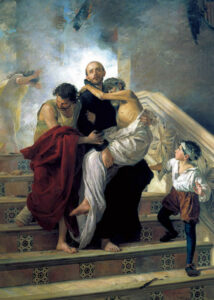
First, it was a simple call to sell devotional and chivalric books (much different from his earlier interests I suspect, and also different because moveable type had been invented just a handful of decades prior). But then, after a sermon by St. John of Ávila, John of God had what most would call a mental-breakdown (wild acts of repentance, public self-beatings, complete collapse from grief and sorrow). He was incarcerated as a mad-man, beaten and chained, and only released when the good John of Ávila advocated for him. It would take time, but gradually the great saint taught John how to turn his insensitive impulsivity into zeal for charity, his tendency to abandon into self-abandonment and complete availability to the poor, and his self-serving adventuring into the tenacity he needed to continue upon the hard road of learning to love (most avoided him, still seeing him as crazy and dangerous). It was in this that he finally found peace.
Some came to slowly to follow him, eventually forming a community who would dedicate their lives not to riches or glamor or adventure or impulsivity, but the simple and humble task of loving those worst off, especially the mentally handicapped. John would die at the age of 55, teaching us all that no matter what crazy path a life may take, charity can win out in the end, and Christ can convert any heart! His order continues the mission to this day, technically called the Hospitaller Order of the Brothers of St. John of God, but more commonly, and fondly, known as the Fatebenefratelli, the Do-Good-Brothers.
We would all find God in that.
– Fr. Dominic Rankin has never ran into a burning building, or out of one, come to think of it. Though there was that time when the fire alarms went off in the airport in Rome and no one batted an eye as they blared away for 10 minutes before his flight… But St. John of God did run straight into a burning hospital, actually the same one where he was beaten and chained those years before, saving all the patients and then beds and whatever else he could throw out the windows. Turns out, God did not have in mind martyrdom for him because as the building collapsed in an inferno of blazing timber, the gutsy saint walked out just fine.
Mass Intentions
Monday, March 8
7am – Anna A. Eleyidath
(Augustine Eleyidath)
12:05pm – Pius Onyejiaju Chineke
(The Anselment Family)
5:15pm – Jack Koester
(Cindy Vahling)
Tuesday, March 9
7am – Special Intention for Sheree Graves
(Sheree Graves)
12:05pm – Mrs. Jack Koester
(Cindy Vahling)
5:15pm – Special Intention for Rev. Brian Alford
(Chris Sommer)
Wednesday, March 10
7am – John Montgomery
(John Busciacco)
12:05pm – Fr. Lambert Leykam,OFM
(Cindy Vahling)
5:15pm – William F. & Shirley Logan
(Lisa Logan & Lori LoganMotyka)
Thursday, March 11
7am – Jean Reno Greenwald
(Richard & Joan Rogers)
12:05pm – Joseph A. DelGiorno
(Patricia Kornfield)
5:15pm – Rosemary Dougherty
(Lou Ann & Carl Corrigan)
Friday, March 12
7am – Patria & Rufino Gontanco
(Hati & Joe Uy)
12:05pm – George Friedel
(Roy Ponce)
5:15pm – Special Intention forBianca
(D. A. Drago)
Saturday, March 13
8am – Catherine Ponce
(Larry & Sue Ruder)
4pm – For the People
Sunday, March 14
7am – Mary Ann Midden
(William Midden)
10am – Pius Onyejiaju Chineke
(The Anselment Family)
5pm – Sally Sedlak Vaugh
(Becky & Woody Woodhull)
Prayer Wall – 02/27/2021
Please pray for me as I am entering my discernment month of March for becoming a Dominican associate.
Prayer Wall – 02/27/2021
Please pray for me as I am entering my discernment month of March for becoming a Dominican associate.
Renouncing Sin
Last week, I proposed as the theme for our reflections during Lent that of the difference between being a true follower of Christ and simply an admirer. Let us reconsider the point made by Kierkegaard describing one who is only an admirer: “he renounces nothing.”
First of all, what does it mean to renounce something? I came across a definition from the Cambridge Dictionary that I really like. It defines ‘renounce’ in this way: “to say formally or publicly that you no longer own, support, believe in, or have a connection with something.”
Working backward through this definition, we see that there is an object to be renounced. During this season of Lent (and during this month during which we are focusing on the Sacrament of Reconciliation), what we want to renounce is sin. Sin is something with which we freely choose to associate ourselves. For something to be a sin, we choose to do something that is contrary to God’s will. We see this in a portion of the definition of sin given in the Glossary of the Catechism of the Catholic Church: “Sin is a deliberatethought, word, deed, or omission contrary to the eternal law of God.”
Let us proceed to the first part of the definition of the word ‘renounce’. To renounce involves a formal or public proclamation of our no longer wanting to be associated with our sins. We will do this in a general way publicly at the Easter Vigil or Easter Sunday, when, in place of the Creed, we will renew our baptismal promises. One of the options for this renewal begins with the question: “Do you renounce sin, so as to live in the freedom of the children of God?” Assuredly, we will all respond with a hearty “I do”, but will it be said of us that our response is indeed true? In order for it to be so, we have to be willing to renounce each and every one of our sins. A common response to that by some people is to say: “I tell God I am sorry in my heart” and that alone is sufficient to renounce our sins. While we should indeed tell God that we are sorry for our sins, we cannot overlook what the Scriptures themselves say on this topic. After the Resurrection, Jesus says the following words to His Apostles:
Peace be with you. As the Father has sent me, even so I send you.” And when he had said this, he breathed on them, and said to them, “Receive the Holy Spirit. If you forgive the sins of any, they are forgiven; if you retain the sins of any, they are retained.” (Jn 20:21-23)
The Church has understood this to be one of the principal Scriptural foundations for our belief in the Sacrament of Reconciliation, which is how Christ intended for us to formally renounce our individual sins to Him through the means He Himself has chosen, the Apostles and their successors (bishops) and those who share in this ministry of reconciliation (priests).
If you are still trying to determine if you are a follower or just an admirer of Christ, ask whether you are willing to renounce your sins by going to Confession this Lent. If not, you may just be an admirer, who claims to renounce sin in general, but is unwilling to do so specifically in the formal way that Christ (whom we claim to follow) intends for those who follow Him as His disciples “in Spirit and in truth.” (Jn 4:24)
Father Alford