Please Dear Blessed Mother: Protect my Crisra, always and forever will and love her and care for her.
Please keep us safe and sound from all spiritual attack and cleanse us of all etheric malice.
Thank you Michael, Raphael and Christ/ YHVH.
Prayer Wall – 01/21/2021
Please Dear Blessed Mother: Protect my Crisra, always and forever will and love her and care for her.
Please keep us safe and sound from all spiritual attack and cleanse us of all etheric malice.
Thank you Michael, Raphael and Christ/ YHVH.
St. Thomas Aquinas: Content with Christ
Feast day: January 28th

He was rich, but had chosen simplicity. Preferring to be an unknown Dominican rather than the position of abbot proposed, and promised, to him. He was thought a dumb ox of a man, but had woven divine revelation and human wisdom together in a marvelous mountain of scholarship that would illumine the Church into eternity. He was now well known, and well-worn, but his eyes had always flickered with a joy, a love, a childlike gleam of gentleness and Godly goodness. His poetry and hymnody were unmatched, his logic impeccable, his memory astonishing. He wrote hymns and prayers that matched those of greatest popes and saints in history, only falling short of the psalms which were the hymns and prayers composed by God Himself. He would dictate multiple books at the same time, quoting scripture verbatim for one, then the next, as the poor previous scribe tried to catch up.
But today he did not consider his humble robe – it had long been all he ever wore – it was simply the garb that he wore below his vestments as he prepared for Mass. This morning his mind was not wresting truth from the swaths of human scholarship, debate, or philosophy – rather his mind was calm, with a deep, pious, loving, tranquility that came from years of placing his heart again and again before God. He did not draw scripture from his memory, but from the missal before him on the altar, trusting that the Church had chosen the passage with which God wished to speak to Him today.
His eyes glanced along the lines offering the host and chalice for sacrifice, and then into the long-prayed Canon of the Mass. Prayed, in various forms, with touches throughout the centuries from saints and scholars, but always leading up to the great words of Jesus: “hoc est enim Corpus Meum…”, “this is My Body…” had said those words countless times, thousands of priests had repeated them after Christ bestowed His greatest gift upon His Church. And today, as like every day those many years, the great saintly, scholarly, simple, man, saw the host, and adored His God, and genuflected before His King, and loved Him.
His eyes were renewed in their joy. His simplicity was filled with divinity. His scholarship once again returned to its source. And His substantial body simply lifted off the floor, entirely caught up in Divine Love. His words were answered by Christ’s, “you have written well of me Thomas” – oh, what a joy to hear His Lord speak His name! – “what would you have from me?” He paused, not to think through His response, but because the yearning He had plumbed throughout his whole life now flashed into four simple words back to God. “Nothing, except You Lord.” Not wisdom, not friends, not peace, not words, not family, not gifts, or life, or fitness, or praise, or victory for the Gospel… no, all those things could come or go, the only truly necessary thing was the gift that he already held in His hands.
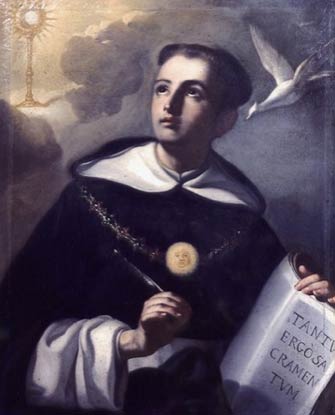
Nothing, except You Lord.
The robe, the words, the friends, the works … all, he ever said after, we’re straw. Of course, he still offered his energy for the Church, but He was ever after a man utterly, and simply, content to be filled with God.
We are too, every time we receive the Eucharist. Do we surrender all our worries and words and works and weariness to Christ, as He receives us? Let us take his words to do so:
O God, who to us in this wonderful Sacrament, bequeathed a memorial of Your Passion: grant, we beseech, that we, in worshipping the Holy Mysteries of Your Body and Blood, may within ourselves continually perceive the fruit of Your redemption. You who live and reign forever and ever. Amen
– Fr. Dominic has prayed before the crucifix that spoke to Thomas, celebrated Mass upon his tomb, and spent an afternoon in the cell in the abbey where he died. But I am closer to him at every Mass when the whole host of heaven surrounds the sacrifice of Christ than I ever was visiting those sites. And, I am closer to His heart when I come before the Blessed Sacrament, when my mind and heart and body are caught up in Our Lord, Who so completely remained in him.
Sunday of the Word of God
A little over a year ago, Pope Francis issued a document in which he declared that the Third Sunday of Ordinary Time be celebrated at the Sunday of the Word of God. In this letter, the Holy Father had promised previously that he would set aside a Sunday so that the faithful could give special attention to the Scriptures. He wrote the following:
Devoting a specific Sunday of the liturgical year to the word of God can enable the Church to experience anew how the risen Lord opens up for us the treasury of his word and enables us to proclaim its unfathomable riches before the world.
I welcome this decision by the pope, as I have become more and more convinced at how powerful the Scriptures can be for us, as they speak to us in ways that encourage us and challenge us, thus pushing us forward in our journey of discipleship. I have had the practice of reading from the New Testament for 5 minutes each day, and by doing so, I have been amazed at how my love of the Word of God has grown. At the beginning of this month, I was made aware of a podcast hosted by Ascension Press titled “The Bible in a Year (with Father Mike Schmitz).” I have been listening every day and I have really enjoyed it, especially listening to the Old Testament in short chunks. Even if you signed up now, you would be getting through most of the Bible in one year. These are just two examples that work for me. There are many different ways in which to have more regular contact with the Word of God. Maybe today can be a day to make a resolution to be more intentional with regards to your relationship with the Word of God.
It is very fitting that that Sunday of the Word of God falls during this month during which we are focusing on the Sacrament of the Eucharist, the sacrament in which we receive the Word of God made flesh in Holy Communion. We speak of His Real Presence in the Eucharist, and that is one of the greatest gifts that we have as Catholics. But just because we have the Eucharist does not mean we do not need the Word of God as much; we need them both. To highlight how interconnected these two are, I share the following from Pope Benedict XVI’s document on the Word of God:
The sacramentality of the word can thus be understood by analogy with the real presence of Christ under the appearances of the consecrated bread and wine. By approaching the altar and partaking in the Eucharistic banquet we truly share in the body and blood of Christ. The proclamation of God’s word at the celebration entails an acknowledgment that Christ himself is present, that he speaks to us, and that he wishes to be heard. Saint Jerome speaks of the way we ought to approach both the Eucharist and the word of God: “We are reading the sacred Scriptures. For me, the Gospel is the Body of Christ; for me, the holy Scriptures are his teaching. And when he says: whoever does not eat my flesh and drink my blood (Jn 6:53), even though these words can also be understood of the [Eucharistic] Mystery, Christ’s body and blood are really the word of Scripture, God’s teaching. When we approach the [Eucharistic] Mystery, if a crumb falls to the ground we are troubled. Yet when we are listening to the word of God, and God’s Word and Christ’s flesh and blood are being poured into our ears yet we pay no heed, what great peril should we not feel?” Christ, truly present under the species of bread and wine, is analogously present in the word proclaimed in the liturgy. A deeper understanding of the sacramentality of God’s word can thus lead us to a more unified understanding of the mystery of revelation, which takes place through “deeds and words intimately connected”; an appreciation of this can only benefit the spiritual life of the faithful and the Church’s pastoral activity.
Father Alford
Eucharistic Miracles
Last week, I reflected on the reality of transubstantiation, the moment when the substance of bread and wine are changed to the substance of body and blood. This happens at the Consecration, just before the priest lifts the host and chalice to show the people. Strictly speaking, a miracle occurs at every Mass when the bread and wine are changed into the body and blood of Jesus, even while the appearance of bread and wine remains. However, sometimes God also allows the appearance of bread and wine to be changed. God usually allows this type of miracle to occur to strengthen the weak faith of an individual or even a whole community.
The first recorded Eucharistic miracle took place in 750 AD when a Catholic priest was having serious doubts about Jesus’ Real Presence in the Eucharist. At the time of the Consecration, the consecrated bread and wine turned into human flesh and human blood right there on the altar. This occurred in a town called Lanciano, which was named after the lance that pierced Jesus’ side, allowing blood and water to pour out. Amazingly, this flesh and blood has not decomposed to this day, and visitors to Lanciano can still visit and venerate them. In 1973, the World Health Organization did a series of tests on this flesh and blood and the findings were astounding. The flesh is a piece of heart tissue from the left ventricle. The blood is type AB which is the universal recipient. Both the flesh and blood showed signs of being alive.
More recently, there have been several similar miracles around the world. Two of these miracles occurred in the Archdiocese of Buenos Aires when Pope Francis was the bishop of that diocese. In 1992, some particles of the Eucharist were placed in the tabernacle to dissolve and be properly disposed of, and they were later found to have changed into a red substance. In 1996, another Eucharistic host in Buenos Aires was placed in the tabernacle to dissolve, and later it was found to be bloody. Not all Eucharistic miracles have been scientifically investigated, but the ones that have been investigated produce similar results: the flesh is from the heart and the blood is type AB.
Blessed Carlo Acutis was just declared “Blessed” by the Church in October. He was an Italian teenager who died at the young age of fifteen from leukemia. Young Carlo was known for two things by his family and friends: his great devotion to Jesus in the Eucharist and being a total computer geek. He combined these two passions and made a website in which he catalogued all known Eucharistic miracles from church history. He had a goal of making a pilgrimage to all these sites in his lifetime, but he did not have the chance to do so because of his cancer. He started this project when he was eleven and finished when he was fifteen.
Blessed Carlo was greatly inspired by these Eucharistic miracles. Even though he had the strong faith of a saint, his faith was still nourished by this manifestation of God’s power and his great love for us. This can give us a clue as to why Jesus sometimes allows Eucharistic miracles. He wants to draw even greater attention to the Eucharist in the Church and he wants us to make the Eucharist the center of our Christian lives. On his website, Carlo wrote, “The more Eucharist we receive, the more we will become like Jesus, so that on this earth we will have a foretaste of heaven.” How true this is! Blessed Carlo, please pray for us, so that we can love Jesus in the Eucharist as much as you did.
The stories from this article were paraphrased from an article entitled, “The Amazing Science of Recent Eucharistic Miracles: A Message from Heaven?” by Jeannette Williams. For more information, see media.ascensionpress.com.
Week of Jan. 25 Mass Intentions
Monday, January 25
7am – Special Intention for Heather McMillen
(Chris Sommer)
5:15pm – Sr. M. Pauletta Overbeck, OP
(Becky & Woody Woodhull)
Tuesday, January 26
7am – Anna A. Eleyidath
(Augustine Eleyidath)
5:15pm – Terry Beggs
(Joan Stannard)
Wednesday, January 27
7am – Repose of the Soul of Averil Rossiter
(Jane Fornoff)
5:15pm – Rev. Samuel Kothapalli
(Joan Stannard)
Thursday, January 28
7am – Special Intention for Erin S.Danaher
(Chris Sommer)
5:15pm – Anna Eleyidath
(Augustine Eleyidath)
Friday, January 29
7am – Bonnie Donnals
(Roberts Families)
5:15pm – John & Edith Bakalar
(John Busciacco)
Saturday, January 30
8am – Angeline Sherman
(Linda Keller)
4pm – John (Jack) McCarthy
(Family)
Sunday, January 31
7am – For the People
10am – Boyd Warner
(Sue Warner)
5pm – Charles & Mercedes Nesbitt
(Kathy Frank)
Prayer Wall – 01/19/2021
Please pray for Wendy, mother of 4, facing Stage 4 cancer.
I’ve Been Here Before
As you are likely aware by now, the priests of the Cathedral (minus Bishop Paprocki and Father Peter who were away at the time) had to go into quarantine due to close contact with a person who tested positive for COVID-19. The first day or two of quarantine involved getting adjusted to a new, albeit temporary, way of life. But after settling into a routine, I found myself thinking: “I’ve been here before.”
Now, this is my first (and hopefully last) time of being in quarantine, but I could not help but feel like there was something very familiar about this experience. The “here” to which I have been is the experience of living life as a priest physically separated from the faithful. In particular, it is the experience of not being able to celebrate Mass with the people physically present that strikes me, something I had to endure for nearly three months this past Spring. Of course, during that time, I still celebrated Mass every day and even though people (including my mom in Texas) joined me every day virtually, it just was not the same. As I am in this situation again (though thankfully for a shorter length of time), I continue to celebrate Mass every day, knowing that doing so is more than just a personal devotion, but that every Mass benefits the entire Church regardless of who is present. Nevertheless, it is hard to escape that unsettling feeling.
However, lest I let my feelings have the final say, I am also reminded of the words of St. Paul: “We know that all things work for good for those who love God, who are called according to His purpose.” (Romans 8:28) The “good” that the Lord is working to bring about in this experience for me is the reminder of something that we Catholics (priests included) can sometimes overlook, namely, that what takes place at Mass far exceeds what we see, hear, or feel. In his last Encyclical Letter, Pope St. John Paul II addressed this very point:
This is an aspect of the Eucharist which merits greater attention: in celebrating the sacrifice of the Lamb, we are united to the heavenly “liturgy” and become part of that great multitude which cries out: “Salvation belongs to our God who sits upon the throne, and to the Lamb!” (Rev 7:10). The Eucharist is truly a glimpse of heaven appearing on earth. It is a glorious ray of the heavenly Jerusalem which pierces the clouds of our history and lights up our journey. (Ecclesia de Eucharistia, 19).
I know that when I return from quarantine, I will be filled with joy at the opportunity once again to celebrate Mass with and for the faithful physically present. At the same time, I will have a greater awareness of how, at each Mass, Heaven and earth unite and we join with the whole host of Heaven in praising God. I pray that each of us will come to better appreciate how truly remarkable each and every Mass is, no matter how large or small.
Father Alford
Transubstantiation
Transubstantiation may be the fanciest word that I ever use with somewhat regularity. I was not sure about the wisdom of writing my article on this word because it’s a little technical, but then I remembered that I taught this word to some first- and second-graders one summer, so if they can handle, so can we.
This word began to be used by Catholic theologians in the 1200’s, especially St. Thomas Aquinas, to describe what happens when the bread and wine become the body and blood of Jesus at Mass. Up until this time, theologians did not have a word for what happens, because what happens at Mass does not happen anywhere else: one thing is changed into another without the appearance changing. Because this had never been a part of our human experience, there was no word to describe it. The word “transformation” gets at the idea, but transformation simply refers to the visual form of something; the form or image of something is changed. Catholics wanted to have a word to describe the events of Mass in a more exact way.
As I wrote last week, Catholics have always reflected on the question from scripture, “How can this man give us his body to eat?” Some ask this question in disbelief; some ask it in faith. The Church wanted to help us understand Jesus’ gift of the Eucharist to us in a fuller way. So, someone had to invent a new term! Transubstantiation is the word that theologians began to use to describe what happens when the bread and wine become the body and blood of Jesus. The substance (what something is) of the bread and wine is changed into the substance of body and blood, while there is no change in the shape, size, color, taste, or location of the object itself. If somebody has a gluten intolerance, he or she will still have the same effects from consuming the Eucharist. Consuming too much of the Blood of Christ will also have the same effect as drinking too much wine. (Every once in a great while, God also changes the shape and appearance of the Eucharist into that of body and blood. This is the topic for a future column.)
Some Christians did not like the use of this new term because it seemed overly technical, and they thought that people with strong faith should not worry about technicalities. However, the Church disagreed and officially adopted this term at the Council of Trent (1545-1563) to describe what happens during the Consecration at Mass. If you care to read it, here is what the Council declared:
“But since Christ our Redeemer declared that to be truly His own body which He offered under the form of bread, it has, therefore, always been a firm belief in the Church of God, and this holy council now declares it anew, that by the consecration of the bread and wine a change is brought about of the whole substance of the bread into the substance of the body of Christ Our Lord, and of the whole substance of the wine into the substance of His Blood. This change the holy Catholic Church properly and appropriately calls transubstantiation.”[1]
It really is an awesome belief – that when we receive the Eucharist at Mass, we receive the entirety of God into our bodies and into our hearts. This makes us, for a few minutes, real tabernacles, just as we find in every Catholic Church. We carry God within us as we leave Mass and go out into the world. Tabernacles are usually embellished with gold plating and beautiful artwork to show the beauty of Jesus who dwells inside. We should be the same. Our actions and whole way of being should be impacted by Who we carry inside of us. How can we be better tabernacles for Jesus?
[1] Quote taken from The Canons and Decrees of the Council of Trent, trans. By Reverend H.J. Schroeder. (Tan Books: Charlotte, North Carolina. 1978.)
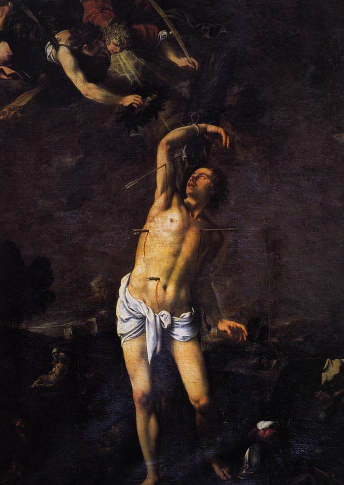
St. Sebastian: One Eucharistic Faith
Feast Day: January 20th
We all know the story of St. Sebastian. Who? Soldier, in the Praetorian Guard of Diocletian. What? Christian, converting others. Where? From Gaul, now in Rome. When? 300s. Why? …
Why?
Why did a sturdy, young man, in the prime of his life, rising towards the highest ranks of the Roman army, make such a big deal out of his faith that he got himself killed for it? Sebastian knew Diocletian was not a fan of Christians, and was looking for somebody to scapegoat and throw the power of Rome against. He knew, as a Praetorian guard, that his actions were going to be doubly scrutinized for fidelity to the emperor. He knew that Marcus and Marcellian, twins also in the guard, and deacons in the Church, had been imprisoned after refusing the usual sacrifices. And yet, when the twins’ affluent parents, Tranquillinus and Martia, came to try and convince their sons to just offer the incense and not get themselves killed, Sebastian converted them, and then he converted the prefect, Chromatius, who had imprisoned them to the true faith.
Why??
Diocletian had Sebastian tied to a stake and shot at for target practice. He survived! He came back to Diocletian and called him out for his persecution of Christians! The emperor, shocked that he was alive, and that this minion had the gall to confront his emperor, had him beaten to death and thrown in a sewer. This time, the crown of martyrdom was granted to him.
Why???
Why make a scene? Why convert others to the faith when it was just going to get them, and him, killed? Why go backafter you survive martyrdom the first time around? Why not just go along with the incense thing, drop a pinch on the charcoal, say a prayer to Jesus under your breath, and live a normal life?
Because as Christians “yet for us there is one God, the Father, from whom are all things and for whom we exist, and one Lord, Jesus Christ, through whom are all things and through whom we exist.” (1 Cor 8:6). Perhaps you have heard those words before? Perhaps you have not realized that Paul is taking the most important prayer of the Jewish faith, the shema, the great prayer professing belief in one God – “Hear, O Israel: The Lord our God is one Lord;and you shall love the Lord your God with all your heart, and with all your soul, and with all your might”. (Dt 6:4) – and St. Paul finds Jesus within that prayer. It is a breathtaking, marvelous, astonishing twist in the saga of salvation history. God is one, and God is three.
Everything the Jews practiced – keeping the sabbath holy, circumcision of their sons, following the dietary laws, reciting daily prayers and psalms, following the decalogue and torah – all these were cultural means of maintaining their worship of the one true God. As Christians, we do not have such cultural norms, instead, we, from every culture under heaven, must conform our lives completely to Christ, Our Lord.
Have this mind among yourselves, which was in Christ Jesus,who, though he was in the form of God, did not count equality with God a thing to be grasped, but emptied himself, taking the form of a servant, being born in the likeness of men. And being found in human form he humbled himself and became obedient unto death, even death on a cross. Therefore God has highly exalted him and bestowed on him the name which is above every name, that at the name of Jesus every knee should bow, in heaven and on earth and under the earth, and every tongue confess that Jesus Christ is Lord, to the glory of God the Father. (Ephesians 2:5-11)
Why?
Because every time we receive Holy Communion, we are giving our lives as living sacrifices in union with the one sacrifice of Christ. We are offering ourselves crucified with Christ to the one true God, committing ourselves to adoring Him alone. We choose to announce Him as the only true King, and to conform our hearts, minds, souls, and bodies, to be like His, and to be His alone!
St. Sebastian is the patron saint of soldiers, athletes, and plague-victims. His Eucharistic faith, His Eucharistic commitment, His Eucharistic self-sacrifice must be an example to all of us of our Eucharistic belief in One God, and a reminder that every day offers us the chance to recommit ourselves to that belief.
– Fr. Dominic Rankin once was with Bishop for a Confirmation and realized that 6 of the young guys, who had all conveniently, and humorously, arrayed themselves in the front row, had all taken St. Sebastian as their Confirmation patron. My usual vocation spiel immediately changed as I challenged those guys, and myself, to be willing to lay down our lives for our One Lord.