Please pray for Aaron B. who has stage 4 cancer. He is a husband and the father of 2 young children.
Prayer Wall – 03/18/2021
Please pray for Jerry who is suffering complications due to a stem cell transplant and for Kathy, recently diagnosed with lymphoma.
St. Joseph – Intercessor Extraordinaire
As I mentioned a couple of weeks ago, Pope Francis has designated this year to be a Year of St. Joseph, marking the 150th Anniversary of the Proclamation of St. Joseph as the Patron of the Universal Church by Blessed Pope Pius IX on December 8, 1870. To kick off the year, Pope Francis released a beautiful reflection on St. Joseph in his Apostolic Letter, Patris corde. I highly encourage you to read this relatively short letter, especially during this month dedicated to him.
There is a hidden nugget to be found in this letter that I did not discover when I first read it. That nugget is found not in the main text of the letter, but in the footnotes! The footnote is referenced by the following line in the text which seems rather insignificant. The Holy Father writes:
Every prayer book contains prayers to Saint Joseph. Special prayers are offered to him each Wednesday and especially during the month of March, which is traditionally dedicated to him.
Great. Thanks for the heads up, but who takes the time to jump to read every footnote? But reading this footnote is like finding gold, as it offers something very personal and beautiful about Pope Francis and his personal devotion to St. Joseph. Here is how the footnote reads:
Every day, for over forty years, following Lauds I have recited a prayer to Saint Joseph taken from a nineteenth-century French prayer book of the Congregation of the Sisters of Jesus and Mary. It expresses devotion and trust, and even poses a certain challenge to Saint Joseph: “Glorious Patriarch Saint Joseph, whose power makes the impossible possible, come to my aid in these times of anguish and difficulty. Take under your protection the serious and troubling situations that I commend to you, that they may have a happy outcome. My beloved father, all my trust is in you. Let it not be said that I invoked you in vain, and since you can do everything with Jesus and Mary, show me that your goodness is as great as your power. Amen.”
What a moving prayer that is! When we think of St. Joseph as Patron of the Universal Church, we might think that our own needs are so minor in comparison to all of the needs of the Church throughout the world. Does he really have time to listen to my prayers and struggles? Absolutely! Just as a good father has time and concern for the individual needs of each of his children, so too with St. Joseph, our father and lord (as St. Josemaria Escriva likes to call him). I think the above prayer prayed each day by our Holy Father is a witness to that reality. Perhaps you and I could adopt that same practice of turning to St. Joseph each day, asking for his help in bringing about a happy outcome to every struggle we entrust to his intercession.
Father Alford
What does the Anointing of the Sick do?
We all know that the Anointing of the Sick should be offered to all Catholics who are nearing death, and also those who are facing a serious illness or weakness from old age. The Church talks about four specific graces that Jesus offers to those who receive this special sacrament. This can be found in the Catechism of the Catholic Church, paragraphs 1520-1523.
The first grace is described as “a particular gift of the Holy Spirit.” People who have received this sacrament can probably testify to the effects of this gift of the Holy Spirit. In this moment, God gives strength, peace, and courage in the face of difficulty. This courage also helps one to be victorious in the battle that takes place “at the hour of our death” as we pray in the Hail Mary. In the moments before death, the devil knows that it is his last chance to tempt us to despair. The grace of God comes in at this very moment to strengthen us! Also, one’s sins can be forgiven if they were not able to receive Reconciliation. The soul is healed and the body is also healed, if God wills it for one’s spiritual good.
The second grace of this sacrament is a special union with the passion of Christ. Through our baptism, we are all united with Christ’s death and resurrection in a spiritual way. However, when our bodies die, we share with Christ’s death in a physical way. As we near this moment, our suffering is especially close to the suffering that Jesus endured in his Passion. As St. Paul tells us, our suffering fills up what is lacking in the sufferings of Christ, and Jesus uses our suffering for the salvation of the world.
The third grace is called an ecclesial grace. “Ecclesial” refers to the Church. In addition to uniting one to Christ, the Anointing unites one more fully to the Church. They can experience a special closeness to the saints in heaven, and their suffering becomes a gift to the entire Church throughout the world.
The fourth and final grace of the Anointing of the Sick is a preparation for the final journey. This is the last sacrament many will receive before passing away (except for Viaticum hopefully). We all receive several anointings during the celebration of the sacraments: two anointings in Baptism, one in Confirmation, and for priests, at the reception of Holy Orders. This final anointing fortifies the end of our earthly life as we prepare for the journey from earthly life to eternal life.
The Anointing of the Sick certainly offers us many graces at what may be the lowest point of our lives. “Precious in the eyes of the Lord is the death of his faithful.” The Lord is very close to us in our suffering, and especially in our death. This past Friday, we just celebrated the Solemnity of St. Joseph. He is the patron saint of a happy death, and we should all pray that we will die a “happy death.” God did not make death, but he has transformed it into the gateway of eternal life. May we all pray that we will receive the gift of the Anointing of the Sick before we die, so that we can receive all these gifts that Jesus desires to offer us.
Caiaphas’ Take on the First Palm Sunday
The lightning had struck early in the morning, on the tenth day of Nisan, the very day on which the procurator returned to the city for his usual stay during the Passover. Not unheralded – for some days past the clouds had been gathering. Agents reported a growing feeling of unrest among the early pilgrims, a few rumors, many rumors, a sea of rumors that “he” was coming, that this time “he” would declare himself openly for what he was, that nothing and nobody would be able to stop the beginning of the “new time”, that the events at the Feast of Tabernacles were no more than a prelude, that no other day but the Passover feast could usher in the coming of the Messiah, the day commemorating Israel’s delivery from bondage.
The old quotations ran from mouth to mouth again, about the “Son of David”, the Anointed One, who would bring peace and happiness to the world, the one of whom Jaqob spoke in the forty-ninth chapter of Genesis: “The scepter shall not be taken away from Judah, or a ruler from his thigh, till he come that is to be sent, and he shall be the expectation of the nations”; quotations from the psalms of David foretelling the coming of the Messiah and Isaias’ dak cry, “Prepare ye the way of the Lord; make straight in the wilderness the paths of our God.” And they were talking of Jochanaan, the Baptist, as the forerunner Isais mentioned. They called up the prophets one by one, Jeremiah and Ezechiel, Amos and Zacharias and Daniel – but they meant that the day was approaching when the Messiah would scatter the Romans and make an end to their rule.
Then suddenly somebody spread the news that “he” had arrived, that “he” was in Bethany and preparing to enter “his” city, and the news raced across Jerusalem like wildfire, and everywhere people bunched together and shouted with excitement and broke off palm branches and streamed out to receive the King Messiah.
And from then on the messengers came in wild-eyed, spluttering and stammering, scarcely any one of them able to deliver a cold, clear report. And no wonder.
It was incredible but true. He really dared to come out in the open. He came riding on a donkey. Of course! He knew his Scripture. He had read his Zacharias: “Rejoice greatly, O daughter of Sion, shout for joy, O daughter of Jerusalem; Behold thy King will come to thee, the just and Savior; he is poor, and riding upon an ass, and upon a colt the foal of an ass.”
Many hundreds of people came with him. They had gone out to Bethany to fetch him in state, and they found him, of course, as the Romans did not, the Romans who could have prevented all this so easily, if only they had acted at once when the High Priest sent them the message.
That man Eleazar was with the Nazarene telling everyone that he had been raised from the dead, and a number of witnesses cried that they had seen it with their own eyes. And the crowds swelled bigger and bigger, and they shouted “Hosanna!”, “Save…”, and “Blessed be he who cometh in the name of the Lord!” The priest who came to tell the High Priest about it could scarcely articulate for anger against such blasphemy.
– From The Spear, by Louis de Wohl, 1998. p275-276.
I certainly recommend all of Louis de Wohl’s books, many which bring the reader vividly into the lives of different saints, but this one, The Spear, he rightly considered his best. If you read it, you will find in yourself the same fears and scheming that consumed Caiaphas, the same love and ardor of Martha and Mary, alongside the wonder-struck crowd as Lazarus stepped from his tomb, and moved to see Christ, filled with longing and loneliness, enter into the city of Jerusalem and take up his cross. This bringing ourselves into the Passion of Jesus, is not the story of a saint, it is the story of every saint!
– Fr. Dominic Rankin was on a mission trip in Tanzania when he first read this tremendous historical fiction by Louis de Wohl. He read it over Holy week and Easter week two years ago, and his imagination has remained transformed by the imagery and characters ever since. It is books like this that have fostered his desire to vibrantly recount the stories of the saints, as well as inspired in him a new and vivid meditation on the stories we know so well in Scripture.
Mass Intentions
Monday, March 22
7am – Anna A. Eleyidath
(Augustine Eleyidath)
12:05pm – Roger Bartley
(Lou Ann & Carl Corrigan)
5:15pm – Pius Onyejiaju Chineke
(Anonymous)
Tuesday, March 23
7am – Jean Reno (Greenwald)
(LouAnn & Carl Corrigan)
12:05pm – Catherine Ponce
(Maggie & Joe Groboski)
5:15pm – George J. Nicoud, Sr.
(Tim Nicoud)
Wednesday, March 24
7am – Joseph Kohlrus, Sr.
(Augustine Eleyidath)
12:05pm – Sophia Bartoletti
(Bartoletti Family)
5:15pm – William Boyle
(Billy LeCrone)
Thursday, March 25
7am – Jean Reno (Greenwald)
(LouAnn & Carl Corrigan)
12:05pm – Patricia Scherrills
(Family & Friends)
5:15pm – George Friedel
(Frank & Nancy Diak)
Friday, March 26
7am – Anna A. Eleyidath
(Augustine Eleyidath)
12:05pm – Vivian Boyle
(Billy LeCrone)
5:15pm – Steven Coogan
(Lou Ann & Carl Corrigan)
Saturday, March 27
8am – Ben Garde
(Family)
4pm – Evelyn Lauer
(Rebecca & Woody Woodhull)
Sunday, March 28
7am – Mary Ann Midden
(William Midden)
10am – For the People
5pm – Delia Sinn
(Pamela Hargan)
Prayer Wall – 03/13/2021
For our son Jonny wife Kelly to have Safe delivery and good health of twin grandchildren.
St. Joseph – Patron of a Happy Death
Several years ago, I came across a drawing in an old Catholic book, probably a Catechism of some sort. One of the pictures in the book depicted a person in the hospital surrounded by a priest and family members. The person in the bed had a peaceful, joyful look on his face. The caption for the picture said something about the importance of praying for a happy death. This might strike us as a little odd today, because we generally do not like to think much about death, and when we do, it does not often evoke a happy response.
But as Christians, we should not fear death, for we believe that we who have been baptized into Christ have been baptized into His death, which grants us a share in His victory over death in the Resurrection. The funeral liturgy of the Church states it well with these words: “Indeed for your faithful, Lord, life is changed not ended.” (Roman Missal, Preface I for the Dead). We should therefore not fear death, but see it as the doorway through which we pass on our way to our heavenly reward where there will be no more suffering, but only joy and peace in the Lord. In our last moments, there is a particularly intense battle that goes on where the devil tries one last time to frighten us, to discourage us, and to tempt us to doubt the mercy of God. The Church offers us many gifts as we face this final struggle, especially the Sacrament of the Anointing of the Sick, which confers a particular gift of the Holy Spirit “who renews trust and faith in God and strengthens against the temptations of the evil one, the temptation to discouragement and anguish in the face of death.” (CCC 1520)
Another gift we have at our disposal is the intercession of St. Joseph, who has among his various titles that of being Patron of a Happy Death. Tradition tells us that St. Joseph died in the peaceful presence of Jesus and Mary, who would have been a source of great comfort to him in his final moments. Having experienced this great grace, from his place in Heaven, he desires that we too should have that same opportunity, to be comforted in our final moments by the presence of Jesus and our Blessed Mother, and indeed all of the saints. The Catechism summarizes this point succinctly and beautifully:
The Church encourages us to prepare ourselves for the hour of our death. In the litany of saints, for instance, the Church has us pray: ‘From a sudden and unforeseen death, deliver us, O Lord’; to ask the Mother of God to intercede for us ‘at the hour of our death’ in the Hail Mary; and to entrust ourselves to St. Joseph, the patron of a happy death.” (CCC 1014)
Another title for St. Joseph is that he is the Terror of Demons. While that title could justify an entire reflection, we can simply recognize how St. Joseph comes to our aid in a special way at the moment of death, fighting against the demons who try to discourage us. We can be at peace knowing this holy man is fighting on our behalf, so that we can keep our minds and hearts fixed on the promise of Jesus who is preparing to bring us into glory in the Kingdom.
If you have not already done so, please consider making it a regular practice to ask St. Joseph to obtain for you a Happy Death. Not only can we count on his protection in those final moments, but he will also help us on this journey no longer to fear death, but to look forward with joy to what awaits us in Heaven.
Father Alford
Last Rites?!
The Sacrament of the Anointing of the Sick has sometimes been referred to as the “Last Rites.” This means that the Anointing is the last “rite” or ceremony someone would receive before death. While this is true, Anointing is not only for those on the verge of death. Vatican II specifically wanted to correct this understanding of the sacrament. As we learned last week, the Apostle James asked, “Are there any sick among you? Let them call for the priests of the Church…” The Anointing of the Sick is for any baptized Catholic who is facing a serious sickness, not just those on the verge of death. Here is what paragraph 73 of the document on liturgy from Vatican II said about the Anointing of the Sick:
“Extreme unction,” which may also and more fittingly be called “anointing of the sick,” is not a sacrament for those only who are at the point of death. Hence, as soon as any one of the faithful begins to be in danger of death from sickness or old age, the fitting time for him to receive this sacrament has certainly already arrived (Sacrosanctum Concilium 73).
The Church hopes that every Catholic who is facing a serious physical illness would be Anointed in these times of difficulty. Far too often, Catholics are hesitant to call a priest until their loved one is on the point of death. Unfortunately, there are times when they do wait too long and their loved one passes before the priest can make it. In addition, it is ideal for a person who is nearing death to also receive the sacrament of Reconciliation and the Eucharist at the time of the Anointing. If a person is unconscious, they cannot receive Reconciliation, although they can sometimes still receive a very small particle of the Eucharist.
It would be helpful if we had a slight shift in our vocabulary regarding Last Rites and the Anointing of the Sick. As the Council said, it is more fitting that we refer to this sacrament as the Anointing of the Sick, rather than Last Rites. This shift in vocabulary would help us as Catholics come to a better understanding and appreciation of this sacrament of healing.
Some people are too intimated to call a priest and ask him for the Anointing of the Sick. This is understandable, but if you don’t want to call, feel free to approach a priest after Sunday Mass and ask him if he has as few minutes to celebrate the Anointing of the Sick. Usually it is no problem, although sometimes the priest may have to be somewhere shortly after Mass. While priests have the reputation for being busy, we are never too busy to give someone the Anointing of the Sick, especially when the situation is urgent, or a new health complication has arisen. If there is an emergency, such as someone having a heart attack or accident in the evening or night-time, the Cathedral rectory has an emergency extension which rings all of the phones in all of the priests’ offices and residences. Typically, at least one of us is home at any given time after-hours.
On Christmas day, I received an emergency call to come to somebody’s home and offer them the Anointing of the Sick. The family was apologetic for “bothering” me on Christmas day, but I did not find it to be a bother at all, and I think almost all priests would agree with me. We do not stop being priests when the office closes, and as Catholics, our sacramental needs are not limited to business hours. We don’t mind being called upon after-hours to celebrate the Anointing of the Sick. (Just please do not use the emergency line for everyday business questions!)
In the coming weeks, I will discuss why it is so good for Catholics to receive the Anointing of the Sick, not only at the point of death, but whenever they are in the face of serious suffering. It is a sacrament of encouragement and healing, which Jesus desires for us to experience!
St. Patrick: “He Who loses his life for My sake will save it.”
Feast Day: March 17th
With Fr. Alford covering the more important saint this week (and year!), St. Joseph, the obvious story for me to tell is that of St. Patrick. Well, actually, let’s have him tell us the tale. This is his “Confessio”.
[12: His introduction]So I am first of all a simple country person, a refugee, and unlearned. I do not know how to provide for the future. But this I know for certain, that before I was brought low, I was like a stone lying deep in the mud. Then he who is powerful came and in his mercy pulled me out, and lifted me up and placed me on the very top of the wall. That is why I must shout aloud in return to the Lord for such great good deeds of his, here and now and forever, which the human mind cannot measure.
[16: Enslavement in Ireland] After I arrived in Ireland, I tended sheep every day, and I prayed frequently during the day. More and more the love of God increased, and my sense of awe before God. Faith grew, and my spirit was moved, so that in one day I would pray up to one hundred times, and at night perhaps the same. I even remained in the woods and on the mountain, and I would rise to pray before dawn in snow and ice and rain. I never felt the worse for it, and I never felt lazy – as I realise now, the spirit was burning in me at that time.
[19: Making his escape] After three days we made it to land, and then for twenty eight days we travelled through a wilderness. Food ran out, and great hunger came over them. The captain turned to me and said: “What about this, Christian? You tell us that your God is great and all-powerful … I said to them with some confidence: “Turn in faith with all your hearts to the Lord my God, because nothing is impossible for him so that he may put food in your way – even enough to make you fully satisfied! He has an abundance everywhere.” With the help of God, this is actually what happened! A herd of pigs appeared in the way before our eyes! They killed many of them and there they remained for two nights, and were fully restored…
[23] A few years later I was again with my parents in Britain. They welcomed me as a son, and they pleaded with me that, after all the many tribulations I had undergone, I should never leave them again. It was while I was there that I saw, in a vision in the night … They called out as it were with one voice: “We beg you, holy boy, to come and walk again among us.” This touched my heart deeply, and I could not read any further; I woke up then. Thanks be to God, after many years the Lord granted them what they were calling for.
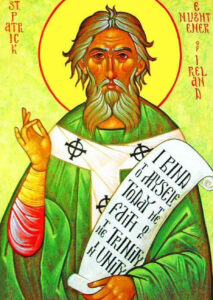
[51: after shepherding the Irish people for decades] I spend myself for you, so that you may have me for yours. I have travelled everywhere among you for your own sake, in many dangers, and even to the furthest parts where nobody lived beyond, and where nobody ever went to baptise and to ordain clerics or to bring people to fulfilment. It is only by God’s gift that I diligently and most willingly did all of this for your good.
[60: His concluding plea] The sun which we see rising for us each day at his command, that sun will never reign nor will its splendour continue forever; and all those who adore that sun will come to a bad, miserable penalty. We, however, believe in and adore the true sun, that is, Christ, who will never perish. Nor will they perish who do his will but they will abide forever just as Christ will abide forever. He lives with God the Father almighty and with the Holy Spirit before the ages began, and now, and for all the ages of ages. Amen … [62] I pray for those who believe in and have reverence for God. Some of them may happen to inspect or come upon this writing which Patrick, a sinner without learning, wrote in Ireland. May none of them ever say that whatever little I did or made known to please God was done through ignorance. Instead, you can judge and believe in all truth that it was a gift of God. This is my confession before I die.
– Fr. Dominic Rankin immensely enjoys corned beef and cabbage, but asks himself this week whether he enjoys prayer as much as the young Patrick? He has rarely suffered serious hunger, but wonders if he would have faith-enough to ask for food miraculously? He loves his family and would find it terribly hard to leave them behind for the Gospel. He has also baptized and preached, but has never been beaten because of it. What if I were to die this week, or this year? Would my “Confessio”, my autobiography, be about me, or about Christ? That might be a good question as I pray St. Patrick’s “Lorica” this week!