There are close to 7.6 billion people currently on earth. That is a lot of people! If you try to estimate how many people have collectively been born since the beginning of time, a good guess is 108 billion! It is hard to contemplate that many distinctly different human beings created by our God. In the midst of all those people, where do you and I fit? Can we really be created to make a difference in the world? One can feel very small and insignificant when reflecting on the numbers.
We render ourselves insignificant when we make the mistake of seeing ourselves as being just like everybody else. However, when looking at the numbers, how can one honestly think we are all the same? Another way we become insignificant is believing the lie that one person in the midst of so many does not have the power to make an impact. However, we all spend time reading books, watching movies, or listening to news about singular people who made all the difference in some part of the world. Imagine your own world without a few key people who have touched you and made a difference.
We are all created with unique gifts. We have those gifts that have been part of us from birth and those that have been imparted to us by the Holy Spirit. St. Paul tried to get the Corinthians to understand that reality when he explained to them the many gifts of the Spirit. Perhaps some of his audience back then thought they were insignificant. The message then remains the message today: God is counting on you to use what He has given you. If you don’t, who will?
Tracy Earl Welliver works for Liturgical Publications, Inc. and writes on various stewardship topics.
 The time has come for us to move beyond the manger, for white and gold to give way to green. Today we come to the end of the Church’s celebration of Christmas with the feast of the Baptism of the Lord and we prepare to enter into the liturgical season of Ordinary Time. This feast jumps us about thirty years forward in the Lord’s earthly life and is understood as the event that inaugurates his public ministry. The Scriptures that the Church has chosen for this feast bring us full circle from where our pre-Christmas journey began in Advent, to Christmas Day, and now to the end of this holy season.
 It is all wrong, or at least it seems wrong. Jesus has no need of John’s baptism. And yet, this is his first recorded act in all four Gospels.
 Because of Jesus’ sharing of his intimate life of prayer, we know that God is Trinity. Hinted at under various guises in the Old Testament, the Trinity is spoken of in a direct way in both the Gospels and the New Testament epistles. The Church later articulated what we know about it in clear and precise terms. The Trinity, a communion of divine Persons in utter unity, unveils an eternal foundation to what we mean by saying “God is love.” Nevertheless, the Trinity cannot be fully grasped, because God is mystery, far above human comprehension.
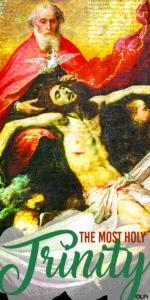 As Christians, we have learned to read Scriptures relating to the Father, Son, and Holy Spirit in light of the doctrine of the Trinity. This is an example of reading Scripture according to the analogy of faith (Catechism, no. 114). The early Christians understood the Trinity intuitively by faith, but they were not yet able to plainly articulate it. They could, however, sense heresy when something was awry in an interpretation. Out of controversies and debates and aided by the guidance of the Holy Spirit, the Church came over the course of several centuries to the full doctrine of the Trinity. Along the way, the Church even developed the term person as we use it today to speak of an individual of a rational nature. The doctrine of the Trinity states that there is one God, three distinct equal divine Persons – Father, Son, and Holy Spirit.
 We all know the drill. We should go to Mass on Sunday. We should go to Mass on Holy Days. And really, in general, we should worship God more in our daily lives.
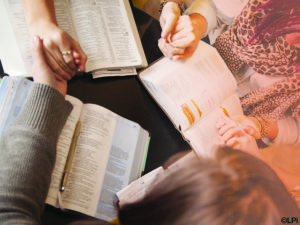 Catholics do not celebrate Mass because we should do it; rather we celebrate the Mass because we need to do it. Coming to the table, hearing scripture, and sharing a meal together are a vital part of our faith life. The Mass gives us the energy and nourishment to go out into the world and live the gospel life every other day of the week. So remember, skip the “shoulds” and determine what you need for a worship-filled life.
 How we do something is just as important as why we do it. As Christians, we are well aware of the injunction to serve the poorest and the most vulnerable. The prophets of Israel continually challenged the Hebrew people with this message and berated them for ignoring it. Our Lord Jesus himself makes it the criteria for judgment and distinction between the “sheep” and the “goats” in the twenty-fifth chapter of Matthew’s Gospel. “…when I was hungry … thirsty … a stranger … naked … sick … in prison …”
 As far as I know, Jesus never sent any person out alone on mission. When disciples went out on mission, sent by our Lord, they went out as at least two. There is value in community and there is value in serving the poor as a community. When I serve with others I have someone to share my thoughts with, I have someone to share a word or an insight when I might be lacking, I have another to share concern with and think new possibilities – other sets of eyes and ears, other hearts to care and minds to imagine. When I am alone in my service I have none of this. Recognizing how our Lord himself sent out his disciples in community, Sant’Egidio encourages service and friendship with the poor to be lived as community and not alone and individual. On our own we are too easily lost and too easily disillusioned. Service can easily become rigid and perfunctory. My experience is that a moment with the poor often has an Emmaus dynamic to it – the Lord is present but we often only recognize him in hindsight as our hearts burn within us and as we share together. It is good for disciples to serve together and it is good for disciples to share together. Apparently, Jesus thought so.
 I confess: I’ve never been particularly successful at keeping New Year’s resolutions because I’m more successful at finding excuses to ignore them. In years past I’ve been sidetracked by crowded gyms, the sniffles, and my general inability to resist temptation. This year, I decided I need some extra help, so I’m turning to the saints. I’m used to asking for the intercession of saints for big concerns, for example, laying my parenting woes at the feet of St. Monica, or asking for St. Peregrine’s support for a friend battling cancer. But what about intercession for life’s more mundane issues? Studies show we are more successful reaching goals when we enlist the help of a friend, and who better than our saint friends? Here are a few of my resolutions with the saints who will help me stay on track in 2019.