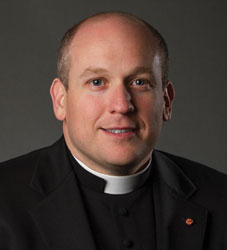
 A few weeks back I wrote in this column about what makes a cathedral a cathedral and I followed that article up with an article discussing a cathedral as being the bishop’s church and, therefore, “mother church” of the diocese. Being that a cathedral has that unique designation, you will at times unique liturgies and Masses celebrated at the cathedral. Even regular Sunday Masses when the bishop is celebrant are different, more “solemn” some might say or “higher.” This is because the bishop is the fullness of the priesthood, standing in the place of Christ our High Priest.
Masses where the bishop is the celebrant are traditionally termed “pontifical,” coming from the Latin word pontifex for “bridge builder.”
All bishops share this title, including the pope who is known as pontifex maximus (the greatest bridge builder), because their life and ministry are to be a bridge to Christ for all people.
At Mass, the bishop’s vesture is similar to what a priest wears, but with a few distinctions. A bishop makes use of a pectoral cross that he traditionally wears under his chasuble (outer vestment), but may also be worn over it. The cross is called a pectoral cross because it is to be worn at chest level in proximity to the bishop’s heart, keeping the mystery of the Lord’s Cross intimately close to him. At Mass, the cross is suspended from a green and cold silk cord. Outside of Mass or other liturgies, the pectoral cross is suspended from a chain for daily use.
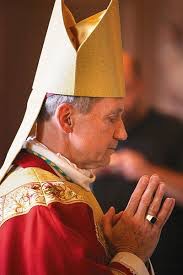 At his ordination, a bishop is given three specific symbol s of hi s episcopal office that he wears or uses at Mass. The first piece of vesture that is unique to a bishop is his episcopal ring. Like the pectoral cross, a bishop wears his ring not just at Mass but always. The ring is a two-fold symbol. First, it is a symbol of his office and the authority that comes with it. Second, even though the bishop wears his ring on his right hand, it is also a symbol of his spousal relationship with the Church.
The second piece of vesture that a bishop wears is his miter. The miter is a tall, pointed hat with two lappets that drape down the back. The miter is white, gold, or some variation of either color, and may be adorned. For funerals and penitential seasons, the miter is supposed to be plain white. The shape of the miter is meant to evoke a flame, a reminder of the gift of the Holy Spirit given to the Apostles at Pentecost. The lappets that drape down the back of the miter are symbols of the two Testaments of the Scriptures. Before the reforms following the Second Vatican Council, there were stricter and more specific norms governing color, material, and heights for miters, depending on the ritual and liturgical season.
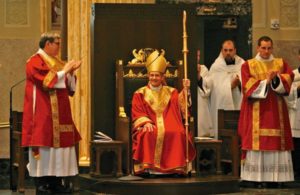 The third symbol used by a bishop at Mass is his crozier or pastoral staff. Resembling an elaborate shepherd’s staff, the crozier is symbol ic of the bishop’s sacred duty as head of the flock that is his diocese. The bishop makes use of the crozier since he stands in the place of Christ the Good Shepherd. Interestingly, a bishop outside of his own diocese may not use a crozier without the permission of the diocesan bishop of wherever he is. It was formerly the practice that when a bishop carried a crozier in another diocese that he carried it backwards, with the crook facing towards him, to show that he was not the chief shepherd in that place. Today this custom is no longer followed.
 Besides his cross and the three unique signs of his office previously mentioned, the bishop also wears a magenta zucchetto or skullcap on the crown of his head. The color of the zucchetto is key as it denotes the rank of the one wearing it; priests may wear a black zucchetto for certain occasions. At more solemn Masses, such as ordinations, the bishop also wears the vesture of all three ranks of Holy Orders. Along with the symbols of his episcopal office, and under the chasuble worn by bishops and priests, he also wears a dalmatic, the outer-sleeved vestment worn by deacons. He wears the vesture of all three offices because he is the fullness of the priesthood.
These are a few of the distinctions that you will notice when Bishop Paprocki celebrates Mass in the Cathedral, and in other parishes throughout the diocese. We find that none of these symbols or items of vesture are “just because” but that each of them has a sacred and symbolic value concerning our Faith and the mysteries that we celebrate.
Father Christopher House is the Rector of the Cathedral and serves in various leadership roles within the diocesan curia, namely Chancellor and Vicar Judicial.
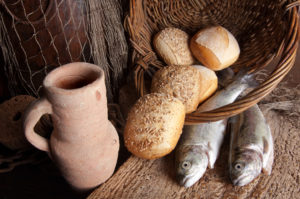 Today’s story begins with the crowd following Jesus and the disciples to a deserted place. A practical problem begins to unfold: How are we going to feed all these people? Philip is focused purely on the problem and the lack of money. Where can we buy enough bread? It will take 200 days wages at a minimum. Philip suffers from a scarcity mentality, as do many of us. He thinks the only solution is money. This may be a realistic approach, but Philip misses just what Jesus’ question was. Not “How much will it cost?”, but “Where will we get enough?” Philip is focused on problem, impossibility, and scarcity; he is unable to focus on the possibilities in and with the presence of Jesus.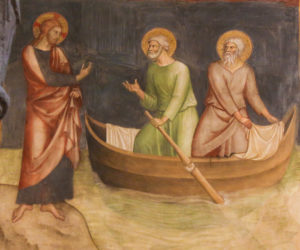
 Fr. Okoye is the Director of the Center for Spiritan Studies at Duquesne University in Pittsburgh, PA. His ministry as a priest has included congregational leadership as Provincial of the Nigerian Congregation of Spiritans and General Assistant in the Congregation’s headquarters in Rome.
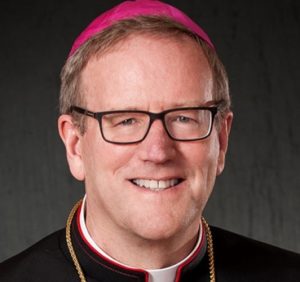 I recently granted an interview to the National Catholic Reporter concerning the upcoming Synod on Young People, the Faith, and Vocational Discernment, to which I was elected a delegate. We discussed a number of topics, including the rise of the “nones,” the purpose of the Synod, and creative ways of listening to the concerns of young people. In the course of the conversation, I also stated that I would bring the issue of apologetics before the Synod, since so many young people have questions about, and objections to, the faith. But when the interview appeared, the author expressed her puzzlement that I would mention apologetics, though it is clear that the working document calls for “accompaniment” of young people. It seems many think doing apologetics and accompaniment are mutually exclusive. To my mind, they’re mutually implicative. Of course, especially in our context today, a brow-beating, “I’ve got all the answers” approach is counterindicated. But apologetics as such is needed more than ever—and more to the point, is perfectly congruent with Pope Francis’ insistence on walking with those who struggle with the faith.
 I sat down with Fr. Michael Friedel to get to know him and his ministry. We are excited to welcome him to our community!
 After some time with his family, Dominic will be returning to Kenrick- Glennon Seminary in St. Louis to finish his last two years of seminary formation and preparations for his Diaconate ordination this coming spring. I am grateful for the goodness that Dominic shared with us in his short time in the parish. Please join me in keeping him in prayer that God will continue to bless Dominic with every grace that he needs to continue to both hear and answer the Lord’s call in his life.
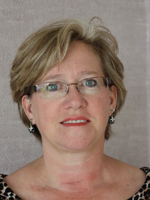 At the same time, I am very happy to welcome a new member of staff to the Cathedral Parish. Vicki Compton is joining the Cathedral staff, having most recently served as the director of the Office for the Missions for our diocese. Vicki will be serving as the parish’s Coordinator for Faith Formation and Mission. Her ministry will be very broad in that she will help the Cathedral clergy in many aspects of parish life, from faith formation and catechesis to ministry formation to helping us constantly examine how we are responding to the call of the Gospel as a parish. One major area of assistance that she will be assisting with is our parish implementation of the goals the Fourth Diocesan Synod that was held this past year.
 During the weekend of August 4-5, 2018, Rev. Dr. James Okoye, CSSp, will visit our parish to speak at the Masses about the missionary work of the Church and in particular that of the Spartans (Congregation of the Holy Spirit, previously known as the Holy Ghost Fathers). To learn more about the Spiritans, please visit their website at http://spiritans.org.
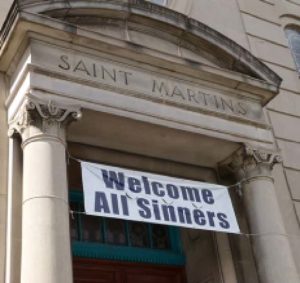 With this basic distinction in mind, let us consider membership in the Church of Jesus Christ. Are all people welcome to the Church? Yes of course! Everyone and his brother cites James Joyce to the effect that the Catholic Church’s motto is “here comes everybody,” and this is fundamentally right. Jesus means to bring everyone to union with the Triune God, or to state the same thing, to become a member of his Mystical Body the Church. In John’s Gospel, Jesus declares, “When the Son of Man is lifted up, he will draw all people to himself.” Bernini’s colonnade, reaching out like great in-gathering arms from St. Peter’s Basilica, is meant to symbolize this universally inclusive welcome offered by Christ. Is the Church, as Pope Francis says, a field hospital where even the most gravely wounded are invited for treatment? Is the Lord’s mercy available to everyone, even to the most hardened of sinners? Yes! And does the Church even go out from itself to care for those who are not explicitly joined to Christ? Yes! In fact, this was one of the reasons the Church was so attractive in the ancient world: when Roman society left the sick to fend for themselves and often cast away the newly-born who were deemed unworthy, the Church included these victims of the “throwaway culture” of that time and place.
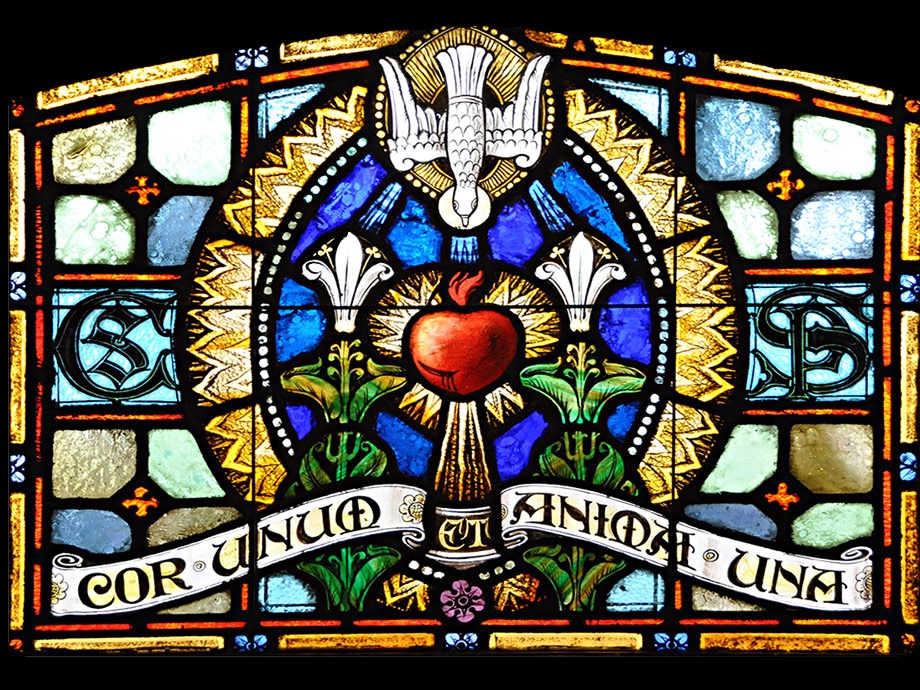
 Think about your day yesterday. Did you lead with your heart? Okay, I understand, that is a tough question. But, what would the day look like if we had led every decision, every action, every encounter only through the way our heart would respond?
 A cathedral being the “mother church” means that, generally, certain special events happen within its walls; this is true of our Cathedral church. Important Masses and celebrations throughout the year occur here such as the Chrism Mass during Holy Week when the new holy oils are blessed for the year and the priests of the diocese renew their priestly commitment to God and the Church. The ordination of deacons and priests takes place in the Cathedral as well as the ordination and/or installation of a new diocesan bishop. Other special events in the life of the diocese happen in the Cathedral as well, such as the yearly Mass for couples celebrating 50+ years of marriage, the annual Mission Mass celebrated with school children throughout the diocese, and the Rite of Election for Catechumens and the Call to On-Going Conversion for those who seek to be received into the Church at Easter.
 In almost every case, the diocesan bishop celebrates these special celebrations in a cathedral. Having received the sacrament of Holy Orders three-fold, a bishop in his own person is the fullness of the priesthood, being deacon, priest, and bishop. The bishops are the successors of the Apostles and they are the guardians of what is termed “Apostolic Succession,” meaning that they hand on from generation to generation the sacrament of Holy Orders to deacons, priests, and other bishops assuring the on-going sacramental life of the Church. The bishops are also the body of authoritative teachers in the Church called the Magisterium. Collegially and individually, they are to strive to protect and preserve the truth of the Faith as given by the Lord Jesus and revealed by the Holy Spirit.
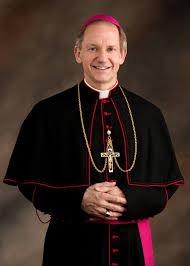 Most bishops are given the ministry of being a diocesan bishop, meaning that they are charged with shepherding a section of the people of God known as a diocese. As our diocesan bishop, Bishop Paprocki is not the pope’s representative here, but rather, he is the representative of Christ himself. As a successor of the Apostles and as our diocesan bishop, Bishop Paprocki unites us to the greater Church in his obedience to and communion with the Bishop of Rome, Pope Francis, who is the successor of St. Peter, the apostolic head of the Church as designated by the Lord Jesus.
 It is the special ministry of the diocesan bishop, combined with his special relationship with the cathedral church, that gives a cathedral its unique place among other churches, making a cathedral truly the mother church of a diocese