We are excited to announce a series of faith formation programs at the Cathedral this fall! Please bring a friend and join us for any or all of these formative programs. All are welcome and we will do our best to provide light hospitality. If you have any questions, please contact Katie Price at [email protected].
Book Study
Facilitated by parishioner Mary Francis and open to all, the book study group will choose a book on saints, spirituality, prayer, Church teaching, or something else to read and discuss. Bring your book suggestions and a snack to share if you like.
Cathedral School Hall, Wednesdays beginning September 19, 6:30-8:00pm
Bible Study
With men and women of Cathedral parish on the first and third Tuesday of the month beginning on September 18. Facilitated by parishioner Larry Travis.
Cathedral parish library, 1st and 3rd Tuesdays beginning September 18, 6:15-7:45pm
Catholicism Series
Bishop Robert Barron journeys around the world and deep into faith to teach us what Catholics believe and why. This video and discussion program uses the spiritual and artistic treasures of the Faith to illuminate the key teachings of the Church. Facilitated by Vicki Compton.
School Hall, Tuesday mornings
September 18-November 20, 10:00-11:30am
The Mystery of God: Who God Is and Why He Matters
Join Father House for a DVD presentation by Bishop Robert Barron followed by discussion. This series will explore the mystery of the Triune God as understood in the Church’s Tradition and taught by such individuals as St. Augustine, St. Thomas Aquinas, and Pope Benedict XVI.
Cathedral Atrium, Tuesdays September 25th and October 2nd & 9th, 7:00pm
Festival Choir Concert
Choirs from throughout the diocese will come together for a musical celebration of the 90th anniversary of the Cathedral.
Cathedral, Saturday, October 13, 7:00pm
Priest, Prophet, and King
The three-fold ministry in which all of the baptized share comes from Jesus himself as Priest, Prophet, and King. Father House will present this DVD series by Bishop Robert Barron that explores who Jesus Christ is as God-made-man and Savior of the world.
Cathedral Atrium, Tuesdays October 23rd, 30th, & November 6th, 7:00pm
The Last Things
As the Church year comes to an end and the faithful are reminded to turn their attention to the Second Coming of Christ, Father Stock will explore the concept of the Four Last Things as taught by the Church: Death, Judgment, Heaven, and Hell.
Cathedral Atrium, Mondays November 19th & 26th, 7:00pm
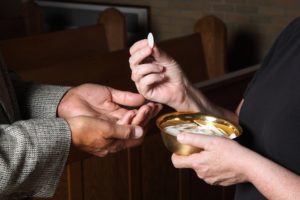
 In 2014, I knelt in the pew at the Easter Vigil Mass having just been confirmed in the Church moments before. Many months of prayer, study, and conversion culminated at that moment, and my heart fluttered with excitement at the thought of receiving the Eucharist for the first time.
 The Christian writer C.S. Lewis in his book Mere Christianity posed the question that Jesus Christ had to be one of three things: a lunatic, a liar, or, actually Lord as he claimed to be. Lewis was not the first to frame this conundrum, but he was the one who “popularized” the question. The question cuts to the point of stating who Jesus is. If he is not who he claims to be as Messiah and Lord then he is out of his mind for claiming to be the Son of God or he is a liar and a charlatan who deceived the masses. Surely we agree that Jesus was not insane nor he was he a liar, so, therefore, Jesus is Lord. Well, aren’t we glad that we settled that? If only it was that easy.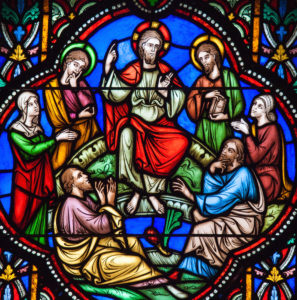
 I must confess. I have not always prayed for someone if I told him or her I would. I have fallen victim to making the phrase, “You are in my prayers,” a sentence void of real emotion or intent. It is like asking the question, “How are you?” Do I always want to know how you are at the time? Then fol lows the mos t common responses of “fine” or “good.” I could have had the worst day, but I still utter a response that does not reflect my true state. Many of us say things to be nice without really thinking about it. At least, I hope I am not the only one.
 Good stewardship requires us to say what we mean and mean what we say. Stewardship is a way of living. It does ask for sentiments of love. It asks for profound actions of love. We need to offer our gifts, talents, time, and prayers to one another and then follow through. This means we need to be more mindful of what we are saying, more committed to following through, and more accountable for our actions if we fail. If we practice this way of living, not only will we be able to say we are doing the right thing, but our integrity will be intact and we will bear witness to the transforming power of Jesus Christ.
 The question has been put to me again and again. Ever since the stories of child sex abuse broke out of Boston in 2002 and threw the Catholic Church headlong into an ongoing and painful Lent, people have asked me: “Why are you still a Catholic?”
 I remain within the Catholic Church because it is a Church that has lived and wrestled within the mystery of the shadowlands ever since an innocent man was arrested, sentenced, and crucified, while the keeper of “the keys” denied him, and his first priests ran away. Through two thousand imperfect years—sometimes glorious, sometimes heinous—the Church has contemplated and manifested the truth that dark and light, innocence and guilt, justice and injustice all move together, back and forth like wind-stirred wheat in a field, churning toward a culmination imaginable yet out of reach.
 Many of you may have witnessed quite a setup on Wednesday evenings after you come out of daily Mass. We have the linens out, pitchers of cool refreshments, a team busily working to set out quite a spread of food, and usually me struggling to get technology perfect. If you were to stay for the Alpha session you would witness even more hospitality. This program has introduced many to the loving and welcoming embrace of Jesus Christ through open discussion and dialogue. We have had Catholics, non-Catholics, searchers and seekers of all different walks of life. Particularly, we have served guests that others, like in the Second Reading this week, may have shut out. This is radical hospitality, and there is a case to be made for why Cathedral should be the epicenter of radical hospitality.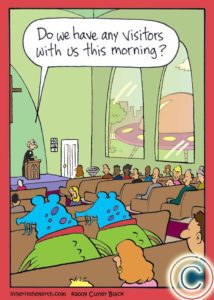
 When Father House introduced me to the parish, he mentioned that one of my responsibilities is to help the parish implement the goals of the recent synod. This is a responsibility I gratefully embrace. Despite my great love for the Missions and the privilege it was to serve as diocesan mission director for over 15 years, helping to build a community of fervent and intentional disciples is the ministry I have been longing to do for the past several years. And honestly, the Cathedral parish is the place I most want to do this. I am excited about the unique mix of parishioners and visitors that makes up this community. Because we have so many visitors with us, especially at daily and weekend Masses, we have a special opportunity for evangelization and hospitality. The Cathedral has always been known for excellent Liturgy, and we are going to make sure it continues to be all that it can be to provide people with a transcendent experience of God in the midst of a welcoming community.