Cathedral of the Immaculate Conception

Springfield, IL

  • About
    • Contact Us
    • History of the Cathedral
    • Liturgical Schedules
    • Parish Staff
    • Register with Cathedral
    • Subscribe to the Cathedral eWeekly
  • Sacraments
    • Baptism
    • Becoming Catholic
    • Matrimony
    • Vocations
  • Ministry List
    • Adult Faith Formation
    • Cathedral Meal Train
    • Cathedral Online Prayer Wall
    • Cathedral Concerts
    • Family of Faith
    • Grief Share
    • Health and Wellness
    • Spiritual Resources
  • Stewardship
    • Stewardship: A Disciple’s Response
    • Stewardship Form
  • Support
    • E-Giving Frequently Asked Questions
    • Give Online
  • Sunday News
    • Announcements
    • Cathedral Weekly
    • Livestream Feed
    • Submit a Mass Intention Request
    • Weekly or Announcement Submission

The Crown of Our Easter Celebration

This Sunday is the final day of the Easter Octave, named Divine Mercy Sunday by Pope John Paul II in 2000, is a “hermeneutical crown” of the eight-day-long celebration of that Eighth and final Day of creation.

Hermeneutical? The word simply means “interpretive,” or the science of discovering meaning. Hence, I mean that this feast of Mercy really gets to the core of Easter’s true meaning.

Eleison?
Mercy, as I intend it here, is love encountering evil and overcoming it, healing it, redeeming it and raising out of its ruins surpassing goods that could never have been apart from these evils. Though God never positively wills an evil, He permits evil only in view of the greater goods He might draw from them. And it is mercy that sustains the mysterious logic of the felix culpa, the “happy fault” of Adam that we sing of in the Exultet at the Easter Vigil.

The whole economy of God’s work in Jesus is at heart a work of mercy, with the Passion being the inner core of that heart. In the Resurrection, God the Father accepted his Son’s sacrifice as a new and eternal mode of God’s being God: in the heart of the eternal Trinity is forever the risen Body of Jesus ever-marked with the signs of the Passion. God now, only and for all ages, relates to creation through the open wounds of the Risen Christ.

To me, this is utterly astonishing to ponder: God’s mode of being- God — etched in His flesh — is forged by mercy’s response to human hatred and cruelty. This is the message embedded in the icon of Divine Mercy revealed to St. Faustina Kowalska.

Eucharistic Chaplet
It’s also the meaning of the “Chaplet of Mercy” that St. Faustina received from God in a vision. The Chaplet is an offering of the Slain-Risen Lord to the Father — by His priestly people — asking the Father to be who he has shown himself to be in Christ: Mercy. As such, the Chaplet is an extension of the liturgicalsacramental offering of the same Slain-Risen Lord that is the holy sacrifice of the Mass.

To see this, one need only reflect on the words of Eucharistic Prayer I that follow the Consecration: “…we, your servants and your holy people, offer to your glorious majesty, from the gifts that you have given us, this pure victim, this holy victim, this spotless victim, the holy Bread of eternal life and the Chalice of everlasting salvation…”

In this sense, I have always found the Chaplet to be a superb way to prepare for, and extend forward the celebration of the holy Eucharist into life. It shapes in me a deeper awareness of my sharing in Christ’s royal priesthood through Baptism. This priesthood calls me to — at every moment — offer both my own life as a living sacrifice to God (Romans 12:1) for the life of the world, and to offer the living sacrifice of Christ Himself.

A number of years ago, this insight — like lightning — flashed in my mind during the per ipsum at Mass. The per ipsum is the moment, at the end of the long Eucharistic prayer after the Consecration, when the priest lifts up the Host and Chalice toward the Father and prays,

 Through him, and with him, and in him,
O God, almighty Father,
in the unity of the Holy Spirit,
all glory and honor is yours,
for ever and ever.

On behalf of all and for all, the priest offers up God to God, the Son to the Father, and the faithful, united to the Son in His selfoffering, seal their co-offering by a solemn and oath-making “great Amen.” As we were singing thrice the great Amen, I understood with what seemed like absolute clarity this Amen was our co-pronouncing with Christ His tetelestai, consummatum est, “It is finished” (John 19:30). I also saw in that moment that our “Amen” was also our consenting “we are able”:

 But Jesus said to them, “You do not know what you are asking. Are you able to drink the cup that I drink, or to be baptized with the baptism with which I am baptized?” And they said to him, “We are able.” And Jesus said to them, “The cup that I drink you will drink; and with the baptism with which I am baptized, you will be baptized…”

That “cup” and “baptism” are, of course, references to his Passion. Amen.

Offerimus
The Chaplet, as a para-liturgical devotion, sustains the moment of our liturgical “great Amen.” It affirms the staggering truth that in Christ we have the authority to — at any moment we choose — apply the infinite treasury of God’s mercy to the world. And the sobering truth that we are willing to join Jesus in His self-offering. Eternal Father, I offer you the Body and Blood, Soul and Divinity of your dearly beloved Son, our Lord Jesus Christ, in atonement for our sins and those of the whole world.

It causes me to tremble. May He who is Risen to forever intercede for us before His Father sustain us daily in fidelity by His grace.

 Dr. Tom Neal presently serves as Academic Dean and Professor of Spiritual Theology at Notre Dame Seminary in New Orleans, Louisiana. Tom received a Masters in Systematic Theology from Mount St. Mary’s University and a PhD in Religion at Florida State University.

Easter Sunday Is Concluded… Now What?

It is now the quiet time… The Triduum services are completed. The Easter Vigil (the “mother” of all vigils) has been concluded for another year — to varying degrees of l i turgical success in each individual parish, I am sure. The crowds that seem to magically appear and arrive for Easter Sunday Mass have come and gone. Candidates and catechumens have been received into the Church. Easter egg hunts are wrapped up as well as family Easter gatherings. Now what?

Is Easter Sunday to now be shelved away as a nice memory testified to by photos posted on Facebook? An opportunity for people to dress up and have good family time? Does the message of Easter end with the last Easter Sunday Mass? Liturgically, the Church says “no.” We have the Easter Season — a needed time to reflect on the truth of the resurrection and to look to the coming of the Holy Spirit at Pentecost. “Liturgical” here is important and it does certainly influence who we are but here I am specifically wondering about our day-to-day life outside the parish walls. Does Easter affect and shape who we are or does it remain a beautiful annual ritual that is left behind in the crowded Easter Sunday church parking lot? Do we take Easter with us into the streets of our lives and of our world or do we keep it hidden away behind locked doors — doors of a private faith, spirituality and morality, doors of our resignations and sense of hopelessness in the face of the pain of our world, doors of our fear to offend the accepted norm?

 Easter cannot stay hidden away. Easter demands that we go into the streets – no matter how uncomfortable it makes us or others.

In Matthew’s account of the resurrection there is an interesting instruction that is given to the women who came to the tomb early that morning by the angel sitting on top of the rolled-away, heavy stone that had been used to seal the tomb. “…go quickly and tell his disciples that he has risen from the dead, and behold, he is going before you to Galilee; there you will see him.” (Mt. 28:7)

The resurrected Lord does not fear the world and its violence and sad resignation because he has overcome all the sin of the world through the love of the Father. The resurrected Lord goes before you to Galilee. He goes into the streets of the world and the expectation and instruction given by the angel of the resurrection is that the followers of Christ do the same!

Easter, if it is to be authentic and be more than a nice memory, cannot stay hidden behind any locked door and neither will it allow us to remain hidden.

There is a culture of fear that continually whispers to us that nothing can change, that we cannot really do anything in the face of the injustice of our world, that we should look upon ourselves and our world with hopeless eyes. The culture of fear is arrogant in its pride and thinks that it alone has words to speak. The culture of fear lies. The culture of fear would convince us that we are its children.

We are not children of the culture of fear. We are children of the resurrection! We are sons and daughters of God! We have nothing to fear and we have words, new words to speak to our world and to one another! The angel announces that the risen Lord is going to Galilee and that there the disciples will see him. The implication is more than apparent, the disciples are meant to go and meet the Lord who goes ahead of them. (The Lord always goes ahead of us.) They are meant to go out into the street and carry the truth of the resurrection into the world!

It is not enough to stay behind locked doors, no matter how pretty and gilded those doors may be and no matter how many other people may also be content to remain there also. If we do so then the culture of fear wins and our lives become exceedingly small, constrained and lifedenying. Joy is found only in following the risen Lord to wherever he might lead.

 One further thought: there is no time to waste.

The angel instructs the women: go quickly. We are each allotted only a certain number of Easters in our lives here on earth. There is no time to lose, both for the work needing to be done in our own hearts as well as the work needing to be done in our world. In the light of the resurrection we must make use of every moment given to us. When all is said and done, we will each have to give an accounting of how we have lived the Easters we have been given in our lifetime.

We are sons and daughters of the resurrection of our Lord! The Easter mystery is placed in our hearts and entrusted to us and it cannot remain behind locked doors, it demands to be taken out to the streets of our world!

 Fr. Michael Cummins is a priest of the Diocese of Knoxville, TN. Ordained in 1995, he has served in a variety of roles within his diocese. Fr. Cummins holds a Masters of Divinity and Licentiate in Sacred Theology from the University of St. Mary of the Lake (Mundelein Seminary) in Chicago.

A Bare Cross, An Empty Tomb

What a couple of days it must have been. It all started with a quick betrayal and a speedy trial. The crowds that yelled “Hosanna” w e r e r e p l a c e d b y a mo b screaming “crucify him!” His friends were gone. His disciples were scattered. Apart from a few who loved him and followed at a distance, he was alone and void of comfort and consolation. He was given a reed for a scepter and thorns for a crown. Draped in what would likely have been a rough purple cloak on his raw skin torn by scourging, he was commanded to ascend the throne of the cross and condemned to die the death of a sinner, all sinners, though he himself did not know sin, all this to fulfill the words of the Prophet Isaiah: he was pierced for our offenses, crushed for our sins; upon him was the chastisement that makes us whole, by his stripes we were healed. We had all gone astray like sheep, each following his own way; but the LORD laid upon him the guilt of us all.

I wonder what that small group who remained was thinking as they looked upon that bare cross, his lifeless body now cradled in his mother’s arms:

 “I don’t understand. How could this happen? Everything is lost.”

How distant the past must have felt for Mary and the others in that moment: the angel, the shepherds and the Magi, finding him in the Temple, the voice of the Father at the Jordan, feeding the multitudes, healing the sick, the blind & the lame, raising the dead, the teachings, the love and the mercy. In the midst of their grief and the rush to bury his body before the setting of the sun, I believe that his mother, possibly the only one, remained resolute in faith, that God’s will be done…. that God’s will was not done, yet. I wonder if anyone came that Passover day, that Saturday, to sit in silence; to wonder, to mourn, or to wait.

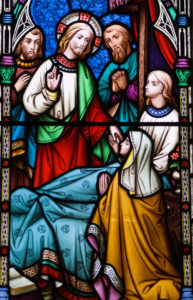
Modern Rendition of Jesus Christ Church Stained Glass Pane

I wonder what those holy women were feeling early in the morning, on the first day of the week, as the Scriptures teach us, when Mary Magdalene and the others came to the tomb only to find it void of the one whom they sought, when in their amazement they were told: Do not be amazed! You seek Jesus of Nazareth, the crucified. He has been raised; he is not here. Those holy women were the first to receive the good news that has forever changed the course of human history and the meaning of our shared human experience.

On this Easter day, the mystery of the cross and the empty tomb looms large. The two truly form one mystery because their meanings are not fully realized alone. Without the empty tomb, the cross stands only as a monument to brutality; without the cross, the joy of the empty tomb is lacking. It is the same for us in our lives.

 We carry the burden of the crosses of our lives, but faith teaches us that these crosses are not ends in themselves when we unite them with the Cross of the Lord Jesus; no cross comes without the promise of resurrection.

The resurrection moments of our lives are made all the sweater because of the sacrifices and hardships that have preceded them. In the end, having borne the trials of this life and having persevered in faith, the joy of everlasting life will be unlike anything that we can imagine now. Until then, the empty tomb stands as the Lord’s promise to us and all who live and die in his friendship.

May the Lord bless you and yours this Easter with the fullness of his grace and the joy that comes from him alone. In every cross may you know that it is not an end. In moments of sacrifice and desolation may you know that you are not alone or forsaken. May you always be mindful that Easter teaches us that God always gets the last word: life; and not just any life, a share in his own divine life.

 All honor, praise, and glory to the risen Christ, who, by his death and resurrection, has gained for us the rewards of everlasting life! Happy Easter!

 Father Christopher House is the Rector-Pastor of the Cathedral and serves in various leadership roles within the diocesan curia, specifically Chancellor and Vicar Judicial.

An Invitation to Steward

Jesus told us “whatever you do for the least of my brothers, you do for me.” Every day we are presented opportunities to help someone. Every day we have the opportunity to see the face of Jesus in others and be the face of Jesus to others. Planting the seed of discipleship starts within ourselves, but requires us to also plant it in others.

I had someone ask why we were sharing daily Stewardship posts on Facebook during Lent? I wasn’t really sure where this question was going or the intent behind it…did they like the posts or not like the posts? Either way, I answered that the primary reason we are promoting stewardship thoughts during Lent is to recognize that stewardship is a conversion process, a spiritual practice, a call to act as disciples, which is Lent, all in. Stewardship is a great spiritual practice to take on during Lent. Each post has shared a quick thought or Scripture that relates back to time, talent, or treasure.

There is another reason why we are sharing the posts. Many Catholics don’t understand stewardship, as it relates to their faith. We have a tendency in the Catholic church to define stewardship as fundraising. It is not fundraising at all. In fact, I have a tagline, “If you want to raise your bottom line do a fundraiser, if you want to raise disciples, do stewardship.”

To be fair, the majority of us did not grow up with the word. Despite it becoming popular during the last 20 years, many parishes focused on the treasure component compared to time and talent. Stewardship extends to each of us and opportunity to get involved.

Anyone can be a steward. My four-year-old is a steward, from attending Mass, praying regularly, sharing her talents (which as a four-year*-old, we focus on being nice to others), and each week she puts something in the basket from her piggy bank. It doesn’t matter your age, your familiarity with stewardship, or where you are on the faith journey, we can all respond with our time, talent, and treasure.

Nothing we have will ever repay what God has given to us. At the end of the road, we too will leave all our possessions behind. What will seem to be most important is the relationship we nurtured with Jesus. The relationship which sustains us, nourishes us during the challenges and obstacles, celebrates with us, keeps us on a pathway that leads toward His Kingdom. All this leads to a stewardship way of life, a response to Jesus’ call to us. A bold and courageous “Yes!”

Katie Price is the Parish Stewardship Coordinator for Cathedral. She has worked in Stewardship ministry for 10 years, from the Parish level to the Archdiocese of Chicago. She can be reached at [email protected].

How Lent Reminds Us We Can Never Repay God

In one of the most shocking passages of the Gospels, Matthew 5:20-26, Jesus describes the righteousness one needs in order to reach the kingdom of heaven, noting that it must surpass that of the scribes and Pharisees. He discusses the relationship one should have with one’s brother, saying that there is much more to it than simply observing the Old Testament commandment not to kill. It is wrong even to be angry with one’s brother or to call him a fool. Furthermore, Jesus advises us that if we are not at peace with our brother, we should make peace with him before offering gifts to God.

In this teaching, Christ describes both justice and the interior dispositions that go even further in making one righteous. The cardinal virtue of justice, as St. Thomas Aquinas defines it, is the

 “habit whereby a man renders to each one his due by a constant and perpetual will.”

From this, we can draw out two of the chief characteristics of justice. The first is that it is concerned with other persons. It’s about giving to one distinct from oneself what he or she deserves. Secondly, justice is objective. It is primarily about the thing that is owed. It is not about what the other wants to receive or what you want to give. The commandment “Thou shalt not kill” regards justice, then, in its most proper form. It is a matter of showing due respect for the life God has given to the other man. Jesus gives other examples of unjust behavior to avoid. One owes respect not just to the life of the other but to his dignity as man as well, and so one ought not to disdain him by slandering or committing detraction against him. Christ goes even further than justice properly speaking (i.e., our outward actions) and addresses what can be called justice analogously. That is, he describes how to “be right” with oneself, and this is by overcoming one’s passions, such as anger.

 If this Gospel passage talks about establishing a just relation with our brother, what about our relationship with God?

Statue of Jesus Christ looking down from the cross. Location: Calvary Cemetery/Rochester/Minnesota, USA

We might be tempted to think that Lent is about merely establishing a just relationship between ourselves and him. Perhaps, for example, we think of the penances we undertake simply as a way of “repaying” God for dying on the Cross for us. It does indeed fall within the scope of justice to offer prayers and sacrifices to God, since we owe all we have and even our very existence to him. We can never really repay God fully, though, either for that existence or for the redemption he worked for us. So we can never have a truly just relationship with him in that sense.

Lent is not about evening things out with God. Since our prayers and sacrifices add nothing to God’s greatness or happiness, they are not primarily for his benefit, but rather for our own. Lent helps us recognize what we owe God, but even beyond that, it is about preparing for the celebration of Christ’s supreme act of charity in suffering his Passion and death for our salvation. The prayer and penances are a means to our growth in charity, which is achieved when obstacles between ourselves and God are removed. As Jesus notes in the Gospel, one of those obstacles often is a lack of peace with our brother.

 For “he who does not love his brother whom he has seen, cannot love God whom he has not seen” (1 John 4:20).

This Lent, may the charity of the Just Man fill us with longing for the kingdom of heaven and inspire us to imitate him.

 This article was written by Br. Joachim Kenney, O.P., who entered the Order of Preachers in 2010 and was found at the Word on Fire blog, used with permission. He is a graduate of the University of Louisville.

The Passion According to Saint Mark

The Passion narratives of Matthew, Mark, and Luke rotate on a three-year cycle for Palm Sunday and this year the Church is presented with Mark’s narrative. Most scholars will agree that Mark’s narrative is the oldest of the four Passion narratives and that his Passion narrative is also the oldest part of the Gospel that is attributed to him. Mark’s narrative is notably dark. Jesus is surrounded by a growing darkness and will face ultimate abandonment from his friends and disciples and the feeling of ultimate separation from God the Father.

Mark’s Passion narrative has a prelude of two events. The first event is the unnamed woman who comes and anoints Jesus. Some have argued that this woman is Mary Magdalene but we do not know her identity. The second event is the Last Supper . While Mark recounts the institution of the Holy Eucharist, what is more poignant concerning the Passion narrative is Jesus’s prediction of Judas’s betrayal, which is followed by Jesus’s prediction of Peter’s denial and the scattering of the disciples, all of whom say it will never happen.

Following the time in the Upper Room, we find Jesus and his disciples in the Garden of Gethsemane. Here the Lord experiences the Agony in the Garden when faced with his impending suffering. As the darkness grows around him, Jesus finds Peter, James, and John asleep, the same disciples who witnesses his glory in the Transfiguration. But Jesus is resolute to the Father’s will and Judas comes and betrays Jesus with a kiss;

in the original Greek, this kiss (kataphilein) is understood as the kiss of a beloved, which lends even greater pain to Judas’s betrayal of Jesus.

The disciples flee. Jesus is left alone. We are given the peculiar detail of the young man who runs away naked. In stark contrast to the rich young man who could not part with his possessions to follow Jesus, this young man is willing to give up absolutely everything, even to the point of being naked, to get away from Jesus.

Jesus is led before the Sanhedrin and Pontius Pilate. Before the religious court, we see that the trial is a mockery and Mark demonstrates that the whole affair is a violation of Jewish law.

Before the elders, Jesus affirms that he is both Messiah and the Son of Man. Before Pilate, Jesus remains silent and resolute.

Pilate knows that the whole affair is a lie, but he lacked the courage to do what was right before the innocent Lord. The crowds choose Barabbas and Jesus is handed over to be scourged and crucified.

On the cross, the chief priests, the Roman soldiers, as well as those crucified with him, deride the Lord.

In this moment he experiences total abandonment.

When he cries out from the cross “my God, my God, why have you forsaken me,” it is response to a sense of total abandonment from the Father for, in his divine person, he is experiencing the damnation of the human race. The Father has not abandoned Jesus, but Jesus, though sinless, experiences the ultimate separation from God because of sin.

Jesus is buried, darkness covers the earth, and all seems lost, but, the greatest of all miracles is yet to come.

Father Christopher House is the Rector-Pastor of the Cathedral and serves in various leadership roles within the diocesan curia, specifically Chancellor and Vicar Judicial.

The Lost Art of Intentionality

 In 1927, G.K. Chesterton penned an essay (h/t Fr. James Schall) for the Illustrated London News titled “Shakespeare and the Dark Lady.” An august scholar, the Comtesse de Chambrun, had written a heady, though insightful, book about William Shakespeare as an actor-poet. After considering her worthy contributions to the bottomless scholarly repository about Shakespeare, Chesterton admitted, “[This book] seems to me both fascinating and convincing. I hasten to say that the lady is very learned and I am very ignorant. I do not profess to know much about Shakespeare, outside such superficial trifling as the reading of his literary works.”

In another essay (“The Orthodoxy of Hamlet”), Chesterton was more pointed about the downside of being particularly refined and well-studied in that which is beautiful. Though he or she is often unaware, there are dangers in being an aesthete. “[Aesthetes] have goaded and jaded their artistic feelings too much to enjoy anything simply beautiful. They are aesthetes; and the definition of an aesthete is a man who is experienced enough to admire a good picture, but not inexperienced enough to see it.”

In his classic puckish and winsome way, G.K. Chesterton had, once again, brilliantly articulated an important distinction: the difference between analyzing something and engaging with it. It is the difference between efficiency and intentionality.

Efficiency is portrayed as the consummate modern virtue. Get up early, go to bed late, multi-task, double book, manage your time, juggle more. To race to the edge of a nervous breakdown without completely going over the edge is lauded like a noble act. Though your family feels abandoned, your health is in shambles, your faith is a memory, and your philosophy is cynical, you should be commended for getting everything done!

And efficiency isn’t solely about managing a schedule; as Chesterton pointed out, it is a way of thinking. Devoid of those pesky hangers-on like emotions and purpose and reflection, efficiency crowns those steely-eyed, decisive, ice-in-the-veins analysts. The cool ideal we are supposed to aspire to is the Navy Seal squinting at the cross-hairs, the neurosurgeon on the cusp of that vital incision, or the bomb squad preparing to cut the right wire. Efficiency. Cool, crisp, unencumbered. Just the facts, ma’am. We’re professionals here.

We’ve become masters of efficiency. But we’ve lost our soul. This isn’t who we are supposed to be.

Oh sure, we need to be objective, think clearly, be on time, and cultivate our expertise. But that is not all. We need to be human too. We are called to be quiet. We are creatures designed to reflect and reform. We need to still the buzzing of our phones and silence the jabbering of our televisions and just simply be. We have to wander, even get lost, so that our direction isn’t always our direction, but God’s. To paraphrase Ludwig Wittgenstein, we are not always to think; we are to look. We must cultivate an interiority of prayer, private thought, and contemplation, so we can more intentionally engage the world. As Romano Guardini once wrote, “Silence opens the inner fount from which the word arises.”

There’s a beautiful essay (“Morning Report”) written by an internal medicine resident physician, Sonia Singh, that I share with all of my medical students and residents. In it Singh characterizes, with stark accuracy, the furious race she runs every morning to see her list of hospitalized patients, write notes, order labs, answer pages, talk with nurses, and manage medical students (not to mention think) in order to get to her teaching conference (known as “Morning Report”). She describes the hurried conversations, the race up and down stairways, the blur of pages, the ticking of the clock. Finally, only moment s before she i s due in conference, she finds herself sitting on a bed next to a wizened veteran nurse (who is now a patient). After a warm exchange and a little teasing, they look at each other and realize that today the biopsy from the pancreatic mass will come back. They both know it won’t be good.

Looking at each other, with eyes welling up, they have a moment. Fleeting, almost intangible, but it is a moment. This frazzled resident and worried patient see, I mean really see, each other. It is a moment of deep humanity in this hell of efficiency. In it, the resident effectively says, I’m sorry and the patient says, I know. And then it was gone.

But it was there. And it was the most important moment in that resident’s day. Life requires efficiency. There is no question about that. But life is not efficiency itself. Rather, it is a million moments of deep intentionality that can be embraced—or carelessly overlooked.

Yes, today we live in a world where intentionality is a lost art. But it doesn’t have to be.

 Tod Worner is a husband, father, Catholic convert & practicing internal medicine physician. His blog, “Catholic Thinking”, is found at Aleteia.com. He also writes for Patheos (“A Catholic Thinker”) and the National Catholic Register. Follow him on Twitter @thinkercatholic.

Of Butterflies and Wheat

In the Cathedral church you will find the or iginal high al tar underneath the great mosaic of the Immaculate Conception and the façades of the original two side altars beneath the mosaics of the Sacred Heart of Jesus and St. Joseph. The façades of all three altars are adorned with various symbols: the right side for St. Joseph, the left side for the Virgin Mary (in most churches the left altar was dedicated to her even though the mosaic is of Jesus), and the high altar for the Lord Jesus. On the far right of the high altar’s façade you will notice the symbol of a butterfly. Some among us may find this an odd choice of decoration but the symbol is very appropriate since the butterfly points to resurrection. A caterpillar is transformed through what is a “death,” essentially, into a beautiful new reality.

The Lord Jesus gives us the image of the grain of wheat in this Sunday’s Gospel reading, telling us: unless a grain of wheat falls to the ground and dies, it remains just a grain of wheat; but if it dies, it produces much fruit. This image used by the Lord points to his own impending death and resurrection which the Church remembers as the Paschal Mystery.

This mystery [Paschal Mystery] is central to who we are as disciples because if we would live with the Lord we must also be willing to die with and for him.

Magnification of wheat ear.

This theme is not new for us, either in our shared life of faith nor in this year’s Lenten journey. Consider each of the Gospel selections that we have heard proclaimed during this holy season; each in their own way touch on the Paschal Mystery from dying to temptation to ultimate transfiguration through the Cross to allowing the temple of our own selves to be formed anew by Jesus to the grain of wheat that must die to itself to produce fruit.

While the butterfly on the high altar may be a somewhat hidden symbol to many, there are other things right in front of us all the time that point to this need to die to self that we may notice, such as the use of candles and flowers. When I was in the seminary, my instructors in liturgy always impressed on us the need to use wax candles and real flowers around the altar of sacrifice as small reminders of the Paschal Mystery as both of these die to themselves in order to give something: the candles diminish in order to give light and the cut flower is dying while giving the gift of its beauty. These are subtle but constant reminders for us to allow the power and grace of the Lord’s death and resurrection to work in our lives.

More than just looking for reminders of the Paschal Mystery, we are called to live it out each day in our own lives.

Discipleship calls us to die to self, to die to self-centered and self-seeking attitudes and behaviors.

This dying to self is accomplished through cooperating with the free gift of God’s grace made available to us through prayer, meditating on the Scriptures, good works, the Sacraments, and in other ways. Like the grain of wheat, when we cooperate with God’s grace and die to self, we are renewed and our truest selves are revealed. Let us seek the grace of God now and always to help us to die to ourselves and the old life of sin so that the Lord Jesus might raise us up and begin to transform us now into a new creation, the fullness of which is yet to be revealed.

Father Christopher House is the Rector-Pastor of the Cathedral and serves in various leadership roles within the diocesan curia, specifically Chancellor and Vicar Judicial.


Our Declining Empathy And Ability To See God

The somewhat questionable consequences of smartphones, social media, and the many other technologies of their ilk have been well documented. A Psychology Today article, “How Technology is Changing the Way Children Think and Focus,” for example, had this to say about the societal effect of recent technologies: “Frequent exposure by so-called digital natives to technology is actually wiring their brain in ways very different than in previous generations.” Terms like “digital natives” and “wiring their brain” can sound vaguely ominous, maybe even apocalyptic. Of course, we could have said something similar about the baby boomers and the advent of their surrogate babysitters: television sets. And to be fair, such recent technologies also offer a lot of in the way of good for our world. Like most things in life, there are “pros” and “cons.”

If we survey the “cons,” the decrease in attention spans tends to be one of the biggest criticisms levied against the tide of technological progress. However, there is another burgeoning criticism that presents some grave implications. A recent article in The New York Times (“Stop Googling. Let’s Talk.”) explores a lesser-known drawback of recent technology: a diminished capacity for empathy. This is worth pausing over, since a society that loses its ability to empathize with others can quickly descend toward the inhumane. The article references a study conducted a few years ago by a team at the University of Michigan led by psychologist Sara Konrath. After reviewing 72 studies conducted over a 30-year period, they found that a “40 percent decline in empathy among college students, with most of the decline taking place after 2000.”

The author of the article, M.I.T. professor Sherry Turkle, goes on to affirm such findings, specifically among young children, by detailing her own experience of consulting with faculty at a private middle school.

Cute pupils using mobile phone at the elementary school

“At a retreat, the dean described how a seventh grader had tried to exclude a classmate from a school social event. It’s an age-old problem, except that this time when the student was asked about her behavior, the dean reported that the girl didn’t have much to say: ‘She was almost robotic in her response. She said, “I don’t have feelings about this.” She couldn’t read the signals that the other student was hurt.’” The problem unfolds quite logically: if we can’t empathize with others, then we can’t as easily love them.

It’s worth mentioning that we can still will the good of others, and love them through acts of service even if we don’t “feel” for our neighbor, but it becomes harder to do so. (To be sure, there will always remain instances when we’re called to love without the feelings.) By cultivating a more empathetic worldview, we are making it easier to fulfill Christ’s command to heal the sick, set captives free, and spread the Gospel of life. There are times in the Gospel when we not only read about what Christ did to help others, but also about what he felt. Christ had “pity” on those suffering in his midst, which then moved him to loving action. The role that empathy plays is crucial, so any threat to our ability to “feel” for our suffering neighbor is worth taking seriously.

Many of us have been conditioned to rely on technology—be that our phones, laptops, or tablets—as a means of comfort, entertainment, information, and in the case of certain awkward social situations, escape. Honestly, when we’re eating dinner by ourselves in a restaurant, sitting on the bus alone, or waiting for a friend meeting us at a crowded venue, how many of us don’t rely on our phones to fill the empty space?

On certain days after work I head to a coffee shop to write. On those days I grab dinner somewhere quickly by myself. As I’m sitting alone at a table with a sandwich or salad in front of me, I feel the overwhelming compulsion to look at my phone. It feels strange not to be doing something and to just sit by myself, not listening to a podcast, talking on the phone, reading articles on my newsfeed, or doing anything else but eating.

Part of the reason it’s hard to sit alone is because it can be boring. I’ve conditioned myself to receive short rewards for looking at my phone. Each YouTube video, Facebook post, or email notification gives me something to chew on. I’m never bored because I have unmitigated access to something to entertain, inform, or engage me.But the less I’m able to sit in my own presence, the less I’m able to sit in another’s as well. As it turns out, being present to ourselves in the form of healthy solitude is similar to being present to our neighbor. If we can’t do one well, we can’t do the other well, either. Turkle unpacks this in her article:

“A VIRTUOUS circle links conversation to the capacity for selfreflection. When we are secure in ourselves, we are able to really hear what other people have to say. At the same time, conversation with other people, both in intimate settings and in larger social groups, leads us to become better at inner dialogue.”

There is tremendous irony in that often our gratuitous desire to connect with others, via social media for instance, can leave us more isolated. Our desire for connection is valid and worth honoring, but the best way to do this may be limiting time spent pursuing “digital connections” in order to create space for face-toface relationships.

There is something mysteriously sacramental about spending time with someone through in-person conversation devoid of expectation or distraction.

When we open ourselves up to relationships with others through our presence—and nothing else—we welcome a level of vulnerability, which can then lead to real and authentic connections. It’s hard to sit in the shared space with someone else and have ordinary, boring, and meandering conversation. There are awkward pauses, moments we don’t know what to say or how to respond, feelings of restlessness and impatience. This is often the case when we’re first getting to know someone, where we have to tread lightly across a plain of superficial and sometimes bland topics in order to set the groundwork to dig deeper. However, if we are talking to others while checking our phone, or thinking about checking our phone, then how can we ever get past that initial superficial level of getting to know someone, and therefore establish real, honest, and empathetic relationships?

Turkle mentions in her article that “the mere presence of a phone” in the periphery of two people in conversation influences what they talk about. With a phone present, two people will tend to only discuss things of which they are willing to endure interruption. It’s okay if the person across from me picks up their phone if I’m talking about a movie I saw or concert I attended over the weekend. However, I won’t risk talking about a struggling marriage, weakened faith, or deep yearning if I suspect that such vulnerability might be met with feigned nodding, eyes glued to a phone.

Not only does the undisciplined use of technology limit our ability to empathize and connect with another, but we ultimately miss out on experiencing God at a deeper level. For the more we enter the inner life of another—one created in the image and likeness of God—the more we come to know about the mystery of God. Charles Dickens wrote in his iconic A Tale of Two Cities that “every human creature is constituted to be that profound secret and mystery to every other.” By keeping our attention on the latest tweet or email alert, we miss out on something of infinitely more beauty and mystery: the person in front of us.

Chris Hazell is the founder of The Call Collective, a blog exploring the intersection between faith, culture and creativity. He holds bachelors’ degrees in English and Economics from UCLA and currently works as a Lead Content Strategist for Point Loma Nazarene University.


Look and Live

Growing up, I remember what seemed to be a more common sight than today when watching sports on television. It was not at all uncommon to see someone in the stands holding a sign that read “John 3:16.” The words of John 3:16 are given to us for this Fourth Sunday of Lent, Laetare Sunday. John is recounting for us a conversation between Jesus and Nicodemus. Nicodemus is a Pharisee and a respected member of the Sanhedrin. Later in John’s Gospel, Nicodemus will caution the elders not to rush to a hasty judgement concerning Jesus and his ministry without attempting to understand his words and actions.

Before Jesus expresses to Nicodemus the words that we have come to know from John 3:16, he implicitly centers the conversation on the impending mystery of the Cross. Jesus refers to an event concerning Moses and the Israelites that is recounted in the Book of Numbers. The people grumbled against God, so God sent poisonous seraph serpents into their camp causing many to die. Moses interceded on behalf of the people and God, in response, commanded Moses to fashion a bronze serpent and to erect it on a pole and anyone who looked at it would be healed of the poison of the serpents. This lifting up of the bronze serpent prefigures the lifting up of Jesus on the Cross so that whoever looks upon Jesus in faith will be saved from the poison of the original serpent given through the bite of the sin.

This brings us to one of the most beloved phrases in all of the Scriptures:

For God so loved the world that he gave his only Son, so that everyone who believes in him might not perish but might have eternal life.

The concept of “the world” in the Gospels is many times equated with darkness and opposition to God, but we hear in this discourse from Jesus that, even though the world is covered in darkness and steeped in sin, God still loves the world. In the mystery of the Cross and Christ crucified we see God’s ultimate judgment on the world: not condemnation and wrath but love and mercy.

We must remember that this love and mercy are not irresistible. We must have hearts and lives that are open to receiving these gifts of God’s goodness. Jesus is the light that has come into the world and we must not be afraid to approach him.

The light that he gives exposes our sinfulness, but only so that we might confess it and choose his love and forgiveness as a remedy for it.

Sadly, there are many people who cannot bear the light, who are unwilling to acknowledge their own sinfulness and their need for a savior. They prefer to remain in the darkness with a false sense of fulfillment and happiness, neither of which can truly exist apart from a real and lasting relationship with God.

This Fourth Sunday of Lent is known as Laetare Sunday, a Latin command to rejoice! We are called to rejoice because our Lenten journey is now more than half over and the joy of Easter fast approaches. We are called to rejoice in the depth of God’s love for us which is fully revealed through the Passion, Death, and Resurrection of Jesus which we will soon commemorate. As we continue our Lenten journey, let us be mindful of why we are fasting, praying, and giving alms.

All of these practices should be responses of a heart that is grateful to God for the mercy that he has shown to us and marks of a desire for continued conversion.

Let us look upon Christ crucified with eyes of faith and hearts open to his saving grace. As with Moses and the seraph staff of old, so now with our crucified Lord: look with faith and live.

Father Christopher House is the Rector-Pastor of the Cathedral and serves in various leadership roles within the diocesan curia, specifically Chancellor and Vicar Judicial.

« Previous Page
Next Page »

Liturgy

Sunday Masses (unless noted differently in weekly bulletin)
Saturday Evening Vigil – 4:00PM
Sunday – 7:00AM, 10:00AM and 5:00PM

Weekday Masses (unless noted differently in weekly bulletin)
Monday thru Friday – 7:00AM and 5:15PM
Saturday – 8:00AM

Reconciliation (Confessions)
Monday thru Friday – 4:15PM to 5:00PM
Saturday – 9:00AM to 10:00AM and 2:30PM to 3:30PM
Sunday – 4:00PM to 4:45PM

Adoration
Tuesdays and Thursdays – 4:00PM to 5:00PM


CatholicMassTime.org

Parish Information

Parish Address
524 East Lawrence Avenue
Springfield, Illinois 62703

Parish Office Hours
Monday thru Thursday – 8:00AM to 4:00PM
Fridays – CLOSED

Parish Phone
(217) 522-3342

Parish Fax
(217) 210-0136

Parish Staff

Contact Us

Contact Us

Copyright © 2025 · Log in