 What a couple of days it must have been. It all started with a quick betrayal and a speedy trial. The crowds that yelled “Hosanna” w e r e r e p l a c e d b y a mo b screaming “crucify him!” His friends were gone. His disciples were scattered. Apart from a few who loved him and followed at a distance, he was alone and void of comfort and consolation. He was given a reed for a scepter and thorns for a crown. Draped in what would likely have been a rough purple cloak on his raw skin torn by scourging, he was commanded to ascend the throne of the cross and condemned to die the death of a sinner, all sinners, though he himself did not know sin, all this to fulfill the words of the Prophet Isaiah: he was pierced for our offenses, crushed for our sins; upon him was the chastisement that makes us whole, by his stripes we were healed. We had all gone astray like sheep, each following his own way; but the LORD laid upon him the guilt of us all.
I wonder what that small group who remained was thinking as they looked upon that bare cross, his lifeless body now cradled in his mother’s arms:
“I don’t understand. How could this happen? Everything is lost.”
How distant the past must have felt for Mary and the others in that moment: the angel, the shepherds and the Magi, finding him in the Temple, the voice of the Father at the Jordan, feeding the multitudes, healing the sick, the blind & the lame, raising the dead, the teachings, the love and the mercy. In the midst of their grief and the rush to bury his body before the setting of the sun, I believe that his mother, possibly the only one, remained resolute in faith, that God’s will be done…. that God’s will was not done, yet. I wonder if anyone came that Passover day, that Saturday, to sit in silence; to wonder, to mourn, or to wait.
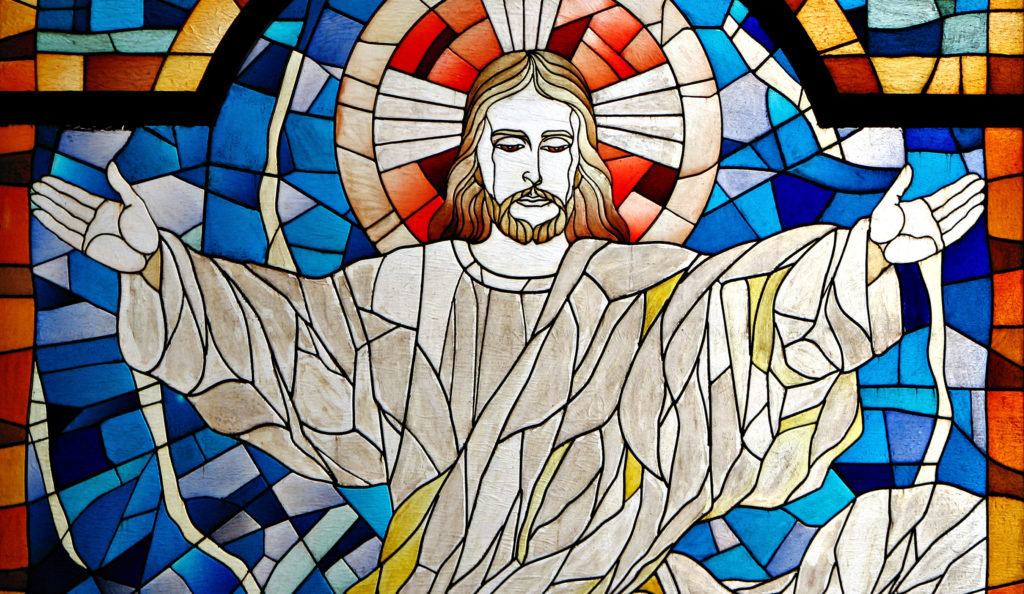
Modern Rendition of Jesus Christ Church Stained Glass Pane
I wonder what those holy women were feeling early in the morning, on the first day of the week, as the Scriptures teach us, when Mary Magdalene and the others came to the tomb only to find it void of the one whom they sought, when in their amazement they were told: Do not be amazed! You seek Jesus of Nazareth, the crucified. He has been raised; he is not here. Those holy women were the first to receive the good news that has forever changed the course of human history and the meaning of our shared human experience.
On this Easter day, the mystery of the cross and the empty tomb looms large. The two truly form one mystery because their meanings are not fully realized alone. Without the empty tomb, the cross stands only as a monument to brutality; without the cross, the joy of the empty tomb is lacking. It is the same for us in our lives.
We carry the burden of the crosses of our lives, but faith teaches us that these crosses are not ends in themselves when we unite them with the Cross of the Lord Jesus; no cross comes without the promise of resurrection.
The resurrection moments of our lives are made all the sweater because of the sacrifices and hardships that have preceded them. In the end, having borne the trials of this life and having persevered in faith, the joy of everlasting life will be unlike anything that we can imagine now. Until then, the empty tomb stands as the Lord’s promise to us and all who live and die in his friendship.
May the Lord bless you and yours this Easter with the fullness of his grace and the joy that comes from him alone. In every cross may you know that it is not an end. In moments of sacrifice and desolation may you know that you are not alone or forsaken. May you always be mindful that Easter teaches us that God always gets the last word: life; and not just any life, a share in his own divine life.
All honor, praise, and glory to the risen Christ, who, by his death and resurrection, has gained for us the rewards of everlasting life! Happy Easter!
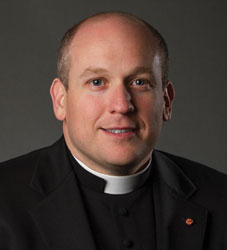
Father Christopher House is the Rector-Pastor of the Cathedral and serves in various leadership roles within the diocesan curia, specifically Chancellor and Vicar Judicial.

 In one of the most shocking passages of the Gospels, Matthew 5:20-26, Jesus describes the righteousness one needs in order to reach the kingdom of heaven, noting that it must surpass that of the scribes and Pharisees. He discusses the relationship one should have with one’s brother, saying that there is much more to it than simply observing the Old Testament commandment not to kill. It is wrong even to be angry with one’s brother or to call him a fool. Furthermore, Jesus advises us that if we are not at peace with our brother, we should make peace with him before offering gifts to God.

 In 1927, G.K. Chesterton penned an essay (h/t Fr. James Schall) for the Illustrated London News titled “Shakespeare and the Dark Lady.” An august scholar, the Comtesse de Chambrun, had written a heady, though insightful, book about William Shakespeare as an actor-poet. After considering her worthy contributions to the bottomless scholarly repository about Shakespeare, Chesterton admitted, “[This book] seems to me both fascinating and convincing. I hasten to say that the lady is very learned and I am very ignorant. I do not profess to know much about Shakespeare, outside such superficial trifling as the reading of his literary works.”


 The somewhat questionable consequences of smartphones, social media, and the many other technologies of their ilk have been well documented. A Psychology Today article, “How Technology is Changing the Way Children Think and Focus,” for example, had this to say about the societal effect of recent technologies: “Frequent exposure by so-called digital natives to technology is actually wiring their brain in ways very different than in previous generations.” Terms like “digital natives” and “wiring their brain” can sound vaguely ominous, maybe even apocalyptic. Of course, we could have said something similar about the baby boomers and the advent of their surrogate babysitters: television sets. And to be fair, such recent technologies also offer a lot of in the way of good for our world. Like most things in life, there are “pros” and “cons.”
 The season of Lent is a special time for Catholics. In almost every sphere of life, those who take something seriously come up with a plan. Championship sports teams, flourishing businesses, triumphant political campaigns and successful individuals all teach us a powerful lesson: Those who get results are generally the ones with better strategies implemented with perseverance.