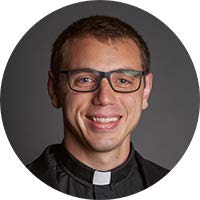
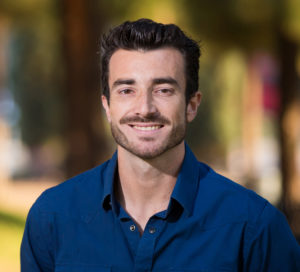
 Dominic is a seminarian for our diocese in formation at Kenrick Seminary in St. Louis. Dominic will be entering his third year of theology studies and will be ordained a deacon next spring. We are happy to welcome Dominic to the Cathedral Parish for the summer!
Corpus Christi
 This weekend we celebrate the feast formally titled the Solemnity of the Body and Blood of Christ, but popularly known as Corpus Christi. Every time the Church gathers to celebrate the Mass, the Eucharist, which is the body, blood, soul, and divinity of our Lord, is at the center of our worship. We must avoid the danger of growing lax in our reverence and awe due to our familiarity with this great and wonderful sacrament, which is one reason why the Church dedicates a particular day of solemnity to focus solely on this mystery. The Eucharist is the life source of the Church, the ultimate manifestation of Christ’s presence among us, and it has been the strength of the faithful for the Church’s entire history. It is not a sign or symbol, because a sign or symbol points to another reality. It is itself a reality because the Holy Spirit changes the humble gifts of bread and wine that we offer into the real presence of Jesus.
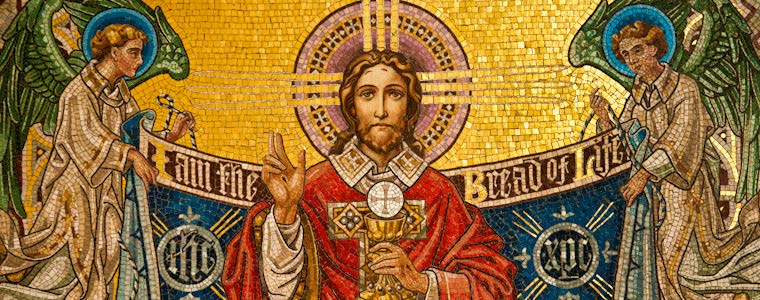
Two years ago at Father Braden’s first Mass, the rector of Saint Meinrad Seminary preached and in his homily he recounted a wonderful story told by the 20th century American Catholic writer Flannery O’Connor. In a letter, Flannery recounted that she was invited to a dinner party and how she felt out of place in a group of “intellectuals.” She goes on to say that she said nothing all night until the conversation turned to the Church and the Eucharist and that her hostess talked about that, even though she had left the practice of the faith, she still thought that the Eucharist was a wonderful “symbol.” Having heard enough, Flannery stated: I then said, in a very shaky voice, ‘Well, if it’s a symbol, to hell with it.’ That was all the defense I was capable of but I realize now that this is all I will ever be able to say about it, outside of a story, except that it is the center of existence for me; all the rest of life is expendable.
May we have the same grace that Flannery O’Connor did to recognize just how vital the Eucharist is for us. The Eucharist has been the strength of martyrs, it has comforted the faithful over the centuries in the face of adversity, it is the source and summit of our life of faith, and the remedy for our mortality that will lead us to everlasting life.
Father Christopher House is the Rector-Pastor of the Cathedral and serves in various leadership roles within the diocesan curia, specifically Chancellor and Vicar Judicial.
Stewardship Activity
Stewardship of Time & Talent
Summer plans can mean lower Mass attendance, which leads to a greater need for volunteer and financial support. Please consider stewarding your talents in Liturgical Ministry this summer or sharing an extra gift toward the offertory during these summer months.
Stewardship of Treasure- May 19th & 20th
Envelopes: $5,113.00
Loose: $3,649.00
Maintenance: $1,434.00
__________________________
TOTAL: $10,196.00
Needed to operate weekly: $15,907.89
Difference: $6,864.67
Stewardship of Treasure- May 26th & 27th
Envelopes: $5,335.00
Loose: $2,281.35
Maintenance: $70.00
__________________________
TOTAL: $7,686.35
Needed to operate weekly: $15,907.89
Difference: $8,221.54
April EFT: $18,486.10
Parishioner News
We want to extend a big Thank You to the Cathedral Council of Catholic Women who have generously supported the new Alpha series (launching June 20th) with a donation of their resources, time and talents! We would not be able to host this program without these amazing women! Thank you ladies!
We are looking for childcare volunteers for the What’s for Dinner program! If you are willing and available the first Thursday of most months, please let us know. Please contact the Parish Offices if you would like to volunteer. We would love to continue providing an evening of family formation for our Parish! The next What’s For Dinner is Thursday, June 7th. We will be hosted by the Knights of Columbus and Deacon Larry will be leading us in faith formation.
Have some news you would like to share? Please email Katie Price at [email protected].
Religion and Skepticism on Campus: An Interview with Bishop Barron
*Note from Cathedral: We thought this would be an interesting article for sharing because many of our families will be welcoming home loved ones from college for the summer. Perhaps you know someone in college or a young adult, please invite them to come to Sunday Mass with you at the Cathedral, or to Alpha starting June 20th. We have many opportunities in the Diocese for them to get involved with their faith. For more information please reach out to the staff.
On April 24, Bishop Robert Barron, theologian and founder of Word on Fire Catholic Ministries, spoke with the staff of The Torch, Boston College’s Catholic Newspaper, on the subject of religion and skepticism. The Bishop began by describing skepticism as a perspective that often “traps” its adherents “in Plato’s Cave,” unable to broaden their views. He then went on to describe possible benefits of the outlook, especially in the context of the university, and to offer advice to students as they continue their search for the truth.
The Torch (T): Do you think, given the restrictions of skepticism, there are any benefits to it?
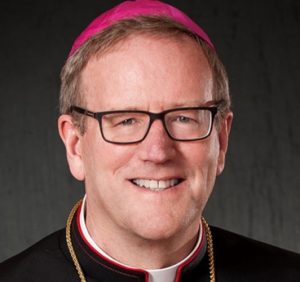 Bishop Barron (B): I think skepticism is not a bad attitude, and I think it’s good for college students to be skeptical. That’s how you learn. If you don’t ask questions, and you don’t wonder about things, you’re not going to make any progress. So, I’m not against it at all. I think it’s really healthy. However, we’ve got to be skeptical of our skepticism. If you take it too far, it becomes uncritical, and it becomes a block to real knowledge. I would say, “Yeah, unleash your skepticism about a lot of things—including skepticism. Be skeptical of the secularist ideology, because sometimes it’s as though [people said], “Oh no, that’s fine, no one should ever question secularism.” That’s the default position. Actually, I would be just as skeptical about that as about anything else. So, yes to skepticism, but not so far that it blocks your access to reality. The danger with excessive skepticism is that you end up living in a very, very narrow space, this little tiny world that you have control over. And that just makes your life cramped.
T. You mentioned having faith in skepticism itself. Do you think there are other, non-religious areas where people hold on generally to a kind of faith they don’t acknowledge?
B. Yes, and it’s a very important thing. Here, I’d rely on the great John Henry Newman. Cardinal Newman said this a lot in his writings, that in every area of knowledge, especially the sciences, something like faith is always operative. Even if you’re making progress in a science, you’re not at every stage of the process personally verifying everything. In fact, you accept all kinds of things on faith: findings that have been done, experiments that have been conducted, settled science that’s happened over the centuries. These you accept on a kind of faith, and then you move forward with your own investigation.
 In fact, in every area of life, including the most basic things, something like faith or trust is operative. In this regard, Newman says that even that you know who your parents are—can you absolutely prove that with apodictic certitude? Or are you taking it on the testimony of lots and lots of people [who] you’ve come to trust? You trust in GPS systems—have you verified it before you set out on your journey, or are you accepting on faith that this is based on the work that a lot of people have done? So, there’s an analogy between religion and the role that faith plays, and the role that faith plays in the sciences.
T. On that note, something many college students have heard, especially with the rise in popularity of the STEM fields, is the statement, “Science is my religion.” What would your response be to that sort of statement?
B. Well, first of all, it’s a pretty pathetic religion. I love the sciences, I think they’re great, and the Catholic Church applauds the sciences. And some of the greatest figures in scientific history have been ardent believers—Gregor Mendel, who invented modern genetics, or Father Lemaître, who discovered the Big Bang Theory. So, we’re not opposed to science at all.
But science looks at reality through a certain narrow lens, an “aspective” reality. That’s an example of what I call scientism, which is the reduction of all knowledge to the scientific form of knowledge. So, science does give you knowledge about certain dimensions of reality, but not everything. There are other ways of knowing that are non-scientific.
Here’s the test case—how do you prove scientifically that science is the only way to know reality? See, that’s what scientism claims. But you can’t verify that empirically; you can’t do an experiment to prove it, you can’t use the scientific method to show that only the scientific method delivers truth. Does that make sense? And that’s why [scientism is] a self-contradictory position. And then [I’d] say, just in answer to the question directly, it’s a pretty narrow, pathetic religion, if you’d say, “Only what I can empirically verify and control is of ultimate meaning and value to me.” Because religion has to do with your ultimate good, your ultimate concern, and if science is your religion, it’s a pretty pathetic religion.
T: Do you think there are specific challenges Catholic colleges face in preaching the Gospel today?
B: Sure, one of them that’s huge is scientism—this aggressive, sort of arrogant, domineering attitude on the part of the scientists. That’s a block. The second thing I’d say would be the whole range of the Church’s teachings on sexuality, which are seen very often as oppressive to people today. And then, relatedly, the third thing I’d say is what I call the culture of selfinvention— that we all have the right and the prerogative to invent ourselves, to determine what’s true for us, and to determine what’s morally right for us. The Church speaks for objective truth and value, and that puts it often at odds with a culture that says, “No, no, it’s up to me to invent the truth and invent the good.” So, I’d say those are the three major obstacles that we face on college campuses.
T: Do you have advice, both for college students who are strong in their faith and those who are still unsure, trying to wade through this sea of different opinions?
B: For those who are strong in their faith, I’d say to keep going to Mass, to keep living the Catholic life, and to do so in a public way. Let people see that you are a person of faith. Don’t do it aggressively—you’re not beating people over the head—but you’re not ashamed of it, and you’re willing to show, publicly, that you’re a believer.
And for those who are searching, I love people who are searching. I’m much more worried about people who are shut down, like those who embrace scientism. That’s the danger —“I’m shut down; there’s nothing beyond what I can see and control.” Someone who’s searching, I love that. I would just say, “Keep searching.” Don’t limit your search to what ideological secularism tells you, but let the mind and heart go all the way, because what they want, finally, is God. It’s only in God that my mind and my heart and my soul are at rest. So I tell searchers, “Keep searching.” And don’t let people limit your passion and your hunger for the truth and for the good.
What I’d say to both groups is [to] keep reading great Catholic literature. So you’re on a college campus, you’ve got access to books, you have the time to read and study. Gosh, everybody from Augustine, to Thomas Aquinas, to G. K. Chesterton, to John Paul II, to Thérèse of Lisieux—there’s so many people you can read [who] are great on these issues. Take the time to delve into the Catholic tradition.
T: If you had to choose one author out of those, someone who you think really speaks to today’s university landscape, do you have one in mind?
B: Well, yes, I suppose I would say Chesterton. But I might even choose someone who’s up at your college, Peter Kreeft, who I think [has] translated a lot of those people into language that contemporary university students can relate to. He’s taught undergraduates at Boston College for decades, so I’d say Peter Kreeft is a great person for people to study on college campuses.
Word On Fire Catholic Ministries is a nonprofit global media apostolate that supports the work of Bishop Robert Barron and reaches millions of people to draw them into— or back to— the Catholic faith. For more information, wordonfire.org.
Cathedral Launches Alpha!
Excitement is growing around the launch of the Alpha series at Cathedral! What is Alpha? Who is invited? Who should we invite or how can I help? These are all great questions. For more information and answers, please check out https://spicathedral.org/alpha or contact Katie Price at [email protected].
All are invited!
Alpha involves radical hospitality, dinner, and engaging conversations on some of life’s biggest questions! We will grow together as a Parish and this is a great way to get to know fellow parishioners and Cathedral guests.
Alpha begins June 20th at 6PM in the Cathedral Atrium.
The Art of Dialogue
 Discussion is impossible with someone who claims not to seek the truth, but already to possess it. (Romain Rolland)
My youngest daughter and I were studying together the other evening for an exam she had the next day. At midnight, my very practical wife (who frequently saves us d r e ame r s f r o m s t a r v a t i o n a n d impoverishment) called timeout for sleep. But neither of us wanted to stop. We were discussing the reasons in the Catholic just war tradition for calling a war “just,” and in what sense the detonation of the atomic bombs at Hiroshima and Nagasaki could be called just.
I love studying with my children, as we launch into wild tangents of exploration that often blow our collective minds. The problem is, we don’t get through the material efficiently and end up panicking around 11:00 p.m. Yet, to this very point my daughter made an astonishing comment before we blitzed through the rest of the material last time: “I think school kills the desire to learn, since just when we start getting excited about what we’re learning in class the teacher says, ‘Okay, we have to move on to get through everything else.’ And then I’m like, okay forget it. What’s the point?”

A photo of grandson spending time with his great-grand mother
“The point” is philosophy, philo sophia, awakening the love of wisdom and knowledge in learners. Leading people to wonder, to fall in love with the quest of the mind after everything. Teachers are inciters of fascination, architects of wonder. And it’s those who eagerly engage in dialogue who are in love with wisdom, with knowledge, with truth.
What Catherine and I did that night was the art of dialogue, of dia logos, which is literally to “think through” another person. Not talking “at” another person, or even “with” them, but thinking through them. My daughter’s thinking “got into” me, and mine into her. It’s really quite amazing. Insights are had in the active, interpenetrating exchange of ideas with another. A dialogue partner helps me to “think through” the truth of the matter we are together seeking. Their thinking influences, disrupts, smacks, illuminates mine, and mine theirs.
Effective, fruitful dialogue requires a number of skills and attitudes if it to yield new insights. Among those, humility is crucial. Humility is an open, willing disposition to learn from anyone and anything—to be corrected and to correct—as well as the persistent realization that I, on my own, never fully possess the whole truth and nothing but the truth. God alone is truth, we are stewards of truth, and truth is only held as a common stewardship. It’s not private property.
St. John of the Cross says it, “Always prefer to be taught by all, rather than to desire teaching even the least of all.” Why? To ensure that you always remain open to the common discovery of new vistas of understanding, new perspectives and insights. The tendency we have is to devolve into monologue, into cliques of agreeable others, or into the pseudo-safety of relativism’s shallow and vapid tolerance of others’ ideas that ostensibly absolves us from the risky duty of engaging in the hard work of “reasoning together” (cf. Isaiah 1:18).
The transformation of humanity into a united community is hard work, and dialogue bears the lion’s share of that work. Which means dialogue is an art of charity, the specific manner by which love binds people more closely together. No dialogue, no unity. This means married couples and families should be the experts, the premier contexts for the art of dialogue, where it is learned, practiced, perfected, and then extended out into the wider civic community, church, and world.
And dialogue, like love, takes time. It requires time “wasted” together, especially time spent face to face. I love the saying, “Children spell love T-I-M-E.” Love requires time-with-me. In your marriage, parenting, friendships—in your relationship with God— the quantity of time invested is an essential ingredient of the quality of your investment. Quality time requires quantity time.
When I think of my closest friendships, all of them, without exception, are relationships in which we do dialogue full throttle. Knock-down, drag-out bliss, enjoying every minute of our joint journey into the Unknown. And it is in those relationships that my deepest, most impactful, challenging, meaningful, and life-changing insights emerge. Over drinks, over meals, during walks, while working on projects together we discuss difficult, fascinating, complex, banal, transcendent issues. Grimacing, pounding the table, shaking heads, nodding, laughing, modulating voice pitch—it’s a wild, unruly, meandering encounter from which I always walk away enlightened, challenged, uplifted, humbler, wiser. Deo gratias.
My grandfather wrote in a letter he sent to Patti and me after our first son was born, “As your children grow, you love them by falling in love with learning all over again every time they ask you a question, want to read a book, or show you a flower they found outside the front door. Time spent speaking with them on anything and everything. That’s your long-term investment in their excellence.”
Amen.
Dr. Tom Neal presently serves as Academic Dean and Professor of Spiritual Theology at Notre Dame Seminary in New Orleans, Louisiana. He has worked for twenty years in adult catechesis, retreat ministry and teaching theology in various contexts trying to make present for others the “Word made fresh.” Tom received a Masters in Systematic Theology from Mount St. Mary’s University and a PhD in Religion at Florida State University.
Groaning Earth Awaits Our Surrender
 You rocked the earth, split it open;
Repair the cracks, for it totters.
(Psalm 60:4)
Neither the lava flowing from Hawaii’s Kilauea volcano nor the National Guard helping people out are asking anyone about their politics or their religion as the magma rolls.
Volcanoes, destructive earthquakes and storms have a way of reminding us that— despite the roiling headlines—our divisions are both embraceable, and releasable as circumstances warrant. Catastrophe has a way of subduing our prejudices until “theys” and “thems” become only “us”—creatures living within a creation that shudders and quakes and shouts out in pain thanks to the actions of a broken humanity.
Wait, what? Human sin contributes to natural disasters?
Well, yes. Pope Francis actually makes that point in the second paragraph of his 2015 encyclical, Laudato Si’ in seldom-quoted lines that seem more relevant every day:
The violence present in our hearts, wounded by sin, is also reflected in the symptoms of sickness evident in the soil, in the water, in the air and in all forms of life. This is why the earth herself, burdened and laid waste, is among the most abandoned and maltreated of our poor; she “groans in travail” (Rom 8:22).
We have forgotten that we ourselves are dust of the earth (cf. Gen 2:7); our very bodies are made up of her elements, we breathe her air and we receive life and refreshment from her waters.
Weird events in nature tend to cue a debate as to wehther they are occurring naturally or are the fault of an anthropogenic (“man-made”) injury to creation. Science is usually at the crux of either argument, but religion can bring a perspective that even the “spiritual but not religious” may be able to get behind.
Nature co-operates with itself and its laws. In so doing, nature sustains, preserves, and perpetuates itself in a way that co-creates with the intention of the Creator. A bird pecks for food and the action aerates the ground, keeping it alive and receptive; the waters evaporate up to the heavens and return to us fresh and clean, and the earth is softened and seedlings grow. Nature operates within its sphere, lives as it is intended to live. There is no conflict.

Humanity came to consciousness possessing free will, and with a co-creative aspect as well. Like the rest of nature—like the blue jay and the soil and the rain —we sustain, preserve, and perpetuate ourselves through cooperation with the design of nature. That is, when we are not in conflict with the great ongoing intention of life, born of the very mind of the Creator.
Nature cannot say it is not what it is. A tree cannot insist that it is a flower; a squirrel cannot declare itself a bird and then try to outthink and outsmart nature, in order to compel its co-operation in that direction. Nature, rightly-ordered, asserts nothing of itself, because it simply is.
Humanity, however, precisely because it is endowed beyond natural instinct and gifted with consciousness, creativity, reason, and free will, is in near-constant conflict with itself. If the birds and worms and earth co-operate easily within the great wholeness of creation, human beings simply cannot. Created in the image and likeness of God, imbued with the spark of God, humanity longs for more; it longs to reunite with that spark, to be forever enclosed within the wholeness of God.
Materially, such an action is—like the hand of Adam, outstretched to the Father—forever beyond the reach of even the strongest human will, and that being the case, humanity fills the empty space of its exile with its own reason and gifts.
The very character of human giftedness, with its conscious observation and sense of self, immediately distinguishes the human animal from the instinct of nature, which—once, more— simply, objectively is; humanity continually prompts an assertion of itself, which is, “I Am.” This assertion initiates an ever renewed, and deluded, quest for meaning as humanity seeks to become the god of its own generation and creation, an ambition that brings human beings, again and again, first into conflict with the self, and then with others, and finally with the rest of creation.
And yet, humankind is most beloved of the Creator, who condescended to incarnate, and set a tent with humanity, in order to save it from a redundantly enthusiastic pursuit of its own demise.
Creation is alive; we wound it with the sins of greed, sloth, pride, gluttony, envy, wrath, and lust, which are embodied in commerce and industry, and also within ourselves, for these sins lie at the core of our insistence that not only may we move beyond the logic of nature, but—in honor of our Godspark, which is reason— we must.
God looked at the perfection of created nature and pronounced it “good.” Into perfect nature, mankind, through the agency of ego and conceit, introduces what is unnatural—and pronounces it “better.”
And when what is natural and perfect must endure what is unnatural and imperfect—whether delivered through chemistry or by explosive brute force, or by social convention—there is a tragic reckoning. Scripture tells us the earth groans; it objects, as it must, because what is natural and pure cannot live in harmony with what is unnatural and impure. The earth roils to be rid of the sin that intrudes upon perfection, and there are the floods and earthquakes and volcanoes, the pestilences and unusual signs and tremors that Christ Jesus himself spoke of.
The earth trembles on its axis because of the human heart and mind, which is bored by exile, unsatisfied with the reality of the natural, and endlessly attempting to play at godhood for its own gratification. This is what Pope Francis means when he asserts that community cannot exist in the unreality of the ether (LS, 103-110), that rejection of God-willed life cannot affirm the very nature we seek to assist (LS, 118-121), and that a confused and conflicted misunderstanding of our own bodies and the dignity inherent within them—ours and everyone else’s—entertains an illusion of power that is in fact an admission of great weakness (LS, 154-159).
As we see within our own church, what is holy and what is profane may exist within close proximity of each other, but they can never be fully one; there will always be the battle between what is deadly and corrupt coming against what is life-giving and good. The Church is even now expressing its anguished moans over the conflict and the destruction that such friction has wrought.
So too, the earth. As long as humanity, serving the muse of gifted reason and ego, insists upon the introduction of unnatural means to achieve its insatiable ends—be they personal or commercial or some amalgam of both—creation will continue to writhe in objection.
If we truly want to be a balm to creation, we must first be humbled to its orderliness, which does abide within us, as well as apart from us. We must cast off the deadly sins which urge us forward, a n d s e e k t h e interior restoration that comes from reconciliation to w h a t i s G o d – ordained, God created, and God sustained.
T h e e a r t h i s perfect; if we are to live in harmony with it, we too must be perfect, as Christ Jesus urged us: “Be perfect, as my Father is perfect.” Then we will be holy, and our outreach to God might finally bring us nearer— lifting the hand of Adam ever-so-slightly forward, toward the All- Holy.
We know that for the Incarnation to form, a pristine vessel in the form of Mary, the Immaculate Conception, was needed to contain and bring forth the All-Purity. Laudato Si’ is an admonishment away from all of our sin, all of our hatreds, all of our conceits, all of our pridefulness, all of our greed, all of our lust and gluttony, all of our self-indulgent wrath, and toward what is holy, good, and pure.
It is an invitation toward Incarnation.
Elizabeth Scalia is a Benedictine Oblate and author of several books including the award-winning Strange Gods: Unmasking the Idols in Everyday Life (Ave Maria Press) and Little Sins Mean a Lot (OSV).
Thank you Father Braden
It was Chrism Mass 2008, the last one before t h e Cathedral restoration. I had finished my six month term as administrator of the Cathedral but had remained in residence in the parish to give sacramental help while serving as the bishop’s master of ceremonies and as the newly-minted diocesan vocations director since the previous January. Being the MC and the director of vocations were both new jobs for me. This was my first Chrism Mass to oversee and I was working on what would be the first class of seminarians that I would shepherd-in for the following fall term. As I was running around before Mass, getting things ready, I was introduced to a senior from St . Anthony High School in Effingham. After meeting him, I went back into the sacristy and realized that I was short one reader for the presentation of the oils that were to be blessed. I walked back into the Cathedral, where this young man was still standing and visiting with those he had come to the Cathedral with, and I pointed at him and told him to come with me. That is how I first met our Father Braden.
Long before he came to us as priest, Father Braden was already familiar with the Cathedral Parish. Though you may not have noticed him then, Father Braden lived with us for two summers (’09 and ’10) while having other responsibilities those summers. It is amazing how fast those ten years passed, from his formation in college seminary to major seminary to ordination and finally to his time with us. I am grateful to him for the ministry that he has provided during his time here in the parish, especially for his faithful care of our sick and homebound.
Father Braden is leaving us to assume some large responsibilities. As you know, he has been assigned as parochial vicar to Our Saviour Parish in Jacksonville, which has its own grade school, Routt High School, and the chaplaincy of Illinois College. The clergy at Our Saviour also serve as the clergy for the parishes in Beardstown, Arenzville, and Virginia. Father Braden will also begin his studies for a degree in canon law at the Catholic University of America in our nation’s capital, spending June and July there before arriving in his new assignment. To say that Father Braden is going to be busy is understatement; he is going to be stretched but he is up to the challenge and he will do well.
He leaves with our love, gratitude, and prayerful support as he continues to model Christ the Good Shepherd for our sisters and brothers in his new parishes.
As Father Braden takes his leave, we have much to be grateful for in these days. We give thanks to God for Father Braden’s ministry and for the ministries of the many other priests who have served this parish.
We give thanks for Father Michael Friedel who will be joining Father Wayne and myself here at the beginning of July.
 We also give thanks for the five new priests who were ordained this weekend for our diocese and we pray that God will lavish them with his grace at the beginning of their priestly lives. Among them is Father Dominic Rankin who spent the summer of 2016 with us here at the parish. Father Dominic will offer a Mass of Thanksgiving here at the regular 5PM Mass on Sunday, June 3rd. Please come and celebrate with us at that Mass next Sunday evening.
Finally, I wish to offer my thanks to you, our parishioners and friends of the Cathedral. I thank you for the love and goodness that you show the seminarians and newly ordained priests who come to our parish.
They are sent here for a reason: Bishop Paprocki knows that they will find good people here who will receive them and love them. I pray that the Lord will grant all of you the reward of your goodness. God bless you!
Father Christopher House is the Rector-Pastor of the Cathedral and serves in various leadership roles within the diocesan curia, specifically Chancellor and Vicar Judicial.
In Response to God’s Silence
 Silence. It can be a reservoir of flowing peace and nourishing grace. It can call to mind our cherished identity, compelling us to respond to God and others with that same, first love he has shown us. Or it can be cold and sterile, a state of abandonment, loss, frustration and sorrow. It’s in the silence that we can choose to trust in his loving presence or his aching absence. We all know of people—maybe even ourselves at times—who turn away from God because in a time of great need they were met with the cold, bitter sound of only their own cries and tears. It’s an experience, I imagine, we can all relate to on some level.
Submitting to God, and the mystery of his sometimes peculiar and painful ways is a sobering challenge, one we can’t escape as we journey back toward the Kingdom of God in this life. God gives us enough grace and light to have a reasonable, firm and joyful belief in him, but so much of our lives remain unclear—we’re asked to trust in his plan even when it appears chaotic, unfair, or meaningless. When the eyes of our bodies are darkened, we are called to rely evermore on the eyes of our faith. This trusting in his will gradually and —at least on our worse days, suspiciously—throughout our lives is hard. And we experience moments in our lives when we cast a full-throated cry to God in words that echo those same ones from Job himself:
I cry to you, but you do not answer me;
I stand, but you take no notice.
You have turned into my tormentor,
and with your strong hand you attack me.
You raise me up and drive me before the wind;
I am tossed about by the tempest.
– Job 30:20-22
I heard a revealing parable once about a solitary monk dwelling in an ancient monastery. The monastery rests on top of a rocky cliff overlooking a small village. For many years, a man from the village wonders about the monastery and the life of the solitary monk. Finally, he decides to scale the cliff to meet the monk. When he arrives at the top, he spots the wizened monk sitting in prayer. The young man calls out to him, “Hello Father, do you still wrestle with the Devil?” The old monk, stirred from his meditative state, replies, “No, I don’t wrestle with the Devil any more. I’m too old now and the devil is too foolish. We’re tired of each other.” Surprised, the young man says, “So your life must be easy now.” The monk responds, “No, it’s much harder. Now I wrestle with God.”
Like the wise monk, as we grow closer to God we find ourselves in seemingly more compromising positions with him. We can choose to relent, allowing God to shape the hardened clay of our lives, or stand firm, not only refusing ground, but even taking the offensive in overcoming God’s will with our own. Yet, when this proves, well, impossible, we can be tempted to leave the ring altogether—to dismiss him from our lives for not heeding our egotistical demands. There can often be an underlying desire to force God’s hand, to test him and charge him to make a convincing and impervious account of himself: of why things are the way they are, of his intentions, and of course, of his and our own existence. Such a desire to be god over God can devolve into a type of violence against God—a warring of the creature against the Creator.
In Raymond Bradbury’s short story collection, The Illustrated Man, one of his stories tells of a handful of travellers from Earth who land on a distant planet. The captain of the ship, giddy with excitement to feed his own insatiable vanity, looks forward to appearing before the inhabi tants of the planet , which he anticipates will cause them to marvel at them. However, he is disappointed when he hears from one of his envoys that another far-off stranger has already visited, one who arrived only yesterday. The language remains somewhat vague at first, but it becomes clear that this strange visitor is Christ. In the story, Christ has come to the alien world to do what he did for us: teach, heal and point us toward eternal life. The captain, an avowed atheist, goes into the town and demands that the inhabitants bring the man to him, whose whereabouts they claim they do not now know. In response, the captain turns to violence against one of the inhabitants, the mayor of the town:
On the floor, holding his wounded arm, the mayor looked up. ‘Put down your gun. You’re hurting yourself. You’ve never believed, and now that you think you believe, you hurt people because of it.’
‘I don’t need you,’ said [the captain], standing over him. ‘If I missed him by one day here, I’ll go on to another world. And another and another…one day I’ll catch up with him! Do you hear that?’ He was shouting now, leaning wearily over the man on the floor.
The captain eventually leaves the planet by himself in search for the mysterious man—in search for God.
“Yes, poor man, he’s gone,” said the mayor. “And he’ll go on, planet after planet, seeking and seeking, and always and always he will be an hour late….And finally he will miss out by only a few seconds. And when he has visited three hundred worlds and is seventy or eighty years old he will miss out by only a fraction of a second. And he will go on and on, thinking to find that very thing which he left behind here, on this planet, in this city—”

And like the obdurate captain, we can be tempted to try and force God to manifest in our lives according to our demands, at the whim of half-hearted prayers. We cry out to God expecting an answer, and when one isn’t given in the form we desire, we can allow our pride and frustration to turn our backs to him.
And isn’t that what many have done? Many have set about building a world without God in response to his seeming absence, a world that is still filled with horrible poverty, violence, a lack of respect for life, and spiritual unrest, to name only a few of the harrowing realities of our time.
“The question is whether you choose for God or for your own doubting self. You know what the right choice is, but your emotions, passions, and feelings keep suggesting you choose the self-rejecting way.”
– Henri Nouwen, The Inner Voice of Love
God continues to wait in the silence, loving us and calling us back to him. It’s in the silence, in the heart of an honest prayer to him, that we come to witness his presence. Christ remained silent, swaddled in a scarlet robe and crowned with thorns, in response to being mocked and abused—offering only love when the world hated him, when it killed him. God’s silence is never a refusal of our pleas for his love or a lack of concern—it’s an invitation to enter more deeply into his presence.
We have to be willing to enter into the silence on our own—no one can do it for us—and meet God there in sincere prayer. It may not come overnight, and it may not mean we still won’t struggle with our own sufferings and difficulties in life, but if we keep asking for God’s presence in the silence, we begin to see that he is really there—that he always was. And in the silence, beneath the doubts and emotional turmoil, the objections and lies of the world and our own fears and insecurities, we hear God responding not with words, but with an inner, inexhaustible flame that sheds lights on who we really are—his beloved.
“I know now, Lord, why you utter no answer. You are yourself the answer. Before your face questions die away. What other answer would suffice?”
– C.S. Lewis, Till We Have Faces
Chris Hazell is the founder of The Call Collective, a blog exploring the intersection between faith, culture and creativity.He holds bachelors’ degrees in English and Economics from UCLA and currently works as a Lead Content Strategist for Point Loma Nazarene University. With a passion for sports, good food and drink, deep conversations with friends, funny stories, writing and seeking to know and love Christ, he attributes all of the blessings in his life—health, family and friends—to nothing but God’s overabundant grace.