Cathedral of the Immaculate Conception

Springfield, IL

  • About
    • Contact Us
    • History of the Cathedral
    • Liturgical Schedules
    • Parish Staff
    • Register with Cathedral
    • Subscribe to the Cathedral eWeekly
  • Sacraments
    • Baptism
    • Becoming Catholic
    • Matrimony
    • Vocations
  • Ministry List
    • Adult Faith Formation
    • Cathedral Meal Train
    • Cathedral Online Prayer Wall
    • Cathedral Concerts
    • Family of Faith
    • Grief Share
    • Health and Wellness
    • Spiritual Resources
  • Stewardship
    • Stewardship: A Disciple’s Response
    • Stewardship Form
  • Support
    • E-Giving Frequently Asked Questions
    • Give Online
  • Sunday News
    • Announcements
    • Cathedral Weekly
    • Livestream Feed
    • Submit a Mass Intention Request
    • Weekly or Announcement Submission

Stewardship Activity

Stewardship of Time & Talent
Time in prayer is a great practice for discerning your talents and what you may be able to share with the Parish!

Stewardship of Treasure
Weekly Collections: April 28th & 29th
Envelopes: $7, 011.22
Loose: $6,531.08
Maintenance: $80.00
__________________________
TOTAL: $13,622.30

Needed to operate weekly: $15,907.89
Difference: $2,285.59

April EFT: $18,486.10
These are recurring electronic donations over the month.

Parishioner News

We are adding a new section to the Weekly in the coming weeks. To celebrate our community and to get to know each other better, we are creating a section in the weekly that highlights parishioner news, prayer requests, and sacramental news to share.222

Have some news you would like to share? Please email Katie Price at [email protected].

May, the Month of Mary

“Bring flowers the fairest, bring flowers the rarest, from garden and woodland and hillside and dale; our full hearts are swelling, our glad voices telling the praise of the loveliest flower of the vale!”

The preceding few lines will be familiar to some who read this but probably not to too many. These words are a part of a thirteenth century hymn entitled “Queen of the May” and this hymn was traditionally sung during May, especially at May crowning ceremonies, in honor of Mary our Blessed Mother. Growing up at St. Aloysius on the north side, the May crowning was a yearly event as it was in many Catholic schools and hopefully it remains so; our school children crowned the statue of Mary in the fountain courtyard this past week.

May is traditionally known as the month of Mary. Centuries ago, May was dedicated to the pagan Roman goddess Flora who was the goddess of blooms. The month was dedicated to her as a way of casting our winter and welcoming in the new life of spring. As the true Christian faith spread throughout the Roman empire and the rest of the world, this festival of Flora disappeared but various practices to welcome the change in seasons remained. Beginning in the Middle Ages, a popular devotion came about entitled Tricesimum which was a thirty-day period celebrated in honor of Mary. At one time, it was celebrated from August 15th (the Assumption) until September 14th (Our Lady of Sorrows) and still is today in some places. As time progressed, this celebration of Tricesimum was merged with honoring Mary in the month of May. By the 13th century, May was becoming synonymous with being the month of Mary throughout many parts of the Church.

During this month of May, as we continue our celebration of the Easter season and the new life won for us by the risen Christ, we are mindful again of the role that Mary played in the drama of our salvation. God’s plan for our salvation in his son Jesus began with Mary’s yes to God’s will for her. We are invited daily to echo Mary’s yes to God’s will in our lives because salvation is the ultimate end of God’s will for each and every person. We honor Mary throughout the Church year, but particularly in this month, because she is our great model of discipleship and our great intercessor with Jesus her son.

The refrain to the old hymn states:

 “O Mary, we crown thee with blossoms today, Queen of the Angels, Queen of the May!”

Let us crown Mary in our hearts with our own faithful discipleship in following Jesus her son, who invites all of us to fullness of life in him.

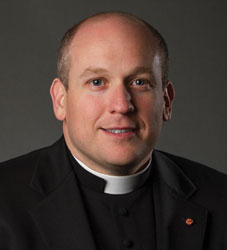
Father Christopher House is the Rector-Pastor of the Cathedral and serves in various leadership roles within the diocesan curia, specifically Chancellor and Vicar Judicial.
Around the Parish

When we changed the format of the bulletin to become The Weekly, the format of my column changed from a sort of “what’s going on” to a more focused column on something usually pertaining to discipleship, many times reflecting on the readings of the particular Sunday. This week I have decided to revisit the old format and I think that I will do that from time to time when things are going on in the parish that I would like to draw your attention to.

May is generally a busy time for families and it is no different for the parish family. This coming month will be of particular significance for us. Since Easter was relatively early this year, one event that normally falls in May has already been celebrated. First Communion for our 2nd grade students in our PSR program and in our school was celebrated this past weekend, April 21/22, on the Fourth Sunday of Easter also known as “Good Shepherd Sunday.” Our parish 8th grade class is preparing for their commencement exercises in just under three weeks on Friday, May 18th at 6:30PM in the Cathedral church. All are welcome.

We ask for God’s blessing on these students celebrating these great achievements.

While these events are always moments of joy, there can be no denying that these events this year are also wrapped with a sense of sorrow as we prepare to end our grade school programming. In these upcoming weeks I would ask that you keep our school children, faculty, staff, and all of their families at the forefront of your prayers. This time of transition will not be easy for many and your prayers are most appreciated.

As we prepare for this transition, I would like to invite you to take a walk through the Cathedral School on Sunday, May 6th, from 11:00AM to 1:00PM.

There will be refreshments provided, many old photographs on display, and memories to be shared.

May will bring another transition with it. If you were not able to join us at Mass last weekend, it was announced that our Father Braden Maher will be concluding his appointment with us and transferring to Our Savior Parish in Jacksonville as parochial vicar. He will also assist as the parochial vicar of the parishes in Beardstown, Arenzville, and Virginia. This new assignment will begin on August 1st. Before Father Maher begins his new assignment, he will begin studies in Canon Law at the Catholic University of American in Washington, D.C. at the beginning of June. This means that he will be leaving us at the end of May. We are grateful to Father Maher for the ministry that he has provided to us over these past two years and we wish him every grace and blessing in his transition.

We will have a farewell reception for Father Maher after the 4:00PM Mass on Saturday evening, May 19th, in the Atrium.

There will be further reminders to come. We will joyfully welcome his successor, Father Michael Friedel, at the beginning of July and I will have more to share with you about Father Friedel in the future.

Personally, I do not like transitions, mostly because they seem to come with grief, but this is a part of the Christian life. As we move towards these times of change, let us remember the Lord’s words to his disciples when he told them that he would be leaving them in the earthly sense but that he would always be present to them in the gift of the Holy Spirit: you will weep and mourn, while the world rejoices; you will grieve, but your grief will become joy. I have told you this so that you might have peace in me. In the world you will have trouble, but take courage, I have conquered the world (John 16: 20, 33). God bless you!

Father Christopher House is the Rector-Pastor of the Cathedral and serves in various leadership roles within the diocesan curia, specifically Chancellor and Vicar Judicial.

A Stewardship Way of Life: Saint Fidelis Sigmaringen

Every month , the International Catholic Stewardship Council writes about a Saint who lived a stewardship way of life. We will begin to share these examples each month, so we too can lear how to bear witness to the Gospel in our lives. For more information, http://catholicstewardship.com/.

Given the name Mark Rey at his birth in 1577, our stewardship saint for April grew up in Sigmaringen, a town located in presentday Germany. He was the son of the town’s affluent burgomeister (mayor) and studied law and philosophy at the renowned University of Freiburg. As a student, Mark made prayer a priority in his daily life. He also spent time visiting the sick. He embraced a humble, chaste and simple lifestyle.

He earned a doctorate in canon and civil law, became a prominent lawyer and soon gained a reputation for representing those who had no money to pay. Mark was affectionately nicknamed “the poor man´s lawyer.” He was known to be extraordinarily generous, and committed himself to working with the poor.

Dismayed by the greed and corruption he found among his counterparts in the legal profession and in the courts of law, Mark abandoned his law practice and entered the Capuchin religious community. He took the name Fidelis, which is Latin meaning “faithful.” He studied for the priesthood and after ordination, celebrated his first Mass in 1612 on the feast of Saint Francis of Assisi (October 4).

After his ordination, Father Fidelis was assigned to preaching and hearing confessions. It was reported that a large number of converts were accepted into the Church because of his zealous evangelizing efforts. He was devoted to Saint Francis of Assisi and revealed that devotion in his pastoral care of the poor and sick. During a severe epidemic in a city in which his friary was located, he cared for and cured many.

In 1621 Father Fidelis was sent to begin missionary work in Switzerland, a territory that had experienced much bloodshed as a result of growing tensions among a number of religious movements of the expanding Reformed traditions. All of these movements were violently opposed to the Catholic faith at the time. His writings, preaching and pastoral ministry converted many in Switzerland to Catholicism. But many others, enraged by his missionary work, threatened his life. On April 24, 1622, while traveling on the road between preaching missions, Father Fidelis was attacked by a group of armed men, beaten and hacked to death. He was 44 years old. Fidelis once wrote: “It is because of faith that we exchange the present for the future.” He was canonized in 1746 and his feast day is April 24.

 Katie Price is the Coordinator of Stewardship at the Cathedral. She has worked in Parish Stewardship for ten years, previously as the Archdiocese of Chicago Parish Stewardship Coordinator. She can be reached at [email protected].

An Unlikely Friend

Sometimes I wonder if we go about it backwards in our catechesis of young people. We tell our young people about the saints, we give them holy cards, we ask them to choose the name of a saint for confirmation – all ways, at least on one level, of hoping that they will be inspired by the saint and come to know more of Jesus and living the Christian faith. Would it not be better, first and foremost, to introduce our young people to Jesus (to truly encounter him as Lord and Savior) and then trust that over time Jesus himself will introduce our young people to his friends, the saints?

I have to admit that this is the way that I have come to know and have friendship with different saints in my own life. Through Christ I have met St. Paul, I have met St. Teresa of Avila, recently I have begun a friendship with St. Josephine Bakhita and (I have to admit) that it is only through Christ that I have developed a friendship with St. Therese.

I grew up one of four boys in East Tennessee in the 1970’s. You quickly learned how to have thick skin growing up with three brothers; as our preferred way of showing affection was either mercilessly mocking one another or sneaking a punch when the parents were not looking. My parents, may they rest in peace, were both converts to the Catholic faith. My father had a life-long struggle with alcoholism (which he lost) and my mother struggled with an alcoholic for a husband. Often, my brothers and I were on our own. My extended family is the proto-typical American family, it seems, when it comes to religion and faith – meaning we are a mix of everything (Lutheran, Evangelical, Episcopalian, Baptist, Catholic, non-practicing Catholic, and agnostic). We cover the whole spectrum. This is my experience.

What possibly could I have in common with a 24- year-old French saint who lived in the mid-to -ate 1800’s, who never left her convent once she entered, and who would break down in tears at the drop of a hat when she was a child?

Yet, I met St. Therese and I was not expecting a friendship. At the seminary I attended for my theology studies, there is a beautiful statue of St. Therese of Lisieux on this “boat-dock” area on the lake near which the seminary sits. I was in the practice of taking walks around the lake, if not every day then at least a few days each week, so every time I went for a walk I would pass by this statue. Over time, I began to notice that flowers were always left by this statue of St. Therese and I thought, “Hmmm, that’s interesting.” Then, one quarter, I took a class entitled “Spiritual Autobiography” offered by Fr. Lou Cameli and one of the books we covered was Therese’s “Story of a Soul.” I really struggled with the syrupy language of the book. It is not my style but I was taken with an incident in her childhood (which she considered her conversion moment) when she was able to let go of her own feelings and rather focus on the needs of another person (her father). She had overheard her father make a comment basically about the pampering she received at Christmas but instead of breaking down in tears (which was her wont) she let it go in a moment and celebrated Christmas with her father and family.

It was a little thing certainly but in this little thing and little moment of encounter she made the choice for love and for Christ.

This choice for love in the “little moments” became her way toward discipleship and, ultimately, sanctity.

I was struck by that, and by the end of that year I had made my first novena to St. Therese of Lisieux. When the Novena concluded I left some flowers by her statue overlooking the lake.

St. Therese does not impose (as some saintly figures do) and I think this is what is so attractive about her. Friendship with St. Therese is like having a sister. Her way is the little way. I was not looking for a friendship but I met her and she has been a friend and a model to me ever since.

Fr. Michael Cummins is a priest of the Diocese of Knoxville, TN. Ordained in 1995, he has served in a variety of roles within his diocese. Currently he is serving as pastor of St. Dominic Church in Kingsport, TN. Fr. Cummins holds a Masters of Divinity and Licentiate in Sacred Theology from the University of St. Mary of the Lake (Mundelein Seminary) in Chicago. He has a deep interest in Christian Anthropology and the interaction between faith and culture.

What’s a Greater Leap of Faith: God or the Multiverse?

How did we get here? I mean, literally. Not just you and me, but the whole shebang. How is any kind of life possible? The universe is a hostile place — solar flares, cosmic rays, asteroids flying about. The odds against our existence are truly astronomical.

Take it from me — I ‘ m a n astrophysicist. My job is to look out into space, at stars and galaxies, trying to answer these basic how-did-the-universe-come-to-be questions.

 Well, those who have a religious faith have an answer: God.

The earth’s distance from the sun, the size of the atom, and a thousand other things large and small that allow us to live and to breathe and to think all seem perfectly tuned for our existence. To many, this design suggests a designer. But from a purely scientific point of view, the faithful have a big problem: They can offer no indisputable proof for this belief.

Because of the lack of hard evidence, it’s probably not surprising that over 70% of the members of the National Academy of Sciences declare themselves to be atheists. But they have a big problem, too. Absent a creator, how do they account for the existence of the universe, of planet earth, of human consciousness? How do they account for the existence of … anything?

Well, turns out they have an answer. And it’s become all the rage in scientific circles. It’s called the “multiverse,” and according to many scientists, our universe isn’t the whole ball game; far from it. These scientists argue that there are an awful lot of universes out there — not just one or two, but an infinite number.

Let me explain: 13.8 billion years ago, there was a Big Bang — from something unimaginably small (we don’t know exactly what), the universe exploded into existence. How did it happen? Why did it happen? Doesn’t matter. ‘Cause it happened.

Immediately after the Big Bang, the universe underwent a rapid expansion. Think of a gush of bubbles exploding from a seriously shaken soda can just after it’s popped open. Cosmologists call this the Theory of Inflation.

As the universe inflates and expands — the bubble universes grow and separate to become their own distinct entities, each with their own unique properties. In other words, new universes are spawned — and not just a handful…an infinite number of them.

Some of these universes would be too cold for life, and some too hot. But, with an infinite number, surely one is bound to get it just right. In short, you and I are just an accident that, given enough universes, was inevitable.

In short, a vast number of the world’s most eminent scientists believe in something that hasn’t been, and in all likelihood, will never be proven.

But, wait — there’s more. Because there are so many universes, it’s very likely, according to the multiverse scenario, that everything that could possibly happen does happen in one universe or another. That girlfriend who broke up with you? You’re married to her in another universe.

Does this sound a bit far-fetched? A little science-fictiony? Well, not to Nobel Prize-winning scientists like Steven Weinberg or the famed cosmologist Stephen Hawking, as well as a myriad of others who whole-heartedly endorse it.

But here’s what’s really surprising: They endorse it knowing there’s not a single shred of hard scientific evidence that supports it. And how can there be? There’s no way we can access another universe.

In short, a vast number of the world’s most eminent scientists believe in something that hasn’t been, and in all likelihood, will never be proven. How does that sound to you?

Probably the same way it sounds to the distinguished physicist Paul Davies: “Invoking an infinity of unseen universes to explain the unusual features of the one we do see is just as [made up] as invoking an unseen Creator. The multiverse theory may be dressed up in scientific language, but in essence it requires the same leap of faith.”

Or, as G.K. Chesterton quipped: “When men stop believing in God, they don’t believe in nothing; they believe in anything.” For multiverse believers, this is literally true: the same scientists who reject God’s existence due to lack of evidence pin their hopes on a theory so all-inclusive and vague it can never be refuted.

Those who believe God created the universe are intellectually honest enough to admit that they do so on the basis of faith. But those who believe in the multiverse are also keeping the faith. They just don’t admit it.

 So, let me ask you, who’s taking the bigger leap?

Brian G. Keating is Professor of Physics at the University of California at San Diego and an astrophysicist at the Center for Astrophysics & Space Sciences (CASS). He is the author of Losing the Nobel Prize: A Story of Cosmology, Ambition, and the Perils of Science’s Highest Honor.

The Not-So-Nice Shepherd

When asked about images or personifications of God, many people name the image of the Good Shepherd. It is an image that is familiar to Christians, both Catholic and non-Catholic alike. The image created by Psalm 23 serves as a basis for this and, for Catholics, every year on the Fourth Sunday of Easter, the Gospel speaks of Jesus as the Good Shepherd. The regularity of this image during this season has resulted in this Sunday being nicknamed “Good Shepherd Sunday.”

Jesus is rightly named the Good Shepherd because of the love and goodness that he shows. He leads us, his flock, by example. He shows us the way by his words and his actions and for those who wander from the path, he calls them back, not allowing us to remain adrift or in error. Jesus is good but he is not “nice” as we have come to understand that word. You will be hard pressed to find any translation of the Gospels that uses the word “nice” to describe Jesus, in fact you will not find the word “nice” used anywhere from beginning to end in the Scriptures, from Genesis to Revelation.

How can I say that Jesus is not nice? I say it very easily. What does it mean to be nice? It means to be agreeable, to be pleasant, to not disturb. All too often we confuse the word “nice” with “good” or “kind.” In reading the Scriptures, we see that the Lord Jesus wanted good for everyone. The ultimate good that he wants for all people is eternal life with God in heaven. As he ministered on earth, Jesus went about doing good: he healed the sick, he comforted the afflicted, and he showed mercy, all of these things pointing to a greater life to come.

Part of the good that Jesus did was also to call out sin when he encountered it. Jesus did not turn a blind eye to bad behavior or look the other way. He was certainly not agreeable to the Scribes and Pharisees but challenged them concerning behaviors and attitudes that were incompatible with their station in life. When faced with the woman caught in adultery, or any other sinner, he did not say “that’s ok” with a wink; no, he extended the mercy and forgiveness of God but with the command to go and sin no more. Jesus was good, kind, and compassionate, but he was not nice.

What does this mean for us as his disciples some 2000 years later? We live in a world that many times is faced with what some might call the “tyranny of nice.” At times society wants to limit us in a way so that we cannot disturb the peace, so that we cannot say something is wrong lest someone be offended or upset. That is not the example that Jesus gave us. As disciples, we are called to be good, to be kind, but not nice. Being a Christian means seeking the good for our neighbor even if the true good is something that they don’t want or understand. If as disciples we never “rock the boat” or “upset the apple cart” in conversations or interactions, for the sake of what is right, good, and holy, then we may want to examine the Christian witness that we are giving.

I don’t know about you, but I don’t want a nice shepherd. I want a shepherd who is good, who loves me enough to challenge me when I am wrong, and who calls me back

to the right path so that I can strive for life with God, here in this life and ultimately in heaven. That is something far better than the niceties that this world offers.


_ _ _ _ _ _ _ _ _ _ _ _

Father Christopher House is the Rector-Pastor of the Cathedral and serves in various leadership roles within the diocesan curia, specifically Chancellor and Vicar Judicial.

The Pope Said What?

A few weeks ago, the beginning of Holy Week, I was browsing news sites on the Internet and was greeted with a large headline that read “Pope Declares No Hell!” I am sure that many of you saw that headline also or at least heard about it. My first thought was “great, its not like there isn’t anything else going on this week,” but that was immediately followed by the assumption that something was just not right about that headline. What did not further help matters was that the Vatican Press Office did not do much to forcefully denounce the story line as false.

Last month the Holy Father began the sixth year of his pontificate and, even with five years behind us, many people still have not gotten used to his style of speaking which is very different from his two most recent predecessors, Pope St. John Paul II and Pope Emeritus Benedict XVI, who were both known for their precision when speaking. That is not exactly Pope Francis’s style. He is much more “off the cuff” which can have its challenges. Some people love his style, some do not, but whether you do or do not, this is who Pope Francis is.

The “Hell controversy” stemmed from a conversation with the 93-year-old editor of an Italian journal. This editor is notoriously known for not taking any notes when interviewing someone. The story was based on his own recollections of what the Holy Father supposedly said. This editor is also known for liking to “stir the pot,” you might say. Do I think that Pope Francis denied the existence of hell? No. I do not believe that for one minute. Pope Francis has been unrelenting in his belief that the devil does truly exist and that the devil is actively engaged against the work of the church and good in the world. The Holy Father reaffirms this in his most recent apostolic exhortation that was released April 9th entitled Gaudete et exsultate (Rejoice and Be Glad) on the call to holiness. If there is a devil then there must be a hell.

When a pope speaks, no one should stand in expectation that he might say something that alters the Church’s theological tradition. Yes, the pope can speak infallibly on matters of faith and morals, and the popes have done so or they have spoken authoritatively on other matters not considered infallible but still important. When they do, it generally occurs after consultation with members of the College of Bishops, it is done in very specific terms and in specific Papal documents, namely in what are called apostolic constitutions or encyclicals, and it is not done in private conversations with haphazard journalists.

If you want to learn more about what the Church teaches definitively on the existence of hell, go to the Catechism of the Catholic Church, paragraphs 1033-1037. If you want to know more about what Pope Francis is saying and teaching, visit the website of the Holy See at www.vatican.va and you will find his writings, homilies, prayers, and speeches. Be careful of what you read in the media, secular and “religious;” some of it is true, some of it is not, and some of it is a mix of the two. The media loves a headline…and so do most readers. Remember to pray daily for our Holy Father as he has an unenviable duty. God bless you!

The Annunciation

The Church Fathers were fond of exploring the relationship between Eve, mother of all the living, and the new Eve, Mary the Mother of God. Where Eve grasped and lost, Mary surrendered and received; where Eve said no to the alluring mystery, Mary said yes.

The angel of the Lord—an agent from a realm beyond what can be seen and known—appears to the maid of Nazareth and greets her in what Balthasar describes as the language of heaven: “Hail, full of grace.” The sinful earth is a place of grasping, but the angel salutes her as someone who is ready to accept gifts.

Then he lays out for her the divine plan in which she is to play a signal role: “And now you will conceive in your womb and bear a son, and you will name him Jesus. He will be great, and will be called the Son of the Most High” (Luke 1:32). Standing still within the confines of what she can know, Mary responds, “How can this be, since I am a virgin?” What the angel has told her does not conform to her expectations, and she is, understandably enough, puzzled.

Then the messenger says: “The Holy Spirit will come upon you, and the power of the Most High will overshadow you” (Luke 1:35). In other words: someone much more powerful than you will overwhelm your physical, moral, intellectual, and spiritual capacities, and in the measure that you cooperate with this intervention, you will come to a life you hadn’t imagined.

Finally, he reminds Mary of her cousin Elizabeth’s unlikely pregnancy and adds, “Nothing will be impossible for God” (Luke 1:37).

Søren Kierkegaard, tweaking the noses of the tidy rationalists of his day, said that authentic faith is a “passion for the impossible.” It is a surrender in love to that which the mind (the too-often arrogant determiner of what is and is not possible) cannot see.

When Mary says, “Here am I, the servant of the Lord; let it be with me according to your word,” she exhibits such faith and thereby undoes the refusal of Eve. And this fiat to the impossible made possible the Incarnation of God.

In accepting the seduction of the alluring Mystery, Mary allowed God’s love to become enfleshed for the transformation of the world. In the Catholic faith, Mary is praised as the mother of the Church, the matrix of all discipleship. What this means is that her fiat is the ground and model of every disciple’s response to God’s desire for incarnation.

Meister Eckhart said that all believers become “mothers of Christ,” bearers of the incarnate word, in the measure that they acquiesce to the divine passion to push concretely into creation.

Bishop Robert Barron is the founder of Word on Fire Catholic Ministries and Auxiliary Bishop of the Archdiocese of Los Angeles. He is also the host of CATHOLICISM, a groundbreaking, award-winning documentary about the Catholic Faith, which aired on PBS.

When God Gives You A Leveler, Learn How To Use It!

When my mother thought the garage would make a nice study, my father—a talented designer, builder and woodsmith—got to work. She eventually took her leisure in a splendid room lined with bookcases and boasting a fireplace with hidden storage, but she’d had to trust him about it, because Dad never drew out a plan. He just kept it all in his head.

We children apprenticed, and would hand off hammers, wood planes, plumb bobs, and vises to him—like nurses to a particularly intense surgeon—while he worked.

My favorite of his tools was the level— the long steel frame with three round windows containing marked tubes filled with liquid. When the little bubble in the tube was centered between the markings, it signaled that a balance had been achieved; the lines were straight, the measure sound.

My depression-era father, who had left school in the fourth grade in order to work, probably had no idea that when he pronounced, “In the middle is perfection,” he was echoing Aristotle in praise of the “via media”—the desirable golden mean that signifies a right-effort.

The via media speaks to the life of faith, too. We seek stability as, with God’s help, we continually do the interior work of spiritual repair and new construction. Virtus in medio stat, wrote Thomas Aquinas: “Virtue lies in the middle,” away from the extremes and all that is out of order, or unbalanced. As with that bubble in the level, when it is dead center, there we are aligned with God, the center of all things.

During the seasonal pageantries of the church we need to frequently check ourselves and judge whether we are maintaining a proper balance in our observances—neither overdoing Lent to an overscrupulous degree, nor becoming so lazy in Easter as to keep grace at a distance. Our renewed excitement over Christ’s victory over death often requires a recalibration of sorts: we need to take another look at the work we have done, discern which tools we can put away for now, which we must keep handy, and which we need to pick up as we head toward Pentecost.

The one indispensable tool, however, is that level—the sacred gauge that can warn us when we have lost our center and are working on something that is tilted and liable to collapse under pressure. For me, this gauge is St. Ignatius Loyola’s examen—a five-step process of discerning my own spiritual drift, so I can make adjustments early and often.

The meditation begins with Light: we can see nothing in darkness, and so we ask God to give us his light, that we might look back on our day not only with our own eyes but his as well. Like Bartimeaus, we want to see. (Mark 10:51).

The second step is Thanksgiving: a sincere expression of gratitude for the day itself, which is a gift. Cultivating a daily sense of gratitude is essential to developing a consistent sense of joy.

After Thanksgiving, we make a Review of the whole day we have just lived through, and allow the Holy Spirit to guide our attention most particularly to what God wishes us to notice and dwell upon. There is always something to learn. Then, we Recognize where we have failed or fallen short: as with any good examination of conscience, we face up to our faults . Perhaps we were so preoccupied with ourselves that we missed another’s need, or lost our temper without just cause. This is where we check that gauge: were we moving away from God, who is at the center, or moving nearer? What was the catalyst to pull us out of balance in either case, and can we entrust it all to the Lord, in his mercy?

Finally, because we do trust in that mercy, we let it go, and Look toward tomorrow—really go into the details of what is before us and where we know we will need God’s help.

The examen concludes with an Our Father.

We need this tool kept at the ready, each day, because it doesn’t take much for us to lose our equilibrium. Every new bit of stimulus, from a troubling headline to an unexpected celebration, can tempt us away from where we want to be. Trained in the examen, we learn to detach from much that comes our way— everything doesn’t have to impact us in dramatic ways. Some things can simply blow by.

Particularly in these first days of Easter, we do well to consider how difficult it must have been for the apostles to maintain a sense of spiritual steadiness. Imagine entering Jerusalem with Jesus amid palms—“the throng wild with joy” (Psalm 42:5). It must have felt like a promise of future conquest.

And yet within days, the same mobs, malleable and ever-fickle, were calling for crucifixion. Jesus was dead, and Peter and the rest were hiding in an upper room. Imagine one’s bubble drifting first in one direction—trending triumphal—and then veering into the other direction, full of fear and doubt; in neither case able to find the still center, where God resides.

Disorientation must have doubled when Jesus appeared to Mary of Magdala. He entered the upper room and talked to the apostles while noshing on a little baked fish!

Forever after, their lives were full of challenges and upheavals; there were shipwrecks, imprisonments and in-fighting, and those bloody martyrdoms by which the faith was seeded and grown.

Up and down. Back and forth. The Church was built through a shifting of triumph and tragedy, over and over again. Just like our lives. Each shift requires another glance at the level, to ensure that we’re building something straight, sane, and strong.

Life can change on a dime, so to speak, and when it does, it is always confounding, sometimes even frightening. But to be mindful of how regularly each day brings us slip-sliding into the next helps us maintain a balance in how we receive and process what happens around us, and whether or not we permit the unavoidable highs and lows of life—all the spiritual and mental jostling we cannot prevent —from disturbing our centered balance in Christ, who is our peace.

Elizabeth Scalia is a Benedictine Oblate and author of several books including the award-winning Strange Gods: Unmasking the Idols in Everyday Life (Ave Maria Press) and Little Sins Mean a Lot (OSV). Elizabeth also blogs as “The Anchoress” at www.theanchoress.com.

« Previous Page
Next Page »

Liturgy

Sunday Masses (unless noted differently in weekly bulletin)
Saturday Evening Vigil – 4:00PM
Sunday – 7:00AM, 10:00AM and 5:00PM

Weekday Masses (unless noted differently in weekly bulletin)
Monday thru Friday – 7:00AM and 5:15PM
Saturday – 8:00AM

Reconciliation (Confessions)
Monday thru Friday – 4:15PM to 5:00PM
Saturday – 9:00AM to 10:00AM and 2:30PM to 3:30PM
Sunday – 4:00PM to 4:45PM

Adoration
Tuesdays and Thursdays – 4:00PM to 5:00PM


CatholicMassTime.org

Parish Information

Parish Address
524 East Lawrence Avenue
Springfield, Illinois 62703

Parish Office Hours
Monday thru Thursday – 8:00AM to 4:00PM
Fridays – CLOSED

Parish Phone
(217) 522-3342

Parish Fax
(217) 210-0136

Parish Staff

Contact Us

Contact Us

Copyright © 2026 · Log in