The Solemnity of All Saints and the Commemoration of All the Faithful Departed
This coming week, November 1st, is the Solemnity of All Saints, the day we honor all those in Heaven, especially the “small s” saints who are not canonized and whom God alone knows. The saints are not just our models they are also our friends. They cheer us on in our earthly struggles and support us with their prayers so that we might eventually join them in the praise of our God in Heaven.
The veneration of the memory of the saints (not worship or adoration) goes back to the earliest days of the Church, to the middle of the second century precisely. It was recorded that the memory, as well as the bones, of St. Polycarp were honored by the early Christians following his martyrdom. It was around the martyrs in general that the veneration of saints began and by the sixth century that veneration extended to other men and women who themselves did not die a martyr’s death, but who nonetheless lead lives that were models of holiness.
In the early seventh century, following successive attacks on Rome, during which the catacombs were raided by barbarians, the bones of the martyrs in Rome were all gathered together and buried beneath the Pantheon, a pagan temple dedicated to all the Roman gods. The Pantheon was then dedicated by Pope Boniface IV as a church to the honor of the Blessed Mother and all the Martyrs with the feast being celebrated on May 13. A century later, Pope Gregory III dedicated a new chapel in the first St. Peter’s Basilica that was dedicated to the Apostles and all saints on November 1, suppressing the former feast celebrated on May 13. Some have attributed All Saints Day being on November 1st because of the Irish pagan traditions of celebrating the dead at that time. This is historically dubious since the November 1 celebration of All Saints did not begin as a universal feast but started in Rome, then spread to Germany, and finally to the rest of the Church.
Immediately following All Saints Day, the Church remembers all the faithful departed on All Souls Day (November 2nd) as well as through the whole month of November. The Church is especially mindful of those souls who, while dying in the state of grace, died with some remaining attachment to venial sin and are experiencing a process of spiritual cleansing and perfection in purgatory. The custom of praying for the dead is found in the Scriptures with one of the primary references found in 2 Maccabees 12: 26, 32 which says, “turning to supplication, they prayed that the sinful deed might be fully blotted out. Thus they made atonement for the dead that they might be free from sin.”
Beginning on All Souls Day, the Book of Remembrance will be placed in front of the baptismal font so that within it you may inscribe the names of family and friends who have died. They will be remembered at all Masses throughout the month of November.
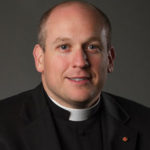 Father Christopher House is the Rector-Pastor of the Cathedral and serves in various leadership roles within the diocesan curia, specifically Chancellor and Vicar Judicial.
Making Good Choices
“Mommy, I can do it, trust me.” She says to me, as she is wavering on an overturned laundry basket, reaching on her tip toes to reach her mermaid costume. “I am not worried about you, hunny, but…(the potential boo-boos that might exist in a few moments). She barely got ahold of the mermaid tail and tumbles down to the ground. Yes, crying begins. And yes, mommy is sorry. I suppose this will not be the last time that I “oversee” a bad choice, a potential pitfall that is going to hurt. It isn’t that we don’t trust our children; it is that they don’t always make the best decisions, right? If the issue isn’t about trust, but about what is the right choice or wrong choice, how come we don’t interrupt? How can we be bystanders to an epic fall that will come from an overturned laundry basket turned ladder?
It got me thinking about my relationship with God and the trust He places on me, despite any metaphorical laundry basket I might be standing on. Just as I have to have a trust in Him, He in turn trusts me. He trusts me to make the right choices, yes, but more importantly to interrupt the bad ones. To interrupt or to stop the bad choices can mean that you are consciously trying to make the good ones. Looking through the lens of stewardship, we see that the good choices are commonly those involving time, talent, and treasure. Simply put, can I make a choice to spend more time with God, to serve God’s people, and to share my wealth with those who need it more than I do week after week? If I live my life through the lens of stewardship, I see that I can keep making good choices a priority, so that I don’t entertain the bad choices that come to mind.
As Gracey got up and calmed down, I had to explain that a laundry basket is not a ladder. She thought she was being creative and that practically, “it worked, mommy.” While I appreciate her cleverness, she and I both realized that sometimes we need to pause, take a step back, and ask for help…oh, and keep the laundry basket right side up.
Katie Price is the Cathedral Stewardship and Discipleship Coordinator. She can be reached at [email protected].
No Better Time to Start Reading Scriptures than Right Now
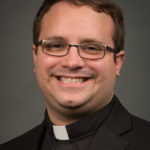 Due to the inexhaustible human capacity to come with excuses, I would like to begin this article by saying that there is no better time to start reading scriptures than right now. The scriptures, however intimidating they may seem, can provide for us deeper insight into the human experience and our relationship with our creator. The Holy Bible contains the story of our salvation and narratives that help us understand who God is, who we are, and the relationship between us. The parables that Jesus told to his contemporaries are just as relevant to the lives of twenty-first century Americans as they were for first century Israelites. The Bible can speak to our hearts and help us through the many experiences that life brings our way from the greatest of joys to the deepest of sorrows. For many, the question of where to begin might raise an issue when deciding to dive into the scriptures. The short answer is, anywhere, but it certainly helps if we have some more direction than that. Many people find it fruitful to begin with the Book of Genesis, or the Psalms, or the Gospels. No Matter where we begin, finding a good Catholic Study Bible can absolutely help us when we first approach scriptures. Knowing the context that each book was written, who it was written to and why it was originally written give us important details that can help us understand what the book is attempting to convey and what that means in our own lives. We must never forget however, that the scriptures don’t only let us know things about God but can truly allow us to know God. Our study of scripture should never be divorced from praying with the scriptures because prayer is the means by which we come to know our God: Father, Son and Holy Spirit. Asking the Lord in prayer to guide our reading of the Bible and bring us closer to him through it can absolutely enhance our experience of spending time with the scripture. This can certainly make our journey through the bible a much slower experience but that it not necessarily a bad thing. We must have patience with ourselves and understand that reading the bible is less about finishing the book and more about coming to know the story of our salvation and truly growing in our relationship with the Lord.
Father Wayne Stock at Parochial Vicar at Cathedral. Ordained earlier this year, this is his first assignment. Aside from his duties at Cathedral, he is also the chaplain at Sacred Heart Griffin High School.
Chapter V. The Christian Steward
This last week of reviewing the USCCB Letter, Stewardship: A Disciple’s Response covers Part V. The Christian Steward. This chapter presents to us the life and characteristics of a Christian Steward. Stewardship is not easy, it is hard to live as Christ calls us to do. However, with much trust and faith in the Lord, we find that as we pray more, serve more, and give more, we are given much in return- a joy-filled heart. I find one of the best characteristics of a vibrant church is the stewards in the pews. At Cathedral, during my first few months here, I am blessed to be a witness to the amazing stewards in our pews. From the women in the CCCW, to the men that are the Knights, to the terrific staff at the Parish Offices and the School, it is easy to find people who are choosing to live the stewardship way of life, daily.
Christian stewards are conscientious and faithful. After all, the first requirement of a steward is to be “found trustworthy” (1 Cor 4:2). In the present case, moreover, stewardship is a uniquely solemn trust. If Christians understand it and strive to live it to the full, they grasp the fact that they are no less than “God’s co-workers” (1 Cor 3:9), with their own particular share in his creative, redemptive, and sanctifying work…Christian stewards are generous out of love as well as duty. They dare not fail in charity and what it entails, and the New Testament is filled with warnings to those who might be tempted to substitute some counterfeit for authentic love. For example: “If someone who has worldly means sees a brother in need and refuses him compassion, how can the love of God remain in him?” (1 Jn 3:17)…The life of a Christian steward, lived in imitation of the life of Christ, is challenging, even difficult in many ways; but both here and hereafter it is charged with intense joy. Like Paul, the good steward is able to say, “I am filled with encouragement, I am overflowing with joy all the more because of all our affliction” (2 Cor 7:4). Women and men who seek to live in this way learn that “all things work for good for those who love God” (Rom 8:28). It is part of their personal experience that God is “rich in mercy [and] we are his handiwork, created in Christ Jesus for the good works that God has prepared in advance, that we should live in them.” (Eph 2:4, 10)
Hold on to Hope- Pastor’s Column
I was able to get away a few weeks ago for a week’s vacation. I went to England, London mostly, for a week. I first visited that grand city twenty-five years ago this past summer on a French club trip, in between my sophomore and junior year in high school. I was way too young then to truly appreciate the city, but over the past ten years or so I have become a self-taught student of Tudor history and decided it was time to go back and see what I have read so much about. That Monday, while I was eating breakfast, news started coming in real-time about the horrific shooting in Las Vegas. Since then our nation has struggled to come to grips with another senseless tragedy which resulted in the loss of so many innocent lives and so many injuries. Debates have raged, and will continue to, about guns, and laws, and rights, and so on. In the aftermath of this great tragedy we may feel adrift in darkness, but that is not so.
At times like this, I always turn to the Word of God for there we can find answers, and if not answers, at least comfort in times of sorrow and distress. This time was no different. In the first chapter of the Gospel of St. John we are told that Jesus has come into the world to give us life and that His life is the light of the human race. And the truth of that light is this: “the light shines in the darkness and the darkness has not overcome it (John 1:5).” The shooting in Las Vegas is undoubtedly one of the darkest moments in our recent history, but the darkness is not absolute, because in the midst of it, the light of Christ shone brightly.
In the stories that have come out in the aftermath of this tragedy we are able to see how the light of Christ shone brightly in those moments. We have been blessed to hear stories of men and women who in those moments ran into the hail of gunfire to help others. How people used their own vehicles as ambulances to rush strangers to the hospital. How one husband sacrificed his own life to shield his wife from the shots. The stories go on and on. If you have not read or heard any of them, I encourage you to do so. These heroes did not debate the pro and cons of what they were about to do, they simply responded naturally to the need before them. The heroism that we have seen in the midst of this tragedy reminds us that human beings are still inherently good, because we have been made in the image and likeness of God. Sin gets in the way of that inherent goodness at times and we have to deal with the struggle of having a will and intellect that have been darkened by the initial fall from God’s grace, but, make no mistake, we are still ordered to good.
Sadly, we must accept the fact that in spite of our best efforts, evil will remain the world until it is forever destroyed when our Lord returns in glory on the last day. Until that day, we must do our part as sons and daughters of God, as heirs of the Kingdom of Heaven, to stand against evil in the world. How do we do this? Simply by being the people that God has made us to be; by striving to witness to his life and love each and every day in thought, word, and deed. There are moments when we are going to be tempted to give up hope, but if we look, God will always give us a reason to hold on to hope and many times those reasons will be found in ordinary people around us.
Let us continue to pray for those who suffer so unjustly from violence and from all sins against God’s love. May those who have died have their sins forgiven and find everlasting joy and peace in heaven. May those wounded in mind, body, or spirit, find comfort, healing, and consolation. May all of us remember the truth spoken to us by our Lord: “you are the light of the world (Matthew 5:4).” May our hearts be open to God’s grace each and every day so that the light of Christ may shine brightly in and through us. Darkness is nothing more than the absence of light. Go and be that light in a world plagued by shadows.
About the Author:
Father Christopher House is the Rector-Pastor of the Cathedral and serves in various leadership roles within the diocesan curia, specifically Chancellor and Vicar Judicial.
Liturgy of the Eucharist Parts I & II
 Part I
Last Sunday we looked at the structure Liturgy of the Word, how the readings of the Mass rotate, and how there are other parts to the Liturgy of the Word besides the readings. This Sunday we focus on the first part of the Liturgy of the Eucharist, which many of the faithful understand as the heart of the Mass.
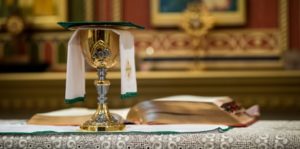
Having offered the Prayer of the Faithful (petitions), the Liturgy of the Eucharist begins with the offertory where the altar is prepared and gifts of bread and wine, along with gifts from the faithful for the work of the Church and care of the poor, are offered. At the altar, a small amount of water is mingled with the wine by the priest or, if present, deacon. This goes back to the ancient practice of having to cut the wine with water if the wine was too strong. Today, this action is retained symbolically to show the mingling of our human nature in the divine person of Jesus. The first prayers that the priest prays over the bread and wine are known as the Berachot prayers (Blessed are you, Lord God…). These prayers are a reminder of Jewish table prayers and are reflective of the Jewish influences on the original structure of the Mass.
Following the Berachot prayers, which may be prayed out loud or privately, the gifts, altar, and people may be incensed on feasts and solemnities. At the end of the preparation of the gifts, the celebrant washes his hands. Again, this act is taken from an ancient practice where the priest at one time had to wash his hands out of necessity, having received crops and even livestock, that were brought forward by the faithful as gifts at the Mass. Today, the celebrant washes his hands as a sign of his desire to have his heart and life purified from sin.
After the offertory is complete, the priest invites the faithful to beseech God to receive the offering of bread and wine, as well as our very lives, and that it may be pleasing to him. Finally, the Prayer Over the Offerings is prayed. This prayer is specific for the day or feast. Next week we will look at the structure and form of the Eucharistic Prayer.
Part II
Last time in the Weekly we looked at the first part of the Liturgy of the Eucharist. This week we are looking at the Eucharistic Prayer which follows the Preparation of the Gifts. The Eucharist prayer starts with the Preface which itself begins with the dialogue between the priest and the assembly and ends with the Holy, Holy which itself is the prayer of the angels found in the Book of the Prophet Isaiah. The Preface is variable and reflects the church season or a specific feast and is marked by the tone of thanksgiving for God’s goodness and grace.
Following the Holy, Holy (the Sanctus), the main part of the Eucharistic prayer begins. There are four main Eucharistic prayers that are generally chosen from as well as nine other ones for specific needs or occasions. All of the Eucharistic prayers follow the same structure beginning once again with praise following the Sanctus and then moving to epiclesis by which the power of the Holy Spirit is called down so that the bread and wine may become the Eucharist. The institution narrative and Consecration immediately follows the epiclesis. Here the celebrant, standing in the person of Christ, speaks Christ’s words at the Last Supper by which, through the power of the Holy Spirit, the bread and wine become the body, blood, soul, and divinity of Jesus. The Consecration ends with the people’s acclamation following the priest announcing “the mystery of faith.”
The Eucharistic prayer continues with the anamnesis which means to remember. Here, God the Father is asked to look upon the sacrifice offered and to remember, then and always, the sacrifice offered by his Son for us, and finally to accept the offering. Following the anamnesis are various intercessions offered for the Church: for her leaders, for all the faithful, and for the faithful departed. The Eucharistic prayer culminates in the doxology by which the glory of God is proclaimed as the Eucharist is elevated by the priest and deacon. The great Amen is the assembly’s response to this declaration.
Following the Eucharistic prayer is praying of the Lord’s Prayer and the Sign of Peace where we make sure to be at peace with our neighbor before approaching the altar. The assembly then receives the gift of the Eucharist and the Mass concludes with the closing prayer, blessing, and dismissal.
Chapter IV. Stewardship of the Church
Chapter IV: Stewardship of the Church
This week we are highlighting Chapter IV: Stewardship of the Church in the USCCB Pastoral Letter on Stewardship. This chapter explores how stewardship is expressed as a community or in solidarity with each other. Many of you reading this are stewards; you pray with us on Sundays, serve during Mass or volunteer in a program, and give generously to the Parish Mission. In times of trouble, struggle, joy, or anticipation, your Parish family surrounds you with the support and prayers you need. Here at Cathedral, we offer Mass intentions, post prayer request on the Cathedral Women Facebook page, offer service to the communion through the Knights of Columbus or CCCW, we educate our youth through the Parish School of Religion or Cathedral School, we support all these important ministries and more through the generosity received in the offertory basket or at our fundraisers. We are a stewardship Parish, which calls each of us to pray, serve, and give!
Excerpt from Stewardship: A Disciple’s Response, USCCB
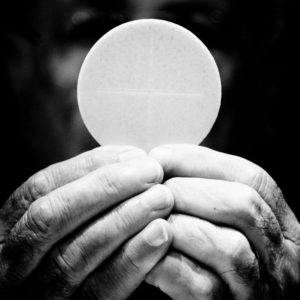 The Eucharist is the great sign and agent of this expansive communion of charity. “Because the loaf of bread is one, we, though many, are one body, for we all partake of the one loaf” (1 Cor 10:17). Here people enjoy a unique union with Christ and, in him, with one another. Here his love—indeed, his very self— flows into his disciples and, through them and their practice of stewardship, to the entire human race. Here Jesus renews his covenant-forming act of perfect fidelity to God, while also making it possible for us to cooperate. In the Eucharist, Christians reaffirm their participation in the New Covenant; they give thanks to God for blessings received; and they strengthen their bonds of commitment to one another as members of the covenant community Jesus forms.
And what do Christians bring to the Eucharistic celebration and join there with Jesus’ offering? Their lives as Christian disciples; their personal vocations and the stewardship they have exercised regarding them; their individual contributions to the great work of restoring all things in Christ. Disciples give thanks to God for gifts received and strive to share them with others. That is why, as Vatican II says of the Eucharist, “if this celebration is to be sincere and thorough, it must lead to various works of charity and mutual help, as well as to missionary activity and to different forms of Christian witness” (Presbyterorum Ordinis, no. 6).
Understanding the Term Liturgy
The term liturgy is used with great frequency in the Church. It comes from the Greek word leitourgia which means a public work done for or on behalf of the people. However, we cannot allow the Church’s understanding of the term to be lost. Liturgy is not a spectator sport where a larger group watches a person or two or smaller group perform. While there is always a celebrant or presider and ministers at the liturgy, everyone is called to full, active, and conscious participation. Why?
We are all called to participate because liturgy is first and foremost an act of divine worship meaning that it is focused towards God greater glory and honor. In this act, we are also lifted up and furthered on the path of salvation. Whenever the Church, the mystical body of Christ, gathers for a liturgical celebration, she is participating in the Paschal Mystery: the life, death, and resurrection of Jesus.
A liturgy is a public celebration of the sacraments or the word of God. Among liturgical celebrations, the holy Mass is the highest of all liturgies because, as the Second Vatican Council teaches us, it is the “source and summit” of the Christian life. The Mass itself is divided into four main parts, the two principal parts being liturgies: Word and Eucharist. Sometimes a liturgy is referred to as “the sacred mysteries.” This term also comes from the Greek work mysterion which was rendered in Latin as mystenum (mystery) and sacramentum (sacrament). The term sacrament is used to define a tangible reality is the liturgical celebration which also points to a hidden reality that is also present, thus the term mystery. The term mystery is also used because another understanding of the word refers to a reality that cannot by exhausted and this is true of the grace of God given in the liturgical life.
May God give us the grace to grow deeper in our love for the Church’s liturgy so that we may see cherish its two fold purpose of glorifying God and lifting us up to the divine life with him forever.
Written by Father Christopher House
What does a friendship with Jesus look like?
Normally, my daughter and I are frantically getting ready for Sunday Mass in the morning. However, this particular morning was different. I eagerly make my way up to her room with a puffy, laced pink Easter dress in my hands. After the normal wake-up routine, I share with her the good news, “Hunny, I have a surprise for you!” Witnessing the look of surprise I was going for, a huge grin from ear to ear appeared on her face. “What is it Mommy?” my daughter said. “Well, today is a very special day, it is Easter Sunday! Jesus came home and God is so happy!” As I grabbed the dress to show her, she exclaimed, “Oh my goodness, Mommy, is God having a ball?” …laughter ensued. “Well, yes, I suppose you could look at it that way!” She said, “Mom, I can’t wait to go to Jesus’ Ball, he deserves a party! We’re friends” It was the first time I heard her say that Jesus and her are friends.
While I know we are not in the season of Easter, I can’t help but come back to that story as I reflect on stewardship of time today. I was curious about her friendship with Jesus and have been asking her questions about her faith, getting a glimpse into a childlike faith life. Can you guess Gracey’s response to the question, “How did you become friends with Jesus?” My little 4-year old’s response was, “Oh, I pray and we talk.” Think about that phrase a bit, “I pray and we talk.”
Oftentimes I think we can be left wanting in our prayer lives; finding ourselves asking for this or that, praying for something to change, or showing up to Mass because we think it is just “what we are suppose to do” and following the motions. However, I challenge us to take a deeper look at our own prayer life. What does it look like to be in a friendship with someone? Friendship is not just about asking, but about being present. If we pursue and desire a relationship with Jesus, we must be willing to be present in conversation with Him. We must be willing to set down the phone, close the app, put the papers away or slow down our thoughts, and listen.
When we consider stewardship of time, we mean building a relationship, or friendship, with God. Cultivating that one-on-one relationship with Him, no matter where we are in the faith journey or even how old we are. We can each pray and talk with Him. I hope each of us has the opportunity to be enriched by the “tiniest” believers in our pews and in turn be inspired by their friendship with Jesus.