Cathedral of the Immaculate Conception

Springfield, IL

  • About
    • Contact Us
    • History of the Cathedral
    • Liturgical Schedules
    • Parish Staff
    • Register with Cathedral
    • Subscribe to the Cathedral eWeekly
  • Sacraments
    • Baptism
    • Becoming Catholic
    • Matrimony
    • Vocations
  • Ministry List
    • Adult Faith Formation
    • Cathedral Meal Train
    • Cathedral Online Prayer Wall
    • Cathedral Concerts
    • Family of Faith
    • Grief Share
    • Health and Wellness
    • Spiritual Resources
  • Stewardship
    • Stewardship: A Disciple’s Response
    • Stewardship Form
  • Support
    • E-Giving Frequently Asked Questions
    • Give Online
  • Sunday News
    • Announcements
    • Cathedral Weekly
    • Livestream Feed
    • Submit a Mass Intention Request
    • Weekly or Announcement Submission

Announcements

Grief Share at Cathedral
The Cathedral of the Immaculate Conception in Springfield is hosting Grief Share, a weekly, faith-based, grief support group. If you, or someone you know, would like help and encouragement after the death of a spouse, child, family member, or friend, please join us beginning Thursday, July 2, 6:00pm-8:00pm in the Cathedral School Library (please enter through the atrium doors off 5th street parking lot). Grief Share runs for 14 weeks, but guests may join the series at any point and can pick up content they missed during the next cycle. For more information, please visit our website, (https://spicathedral.org/grief-share/) or contact Vicki Compton @ 217-522-3342 or or at [email protected].

BOLT! Vacation Bible School
We’re so excited to announce that BOLT VBS is coming to your house on July 7th! With minimal preparation, easy-to-follow instructions, and a video that leads your family step-by-step through each day, BOLT is designed to bring the fun and faith-formation of VBS to your home. Although we wish we could have VBS in person as we do every year, we are so excited to offer this program to our Cathedral families.

If you are interested in participating in BOLT VBS, please register your family by going to https://spicathedral.org/vacation-bibleschool-2020/. We will be reaching out to those who register with details regarding access to materials and how to run the program all from your home. Registration closes on June 15th, so sign up today! If you have any questions, please feel free to reach out to us by calling the Parish Office at 217-522-3342 or by emailing Haley at [email protected].

A Unique and Dynamic Communion

There is an African folk tale about three blind men who examine an elephant to try to determine what sort of animal it might be. One grabs hold of the elephant’s tail and exclaims, “This creature is very like a rope.” The second man runs his hand over one of the tusks, declaring, “This creature is very like a spear.” Finally, the third man, patting the wide, solid side of the elephant, says, “This creature is surely a wall.”

Individually, each of the blind men grasped an aspect of the majestic creature, but their understanding was limited. But, by sharing their insights, they were given an understanding of elephants that none of them could have alone.

Like the experience of those three men, all of the Church’s various celebrations throughout the year work together to help us enter more deeply into the mysteries of salvation and the ways that God has been — and continues to be — at work in the world. This Sunday’s celebration honoring the Most Holy Trinity is no exception.

This special day honoring the Holy Trinity was, however, a fairly late addition to the Church’s cycle of seasons and feasts. In fact, Pope Alexander II (d. 1077) is said to have objected to having a special day to honor the Holy Trinity because, as he observed, the Holy Trinity is celebrated every Sunday and every day in the Church’s prayer. It was Pope John XII who made the Feast of the Holy Trinity part of the official liturgy of the Universal Church in 1334.

Falling as it does on the Sunday after Pentecost, this day honoring the Trinity brings together all the mysteries that we have celebrated during the seasons of Lent and Easter: the creative, saving, and sanctifying work of God that not only freed us from the powers of sin and death, but which also unites us as a community of faith — the Church.

The Solemnity of the Most Holy Trinity also reminds us that the God whom we adore is “one God in the Trinity” and “Trinity in unity” (from The Athanasian Creed), inviting us to consider that all of our relationships are reflections of that unique and dynamic communion that exists within God — the Father, the Son, and the Holy Spirit. By grace, we are constantly being invited to be part of that relationship, to live in the love of God.

We get a sense of this when we recall Jesus’ words to his disciples (recounted in the Sunday and weekday Gospels in the days before Pentecost) about his relationship with the Father and the Holy Spirit, whom he promised would come to his followers after his departure. In these beautiful texts, Jesus explains that the promised Spirit, “will take from what is mine and declare it to you.” But, as Sister Barbara Reid, O.P., notes, “What is Jesus’ is also what is the Father’s as Jesus asserts, ‘Everything that the Father has is mine.’ There is no ‘yours and mine’ in the Godhead — only ‘ours,’ as the three interweave in a communion of love in which there is no possessiveness,” (from Abiding Word, Year A).

In the end, our celebration of Trinity Sunday is an invitation for us to continue to move beyond our selves and our own sense of “mine.” In the Mystery of the Most Holy Trinity, God continues to bless us — in the ongoing act of creation, in the freely given gifts of healing and redemption of Christ, and the life-giving Spirit that inspires faith, hope, and love — and invites us to receive the graces and gifts he so freely gives. As Henri Nouwen reflected in Sabbatical Journey,

I am deeply convinced that most human suffering comes from broken relationships. Anger, jealousy, resentment, and feelings of rejection all find their source in conflict between people who yearn for unity, community, and a deep sense of belonging. By claiming the Holy Trinity as home for our relational lives, we claim the truth that God gives us what we most desire and offers us the grace to forgive each other for not being perfect in love.

Trinity Sunday reminds us that we are called to extend that invitation to others by sharing what we have received

A Benedictine monk for nearly 11 years, Br. Silas Henderson, SDS, is an author, retreat leader, and catechist, and former managing editor of Deacon Digest Magazine and Abbey Press Publications. You can find more of Br. Henderson’s blogs at www.fromseason2season.blogspot.com.

Announcements

Grief Share at Cathedral
The Cathedral of the Immaculate Conception in Springfield is hosting Grief Share, a weekly, faith-based, grief support group. If you, or someone you know, would like help and encouragement after the death of a spouse, child, family member, or friend, please join us beginning Thursday, July 2, 6:00pm-8:00pm in the Cathedral School Library (please enter through the atrium doors off 5th street parking lot). Grief Share runs for 14 weeks, but guests may join the series at any point and can pick up content they missed during the next cycle. For more information, please visit our website, (https://spicathedral.org/grief-share/) or contact Vicki Compton @ 217-522-3342 or or at [email protected].

BOLT! Vacation Bible School
We’re so excited to announce that BOLT VBS is coming to your house on July 7th! With minimal preparation, easy-to-follow instructions, and a video that leads your family step-by-step through each day, BOLT is designed to bring the fun and faith-formation of VBS to your home. Although we wish we could have VBS in person as we do every year, we are so excited to offer this program to our Cathedral families.

If you are interested in participating in BOLT VBS, please register your family by going to https://spicathedral.org/vacation-bibleschool-2020/. We will be reaching out to those who register with details regarding access to materials and how to run the program all from your home. Registration closes on June 15th, so sign up today! If you have any questions, please feel free to reach out to us by calling the Parish Office at 217-522-3342 or by emailing Haley at [email protected].

For other important information and announcements, please visit https://spicathedral.org/blog/category/announcements/.

Scripture & Tradition: The Story & the Life

The Bible. For some, the very words evoke feelings of warmth and wisdom, but for many Catholics today, the Bible can be chronologically confusing and its meaning hard to grasp. How tragic this is in light of the fact that as Pope Leo XIII said, “Scripture is a Letter written by our Heavenly Father” to his children for the purpose of revealing himself to them.

Those who come to the Holy Bible for the first time could expect to open at the beginning of Genesis and read on through to Revelation with the same ease and excitement as reading the novel Gone With The Wind. But it doesn’t take the novice long to figure out that the Bible doesn’t read like a popular novel. In fact, it isn’t put together as a sequential narrative; rather the books are grouped by literary types. Consequently, the once-excited inquirer puts the untapped treasure back down on the coffee table with a sigh of “what’s the use?”

Featured image by Mystic Art Design from Pixabay

History of Salvation and the World
An important challenge facing the reader is to find and understand the basic storyline of salvation history within the Bible’s pages. We are not talking at this stage about understanding detail, but rather grasping the scope of the divine story, the “big picture.” The Bible, although made up of many stories, contains a single story. In a nutshell, it is about God and his relationship with mankind, the most complex part of his creation, and the true object of his love and affection. It is mankind that would betray God, and yet God, in turn, would die for.

Starting with the first chapters of Genesis on through the book of Revelation, God gradually reveals his plan to re-establish the broken relationship between himself and his treasured creation. It is only in God’s revealed plan that mankind once again finds its intended purpose for being “because man is created by God and for God; and God never ceases to draw man to himself. Only in God will he find the truth and happiness he never stops searching for” (Catechism of the Catholic Church, 27).

It is important for the modern Catholic to understand that, although the Bible is a mystery on one level, it is also a book of history. There should be no misunderstanding—it is true history as opposed to cleverly devised tales. Pope Paul VI said in the Second Vatican Council document, Directorium Catechisticum Generale (Sacred Congregation for the Clergy):

“the history of salvation is being accomplished in the midst of the history of the world.”

The Bible gives a wide range of examples of how through word and deed God has entered the life of his people.

The Narrative Approach
The difficulty facing Bible readers is how to make this personal yet ancient story of salvation history come alive. They must discover the critical plot and, through the guidance of the Church, understand its meaning in order to make it their own story. Dei Verbum emphasizes the importance of using the contemporary literary form to search out the meaning of the Sacred Scriptures:

“To search out the intention of the sacred writers, attention should be given, among other things, to ‘literary forms.’ For truth is set forth and expressed differently in texts which are variously historical, prophetic, poetic, or of other forms of discourse. The interpreter must investigate what meaning the sacred writer intended to express and actually expressed in particular circumstances by using contemporary literary forms in accordance with the situation of his own time and culture.” (DV 12)

The first step to understanding the Bible chronologically as a story is to identify which of the seventythree books are of historical nature. The term “historical” refers simply to those books that keep the story moving from one event to another. Not all books in the Bible are historical accounts, some are poetic in nature, some are wisdom literature, and some prophetic. The historical books provide us with continuity or give us an ordered account of connected events from Genesis to Revelation. This is called the narrative approach and was common among early Church Fathers such as St. Ambrose and St. Augustine.

Becoming Christian
There are twelve historical books in the Old Testament and, for the sake of simplicity; two historical books in the New Testament (Genesis, Exodus, Numbers, Joshua, Judges, 1 & 2 Samuel, 1 & 2 Kings, Ezra, Nehemiah, 1 Maccabees, Luke and Acts). These books provide the narrative structure on which all the other books hang.

Flowing from the written word, the Catechism moves into the second pillar, the sacraments and liturgy. What are the sacraments and liturgy in relation to the written word? The sacraments and Liturgy provide us with the means of entering the story declared in the Creed, the first pillar.

“From the time of the apostles, becoming a Christian has been accompanied by a journey and initiation in several stages.” CCC, 1229

Certain essential elements will always have to be present: a proclamation of the Word, acceptance of the gospel entailing conversion, a profession of faith, and baptism itself. Throughout this faith journey, the sacraments provide direct encounters with Christ, resulting in the grace of God, which is the life of the Trinity. The new believer travels through initiation (baptism, confirmation and the Eucharist) and participates in the sacraments of healing (penance and anointing of the sick), and service (holy orders and marriage).

Life in Christ
Once the new believer is initiated into the story (Creed) through the sacraments they move into life in Christ, the third pillar of the Catechism. What is life in Christ in relation to the Creed, Liturgy, and sacraments? Life in Christ is our personal and communal script on how to live. Because the Church is the body of Christ, we live the life of Christ in the world. In this pillar we learn about the moral life, virtues, sin and our relationship with society. With the Ten Commandments as a backdrop, we learn how to conduct ourselves along the journey of faith.

Prayer
Prayer, which makes up the fourth pillar of the Catechism, provides us with the guidelines to fortify a close personal relationship with God. There are several wellsprings where Christ awaits us to enable us to drink deeply of the Holy Spirit; the Word of God, the Liturgy and the theological virtues.

Through prayer we can drink more deeply from the Word of God and participate more fully in the sacramental life. It is in prayer that our bond with God grows deeper and with an understanding of the three previous pillars, our understanding of revelation becomes more profound.

This is the third and final installment in the Scripture & Tradition series. It was published on the Great Adventure Blog, the Ascension Blog’s former home, on April 19, 2015. Both previous installments were also published in last week’s Weekly, which can be found on our Cathedral website.

Jeff Cavins is passionate about helping people understand Scripture and become disciples of Jesus Christ. Though he was born Catholic, Jeff went to Bible school and served as a Protestant minister for twelve years before reverting to the Catholic Faith. He then quickly became a leading Catholic evangelist and author. Jeff is best-known for creating The Great Adventure Bible study programs published by Ascension, which have been used by hundreds of thousands of people to engage in Scripture in a life-changing way. In addition to The Activated Disciple, some of his other recent projects include his podcast, The Jeff Cavins Show, and the Great Adventure Bible studies, Ephesians: Discover Your Inheritance, and Wisdom: God’s Vision for Life.

Called to Community

We were created for community. Human beings are not meant to be alone. As each of us grows in our relationship with Jesus, we find ourselves drawn further into community. Our stewardship never reflects just on us, but on the Body of Christ to which we belong.

When speaking to his Father, Jesus always spoke about all of us as a whole. Jesus has a unique relationship with each and every one of us, but he also sees us collectively as one. When the Holy Spirit was sent to assist us until the Second Coming, she ascended upon a multitude, not just one person at a time.

We are called to live a fruitful stewardship way of life. It is by that fruit that we can tell if we are really giving of ourselves in a generous manner. However, the fruits that result from my stewardship and your stewardship will never amount to more than what we can produce together.

As you try ever harder to cultivate what God has given you and offer it back to Him with an increase, what does your relationship with your parish community look like? How has your stewardship helped enable your community to become a clearer reflection of God? It is important to reflect on these things because we can sometimes find ourselves drifting away from community if we are not careful. We are always stronger together. We never want to wake up one day and find ourselves alone.

Tracy Earl Welliver is currently the Director of Parish Community and Engagement for LPI where he manages the company’s coaching and consulting efforts. He has spoken on and coached dioceses, parishes, and individuals on stewardship, engagement, strengths, and discipleship all over North America, Australia, and New Zealand.

Happy Birthday to the Church!

Following the Lord’s Ascension into heaven, the Apostles were gathered once again in the Upper Room where the Lord had instituted both the Eucharist and the Priesthood at the Last Supper. It was also the place where He first appeared to them following the Resurrection. Tradition tells us that the Apostles were not alone on this particular day and that Mary, the Mother of the Lord, was with them. Jerusalem was filled with Jews who had come to the holy city for the feast of Pentecost, a feast celebrating the wheat harvest that was celebrated seven weeks and one day (50 days) following Passover. That particular day was a day that would forever change the face of the earth.

Before His Ascension, the Lord promised the Apostles that He would send a paraclete, an advocate to be with them always until He returned in glory. It was precisely this advocate for whom the Apostles waited in the Upper Room, when on that Pentecost day, the Lord Jesus fulfilled His promise and the Holy Spirit came upon the Apostles and Mary, appearing as tongues of fire. It was precisely in this moment that the Good News, the Gospel of Jesus Christ, we preparing to break forth into the greater world.

From the Upper Room, the Apostles went forth as new men, as new creations. The grace of the Holy Spirit had forever changed them, transforming their fear and trepidation into courage and zeal. With this gift of the Holy Spirit, they went out and fulfilled the Lord’s command to preach the forgiveness of sins, beginning first in Jerusalem. The Acts of the Apostles recounts that some 3,000 people that very day heard the preaching of the Apostles, believed, were baptized, and thus the Church was born.

Today, we, the living stones of the Church, claimed by Christ in baptism and anointed with the Holy Spirit through Confirmation, are called to carry on this mission begun by the Apostles some 2,000 years ago. We who profess the name of Christ are His disciples because we have come to believe in Him, but our discipleship must be transformed into apostleship. The word apostle means “one who is sent.” The Apostles were the first to be sent but we are called to continue their mission. On this Pentecost Sunday and always, let us open our hearts to the gift of the Holy Spirit who continues to guide the Church. Let us cooperate with the grace of the Spirit that seeks to make us witnesses of the crucified and risen Lord so that through our lives others may come to know and believe in the Lord Jesus and accept His free gift of salvation.

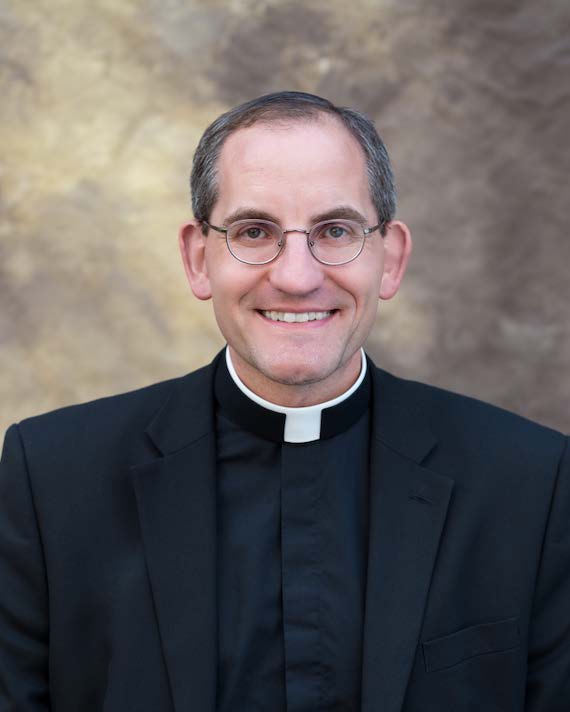
Father Christopher House is the Rector of the Cathedral and serves in various leadership roles within the diocesan curia, namely Chancellor and Vicar Judicial.

Being Sent Forth Into the New World

That first Pentecost Sunday found the apostles in the upper room gathered in prayer.

In many ways, we find ourselves in a similar situation as the apostles did on that first Pentecost Sunday.

Many of us are still under stay-at-home orders or are working under restrictions to wear masks and keep our distance from each other. We have not been able to attend Mass since the first weeks of Lent.

In the meantime, our homes have become places of more intense prayer. Not able to gather with our parish community, we watch the Mass on television or broadcast through social media. All the while, our longing to receive Jesus in the Eucharist is growing. We long for the day when we will receive Holy Communion alongside our brothers and sisters in faith.

Just so, the apostles experienced a longing for the Lord. Only ten days earlier, Jesus had ascended into heaven. He was taken from their sight and their only consolation was his promise,

“You will receive power from on high.”

With longing for their Lord, they prayed fervently until the promise was fulfilled on that first Pentecost Sunday.

Saint Luke tells us in the Acts of the Apostles that, on that day, when the apostles preached the good news of Jesus’ resurrection, three thousand were baptized and added to the faith.

Under normal circumstances, those who are preparing to enter the Catholic Church are baptized during the Easter Vigil. However, under the circumstances of this pandemic, many parishes planned to baptize and confirm new Catholics on Pentecost Sunday. We pray that restrictions have been lifted enough that they can finally receive what their hearts have longed for during this long season of preparation — to be united with Jesus in His Church through the sacraments of initiation.

Baptism on Easter is fitting because, through baptism, Jesus’ victory over sin and death is applied to us. But it is also fitting to baptize on Pentecost, because baptism makes us members of Jesus’ mystical body, the Church, and empowers us to participate in the mission of making Christ known throughout the world. Perhaps the grace of this Pentecost Sunday is that we can discover our calling to spread the gospel wherever we find ourselves.

Before ascending to heaven, Jesus gave his apostles the great commission to go out to all the world. On this Pentecost Sunday, “going out into the world” will look a lot different than it has in the past. We will have to use technology and social media even more than we have to this point. Hopefully, our increased involvement will make Facebook, Twitter, and the other social media platforms more civil and less divisive. What a witness it would be if people sat up and noticed that our content on social media was more loving and positive. What a great thing it would be if they could say, “See how they love one another,” after reading our posts.

We have good news for a world that is growing weary of division, hatred, and negativity. It is the saving message of a God who is with us, who brings good out of all situations, and who loves us unconditionally. It is the good news of a God whose Spirit empowers us to bring light to the dark places of this world and hope to those who despair. He leads us out of confinement, out of fear, to embrace new possibilities.

Douglas Sousa, S.T.L. is an author for Liturgical Publications, Inc., and writes reflections on various topics, including reflections on Sunday readings.

Scripture & Tradition: Bringing Harmony

The perception from the outside is that the Catholic Church is big. I remember those first weeks when my interest in the Church was stimulated by the writings of Pope St. John Paul II. Before understanding the details of doctrine, liturgy, and Church structure, I was in need of something that would tie together the whole faith. I desperately wanted to see the big picture of the Catholic Faith. Once I began to read the documents of Vatican II, I realized I had come face to face with a gold mine in terms of explaining how all things Catholic fit together. Then, reading the Catechism of the Catholic Church further organized and synthesized all the various themes of the Catholic Faith into a structure that I could understand and put into practice in my daily life.

I discovered something important in those early months of seeking God in the Catholic Church. God wants to fully reveal himself to us, he wants us to fully participate in his family and has passed on a structure and methodology that not only reveals him, but also can be maintained throughout the centuries. Truth is not always simple; in fact it can be hard sometimes. This is why it is important for young Christians to work with key foundational Church documents such as the Bible, the Catechism and the writings of Vatican II.

Featured painting, “The Exhortation to the Apostles”
(ca. 1886-1894), by James Tissot sourced from Wikimedia Commons

Today, many non-Catholic Christians understand divine revelation as a personal exercise, where the individual mines the depths of the sacred text with the help of the Holy Spirit. This simplistic approach seems easy, personal and liberating, but in reality sola scriptura complicates the search for truth and leaves the individual with a lack of certitude. The thought of interpreting the most profound book on earth—with no guidance other than a hope that God is somehow leading the reader into a more profound understanding of the world, God, and self—borders on spiritual guessing. If God, who created the complexities of the universe, chose to reveal himself, wouldn’t he reveal himself with the same attention to order and detail that went into creation itself? Wouldn’t there be order and guidelines?

Handed on by the Apostles
One document that every Christian should be acquainted with is The Dogmatic Constitution on Divine Revelation, Dei Verbum. Dei Verbum is the concise articulation of how we receive divine revelation and grow in our understanding of it. The document reveals the liberating truth that revelation is not contained in Scripture alone, but is progressive and involves both Sacred Scripture and Sacred Tradition. Starting with the Old Testament, God entrusted himself to a people and began to manifest himself through word and deed. The Old Testament, while written for our instruction, prepared God’s people for the coming of Jesus Christ. In the New Testament Christ established the kingdom of God on earth and manifested his Father and himself again by deeds and words. There is a relationship between the two Testaments in that both Testaments are arranged in such a way that “the New Testament is hidden in the Old and the Old is made manifest in the New.”

This progression continues after Jesus commissioned the apostles to preach to all men the gospel. The apostles faithfully fulfilled this commission and “handed on what they had received from the lips of Christ, from living with him, and from what He did, or what they had learned through the prompting of the Holy Spirit” (DV, 7). In “order to keep the gospel forever whole, the apostles left bishops as their successors, ‘handing over’ to them the authority to teach in their own place.”

What was it that was handed on by the apostles to the succeeding generations? Dei Verbum tells us “what was handed on by the Apostles includes everything which contributes toward the holiness of life and increase in faith of the people of God; and so the Church, in her teaching, life and worship perpetuates and hands on to all generations all that she herself is, all that she believes (DV, 8).” This is what constitutes Sacred Tradition.

The Sacred Page
Part of this Sacred Tradition includes the teaching role of the Magisterium of the Church, the bishops in union with the pope. The task of “authentically interpreting the word of God, whether written or handed on, has been entrusted exclusively to the living teaching office of the Church” (DV, 10). The Magisterium not only hands on the objective truth of the Faith but also provides methods of study that have been carried on for centuries. One point that is important to remember is stated in Dei Verbum 12, which states:

“The living tradition of the whole Church must be taken into account along with the harmony which exists between elements of the faith.”

The best example of this harmony, which exists between the elements of the Faith, is seen in the Catechism of the Catholic Church. Within the structure of the Catechism, there is a harmony between the elements of the Faith with sacred theology resting on “the written word of God, together with sacred tradition, as its primary and perpetual foundation” (DV, 24). To go even deeper:

“the sacred page is, as it were, the soul of sacred theology.” (DV, 24).

Christ and the Written Word
We see in the structure of the Catechism how the written word of God is the starting point to harmonize each key element of the deposit of faith. To the novice the Catechism certainly is an impressive display of the basics of the Catholic Faith, but too often the very teaching structure of the Catechism is lost. The Catechism is divided into four pillars, organizing the Faith into meaningful divisions: The Creed, Sacraments & Liturgy, Life in Christ, and Prayer.

The first pillar of the Catechism is the Creed. The Creed is the Church’s profession of faith. St. Augustine recognized that new believers could not handle the whole of salvation history, so he gave them the Creed as the starting point. The Creed is a distillation of salvation history and was the “rule of faith” for the early believers. It was through the lens of the Creed that the early believers began to see and digest the wonderful revelation contained in Sacred Scripture. The Creed could be thought of as salvation history, from Genesis to Revelation, in a tightly wound form. This true story of the world is critical to understand because there is a relationship, indeed a harmony, between it and the elements of the Catholic Faith.

This is why “the Church forcefully and specifically exhorts all the Christian faithful to learn the surpassing knowledge of Jesus Christ, by frequent reading of the divine Scriptures. Ignorance of the Scriptures is ignorance of Christ” (CCC, 133). This relationship between the written word of God and knowledge of the Christ is seen in the relationship between the first and third pillars of the Catechism. This will be discussed in the third and final part of this series.

This is the second part of the Scripture & Tradition series, originally published as an article in Envoy Magazine. It was republished on The Great Adventure blog, Ascension Blog’s former home, April 18, 2015. The first part was also published in last week’s Weekly, which can be found on our Cathedral website.

Jeff Cavins is passionate about helping people understand Scripture and become disciples of Jesus Christ. Though he was born Catholic, Jeff went to Bible school and served as a Protestant minister for twelve years before reverting to the Catholic Faith. He then quickly became a leading Catholic evangelist and author. Jeff is best-known for creating The Great Adventure Bible study programs published by Ascension, which have been used by hundreds of thousands of people to engage in Scripture in a life-changing way. In addition to The Activated Disciple, some of his other recent projects include his podcast, The Jeff Cavins Show, and the Great Adventure Bible studies, Ephesians: Discover Your Inheritance, and Wisdom: God’s Vision for Life.

Announcements

Holy Mass Livestreams
Did you know you can join us at daily Mass from home? Mass is livestreamed every morning at 7:00am on the Cathedral Facebook page. All Masses are also added to the Cathedral website and can be found at www.spicathedral.org/holy-mass-livestreams/.

You can also join Bishop Paprocki on Sundays at 10:00am for Sunday Mass. These livestreams can be found at www.dio.org/live.

Distribution of Holy Communion
The distribution of Holy Communion at the Cathedral will take place from 8:00AM to 9:00AM and from 11:30AM to 12:30PM on Sundays until we are able to return to the celebration of Holy Mass. Holy Communion will be distributed at three stations: in the vestibule of the Cathedral, at the Sixth Street entrance of the Cathedral atrium, and at the Fifth Street entrance of the Cathedral atrium. For more detailed instructions, please visit our website (https://spicathedral.org/blog/2020/05/15/pandemic-holy-communion-distribution/).

In addition to the times for Sunday distribution, Holy Communion will be distributed following the 7:00AM livestreamed Mass. The distribution will take place at the atrium entrance off of 5th Street from 7:45AM to 8:15AM, Monday thru Saturday. Please contact the Parish Office at 217-522-3342 with any questions.

For other important information and announcements, please visit https://spicathedral.org/blog/category/announcements/.

What the Lord’s Ascension Means for Us

We are fast approaching the end of the Easter season. It was seven weeks ago that we celebrated the joy of the Resurrection on Easter Sunday (albeit more subdued this year) and now the Church celebrates the first of two key events in our life of faith: this Sunday with the Solemnity of the Ascension of the Lord into heaven and the second being Pentecost next Sunday. St. Luke teaches us in Acts of the Apostles that Jesus, having revealed his risen glory to his disciples after the Resurrection, returned to his place with the Father in heaven forty days following his resurrection. What does this mean for us some two thousand years later?

The Lord’s Ascension into heaven is the fulfillment of his mission to achieve our salvation; we might use the phrase that he has come “full circle” in his return to the Father. However, there is a marvelous new reality that makes all the difference for us. In his return to the Father, Jesus takes with him our human nature. When he first descended from the Father in the Incarnation, Jesus joined his divinity to our humanity in a bond that was made inseparable in the Resurrection. Jesus’s humanity was and remains real. It was not something that was an illusion nor was it discarded when his earthly ministry was completed. Jesus retains his glorified human nature beyond the boundaries of space and time in heaven. This fact points to the coming reality of the Resurrection of the Just on the last day when not just the soul but also the body will be fully redeemed and the two realities reunited forever in heaven.

Let us not forget the command of the Lord Jesus from Matthew’s Gospel today:

“Go, therefore, and make disciples of all nations, baptizing them in the name of the Father, and of the Son, and of the Holy Spirit, teaching them to observe all that I have commanded you.”

This great feast of the Ascension reminds us that the Lord Jesus has done his part and, now, we must do ours. We must continue the proclamation of the Kingdom both in word and action. Every aspect of our lives is to point to Christ, crucified and risen, who will come again in glory. Until that day, we, as his disciples, must be about the work of the building up of the Kingdom of God. We cannot be like the disciples following the Ascension simply “standing there and looking at the sky.” The Lord’s Ascension calls us to be a people of action, proclaiming Jesus Christ and the forgiveness of sins and the coming of the Kingdom here and now.

The Lord’s Ascension does not mean that his work on our behalf is over. From his place at the Father’s right hand, the Lord Jesus continues his mission as our intercessor, as the one who continually pleads our cause to the Father. Jesus’s return to heaven also stands as a sign of hope for us that where he has gone we also may follow. We are reminded of both of these truths in the Preface of the Mass for the Ascension in which in the Church prays: “Mediator between God and man, judge of the world and Lord of hosts, he ascended, not to distance himself from our lowly state but that we, his members, might be confident of following where he, our Head and Founder, has gone before.” We are also reminded of the Lord’s abiding presence with us in today’s Gospel, which hopefully strengthens our hope in these on-going pandemic days: “And behold, I am with you always, until the end of the age.”

Father Christopher House is the Rector of the Cathedral and serves in various leadership roles within the diocesan curia, namely Chancellor and Vicar Judicial.

« Previous Page
Next Page »

Liturgy

Sunday Masses (unless noted differently in weekly bulletin)
Saturday Evening Vigil – 4:00PM
Sunday – 7:00AM, 10:00AM and 5:00PM

Weekday Masses (unless noted differently in weekly bulletin)
Monday thru Friday – 7:00AM and 5:15PM
Saturday – 8:00AM

Reconciliation (Confessions)
Monday thru Friday – 4:15PM to 5:00PM
Saturday – 9:00AM to 10:00AM and 2:30PM to 3:30PM
Sunday – 4:00PM to 4:45PM

Adoration
Tuesdays and Thursdays – 4:00PM to 5:00PM


CatholicMassTime.org

Parish Information

Parish Address
524 East Lawrence Avenue
Springfield, Illinois 62703

Parish Office Hours
Monday thru Thursday – 8:00AM to 4:00PM
Fridays – CLOSED

Parish Phone
(217) 522-3342

Parish Fax
(217) 210-0136

Parish Staff

Contact Us

Contact Us

Copyright © 2025 · Log in