Cathedral of the Immaculate Conception

Springfield, IL

  • About
    • Contact Us
    • History of the Cathedral
    • Liturgical Schedules
    • Parish Staff
    • Register with Cathedral
    • Subscribe to the Cathedral eWeekly
  • Sacraments
    • Baptism
    • Becoming Catholic
    • Matrimony
    • Vocations
  • Ministry List
    • Adult Faith Formation
    • Cathedral Meal Train
    • Cathedral Online Prayer Wall
    • Cathedral Concerts
    • Family of Faith
    • Grief Share
    • Health and Wellness
    • Spiritual Resources
  • Stewardship
    • Stewardship: A Disciple’s Response
    • Stewardship Form
  • Support
    • E-Giving Frequently Asked Questions
    • Give Online
  • Sunday News
    • Announcements
    • Cathedral Weekly
    • Livestream Feed
    • Submit a Mass Intention Request
    • Weekly or Announcement Submission

The Not-So-Fine Print

This weekend as we celebrate the third Sunday of Easter, we continue with the appearances of the risen Lord as recounted in John’s Gospel. This Sunday’s Gospel selection is packed with details, beginning by taking us to the shore of the Sea of Galilee where the disciples, who are out on the sea fishing, encounter once again the risen Jesus who is waiting for them on land. The Gospel implies that they do not recognize Jesus physically as his appearance has been glorified in the resurrection, but they do recognize him in faith due to their catch of fish having followed Jesus’s command to lower their nets.

This is Peter’s first personal encounter with Jesus since denying knowing him while in the court yard of the high priest during Jesus’s trial. What a change we see in Peter.

Most of us would be reluctant from guilt to come face to face with the Lord, but Peter, who ran from him, now cannot wait to get to him; he doesn’t wait for the boat to get to shore but jumps over the side in a hurry to greet Jesus.

While Peter sinned against the Lord, it is apparent here that Peter trusts in the Lord’s love, mercy, and forgiveness.

While at breakfast, Jesus asks Peter “do you love me more than these?” This could mean one of two things. One interpretation is that Jesus is not comparing Peter’s love for him with Peter’s love for his brothers, but rather that Jesus knows that they all love him but he asks Peter if Peter’s love for him surpasses the others’ love for Jesus. Another interpretation is that Jesus is asking this in reference to the boat and the nets, symbolic of Peter’s former life; Jesus could be asking if Peter is truly willing to leave it all behind for love of him. What is agreed upon by scholars and theologians is that this is the moment of Peter’s rehabilitation. It was next to a fire that Peter denied that Lord three times; here, again by a fire, Jesus affirms his love for Jesus three times, not with great remonstrations as he had done at the Last Supper but simply but saying with emotion “Lord, you know that I love you.”

Assured of his love, Jesus now tells Peter, rather plainly and not hidden in fine print, what the reality of that love will mean, that days will come when Peter will suffer for that love, and in the same breath Jesus once again makes the great invitation to Peter: “follow me.”

As disciples, the same question is asked of us: “do you love me more than these?”

Are we striving to perfect our love for the Lord? Are we willing to place love of him before everything and everyone else? Are we willing to accept the crosses that come from loving him? While loving him will certainly bring crosses, his love will bring us beyond those crosses to greater life, both here and in the life to come. Jesus lays everything out before us concerning discipleship, the good and the unpleasant. He also gives us the same invitation: “follow me.”

What’s our answer?

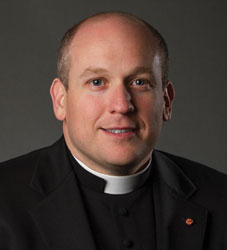
Father Christopher House is the Rector of the Cathedral and serves in various roles within the diocesan curia, namely Chancellor and Vicar Judicial.

**Please note there is NO 5:15 PM Mass Tuesday, May 7th.**

Bring Flowers to the Fairest

[This article was originally published May 2, 2017, link below]

“If there’s a bustle in your hedgerow, don’t be alarmed now. It’s just a spring clean for the May Queen.”

Those of us living in the Midwestern United States have had a springtime in which it really feels that we “know that all creation is groaning in labor pains…” (Romans 8:22) After a disappointingly mild winter – the disappointment being the lack of a picture book “White Christmas”- which ended in several weeks of multiple snowstorms, the wintery gloom and chill have dragged on. The groundhog who predicted an early spring should look into a new career. The labor of the earth bringing forth new life has been painfully stalled. At last, there have been some blessedly warm days, finally bringing the beauty of buds on the trees and the first flowers of spring. On the sixth Sunday of Easter, I can look out my window and safely say that spring has sprung. Though I wouldn’t say I’m packing away my winter coat just yet.

Each spring I enjoy one of the happiest perks of my job as a church secretary: a good perch for viewing the procession of school children to the annual May Crowning. There are the eighth graders, trying to look casually grown-up as they wait for one of their own to crown the statue of the Blessed Mother. We are always especially touched by the gravity of the second graders, wearing their First Communion clothes for a second time. They are so pious and serious as they walk past in single file. I think of the impression this is making on their young hearts, helping form a lifetime of devotion to the mother of Our Lord.

The popular Marian hymns sung at May Crownings tend to be treacly in their sentimentality. But I’ll give these sweet tunes a pass here, as they help ingrain an unforgettable devotion. A friend of mine brings Holy Communion to an elderly shut-in who just celebrated her 100th birthday. Many conversations in these calls are one sided; but a visit last week, on the first of May, had more animation. My friend began with a mention of the date and started to sing “Bring Flowers of the Rarest.” And she was joined by her usually quiet companion as the tune brought back memories of May devotions in years gone by: O Mary! We crown thee with blossoms today, Queen of the Angels, Queen of the May.

May Day and other May festivities provide a prime example of a pagan holiday sanctified rather than suppressed by our Church. In agrarian societies, the life-giving rebirth and blossoming of nature was something to be heartily celebrated. In “The Bad Catholics Guide to Good Living,” author John Zmirak elaborates on how “the Church never tried to quash these festivities, only to steer them gently in a more Christian direction.” It follows naturally that the celebration of spring be given over to a celebration of Mary. As Gerard Manley Hopkins wrote in The May Magnificat: Ask of her, the mighty mother: Her reply puts this other Question: What is Spring?— Growth in every thing—

The primal concerns celebrated in spring are now steered towards honoring the ultimate act of new life for humanity, in a woman whose cooperation with God allowed the Word to become flesh and dwell among us. Some say that pagan celebrations have been ‘tamed’ or ‘laundered’ into Christian celebrations, but there is nothing bland nor safe in what we celebrate. We celebrate God’s Love. Love that was willing to become one of us, grow like one of us, and finally suffer the agony of the Cross for our redemption.

Since I became a Catholic over twenty years ago, I have had a special affection for May’s Marian devotions. I always felt a little ‘robbed’ of the beautiful May Crowning, as my children had been in our parish’s religious education program, which wrapped up at the end of April. The May Crowning has been strictly an event for the children of the parish school.

When we began homeschooling our children, I wanted to have our own May Crowning and to begin a special tradition of honoring Mary in a special place in our home during Mary’s month. Our “school sized” forty-four inch statue of the Blessed Mother was a gift that my husband and I gave to each other. I had found it on eBay, looking to find a substantial statue of Our Lady with a bit of money that I had put aside. When the bidding got frantic at the end of the auction, my husband offered to double the amount as an early anniversary present.

The statue took over six weeks to arrive; the delay so long that a friend of mine was sure that I had been scammed. But arrive it did, looking worse for the wear, with its hands fractured off. It was obvious that the hands been bumped, jostled, and glue back together over the years. I set about to reverse the affects of a bad repainting. Someone with an intent to modernize the statue had painted the face, hair, and hands white, leaving only the blue cloak for contrast. I was grateful that whoever did the job ran out of paint and/or ambition before getting to the base of the statue, leaving the original paint on the cherubs, globe, and evil serpent (complete with juicy apple!) being crushed under Our Lady’s heel. It was the stunning base of the statue that caught my eye when I was cyber-shopping, crying out for someone to give it a little help.

The project took all that I knew about painting plus years of knowledge acquired flipping through fashion magazines and hanging around the Clinique counter. It was more of a cosmetic makeover than paint job – and I wanted it to be dignified, subtle, and worthy of the subject. And after painting, repainting, retouching and regluing one hand that was broken off – again! – in the process, Our Lady was ready to take her place at our first May Altar.

These things never go quite as I imagine they should. Not having years of large-scale Marian devotions behind them, my older daughters were mortified by the large statue moved into a prominent place in the living room. That first year the May altar was quite visible through the living room window. I didn’t mind. In fact, if you have a forty-four inch statue, why not share it with the world! But for image conscious teenagers, it took a bit of getting used to. They said it looked ‘ethnic,’ though no one was sure what ethnicity to pin it on. (May Altars first became popular throughout the countries in the southern part of Europe, i.e., the Catholic countries. They are also known to pop up in Ireland.) Perhaps the ethnicity they were thinking of is “Catholic” — as in, unapologetically Catholic with the appropriate devotion to Mary, the Mother of God.

That is the kind of grousing one gets from teenagers who want so much to be like the rest of the crowd. If everyone else had May Altars, ours might not have been big enough or prominent enough. It’s all a matter of contrast. Now the family is used to it. Maybe still not 100% on board. It is not easy to be present at the beginning of a family tradition; it is so much easier to grow up remembering that something has “always been done that way.”

Out in the yard, many flowers have names of Marian significance (marigolds, anyone?) and most others have alternate names honoring the Blessed Virgin. The Mary Garden is another springtime exercise in honoring Mary that has found a resurgence in popularity. Plantings in a Mary Garden create an earthy shrine for meditation on the lives of Mary and Jesus. I have clipped articles, read websites, and planted a Mary Garden in my mind. My tangible experience is pretty much limited to marigolds, but just knowing the symbolism behind the random flora of our garden is another way of appreciating the beauty of the created world in which God was made flesh.

Long before the child Jesus picked his first dandelion for Mary (or whatever was the Holy Land equivalent of the iconic American child’s love offering), people had been celebrating the rebirth of life each spring. Our Church has made this time of celebration its own and made this a blessed time to honor the woman full of Grace. May Crownings, May Altars, and Mary Gardens are a deliberately “ethnic” and proud way of celebrating our faith. At my house, Catholic is what we are now – and we set aside the month of May for remembering Our Lady in this lovely, verdant way.

Bring flow’rs of the fairest, bring flow’rs of the rarest, From garden and woodland and hillside and vale.

Our full hearts are swelling, our glad voices telling The praise of the loveliest, Rose of the vale.

Ellyn von Huben is a native of Wisconsin. Never one to keep her opinions to herself, her interests in the Church, family issues, and an eclectic array of topics led to her branching out into blogging, writing, and speaking. Ellyn lives in the suburbs of Chicago, and still has her ‘day job’ as an administrative assistant in a large Catholic parish on Chicago’s North Shore.

Article link: https://www.wordonfire.org/resources/blog/bringflowers-to-the-fairest/18616/

During the month of May, we will be sharing Catholic Marian prayers with you in the Weekly. We hope this will enhance your devotion to Mary, our Blessed Mother.

The Memorare

Remember, O most gracious Virgin Mary, that never
was it known that anyone who fled to thy protection,
implored thy help, or sought thine intercession was
left unaided.
Inspired by this confidence, I fly unto thee, O Virgin of
virgins, my mother; to thee do I come, before thee I
stand, sinful and sorrowful. O Mother of the Word
Incarnate, despise not my petitions, but in thy mercy
hear and answer me.
Amen.

The prayer, traditionally attributed to St. Bernard of Clairvaux, gets its name from the first word of the original Latin prayer. However, the prayer as we know it today is actually found within a much larger prayer to the Virgin Mary entitled Ad sanctitatis tuae pedes, dulcissima Virgo Maria(“At your holy feet, most sweet Virgin Mary”).

The Memorare was popularized by another Bernard, Fr. Claude Bernard, in the 17th century. Fr. Claude believed that the recitation of the prayer was the cause of his miraculous healing. He printed over 200,000 leaflets with the prayer on it in different languages to distribute wherever he could.

St. Francis de Sales said the prayer daily and St. Teresa of Calcutta taught others to pray it when they most needed help. Mother Teresa would pray it whenever she was faced with an emergency situation and most needed a miracle. It never failed her and has proven its miraculous character over the years through thousands of testimonials.

Wet Clothes, Don’t Care

I hate wet clothes. Maybe I should saying highly dislike, because hate is such a strong word, right? I detest wet clothes even on a hot summer day. I am not sure why it is, but ever since I was a kid, something about a “water ride” at an amusement park never scared me, just annoyed me. You would set out on this fun roller coaster, just to come off it soaking wet for the remainder of the afternoon…your next ride would be wet, the bench at lunch would be wet, your tennis shoes, socks, oh the list of terror continues. I know this sounds silly, but I would prefer to do anything over jumping in the water fully clothed.

Reading the Gospel this Sunday made me think of getting uncomfortable for Jesus. Peter upon seeing Jesus was so excited that he didn’t have the patience for the boat to come ashore. He jumped right in the water, fully clothed, no hesitation. With joy and zeal, the last thing on his mind were wet clothes. That would be the one instance I would jump freely out of the boat, fully clothed, to get to Jesus. It would require discomfort, annoyance, and general displeasure to do so, but it would be worth it to see Him on the shore.

Friends, this is what discipleship and stewardship are all about. How many of you are comfortable witnessing the Good News on Facebook? When we see a post about a pro-life issue, do we share it, even if we may have “friends” who would be offended? How many of us are willing to sit next to the stranger in the pews and shake their hand, offering welcome? How many of us are willing to say yes to tithing, even though we fear we may run out of money for weekend activities? How many of us are willing to bring the kids or grandkids to Mass on Sunday or daily Mass, even though we know it is sometimes a challenge and we face kicking and screaming? What is normally an inconvenience or uncomfortable experience, often produces the best fruit for the soul.

  • Maybe your “shared” Facebook post reaches someone considering an abortion.
  • Maybe that stranger was considering joining the parish and becoming Catholic and you were the one that introduced them to Jesus and our Parish.
  • Maybe the re-prioritization of our finances leads our family into a deeper prayer life, in which we eat at home on Friday night and pray before the meal, instead of rushing through a drive-thru window.
  • Maybe the grandkids won’t kick and scream, and next time invite their parents to Mass with you.

The willingness to jump in, to “let go, and let God,” is hard. However, in my life during the hardest times, I found my vocation, my spiritual home, and great joy. Let go and let God be the driver. He would jump in, fully clothed, to get to you. What would it look like if we were willing to jump in first toward Him?

Katie Price is the Coordinator for Stewardship at the Cathedral and works for the Diocese of Springfield, IL by helping parishes grow in discipleship and stewardship efforts.

Continuing Our Easter Journey

This Sunday concludes the Octave of Easter. An octave is a celebration of eight days in the Church and each day is honored liturgically in the same way as the day in which the octave began, in this case Easter Sunday. Following the reforms of Vatican II, only two octaves remain in the ordinary form of the Churches liturgical calendar: Easter and Christmas. While the octave may be finishing, the joy of the Easter Season continues on. I want to offer a special welcome to those who joined the Church and our parish at the Easter Vigil: Jordan, through Baptism, and Darren, Janet, & Katie through reception with the Profession of Faith. I wish to thank all those who helped to get that joy starts in our liturgical celebration of the Easter Triduum; thank you to our readers, extraordinary ministers of Holy Communion, ushers, and servers. Finally, a big thank you to our Cathedral choir and musicians for the tremendous work they put into our Triduum liturgies; the music was truly wonderful!

While the Church focuses on the faithful departed in a special way in November, I am also especially mindful of those from our parish community who have gone before us in faith as we celebrate this season of the Resurrection. I would ask you to please remember Kathy Dhabalt in your prayers. Kathy is the mother of Vicki Compton who serves on our parish staff. Kathy’s funeral Mass was celebrated at Christ the King this past Tuesday. I would also ask you to please remember Jim Graham in your prayers. Jim’s funeral Mass was celebrated at Blessed Sacrament this past Thursday. He was the principal architect during the Cathedral’s restoration project back in 2008-2009 and his work here endures as a beautiful testament to the glory of God.

The Gospel for this weekend, the Second of Sunday of Easter, is popularly known as the Gospel of Doubting Thomas. Here our Lord appears to Thomas, and the other ten Apostles, and invites Thomas to see and probe his wounds so that Thomas might believe that the Lord is truly risen and that he is who he says he is. While the Lord’s body has been changed and glorified, the wounds from his crucifixion remain. Theologians have marveled over this reality for 2,000 years and posed various reasons as to why. As in the case of St. Thomas the Apostle, the wounds identify the Lord for who is but they also tell us what death is no longer; death is no longer an eternal reality for those who live and die in God’s friendship. The marks of the Lord’s death remain but, but death has no power over him, and through him neither over us. St. Leo the great says it more eloquently in a homily on the Lord’s Passion: He did away with the everlasting character of death so as to make death a thing of time, not of eternity.

As we continue our journey through this Easter Season, let us turn to the risen Lord to draw newness of life from him, remembering that the wounds and the scars of our present lives, painful as they may be, are only things of the here and now; in the Resurrection on the last day, when Christ makes us new, those things will be no more.

Father Christopher House is the Rector of the Cathedral and serves in various roles within the diocesan curia, namely Chancellor and Vicar Judicial.

Divine Mercy Sunday
On Divine Mercy Sunday, April 28th, the Cathedral will host devotions in honor of the day. Exposition of the Blessed Sacrament will begin at Noon. Confessions will be available from Noon until 3PM with three confessors available during that time. At 3PM, the hour of Divine Mercy, Benediction of the Blessed Sacrament will be celebrated as will the Chaplet of Divine Mercy. All are welcome!

Cultivating Our ‘Eulogy Self’

Recently, a death arose that brought me back to Brian Doyle’s bittersweet essay, Notes from a Wake. An Irish priest had passed. Amid photographs and a chalice, whiskey and a few fine cigars smoked “on a side porch under a cedar tree [by] a dozen men and two women,” family, friends and the faithful gathered. An old friend told stories of his youth. Younger folks sang – and debated the lyrics – of an old Irish song, St. Brendan’s Fair Isle. A tally was made of family baptisms, marriages and funerals performed by the deceased. Jokes were told. A slow jig was danced. Infants were up too late. Food was packaged up. And then it was done. It was perfect. That’s how I want to be remembered.

A few years ago, David Brooks wrote The Road to Character. With more heartache than anguish, he mourns what we have become in our modern, efficient, unreflective world. The two sides of our nature (described by Rabbi Soloveitchik as Adam Iand Adam II) are forever in tension with one another. Adam Iis our exterior self, driven by achievement and honors. It is our “resume self”. Adam II is our interior self, moved by eternal verities and ineffable moments (falling in love, doing the right thing, honoring our God and our family). It is our “eulogy self”. Brooks observes, with no small amount of regret, that we have lost Adam II because of the oversized drive and social celebration of Adam I. We give lip service to what we would like people to say of us after we have passed, but our daily lives betray that we are in fact obsessed with our growing list of shiny, new achievements. While I wouldn’t call Soloveitchik’s construct or Brooks’ expansion upon it the definitive or last word on the complexity of man and his soul, their point is worthy of consideration.

What have we become? And what have we lost? In a wonderful little essay, Morning Report(which I have written about in these pages before), a harried first year internal medicine resident races through the morning examining fourteen patients, reviewing labs, writing notes, speaking with nurses and families in the desperate effort to finish and make it to her residents’ conference at 10 a.m. What foils her efforts (interesting that, in the race for efficiency, it is the work of the soul that is always blamed for foiling the effort), is an emotional moment with a patient who has just come to the fuller realization that she will die from pancreatic cancer. What upsets this resident’s efficient plan is that she sits down, holds a hand, and feels her own eyes well up with tears. It is a fleeting, but real, transcendent moment of fellowship. It only lasts a moment, but Adam II just told Adam I to wait.

Daily, in my medical practice, I see this struggle. And in my life, I experience it. Reasonably, we are all simply trying to survive. We go to school and get our degrees. Along the way, we compete in sports or sing in choirs or join the robotics team or work toward our Eagle Scout. Surely, we take on new experiences to grow as individuals, but we also strive to make ourselves more attractive and more marketable for bigger and better opportunities. We are using our gifts. We are trying to do well. And as we do well, we get stroked. We are told how good we are, how much we have helped, how far we will go. And Adam I, smiles and grows bigger and bigger. But then something happens: an illness, a death, a divorce, a job loss, a house fire, a betrayal. It is something that reminds us that, while our resume is awesome, it won’t make a damn bit of difference in this moment. Adam I shrinks; Adam II, in his wobbly, underfed state, begins to rise.

It is Easter Sunday morning as I write this. Everyone is asleep. In a few hours, the house will be bustling with preparation for Mass, disputes about who is in which bathroom for how long, followed by an eager search for all twenty Easter eggs stuffed with Starbursts and Twix bars (several of which, I will help in eating). THIS is my life. The worship of a God who not only made me, but went through (and to) Hell to rescue me in my brokenness. The warm fellowship with my lovely wife and my beautiful and delightfully squirrely daughters. Good food. Fatherly tomfoolery. Crushing hugs from little ones that still believe in me. Moments. Transcendent moments. Moments that would never make it on a resume because they are too precious for that scrap of paper.

In 1906, as G.K. Chesterton concluded his book about Charles Dickens, he made this wonderful and indispensable observation. Comradeship and serious joy are not interludes in our travel; but… rather our travels are interludes in comradeship and joy, which through God shall endure for ever. The inn does not point to the road; the road points to the inn. And all roads point at last to an ultimate inn, where we shall meet Dickens and all his characters; and when we drink again it shall be from the great flagons in the tavern at the end of the world.

It is an observation celebrated by those at the Irish priest’s wake. It is an ethic aspired to by the Adam IIin each of us. It is my Easter Sunday morning. It reminds us that our love of family, fellowship of friends and worship of a crucified (now, risen) God are not interludes – pit stops or way-stations – on our road to success, our journey to resume building, or our cultivation of Adam I. They are the central act, the reason for being, the essence of life. They. Are. Everything.

Surely, we should achieve, strive and be excellent. Our “resume self” is a fine self worthy of regard.

But our “eulogy self”? Now, that’s who God has truly called us to be. Worthy of a fondly recalled memory, a slowly danced jig or a wistful, warm puff on a fine cigar.

Dr. Tod Worner is a husband, father, Catholic convert & practicing internal medicine physician. His blog, “Catholic Thinking”, is found at Aleteia.com. He also writes for Patheos (“A Catholic Thinker”) and the National Catholic Register.

How to Carry the Meaning of Holy Week Through the Rest of the Year

I remember the first time I attended services at my church for the entire Triduum: Holy Thursday, Good Friday, and Easter. I was 10 years old, and my mother insisted that I go with her. I wasn’t happy with Mom at first, but I was asked to be part of the washing of feet at Mass on Thursday, and the experience blew me away. It seemed like such a beautiful, concrete, intimate act that Jesus shared with his disciples, and I felt so lucky that I got to be part of its depiction.

Then the next night, I was asked to be in a special procession on Good Friday. I carried a crown of thorns as the organ swelled and the choir sang, “Were You There When They Crucified My Lord?” Easter Mass on Sunday morning was the culmination of all of this for me. While singing along with “Jesus Christ Is Risen Today,” I felt that I had actually walked along with Jesus from the last moments with his friends on Thursday through the agony of his death on Friday back to the joy of new life on Sunday. In his book, “I Know This Much Is True,” Wally Lamb writes, “The evidence of God exists in the roundness of things.” I couldn’t agree more.

The cycle of seasons that moves from the lushness of spring and summer into the shriveled barrenness of fall and winter before erupting in the fresh, new buds of spring once again is another example. The roundness of our planet’s journey around the sun points to the divine origin of all life. In my own life, I’ve seen the same divine pattern at work.

When I finally landed on a major in college, I decided that I wanted to be a high school religion teacher. I became certified to teach English and got a minor in theology, which helped me get a job in a Catholic school. But I soon fell in love with teaching English and kept with that path. After several years of teaching, I became an assistant principal, and then a principal. Not enamored with the stress that went along with the principal role, I stepped down, left the school I had loved for 20 years and worked in different capacities for awhile.

Until I got a phone call. A friend from my school told me that the current campus minister was going to retire, and she thought I should apply. I had never considered the position before, so I thanked her for her kind words but said, “No, thanks.” However, the idea of it stuck with me. Several months and lots of prayerful reflection later, I became the campus minister at my school, a position I currently hold and find very fulfilling. I feel like I have come full circle. I’m not a religion teacher in the way I had originally intended, but I definitely teach religion in my current role.

As Catholics, we celebrate a “roundness” that we call the Paschal Mystery during Holy Week each year. Jesus’ life, death, and resurrection demonstrate for us that death is not an ending; it’s not the last stop on a linear journey. Instead, Jesus shows us that with God, we can move from birth through death into new life. We call the week in which we celebrate the Triduum of Holy Thursday, Good Friday, and Easter a “holy” week. And rightly so. The word holy means sacred or blessed in our current usage, but it comes from a Germanic root that means something a little different – whole. In other words, the very roundness of the journey from life through death and back to life again is what makes it sacred.

Perhaps the biggest mistake we sometimes make with Holy Week is when we think of it as just one week out of the year. Certainly, there is just one week in which we celebrate the Triduum as a community in ritual and sacrament. But every week can be a holy week. Every week should be whole.

For that to happen, we simply need Easter eyes – eyes that see and honor the roundness in all of life as experiences of God. Every time we love, get hurt, but then forgive, we become whole. Every time we succeed, then fail, but then gain the courage and wisdom to start again, we understand that life is sacred. Every time we are home, then move away, then return home – literally or figuratively – we are blessed.

I see this at work in my own life. Both of my parents passed away over the last two years, each suffering from a lengthy battle with dementia. As hard as it was for me to care for them while working and caring for my own family, as hard as it was to visit them in a nursing home and watch them decline, something felt right about the process. I had come full circle. The people who had helped bring me into the world and cared for me as a child were the same people I cared for and comforted as they slipped back into God’s divine embrace.

Holy Week celebrates more than a historical event from more than 2,000 years ago. It’s also a powerful invitation for us to make every week of our lives a holy one. I truly believe that “the evidence of God exists in the roundness of things.” Going forward after Easter, we’re called to embrace this wholeness in all parts of our lives. May we be watchful and hopeful with Easter eyes.

Mary Ann Steutermann is currently the director of campus ministry at Assumption High School, an all-girls Catholic high school in Louisville, Kentucky.. She holds a bachelor’s degree in English and two master’s degrees in education. Mary Ann lives in Louisville with her husband and son.

Saved by a Stick

Some people are called to be a good sailor. Some people have a calling to be a good tiller of the land. Some people are called to be a good friend. You have to be the best at whatever you are called at. Whatever you do. It’s about confidence, not arrogance. — Bob Dylan

My grandfather wrote me in a letter, “It’s not what you do, it’s how you do it. It’s not what you make, it’s who you become in the making. It’s not about getting recognized for what you’ve done, it’s recognizing what you’ve done you did for the right reason. And the right reason is always the Almighty and your fellow man. The rest is incidental.”

“Being best at it” is to strive to do each thing you do with full intention, as if each action were the first, last and only thing you will ever do. Living as if now was all your legacy would be in time, all your name would signify in eternity. To treat each encounter as defining, each next as a new beginning, as the whole present in the part. For God does not treat any moment as insignificant, since He is wholly present to each moment, loving with equally infinite intensity.

Back when my daughter Catherine was 4 years old, I came home from work one day feeling defeated and tired, and not prepared to patiently interact with my children. I wanted to stare at a blank wall that did not talk back, and sip a Blue Moon.

As I got out of my car and started toward the front door, I noticed Catherine was playing over by the tree line. When she caught sight of me, she ran excitedly toward me with a stick in hand and shouted, “Daddy look! A stick! A stick!” I mumbled something and hoped she’d go back to her solitary play. But she persisted, “No! No! Look at the stick!” As I looked, she pointed to little red mites running in and out of the cracks in the stick. She pulled me with her to the ground, and we blanked the whole world out to examine this microcosm together.

In a matter of seconds my whole disposition changed, the present presided over both past and future, and my regrets and worries were forgotten amid the lilies of her field.

The wolf shall live with the lamb, the leopard shall lie down with the kid, the calf and the lion and the fatling together, and a little child shall lead them. — Isaiah 11:6

In that moment, Catherine’s love seized me, and I was prepared to worthily receive the sacrament of the present moment. It is in such moments that the Kingdom Come, comes. More than anyone in the world, my children have taught me how to discover my vocation in the moment. “See, now is the acceptable time; see, now is the day of salvation” (2 Cor. 6:2).

Dr. Tom Neal presently serves as Academic Dean and Professor of Spiritual Theology at Notre Dame Seminary in New Orleans, Louisiana. Tom received a Masters in Systematic Theology from Mount St. Mary’s University and a PhD in Religion at Florida State University.

A Bare Cross, An Empty Tomb

I wonder what that small group who remained was thinking as they looked upon the bare cross that Friday afternoon, the Lord’s lifeless body now cradled in his mother’s arms. How distant the past must have felt for Mary and the others in that moment: the angel, the shepherds and the Magi, finding him in the Temple, the voice of the Father at the Jordan, feeding the multitudes, healing the sick, the blind & the lame, raising the dead, the teachings, the love, and the mercy. In the midst of their grief and the rush to bury his body before the setting of the sun, I believe that his mother, possibly the only one, remained resolute in faith, that God’s will be done…. that God’s will was not done yet in its fullness.

I wonder if anyone came that Passover day, that Saturday, to sit in silence; to wonder, to mourn, or maybe to wait.

I wonder what those holy women were feeling early in the morning on that first day of the week, as the Scriptures teach us, when Mary Magdalene and the others came to the tomb only to find it void of the one whom they sought, when in their amazement they were told:

Do not be amazed! You seek Jesus of Nazareth, the crucified. He has been raised; he is not here (Mark 16:6).

Those holy women were the first to receive the good news that has forever changed the course of human history and the meaning of our shared human experience.

On this Easter day, the mystery of the cross and the empty tomb looms large. The two truly form one mystery because their meanings are not fully realized alone. Without the empty tomb, the cross stands only as a monument to brutality; without the cross, the joy of the empty tomb is lacking. It is the same for us in our lives.

We carry the burden of the crosses of our lives, but faith teaches us that these crosses are not ends in themselves when we unite them with the Cross of the Lord Jesus; no cross comes without the promise of resurrection. The resurrection moments of our lives are made all the sweeter because of the sacrifices and hardships that have preceded them.

In the end, having borne the trials of this life and having persevered in faith, the joy of everlasting life will be unlike anything that we can imagine now. Until then, the empty tomb stands as the Lord’s promise to us and all who live and die in his friendship.

On behalf of Bishop Paprocki and the Cathedral clergy and staff, I pray that the Lord will bless you and yours this Easter with the fullness of his grace and the joy that comes from him alone. With every cross may you remember that it is not the end.

In moments of sacrifice and desolation may you know that you are not alone or forsaken. May you always be mindful that Easter teaches us that God always gets the last word, and in the case of the cross and the tomb, his last word is life.

All honor, praise, and glory to the risen Christ, who, by his death and resurrection, has gained for us the rewards of everlasting life! Happy Easter!

Father Christopher House is the Rector of the Cathedral and serves in various roles within the diocesan curia, namely Chancellor and Vicar Judicial.

Carrying Lent Forward

For Many, the season of lent can serve as a time of renewed dedication to living the Christian faith. We adopt forms of prayer, fasting and almsgiving in order to help us live that Lenten call to “repent and believe in the Gospel”. Now that we have reached Easter and Lent is over it might be our experience that any bad habits we avoided or good habits we formed during this Lenten period will begin to fade. However, it does not have to be the case.

The actions we took during lent as signs of penance can now be performed as acts of rejoicing!

The Easter season is a special time of celebration in our for the Lord is RISEN. What better way can we celebrate the resurrection of Jesus Christ than by continuing to seek ways to pray, offer sacrifices and help others? Of course, the Easter season is not a time for fasting or penances but it is also possible for us to serve others and spend time in prayer as a way of celebrating and bringing glory to God. The resurrection of our Lord has changed the entire world and we can continue to spread that message of hope and life by carrying our Lenten dedication to the Gospel forward through the Easter Season and for the rest of our lives.

Fr. Wayne Stock is a Parochial Vicar for the Cathedral of the Immaculate Conception.

Witnessing to the Joy of the Resurrection

My sophomore year at the University of Illinois, my friend Alice finally thrust an application for a Koinonia retreat into my hands. She had already filled it out, and the only reason she didn’t just turn it in for me was out of common courtesy: to make sure the dates worked in my calendar. Truth be told, she had already invited me at least five times up to that point to this “life-giving” retreat experience, but as a busy, non-committal college student, I found plenty of convenient excuses to turn her invitations down.

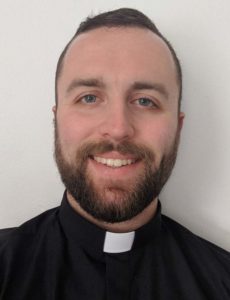
For reasons I couldn’t discern at the time, Alice cared about me having this real experience of Christ’s love— and like the friend at midnight, it was her perseverance that won me over. And I’ll be honest: that retreat was the beginning of a long road that led me, in His time, to the priesthood. Without Alice’s joyful and persistent invitation, there’s a real possibility that I would not be a priest today.

We are an Easter people! Like the Apostles, we experience anew this Easter the joy and the glory, the profound and life-giving Resurrection of Jesus Christ from the dead—the moment that Christ definitively conquers in us anything that could ever separate us from Him. And we, like the apostles, are promised at Pentecost an outpouring of the Holy Spirit, precisely so that we can witness to what we have seen.

Imagine if the apostles had kept the Resurrection to themselves, just their little secret. Where would our world be today? Our call this Easter is to spread the Word. To not stay silent. To witness to the joy of the Risen Christ.

If we are convicted of the truth of Jesus Christ, returning to our former ways of life is not an option. We must commit ourselves to the Lord and to sharing the joyful news of His Resurrection. As the numbers in our pews decrease, opportunities for witness abound! Whether it’s a friend or a family member, a colleague or a neighbor, that lady who teaches your spin class or the guy who makes your coffee in the morning—extend the invitation. Don’t stop just because you get a non-committal answer. Be joyful, but be brave. Who knows? By your persistence and your joy, you may just change someone’s life forever.

Fr. Michael Friedel is a Parochial Vicar for the Cathedral of the Immaculate Conception.

« Previous Page
Next Page »

Liturgy

Sunday Masses (unless noted differently in weekly bulletin)
Saturday Evening Vigil – 4:00PM
Sunday – 7:00AM, 10:00AM and 5:00PM

Weekday Masses (unless noted differently in weekly bulletin)
Monday thru Friday – 7:00AM and 5:15PM
Saturday – 8:00AM

Reconciliation (Confessions)
Monday thru Friday – 4:15PM to 5:00PM
Saturday – 9:00AM to 10:00AM and 2:30PM to 3:30PM
Sunday – 4:00PM to 4:45PM

Adoration
Tuesdays and Thursdays – 4:00PM to 5:00PM


CatholicMassTime.org

Parish Information

Parish Address
524 East Lawrence Avenue
Springfield, Illinois 62703

Parish Office Hours
Monday thru Thursday – 8:00AM to 4:00PM
Fridays – CLOSED

Parish Phone
(217) 522-3342

Parish Fax
(217) 210-0136

Parish Staff

Contact Us

Contact Us

Copyright © 2025 · Log in