Cathedral of the Immaculate Conception

Springfield, IL

  • About
    • Contact Us
    • History of the Cathedral
    • Liturgical Schedules
    • Parish Staff
    • Register with Cathedral
    • Subscribe to the Cathedral eWeekly
  • Sacraments
    • Baptism
    • Becoming Catholic
    • Matrimony
    • Vocations
  • Ministry List
    • Adult Faith Formation
    • Cathedral Meal Train
    • Cathedral Online Prayer Wall
    • Cathedral Concerts
    • Family of Faith
    • Grief Share
    • Health and Wellness
    • Spiritual Resources
  • Stewardship
    • Stewardship: A Disciple’s Response
    • Stewardship Form
  • Support
    • E-Giving Frequently Asked Questions
    • Give Online
  • Sunday News
    • Announcements
    • Cathedral Weekly
    • Livestream Feed
    • Submit a Mass Intention Request
    • Weekly or Announcement Submission

Easter Sunday Is Concluded…Now What?

It is now the quiet time… The Triduum services are completed. The Easter Vigil (the “mother” of all vigils) has been concluded for another year — to varying degrees of liturgical success in each individual parish, I am sure. The crowds that seem to magically appear and arrive for Easter Sunday Mass have come and gone. Candidates and catechumens have been received into the Church. Easter egg hunts are wrapped up as well as family Easter gatherings. Now what?

Is Easter Sunday to now be shelved away as a nice memory testified to by photos posted on Facebook? An opportunity for people to dress up and have good family time? Does the message of Easter end with the last Easter Sunday Mass? Liturgically, the Church says “no.” We have the Easter Season — a needed time to reflect on the truth of the resurrection and to look to the coming of the Holy Spirit at Pentecost. “Liturgical” here is important and it does certainly influence who we are but here I am specifically wondering about our day-to-day life outside the parish walls. Does Easter affect and shape who we are or does it remain a beautiful annual ritual that is left behind in the crowded Easter Sunday church parking lot? Do we take Easter with us into the streets of our lives and of our world or do we keep it hidden away behind locked doors — doors of a private faith, spirituality and morality, doors of our resignations and sense of hopelessness in the face of the pain of our world, doors of our fear to offend the accepted norm?

Easter cannot stay hidden away. Easter demands that we go into the streets – no matter how uncomfortable it makes us or others.

In Matthew’s account of the resurrection there is an interesting instruction that is given to the women who came to the tomb early that morning by the angel sitting on top of the rolled-away, heavy stone that had been used to seal the tomb. “…go quickly and tell his disciples that he has risen from the dead, and behold, he is going before you to Galilee; there you will see him.” (Mt. 28:7)

The resurrected Lord does not fear the world and its violence and sad resignation because he has overcome all the sin of the world through the love of the Father. The resurrected Lord goes before you to Galilee. He goes into the streets of the world and the expectation and instruction given by the angel of the resurrection is that the followers of Christ do the same!

Easter, if it is to be authentic and be more than a nice memory, cannot stay hidden behind any locked door and neither will it allow us to remain hidden. There is a culture of fear that continually whispers to us that nothing can change, that we cannot really do anything in the face of the injustice of our world, that we should look upon ourselves and our world with hopeless eyes. The culture of fear is arrogant in its pride and thinks that it alone has words to speak. The culture of fear lies. The culture of fear would convince us that we are its children.

We are not children of the culture of fear. We are children of the resurrection! We are sons and daughters of God! We have nothing to fear and we have words, new words to speak to our world and to one another! The angel announces that the risen Lord is going to Galilee and that there the disciples will see him. The implication is more than apparent, the disciples are meant to go and meet the Lord who goes ahead of them. (The Lord always goes ahead of us.) They are meant to go out into the street and carry the truth of the resurrection into the world!

It is not enough to stay behind locked doors, no matter how pretty and gilded those doors may be and no matter how many other people may also be content to remain there also. If we do so then the culture of fear wins and our lives become exceedingly small, constrained and life-denying.

Joy is found only in following the risen Lord to wherever he might lead.

One further thought: there is no time to waste. The angel instructs the women: go quickly. We are each allotted only a certain number of Easters in our lives here on earth. There is no time to lose, both for the work needing to be done in our own hearts as well as the work needing to be done in our world. In the light of the resurrection we must make use of every moment given to us. When all is said and done, we will each have to give an accounting of how we have lived the Easters we have been given in our lifetime.

We are sons and daughters of the resurrection of our Lord! The Easter mystery is placed in our hearts and entrusted to us and it cannot remain behind locked doors, it demands to be taken out to the streets of our world!

Fr. Michael Cummins is a priest of the Diocese of Knoxville, TN. Ordained in 1995, he has served in a variety of roles within his diocese. Currently he is serving as pastor of St. Dominic Church in Kingsport, TN. Fr. Cummins holds a Masters of Divinity and Licentiate in Sacred Theology from the University of St. Mary of the Lake (Mundelein Seminary) in Chicago. This article was used with permission from the Word on Fire blog, wordonfire.org.

Everyday Stewardship

This Easter, in churches all over the world, people will be fully initiated in the Catholic Church. Those who have come from another Christian denomination have already begun their journey with Jesus Christ. But for those who are baptized at the Easter Vigil, a new reality has come to pass. Each newly baptized man, woman, and child have become new creations in Jesus Christ. They have died and risen with the one who rose on the third day and whose empty tomb we celebrate every Easter. Easter Sunday morning, they awake after many months of RCIA and all have the same question before them: “Now what?”

When one finds themselves having journeyed through various thresholds of conversion and now they bear the name of Christian, the time comes to chart the course of life as a disciple. Stewardship is that course of life. How one lives out their life from now on is the life of stewardship. The less one understands true stewardship and the value of their gifts and talents to the Body of Christ, the harder the journey.

Those of us who were baptized many years ago can easily fall into a false sense of comfort. We forget that sense of excitement those coming into the Church experience at the Easter Vigil. However, the story of that empty tomb reminds us of the power behind our baptism. Today, we, too, are called to discipleship and a stewardship way of life. Jesus continues to provide the answer to our, “Now what?”

– Tracy Earl Welliver, MTS

What Would You Do?

Have you seen this picture around the web? It has been shared thousands of times on social media, major news outlets, and newspapers. The story is of a little girl with her family, when they were praying the Stations of the Cross. When she saw that Jesus had fallen she said, “Oh no, Jesus needs help.” So, she proceeded to go over to the cross and with all her might, muster up the strength to help Him. Of course, she probably grew frustrated quickly with how hard that task became.

And, it is a hard task. Would we have run to Jesus to help Him with the Cross?

Without hesitation, the child saw Jesus in need. I would imagine if the child saw anyone else with that cross she would run to help them, as well. Jesus dying for us and resurrecting to new life is not the only lesson here. We should step up, without hesitation, to help the face of Jesus around us. When one of us is in need, we help. When one of us needs prayers, we pray. When one of us needs a collection, we give. Everyone is carrying a different cross. The Easter message challenges us to jump in and help pick up the Cross. Will you do it?

Stewardship provides us a great framework for this challenge. This may be a silly story, but my five year old daughter and I discussed tithing last week because of the show, “American Idol.” She was really fond of one particular artist named, Kai. The young singer had a beautiful voice, but she also had a story of homelessness. One could see that she had a very heavy cross. She had to make an appeal to her Church to take up a collection for her to be able to afford “Hollywood Week,” which was the next stop in her American Idol journey. On the show you see a scene of church- goers generously donating to this fund and all of them coming together around their fellow member. My daughter saw the money in a golden offering plate and said, “I do that too! Does our church send people to American Idol?” I couldn’t help but laugh, and of course explain to her that no, not necessarily. It isn’t an obligation for us to give, it is a blessing to be able too. It is a life lesson that when one of us needs help, we all are here to pitch in. Some day we may need to “withdraw” from the basket ourselves. We may need sacramental help, spiritual direction, help with a family funeral, fellowship or formation. Contributing to the basket isn’t about the money, but the Mission. Challenge yourself in the Easter season to consider three things every-time the offertory goes around: how can I pray more, give more, and serve more in order to help carry the Cross?

The Easter message for us is one of joy, excitement, and action. How will we respond to the message of the resurrection? What will you do next, now that the tomb is empty?

Katie Price is the Coordinator for Discipleship and Stewardship at the Cathedral.

Getting Ready for Your Holy Week Journey

When I returned to the Church in my late twenties, one of the things that became very important to me was fully investing in the liturgical year. As a child, any day at church was just the same as another, and though Christmas and Easter had extra trappings, my adolescent apathy didn’t allow for much conviction or interior renewal. So, when I came back I wanted to learn, appreciate and enjoy all the unique aspects of living life according to the liturgical calendar. And there was no time where that commitment to commitment became as significant as during Holy Week.

Holy Week is the apex of our liturgical year. The entire week is one of continued heightening, building and expanding of our faith in and love for Christ, culminating with the celebration of the Resurrection on Easter. There’s so much to do during the week, and the ups and downs of the scriptural events throughout can seem rather chaotic. I’ll admit my first few Holy Weeks upon my return to Catholicism had me feeling frazzled and overwhelmed, because I wanted to have the full-on, no holds barred Holy Week experience. Instead, I wound up finding myself burnt out and exhausted by the time Easter came around. This is a rather common experience amongst the faithful, so I offer some gentle guidance and things to focus on during the week in order to make for a rich and rejuvenating encounter with God.

Palm Sunday

To make things simpler, it might help to look at Holy Week as a journey, one that moves from the interior to the exterior. We begin in an interior space on Palm Sunday — the traditional start of Holy Week — allowing ourselves the opportunity for both anticipation and reflection. In the account of Jesus’ entry into Jerusalem, read during the blessing of the palms at the beginning of Mass, we anticipate the events of the week to come, but in the Gospel reading later, we encounter Christ in his Passion and death.

Palm Sunday holds in tension the suffering and death of Jesus, and the promise of the Resurrection. We hear of the crowds waving palm branches — a symbol of victory — as they greet Jesus entering Jerusalem, riding on the back of a donkey — a symbol of peace — and yet we know that “the son of man must suffer many things and be rejected” (Luke 9:22) as well.

We can look to Palm Sunday as the impetus for the week; it is the invitation by Jesus to accompany him on his most important mission. Jesus is inviting us to be with him in a more intentional way this week, and we might take this time — from Palm Sunday onward — as an opportunity to go back to the scriptural accounts of his entry into Jerusalem, as well as his Passion and death, and reflect on their meaning, for both ourselves individually and humanity on a larger scale. We might want to take the time to sit with these scriptural passages, placing ourselves in the scene, going deeper and strengthening our relationship with Jesus. This time should be one spent primarily within, as we consider the significance of the events that are about to take place, but also consider their necessity. What is it about the world we live in that called for a Savior?

Holy Thursday

Entering into the Triduum — which begins with Holy Thursday and the Feast of the Lord’s Supper — we begin to move from the interior to the exterior, as we commemorate the Last Supper both in the Eucharist and in the ritual washing of the feet. As we partake in and witness the ritual washing amidst our own faith community, it is important for us to heed the instructions Jesus gave his apostles that fateful night: “I have given you a model to follow, so that as I have done for you, you should also do.”

As the Body of Christ, we are called to emulate Jesus, our head, and go out into the world and be a servant for all. Our faith is a communal faith, and having spent the previous few days in reflection and quiet, we are now being awakened and called out of ourselves to serve and sacrifice as Jesus did. When the Feast concludes, and the Eucharist has been brought to the Chapel, we are given the opportunity to reflect on Jesus’ time in the Garden of Gethsemane. Jesus: alone, abandoned and afraid, in his full humanity, cannot escape the reality of suffering and sorrow, a reality that we all must live with. Holy Thursday is a time to be with Jesus in his frailty, while simultaneously recognizing our own.

Good Friday

We leave the Garden, and enter into Good Friday, a time of solemnity and silence, as we listen to the proclamation of Jesus’ Passion and Death according to the Gospel of John. While we’ve been sitting with the crucifixion throughout the week, it now takes center stage, and with it comes the realization of our own sinfulness in the wake of Jesus’ suffering and death on the Cross.

Most parishes offer the Sacrament of Reconciliation as a matter of course, but it is also a good time to consider the evil occurring in the world on a broader scale, and — remembering Jesus’ instruction from the ritual washing of the feet — perhaps take the opportunity to fill part of this day of fasting with spiritual nourishment, through service of some kind. While the day is (and should be) tinged in sorrow, it is also important to remember to never give up hope, to never forget the end of the story.

Easter Vigil

The Exsultet, sung after the lighting of the Paschal candle at the beginning of the Easter Vigil, is the climax of the week, an outpouring of joy and praise for the reality that is our Salvation. The entire week has been moving toward this moment, just as the history of the faithful, as recounted in the nine passages read during the Vigil, had been awaiting the Resurrection.

Now is the moment to celebrate Christ’s victory over death and his invitation to us to join him in new life. All the sorrow we’ve encountered throughout our journey with him is to be forgotten and the time has come to rejoice, through him, with him and in him. It is also the time to remember that with the Resurrection comes our responsibility to proclaim it, in both word and deed. Easter does not end Monday morning. It never ends, and it is our duty to always live in the hope and joy of the Resurrection and bring that hope and joy to all whom we encounter.

Fr. Jake Martin, SJ, is a Jesuit priest, comedian and writer. He is pursuing a Licentiate in Sacred Theology at Heythrop College in London.

Everyday Stewardship

Jesus warns us in the Gospel of Matthew, “If anyone wishes to come after me, he must deny himself, take up his cross, and follow me.” It is an invitation to a way of life, and a plan that leads to holiness. But make no mistake, it is a warning as well. The cross is a sign of victory, but only in light of the Resurrection. Alone, it is a symbol of ultimate sacrifice: the sacrifice of Jesus Christ for a fallen world, and the sacrifice we are called to make to truly follow him.

 The power of this symbol has been diminished in popular culture. It is often used in fashion and simple wall art and on bumper stickers and T-shirts, sometimes with Christian clichés and sometimes not. But the cross is something so much more. It is a reminder of the pain, suffering, and death of one who loved us so much that he would give his very life for us. It is our God on that cross. It is God who cries out in despair, feeling the ultimate depth of human emotion. And there lies the key for us in trying to live this life of carrying our crosses.

 For those who suffer the death of a loved one, the Father lost his Son. For those who suffer the ravages of disease, his body was broken, beaten, and pierced. For those who feel they have no way out – whether due to prisons that are physical or prisons that are of the mind – he hung on a cross and cried out, “Why?” For those who feel alone and abandoned, he hung on a tree where no one could comfort him, not even his own mother. He has walked in all our shoes, and now we are called to walk in his. In the cross, we find solidarity with the human condition. In an empty tomb, we find our hope.

Tracy Earl Welliver, MTS is in charge of Stewardship Direction for Parishes at Liturgical Publications, Inc.

Luke’s Passion Narrative

One of the most striking occurrences for me in Luke’s Passion is early on at the Last Supper, when Jesus speaks to Peter telling him that the devil had demanded to sift Peter like wheat but that Jesus had prayed for Peter’s faith. Peter quickly responds that he will never falter in his faith, in fact that he is prepared to go to prison for the Lord and to even die for him. Yet, in that same moment, Jesus tells Peter that he will deny him three times. Later that evening, the Lord’s prophecy comes to pass, just as he is being mocked by the Temple guards who tell Jesus to prophesy. When Peter denies Jesus, Luke tells us that Peter catches the Lord glancing through the crowd at him in that moment.

 What a moment; in fact the thought of that scene always gives me chills. After that moment, realizing what has happened, Peter goes out and weeps bitterly for his betrayal. I have often thought about that glance of Christ towards Peter. What did it look like? I can imagine it being mixed with heart-break and pain but also with love and mercy; in no way do I imagine that glance being one of condemnation. So, what about in our lives, in those moments when we fail the Lord through our sinfulness and human weakness? How is the Lord looking at us? I imagine its quite the same. A look of pain but also one that invites us back, to know again the love that the Lord always has for us. His glance is one that does not illicit fear but that invites us to the fullness of mercy.

The Passion narratives of Matthew, Mark, and Luke rotate on a three-year cycle for Palm Sunday and this year the Church is presented with Luke’s narrative. Throughout Ordinary Time this year we have been presented with Gospel selections from Luke and that will continue after Pentecost but this Lucan year also continues in the upcoming Easter season as Acts of the Apostles is traditionally understood as being authored by Luke too. Luke’s Gospel is divided into four parts: in the garden, before the Sanhedrin, before Pilate and Herod, and finally Jesus’s crucifixion, death and burial. While Mark and Matthew present us with a Jesus surrounded by darkness and impending doom, and John portrays a triumphant Christ, Luke offers us a gentle and merciful healer who has given himself over to the Father’s will and continues his mission to the end.

Just as the Lord’s prophecy of Peter’s denial came to pass so did his prayer that Peter would not fail because Peter ultimately turns back to him. Peter humbles himself in contrition and therefore is able to receive the grace and the strength that the Lord wanted him to have. Sinners though we are, the Lord Jesus continues to intercede for us as he did for Peter. Mindful of our sinfulness in these sacred days of Holy Week, and always, let us turn to the Lord with humble and contrite hearts that we might know the fullness of his mercy, the power of his grace, and ultimately share in his victory as St. Peter did.

Father Christopher House is the Rector of the Cathedral and serves in various roles within the diocesan curia, namely Chancellor and Vicar Judicial.
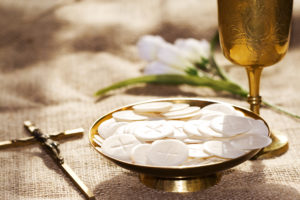
Maintenance vs. Mission

There are two kinds of Catholic  parishes in the US these days.  Maintenance parishes and mission  parishes. Maintenance parishes are  primarily concerned with maintaining  the status quo, keeping current  parishioners happy and involved, and  believing that “if it ain’t broke, don’t fix  it”. Parishes driven by a culture of mission, on the other hand,  seek to help all people, parishioners and non-parishioners,  encounter and fall in love with Jesus so that their lives only make  sense when fully committed to Christ. Mission parishes seek to  grow disciples who understand their call to make Christ known in  the world and transform the culture. Maintenance parishes are  shrinking and dying Mission parishes are growing and thriving.  Cathedral is a mission-focused parish.

During the past nine months our staff and clergy have combined  to offer a dozen short- and long-term adult faith formation  courses open to all in the Springfield area. Equipping disciples  with an understanding of the faith is essential to living that faith in  a world that is frequently hostile to Christianity. But we have also  focused on providing opportunities for the un-churched or  disengaged to find encouragement and hope. Over 100 guests  and team members have renewed their relationship with Jesus  through our parish Alpha courses. We are reviving a pro-life  ministry that will keep our parish focused on caring for our most  vulnerable, and we are seeking to understand how trauma keeps  people from realizing their full potential so that we can be part of  a healing process.

This is a very exciting time for the Church and for the Cathedral  community. The Holy Spirit is moving powerfully in our parish and  in the lives of parishioners and guests. Christianity is no longer a  spectator sport; indeed, it was never meant to be. Here are three  things you can do to be part of the mission focus at the  Cathedral.

Smile and make room in the pew.

Next weekend is Easter. There may be many people in the pews  who don’t often attend Mass. Instead of secretly resenting them  for taking “your” pew or making it difficult to find a parking place,  extend to them the love and mercy God has for you and all His  children by sitting in the middle of the pew so you are ready to  welcome and smile at those who will share it with you.

Attend Alpha and/or invite a friend to attend.

The next Alpha course is starting on June 10. Postcards are  available to help you extend an invitation. Alpha can help you  connect in a more intimate way with Christ and with the Christian  community. And Alpha is an essential tool for a mission-focused  parish. But it is only successful if parishioners become an  invitational engine.

Pray for help in discovering your own mission.

Your task as a missionary disciple is to proclaim and witness  Jesus Christ, and he has given you unique gifts to carry out that  mission. If you have not yet discovered how God has equipped  you, ask the Holy Spirit for enlightenment, understanding and  wisdom.

Cathedral will continue to offer ways for individuals to meet Jesus  and experience conversion. We are committed to growing  disciples and are interested in your ideas for how we can better  facilitate that. Please join us in asking for the Holy Spirit to inspire  us that we may discern and follow God’s glorious plan for our  parish.

 Vicki Compton is the Coordinator for Faith Formation and Mission  at the Cathedral. She can be reached at  [email protected].

A Scandalous Mercy

This Sunday marks a turn in our Lenten journey; with the coming of the Fifth Sunday of Lent we now enter into the second part of this penitential season known as Passiontide. This time is marked by our use of the custom of veiling images in the Church, which not only mark a liturgical shift but also invites us to sharpen our focus.

The covering of these images, this “deprivation” of our sense of sight is meant to heighten our listening to the Word of God which will not focus on our Lord’s impending passion, death, and resurrection.

Even though we are making this liturgical shift into Passiontide this does not mean that we jettison the initial theme of Lent, the call to repentance and conversion, that has been guiding our journey since Ash Wednesday. This theme is manifested wonderfully in our Gospel this weekend with the story of the woman caught in adultery.

The Scribes and the Pharisees think they have finally caught the Lord. They bring a woman to him who has been caught in adultery (oddly, we hear nothing about the man even though adultery takes two people).

The Mosaic Law stated that such a crime was to be punished by stoning. If Jesus tells the crowd to let her go, then the authorities will say that he is subverting the law. If he tells them to follow the law and stone her, then the religious authorities can turn Jesus over to the civil authorities for inciting the crowd since the Jews could not inflict capital punishment on anyone themselves for any crime.

Next there is a rather dramatic pause, one that has baffled scholars as to what Jesus was writing on the ground. One theory, one which I very much like, says that the Lord was writing the sins of the woman’s would-be executioners on the ground in front of them. This theory is set forth because the normal Greek verb for “to write” is graphein; here, the Greek verb used is katagraphein which can mean “to write a charge against.” Whatever the Lord was doing in that moment is ultimately inconsequential because then he eloquently turns the tables on his would-be trappers. Reminding the crowd that the one who seeks to pass judgment is also liable to judgment, one by one they drop their stones and walk away.

The Gospel then leaves us with only the Lord and the woman, but to only focus on the Lord’s dispersing of the crowd and to not pay attention to the exchange that follows between the two would be a mistake. It would also be a mistake to underplay what the Lord says to her. The Lord Jesus extends his mercy to the woman, stating that he does not condemn her, but he also calls her to conversion: Go, and from now on do not sin anymore. Here we see the beautiful interplay between justice and mercy. Mercy is extended to this woman, but, with it, her conversion is commanded in justice. It is the same for us as well.

God does not dismiss our sins. He forgives us our sins with the understanding that we are to change our lives and avoid sin in the future.

Interestingly, this section of John’s Gospel was edited out for a time in the first few centuries of the Church’s life. St. Augustine states that this was done by certain Scripture scribes because it was a scandal to some in the early Church; a scandal that Jesus might seem to be “too light” on a sin as grievous as adultery. To the contrary of that ancient view of some, this story should be well-known to us because it reminds us first that, no matter how great our sinfulness may be, God’s love and mercy is greater. Second, as gracious as God’s forgiveness is, we should never be presumptuous of it, but accept it with humble gratitude and a firm resolve to change our lives. Finally, we must remember that ultimately there is one judge and no of us is he, and, in the end, we will all be in need of his mercy.

Father Christopher House is the Rector of the Cathedral and serves in various roles within the diocesan curia, namely Chancellor and Vicar Judicial.
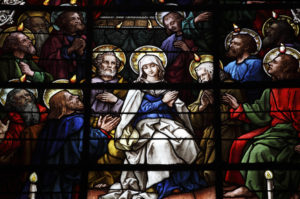
4 Ways Lent Can (Still) Change You

Like the dark smudge on your forehead, Lent is something that has already disappeared for many in today’s stressful world. However, observing Lent can alter our perceptions and how we view the world can be greatly transformed. So, while there’s still time during this holy season, all is not lost.

We can take a page from a Jewish rabbi on this. On Yom Kippur he gave out to each member of his congregation a small piece of paper. On one side of it was written: “It’s later than you think!” On the other side, it said, “It’s never too late!” What he was speaking about is a sense of mindful prayerfulness — being in the now with our eyes wide open to the presence of God in so many different and wondrous ways. And, fortunately, this Lent, we still have time if we take it now. So, why not reflect on the following four ways Lent can change you?

  1. Remember the ashes

The message of “from dust to dust we shall return” is not really a downer — it is reality. When we remember that we are mortal, impermanence can help us appreciate our lives even more. The ashes teach us to be more grateful for the people and things in our lives that are already there. Even though the ashes are physically gone, remember what they symbolize and you will live differently knowing this day can be your last.

  1. Recognize that sacrifice is truly an act of beneficial simplicity

When we give things or activities up during Lent, it is not simply an act of self-denial, although it is good to postpone gratification at times. Instead, through the simplicity practiced in Lent, making our needs and consumption smaller, we can gain a greater appreciation of what is in our lives. Secular society would have us think we need more, but when we have it, we need even more. It also would have us think we need different but once we have it, it is the same. And, secular society would have us think we need perfect but there is no such thing or person but God. Lent helps us make our world smaller so our perception of all that is so good in it now becomes keener.

  1. Lent gives us the opportunity to be compassionate in new ways

Almsgiving, which is one of the hallmarks of Lent, doesn’t involve simply giving money — although, once again, that is good too. It is giving of ourselves to others in our family, circle of friends, and at our workplace in a very different way. Namely, with a true sense of mitzvah, expecting nothing in return — not a smile, not a thank you, not an iota of appreciation. Learning this type of complete gift-giving of ourselves has a true platform in Lent under the banner of “almsgiving.”

  1. Prayer gets a fresh start

By putting ourselves in the presence of God in the morning as we reflect on these four ways, we can allow Lent to be a time of change for us. The prayer life we always promised ourselves we would start or strengthen comes to life — maybe for the first time in a long while. We know that, along with fasting and almsgiving, prayer is the third and most important part of a Lenten practice, but after Ash Wednesday it usually falls by the wayside until we are abruptly awakened to the need for it during Holy Week. If we take a couple of minutes in the morning (remember, regularity rather than length of prayer is what’s important) to quiet ourselves before we get out of bed, maybe in the shower, or during our ride to work, we can begin a new prayer life regimen.

When God’s will and our will intersect, we become free, more whole, and life changes for the better — no matter what darkness we may be facing at the moment. And so, while some of Lent is still before us, let’s remember that “it’s later than you think” and “it’s never too late” if we turn to God now with a sense of spiritual intrigue as to how God is walking with us through life.

Dr. Robert J. Wicks is a clinical psychologist on the faculty of Loyola University Maryland. He has authored more than 50 books, the latest of which is Perspective: The Calm within the Storm.

Five Features of Faith

In our efforts to evangelize and proclaim the Gospel, it is good to keep our focus and prayer on the goal of our work—that others will come to faith in Christ and enjoy a personal relationship with him. This intrinsic connection between faith born from evangelization begins with Jesus himself in Mark’s Gospel where his first words are: “The time has come and the kingdom of God is at hand. Repent and believe the Good News!” (1:15). For St. John in his Gospel, his entire life of preaching and writing about Christ has been at the service of faith in him: “These things have been written so that you may believe that Jesus is the Christ, the Son of God and that through your faith in him you may have life” (20:30). So what then does this faith look like? What kind of faith do we hope to be born from our efforts to evangelize?

A Faith Born from Above.

In the fourth Gospel, Jesus reminds us that “no one can come to me unless the Father draws them” (John 6:44). Faith then is a gift from God born of hearing his Word and seeing it in action (cf. Rom. 10:17). Faith is not our own opinion or achievement. We cannot come to it by our own efforts. Faith does not arrive to us through one single argument or even a series of converging signs. Even when these signs are in place, it takes the gift of the Holy Spirit for us to finally “get it” and to assent to faith with our whole being. This is because the love of God engages the entire human being with all of his or her physical, psychological, and spiritual powers. This is what happened in the case of Lee Strobel as he tells his story in The Case for Christ in the movie based on the book of the same name. He set out to debunk his wife’s faith and gathered all the evidence he could find to prove his case. But while the evidence moved him in the direction of faith, it was the love of his wife and her prayers that finally clinched his assent.

A Faith that Grows. We often think of faith as something we have or we don’t have. I believe or I don’t believe and those are the only two possibilities. We also can think of faith as something that remains static and doesn’t grow. The truth is that faith can be born or reborn in us at any time, just like it was in the people who encountered Christ in the Gospels. For those who believe, there is an organic quality to faith that we recognize over time. Faith lives and grows. In the Gospels, Jesus often likens the gift of faith to a mustard seed (cf. Matt. 17:20). It begins small but can grow to such a degree that others benefit from it, like birds in the branches of a tree that began its life as a seed. Our faith in Christ is something alive and active. It prompts us to think in new ways, to act differently, and to understand God in bigger terms, beyond the image of him we already have. Faith also takes us beyond our comfort zones, moves us closer to those on the margins, and grounds our faith in the service of truth and charity.

This demands a necessary openness on our part to allow our faith to grow, to be affirmed and to be challenged when necessary. So when it comes to the big questions of our time, we should not be afraid to engage our faith with the confidence that the Holy Spirit gives us. The Gospel message entrusted to us bears within itself the truth that sets humanity free and sets us on course for a better life.

While this task of engaging with the big questions of the world can be difficult and even dangerous, it affords us the opportunity for our faith to be tested and to grow. It is like a muscle of our bodies that grows stronger when it is used and made to work. So far from being something static, our faith is something that progressively changes us to become more Christ-like and sends us on mission in his name. There is a dynamism in faith that invites us to a meta-noia or “going beyond the mind we have.” It opens us to new horizons and to see all things with new eyes.

A Faith that Draws Us into Relationship.

Faith is often exclusively associated with religion. So we might hear someone say: “Yes, I have faith, I believe in God”; or, “No, I don’t have faith, I am an atheist.” This is inaccurate because it assumes that only religious people have faith while nonreligious people don’t. The truth is that faith is much more part of everyday life than we realize. As Bishop Barron has often pointed out, if a young man is in a relationship with a girl, he can collect all the data he wants about her, but until she speaks to him, the relationship can never get off the ground. Only when the two parties speak to one another can the trust begin to grow. And if the relationship grows to the point of them wanting to marry, then their decision is still based on faith and trust. By getting married, both put their faith in one another and nourish that trust afterwards as husband and wife.

So it is with God. God has spoken first through his creation and through the history of a people he loved. In the words of St. John: “God loved us first” (1 John 4:19). As Christians we see this love offered to us through the person of Jesus Christ who came to reveal God to us. Faith then is our “Yes” that accepts the truth of what God has spoken and the love for us that he has revealed. Faith is a “Yes” to a “Yes.” It is our “Yes” to God’s “Yes” that comes first. This is the basis of a relationship that unites us to God.

A Faith in Christ Jesus Our Lord.

Throughout the Gospels, Jesus reveals a God who desires a personal relationship with each of us. Through faith and trust we are invited to know him and be known by him, to be loved by him and to love him in return.

Throughout the Gospels, Jesus invites us to faith in him: “Do not let your hearts be troubled. Trust in God still and trust in me” (John 14:1); “I am the resurrection and the life. The one who believes in me will never die” (John 11:25-26). What an extraordinary claim for anyone to make! There are only two possible responses to this invitation to faith by Jesus. One is to reject him out of hand as a narcissistic madman, and the other is to do exactly what he asks us to do and come to believe in him and who he claims to be. There is no middle ground.

The more we contemplate the life of Christ—his goodness, truth, and beauty—the easier it is to believe in him. First, his goodness —his mercy, his compassion, his patience, his understanding, and his love. He spent his whole life doing good for everyone, and his love gave birth to faith in him. His truth—before Pilate he said that he had come for this, was born for this, to bear witness to the truth, and all who are on the side of truth listen to his voice. Without truth, humanity caves in on itself in deception and fear. His beauty—the life of Jesus was beautiful and radiant with light as revealed at his Transfiguration. And all who are united with him in Spirit radiate that same light and exude the fragrance of his charity. This is why he asks us to be light to the world (Matt. 5:14) and carry the light of his presence to all we meet.

A Faith to Be Shared.

The gift of faith is not given for ourselves. It is given to be shared. The joy of the Gospel leads us to be people of mission in all kinds of ways. We want others to know God and we desire to lead others to faith in him. We want his kingdom of peace and justice to flourish, and so pray for it and work for it. In this spirit, Pope Francis urges us to “go forth to offer everyone the life of Jesus Christ” (The Joy of the Gospel, 49). Our act of believing must allow the joy of faith to shine through in lives that are centered on the Lord and united to others in community. And it is with others in the family of the Church that our faith is nourished and strengthened to carry it forth to all in Jesus’ name.

For us dedicated to evangelization, the haunting words of Jesus are never far from our hearts: “When the Son of Man returns, will he find any faith on earth?” (Luke 18:8). Evangelization is not an end in itself but is at the service of faith. This article has described five features of that faith: that it is a gift from God that grows, that draws us into relationship, that centers on Jesus Christ, and that leads us to give ourselves away in loving service and mission. May the quality of our own faith be marked by these features so that we can share it confidently and effectively with a skeptical world.

Fr. Billy Swan is a priest of the Diocese of Ferns, Ireland. He holds a degree in chemistry and worked for a number of years for a pharmaceutical company before entering seminary. Ordained in 1998, he served for four years as an associate pastor before further studies in Rome where he was awarded a Licentiate and Doctorate in Systematic Theology from the Gregorian University. He served for four years as the Director of Seminary Formation at the Pontifical Irish College, Rome. He is currently based at St Aidan’s Cathedral, Enniscorthy, Co. Wexford.

« Previous Page
Next Page »

Liturgy

Sunday Masses (unless noted differently in weekly bulletin)
Saturday Evening Vigil – 4:00PM
Sunday – 7:00AM, 10:00AM and 5:00PM

Weekday Masses (unless noted differently in weekly bulletin)
Monday thru Friday – 7:00AM and 5:15PM
Saturday – 8:00AM

Reconciliation (Confessions)
Monday thru Friday – 4:15PM to 5:00PM
Saturday – 9:00AM to 10:00AM and 2:30PM to 3:30PM
Sunday – 4:00PM to 4:45PM

Adoration
Tuesdays and Thursdays – 4:00PM to 5:00PM


CatholicMassTime.org

Parish Information

Parish Address
524 East Lawrence Avenue
Springfield, Illinois 62703

Parish Office Hours
Monday thru Thursday – 8:00AM to 4:00PM
Fridays – CLOSED

Parish Phone
(217) 522-3342

Parish Fax
(217) 210-0136

Parish Staff

Contact Us

Contact Us

Copyright © 2025 · Log in