Cathedral of the Immaculate Conception

Springfield, IL

  • About
    • Contact Us
    • History of the Cathedral
    • Liturgical Schedules
    • Parish Staff
    • Register with Cathedral
    • Subscribe to the Cathedral eWeekly
  • Sacraments
    • Baptism
    • Becoming Catholic
    • Matrimony
    • Vocations
  • Ministry List
    • Adult Faith Formation
    • Cathedral Meal Train
    • Cathedral Online Prayer Wall
    • Cathedral Concerts
    • Family of Faith
    • Grief Share
    • Health and Wellness
    • Spiritual Resources
  • Stewardship
    • Stewardship: A Disciple’s Response
    • Stewardship Form
  • Support
    • E-Giving Frequently Asked Questions
    • Give Online
  • Sunday News
    • Announcements
    • Cathedral Weekly
    • Livestream Feed
    • Submit a Mass Intention Request
    • Weekly or Announcement Submission

The Effects of the Sacrament of Matrimony

In our American society today, there seems to be skepticism about the goodness of marriage. This is also a reflection of our skepticism about the world in general. As the Catechism quotes from Vatican II, “The well-being of the individual person and of both human and Christian society is closely bound up with the healthy state of conjugal and family life” (CCC 1603). Marriage is a human reality even before it is a Christian reality, but the degradation of the esteem in which marriage is held has serious consequences for us as Catholics, because this sacrament is a great source of grace for those who need it. 

Marriage is hard. It is a way that most people in our Church are called to lay their lives down in service of God and his Church. Since God never expects us to do the impossible, we can know that he gives the help that is needed to live out such a sublime calling. Without the eyes of faith, it may be easy to discount the value of marriage as a simple social construct (even though this is not true). For Christians however, marriage is a source of incredible grace. 

When two Christians enter into a marriage, a special, invisible bond is formed, and this bond is the source of strength for the married couple. This covenant between the spouses does not remain simply on a human level but is “integrated into God’s covenant with man: ‘Authentic married love is caught up into divine love’” (CCC 1639). Christ dwells in a special way with a married couple. The graces that Jesus gives through the sacrament of matrimony are quite remarkable: “Christ dwells with them, gives them the strength to take up their crosses and so follow him, to rise again after they have fallen, to forgive one another, to bear one another’s burdens, to ‘be subject to one another out of reverence for Christ,’ and to love one another with a supernatural, tender, and fruitful love” (CCC 1642). Marriage sounds like quite the sacrament! Couples who choose to forego marriage in favor of simply living together are forfeiting all of these possible graces, and sadly the results often reflect this. 

True love is found in commitment. It can be very attractive to keep our options open indefinitely, and never make a true life commitment. But true freedom is found through giving ourselves away in love. This is true for married couples, priests, religious, and for all of us who are generous with ourselves in any way. “It can seem difficult, even impossible, to bind oneself for life to another human being. This makes it all the more important to proclaim the Good News that God loves us with a definitive and irrevocable love, that married couples share in this love, that it supports and sustains them, and that by their own faithfulness they can be witnesses to God’s love. Spouses who with God’s grace give this witness, often in very difficult conditions, deserve the gratitude and support of the ecclesial community” (CCC 1648). 

I used a lot of quotes from the Catechism this week, because I thought that these quotes expressed the great value of marriage so well. Let us give thanks to God for all the wonderful examples of married love that we have in our parish and in our families! 
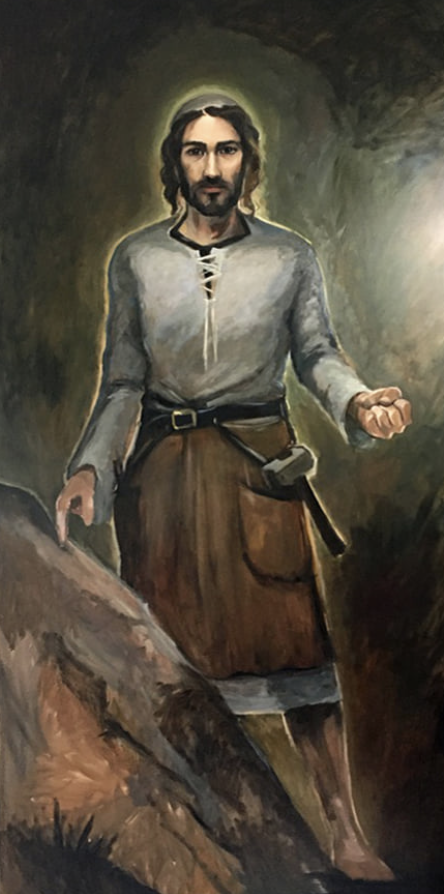
Saint Joseph, the Carpenter

Feast Day: May 1st 

Last week we stepped into Joseph’s workshop and spent a few moments watching love transform his simple efforts into joy, and grace, and peace.  We saw the delight spread across his face as Jesus learned from him to work with his hands, and to offer his heart.  We learned from his humility: to be forgotten, and yet to send ripples of hard-won love out into eternity…  

But what exactly was his work?  What tools were scattered across Joseph’s, and then Jesus’, workbench?  Matthew tells us that Jesus is the “carpenter’s son” (Matthew 13:55) using the Greek word tektōn [τέκτων], but this is a less precise term than our typical translation, “carpenter”.  Tektōn referred to a craftsman in a more general sense, someone who had tech-nical knowledge of forming wood, metal, or stone, even someone who constructed things from those natural resources, an archi-tect of some sort.  In the Old Testament, the wood-workers and stone-masons who built David’s palace (2 Samuel 5:11) are both described with that same word, tektōn.  Now, around Nazareth, there were not many trees in Jesus’ day.  Some 90% of the homes in the area were constructed from stone, and there was a giant quarry about a mile and a half from their home.  So was Joseph a stone mason, a builder?  Making the question even more incisive, Mark describes Jesus as “the carpenter [tektōn], the son of Mary” (Mark 6:3), so was Jesus a stone mason or builder?!

If we look elsewhere in the Gospels, we see plenty of examples and parables that Jesus gives with rocky-references: He acknowledges the beautiful stones of the temple (Mark 13:1-2), He refers to himself as the cornerstone (Luke 20:17), He calls Peter to be the rock upon which he will build the church (Matthew 16:18), and describes the life of discipleship as one founded upon rock (Matthew 7:24).  Perhaps it is fitting that the human work of the Creator of the world was to again shape stone and house humans?

Perhaps…

Yet one of the earliest Christian writers after the New Testament was St. Justin Martyr (who lived in the 100s), and he tells us that Jesus “was in the habit of working as a carpenter when among men, making ploughs and yokes; by which He taught the symbols of righteousness and an active life.”  Ah, now this is interesting!  There was not much wood around Nazareth, but they would have used wood to make plows, yokes, and other such implements.  No other material at the time would have been practical.

And, once again, we find a number of references in Our Lord’s words to such things as these.  “My yoke is easy, and burden is light” (Matthew 11:30) Jesus says describing the role of discipleship.  What a beautiful thought it is to consider Jesus fashioning a yoke for you or I, gradually shaping it to fit His and our shoulders perfectly!  Or, consider Luke 6:41, when the Gospels record Jesus’ teaching on judging others, retaining the vivid words “karphos” and “dokos” for “speck” and “beam”.  He could have used many other analogies, but chose this one – of a splinter of wood in one’s eye.  Did the image come naturally to our God, who very well could have endured that pain Himself?  

We do not know for sure what occupied Joseph, and Jesus, in their workshop.  Probably it was a mix of various humble tasks, but I think that we have learned another important lesson from the workshop of Nazareth: the no task is too menial for the God-man to do, and neither should it be for us.  

This past week, Pope Francis has added a few titles to those we use in the Litany of St. Joseph.  They are all wonderful – Guardian of the Redeemer, Servant of Christ, Minister of Salvation, Support in Difficulties, Patron of Refugees, Patron of the Afflicted, and Patron of the Poor – but perhaps that second one should inspire our understanding of marriage, and discipleship, this week: “Servant of Christ”.  If last week we learned self-gift, maybe this week would be a good one to work on servant.  I think none of us much likes the idea of servitude, but when the apostles describe their relationship to Christ, the first title they choose is that of “servant”.  “Paul and Timothy, servants of Christ Jesus” (Philemon 1:1).  “James, a servant of God and of the Lord Jesus Christ” (James 1:1).  “Simon Peter, a servant and apostle of Jesus Christ” (2 Peter 1:1).  “Jude, a servant of Jesus Christ and brother of James” (Jude 1:1).  And, Jesus chose the same identity for Himself: “the Son of man also came not to be served but to serve” (Mark 10:45).  

How did Christ serve?  Well, for about 20 years, by carving wood or carrying stone, and during His public ministry, but sleeping on stones and shouldering the cross.  May we find ourselves close to Him as we seek to do the same this week!

– Fr. Dominic Rankin has recently begun working out (with Fr. Dominic Vahling) at the gym.  He has not had a tremendous amount of experience doing such things, but has quickly come to realize the difficulty of trying to lift hundreds of pounds with his arms or legs.  Hopefully it is good practice for shouldering his daily yoke that often has greater spiritual, rather than material, weightiness.

Mass Intentions

Monday, May 10

7am – Special Intention for Rev.Christopher House
(ChrisSommer)

5:15pm – Angelo Family 
(Genny Severino)

Tuesday, May 11

7am – Anna A. Eleyidath
(Augustine Eleyidath)

5:15pm – Delores Hebig
(Nick & Teresa Gray)

Wednesday, May 12

7am – Special Intention for JanetVespa
(Chris Sommer)

5:15pm – John Garvey 
(Lentz Family)

Thursday, May 13

7am – Roy Carter, Sr.
(Lindat Carter)

5:15pm – Special Intention forBianca
(D.A. Drago)

Friday, May 14

7am – Jean Reno Greenwald 
(Dennis & Sharalyn Lochman) 

5:15pm – John Montgomery
(John Busciacco)

Saturday, May 15

8am – Angeline Sherman
(Hattie Pinski)

4pm – Jesse & LorraineGonterman
(Mike & Jo Gibbs)

Sunday, May 16

7am – Dean & Mary Helen Conrad
(Mike & Jo Gibbs)

10am – John & Edith Bakalar
(John Busciacco)

5pm – For the People

Complementary Vocations

Later this month, I will have the joy to celebrate the 10th anniversary of my ordination to the priesthood.  While there were so many things that made that day special, there is one thing that stands out of which I am particularly proud.  At a dinner celebration the night of my ordination, I had the opportunity to say a few words to the family and friends who were gathered to celebrate the event, and my first words were to acknowledge my parents.  I drew attention to the fact that the following Saturday, they were going to be celebrating their 40th wedding anniversary.  I was also happy to share that my grandparents on my father’s side (both of whom were there) had earlier that month celebrated their 65th wedding anniversary.  It struck me in that moment how the fidelity of my parents and grandparents to their marriage commitment provided a powerful witness to me as I was beginning my life as a priest.  Just as God’s grace in their lives enabled them to persevere in love, so too was I hopeful that God would do the same for me in the years ahead as a priest.  And after 10 years, I have experienced how God’s grace has indeed been the sustaining factor in my ministry, filling me with so much gratitude for the graces He has showered upon me.

As I mentioned two weeks ago, the Sacraments of Holy Orders and Matrimony are known as Sacraments at the Service of Communion, for they are ordered toward the salvation of others.  More than just being categorized together in the Catechism, there is a very real way in which these two sacraments are complementary to one another.  After ten years as a priest, I can see the many positive ways that I have been influenced by the example of how my parents have lived (and continue to live) their lives.  Beyond my parents, I also think of the many married couples I have known in my 10 years as a priest, and how they have been a source of encouragement and inspiration to me.  I can only hope that the witness of living my priestly commitment has done the same for married couples or those preparing for marriage.

I know that I am not alone when I say how important married couples are to priests and deacons.  I have no doubt that all of the clergy of this parish could point to the example of their parents, grandparents, and parishioners who have been sources of support and inspiration to them, helping them to live their ministerial commitment more fully.  So on behalf of all of the clergy here at the Cathedral, I offer a special thank you to the many married couples in our Cathedral Parish for your witness.  You help to make us better ministers who are privileged to help you in living out your vocations, as we all work together to help one another get to Heaven.

Father Alford     

Marriage in Scripture

This year, we have been aligning the theme of our bulletin articles with the theme of our Family of Faith formation program here at our Cathedral parish. The last sacrament we are studying this year is the sacrament of Marriage. It is always helpful to me to begin with where we find this sacrament in Scripture. Part of the definition of a sacrament is that it was instituted by Christ, so we can always find something about the sacraments in the scriptures. 

Marriage is unique among the sacraments in the way that it was instituted. Jesus did not “invent” marriage; marriage was a part of the human race since the very beginning with Adam and Eve. Marriage has been the most basic part of society in every culture in all parts of the world. This is why we say that Jesus raised marriage to the level of a sacrament. Any man and woman in the world can get married, but only baptized Christians have the sacrament of Marriage as a source of grace and strength. 

The most clear example of Jesus raising marriage to be a sacrament is found in the story of the wedding feast at Cana (John 2:1-11). Jesus attended this wedding of somebody who was presumably his friend or at least a friend of his family. During the feast, the wine ran out, causing a clear panic among the servers and a potential point of embarrassment for their newlywed hosts. When Mary said to Jesus, “They have no wine,” she interceded for the couple as she does for us even today. We know how the story ends and that Jesus turned approximately 150 gallons of water into wine. This is clearly way too much wine for even the best wedding reception! The Church has always seen this abundance of wine (which gives joy to the heart, according to the Psalms) as a symbol of God’s abundant grace given through this new sacrament. The Catechism says, “The Church attaches great importance to Jesus’ presence at the wedding at Cana. She sees in it the confirmation of the goodness of marriage and the proclamation that thenceforth marriage will be an efficacious sign of Christ’s presence” (CCC 1613). 

By becoming a sacrament, marriage for Christians is a sign of God’s faithful love for his Church. The Gospels describe Jesus as a “bridegroom” who lays down his life for his spouse, the Church. When describing the reasons for celibacy, I often say that Jesus was never married. While this is true, this renouncing of marriage is for the sake of another marriage: being married to the Church. Christ and his Church are united in a mystical union which gives birth to new life, such as in baptism! Christ laid down his life for his bride, which St. Paul encourages all husbands to do for their own wives. Since marriage is a fairly common sacrament, the depth and beauty of this great mystery is sometimes forgotten about. During this month, I hope to at least begin the exploration of this sacrament of spousal love. 

Saint Joseph the Worker

Feast Day: May 1st 

“This simple word sums up Joseph’s entire life” says Pope St. John Paul II in Redemptoris Custos (Guardian of the Redeemer).  That simple word that he references is not “guardian”, as the great pope described him, nor one of the words from scripture that defined Joseph’s vocation towards Jesus: “father”, “husband [of Mary]”, or “just [man]” … Nor is this word any of the titles upon which the Church calls upon St. Joseph: “most chaste”, “most prudent”, “most obedient”, “patron of the dying”, “terror of demons” or “protector of the Church.”  That word is “carpenter”, tektōn in the Greek that the authors of the Gospels wrote, by which Joseph is remembered by Jesus’ friends and family when Our Lord returned to his synagogue in Nazareth: “Where did this man get this wisdom and these mighty works? Is not this the carpenter’s son?” (Matthew 13:54-55).  

There is a spectacular humility to our spiritual father Joseph!  As his son Jesus steps into His public ministry, we hear nothing more about him, even his great Old Testament name, Joseph, is left by the wayside as everyone simply remembers “the carpenter”.  It points to the unimportance of Nazareth: there were not a dozen tektōn’s listed in the yellow pages for the village to enlist, nope, just “the” carpenter, who everyone knew was Joseph!  And perhaps humility is the first lesson learned from good, honest, simple labor.  There is something simple, in the end, unimportant, about the work we do.  It comes and goes, a hundred years from now it probably will not matter too much, and in the big scheme of things, it does not even make all that much of a difference right now.  And yet the greatest saint after our Lady was known as “the carpenter”, and that delighted him.

You and I – both of us entities destined-for-forever – put our day’s effort, attention, energy, and love into whatever work we are called to do today, which probably brings us into countless interactions with other human persons, and suddenly the smallest of labors takes on the importance of eternity.  Furthermore, our work is done not just with others, but for someone.  Well, it can be.  Our work can be done with love, or not.  Our work can be done for others, or just ourselves.  Our work can strengthen, complete, and sustain us, or it can be a burden, a complaint, a worry, a fruitless, facile, futile expenditure of our energy.  Your choice.

Michael Corsini, St. Joseph, Father of All, 2021 (still being painted).  https://michaelcorsini.com/store1/st-joseph-father-of-all-preorder, Reprinted with Permission.

Back to Joseph: nothing brought our saintly Carpenter more delight than when he worked alongside his son.  Watch a father and son mow the yard or paint a wall, and you will see a glimmer of the delight that flickered from the workshop in Nazareth.  Beyond that was the love with which he worked.  Even working alone late into the night, a supernatural fire propelled his heart and hands. But Joseph was brought to even greater happiness as Jesus Himself took on the role of tektōn.  Mark passes on that little detail, when he narrates Jesus’s description not just as the “son of the carpenter”, but the carpenter himself.  “Is not this the carpenter, the son of Mary…” (Mark 6:3)  Could anything make a dad happier than when his son takes up the work that the father had done out of love for so long?  Could anything move a mother more than watching her son learn the ways of manly work from her husband?

We begin this month examining the sacrament of marriage stopping to learn from St. Joseph, not generically, but specifically as a worker, a carpenter, a craftsman, a laborer.  

The fact is that marriage depends fundamentally on one man giving himself to one woman.  That takes place in the splendid moment of matrimony itself.  It happens as they speak and begin to share a story together.  Perhaps most supernaturally, it happens when they pray together and come to the sacraments together.  Perhaps most splendidly, it happens when they join together body and soul and create a new life.

But the other 90% of the time, their self-gift is done by work.  

We approach their cubicle, or car, their computer, or kitchen counter … and can choose love, and other, and spouse, and God.  Or not.  It is our choice.  We choose one way or another with every work we do.  Let us labor with love.

– Fr. Dominic Rankin has stripped many drywall screws trying to help his dad around the house.  He has broken a lot of cutting disks off the Dremel tool, and blades off the reciprocating saw.  He might have sliced a 100-foot extension cord down to something much shorter while trimming the bushes out front…  And he definitely pushed the limits that a lawnmower blade can handle.  And he learned of his father’s love as he did it, and learned how to love like a father as he did it.

Mass Intentions

Monday, May 3

7am – Anna A. Eleyidath
(Augustine Eleyidath) 

5:15pm – Blake Anderson
(Kluckman Family)

Tuesday, May 4

7am – Jean Reno Greenwald
(Patricia K. Siehr)

5:15pm – Daniel Cadigan
(Genny Severino)

Wednesday, May 5

7am – Maria Martinez
(John Busciacco)

5:15pm – NO MASS 

Thursday, May 6

7am – Wallace Hall
(Julie & Joe Morrison)

5:15pm – Ben & Monique Gaston
(Marie Fleck)

Friday, May 7

7am – Elizabeth & Paul Tellor
(Norma & Tom Lesko)

5:15pm – David Flatt
(Phil Flatt)

Saturday, May 8

8am – James & Emily Gibbs
(Mike & Jo Gibbs)

4pm – Special Intention for Rev. Dominic Rankin
(Chris Sommer)

Sunday, May 9

7am – For the People

10am – Norma & Eileen Rovey
(Family)

5pm – Rita DesMarteau
(Nancy Schrenk & Harvey)

Prayer Wall – 04/27/2021

Please pray for Amy, a single Mom, that she would be reconciled with her family and come back to her Catholic Faith. Also, pray for a 17 year old boy named James, who is suffering health issues due to his condition of Spina Bifida.

Prayer Wall – 04/25/2021

Please pray for my wife as she is facing up to a year or more in jail or wherever they might move her at some point. I pray for a merciful outcome of her being out in May, the end of the summer, December or something else, whatever can be done. The Lord knows her situation.

I pray this in Jesus

Good Shepherd Sunday

On the 4th Sunday of Easter, the Church places before us a section of the 10th chapter of John’s Gospel where Jesus speaks of Himself at the Good Shepherd.  Some of the earliest images of Jesus depicted in the artwork found in the Roman Catacombs show Him as a shepherd, highlighting how well this image resonated with the early Christians.  And it is an image the Church invites us to consider on this day.

When I was preparing for my ordination to the priesthood, I looked at hundreds of pictures of Jesus to use on the ordination holy card that I would give out to family and friends.  I came across an image of the Good Shepherd that was different from the other images I had seen of Jesus as the Good Shepherd.  Many pictures had Jesus looking very meek and peaceful as He gently carried a sheep around his shoulders.  But in the image that I chose, the artist Alfred Soord proposed a picture of the Good Shepherd that showed something very different.  The Good Shepherd was reaching over the edge of a cliff to rescue a sheep who was in danger of plummeting down to the ravine below.  There were scratches on his arms as He pushed aside the thorny brush in order to get access to the sheep whose life was in peril.  This image resonated as it depicted the sacrificial nature of being a shepherd who was willing to put his own life at risk in order to save his sheep.  Such was the life of Jesus who laid down His life for His sheep, and such should be the life of those the Lord has called to be His shepherds, particularly bishops and priests who share in His work of being a shepherd in a more direct way.

In 1992, Pope St. John Paul II issued a beautiful document on the priesthood titled Pastors Dabo Vobis, the Latin for the words from the Prophet Jerermiah: “I will give you shepherds after my own heart” (Jer. 3:15)  The Lord promises that He will continue to provide shepherds for His Church, but the Holy Father offers the following reminder:

The Church must never cease to pray to the Lord of the harvest that he send laborers into his harvest, (cf. Mt. 9:38). She must propose clearly and courageously to each new generation the vocational call, help people to discern the authenticity of their call from God and to respond to it generously, and give particular care to the formation of candidates for the priesthood. (PDV, 2)

Today is a good day for us to pray for young men, especially here in our diocese, to hear and respond to the invitation to consider serving as a shepherd of the Church as a priest.  Let us also pray for the shepherds of our diocese, particularly that they might be shepherds after the heart of the Good Shepherd, being willing to make the necessary sacrifices to their comfort, their preferences, their reputations, even their own lives in order to save those entrusted to their care.  Along those lines, I would also invite all of us to consider making some regular, small sacrifices for the benefit of more vocations to the priesthood in our diocese and for holy, sacrificial shepherds who care for only one thing – helping us to get to Heaven!

Father Alford     

« Previous Page
Next Page »

Liturgy

Sunday Masses (unless noted differently in weekly bulletin)
Saturday Evening Vigil – 4:00PM
Sunday – 7:00AM, 10:00AM and 5:00PM

Weekday Masses (unless noted differently in weekly bulletin)
Monday thru Friday – 7:00AM and 5:15PM
Saturday – 8:00AM

Reconciliation (Confessions)
Monday thru Friday – 4:15PM to 5:00PM
Saturday – 9:00AM to 10:00AM and 2:30PM to 3:30PM
Sunday – 4:00PM to 4:45PM

Adoration
Tuesdays and Thursdays – 4:00PM to 5:00PM


CatholicMassTime.org

Parish Information

Parish Address
524 East Lawrence Avenue
Springfield, Illinois 62703

Parish Office Hours
Monday thru Thursday – 8:00AM to 4:00PM
Fridays – CLOSED

Parish Phone
(217) 522-3342

Parish Fax
(217) 210-0136

Parish Staff

Contact Us

Contact Us

Copyright © 2026 · Log in