Cathedral of the Immaculate Conception

Springfield, IL

  • About
    • Contact Us
    • History of the Cathedral
    • Liturgical Schedules
    • Parish Staff
    • Register with Cathedral
    • Subscribe to the Cathedral eWeekly
  • Sacraments
    • Baptism
    • Becoming Catholic
    • Matrimony
    • Vocations
  • Ministry List
    • Adult Faith Formation
    • Cathedral Meal Train
    • Cathedral Online Prayer Wall
    • Cathedral Concerts
    • Family of Faith
    • Grief Share
    • Health and Wellness
    • Spiritual Resources
  • Stewardship
    • Stewardship: A Disciple’s Response
    • Stewardship Form
  • Support
    • E-Giving Frequently Asked Questions
    • Give Online
  • Sunday News
    • Announcements
    • Cathedral Weekly
    • Livestream Feed
    • Submit a Mass Intention Request
    • Weekly or Announcement Submission

Mass Intentions

Monday, March 8

7am – Anna A. Eleyidath 
(Augustine Eleyidath)

12:05pm – Pius Onyejiaju Chineke
(The Anselment Family)

5:15pm – Jack Koester
(Cindy Vahling)

Tuesday, March 9

7am – Special Intention for Sheree Graves
(Sheree Graves)

12:05pm – Mrs. Jack Koester
(Cindy Vahling)

5:15pm – Special Intention for Rev. Brian Alford
(Chris Sommer)

Wednesday, March 10

7am – John Montgomery
(John Busciacco)

12:05pm – Fr. Lambert Leykam,OFM
(Cindy Vahling)

5:15pm – William F. & Shirley Logan
(Lisa Logan & Lori LoganMotyka)

Thursday, March 11

7am – Jean Reno Greenwald
(Richard & Joan Rogers)

12:05pm – Joseph A. DelGiorno
(Patricia Kornfield)

5:15pm – Rosemary Dougherty
(Lou Ann & Carl Corrigan)

Friday, March 12

7am – Patria & Rufino Gontanco
(Hati & Joe Uy)

12:05pm – George Friedel
(Roy Ponce)

5:15pm – Special Intention forBianca
(D. A. Drago)

Saturday, March 13

8am – Catherine Ponce
(Larry & Sue Ruder)

4pm – For the People

Sunday, March 14

7am – Mary Ann Midden
(William Midden)

10am – Pius Onyejiaju Chineke
(The Anselment Family)

5pm – Sally Sedlak Vaugh
(Becky & Woody Woodhull)
Prayer Wall – 02/27/2021

Please pray for me as I am entering my discernment month of March for becoming a Dominican associate.

Prayer Wall – 02/27/2021

Please pray for me as I am entering my discernment month of March for becoming a Dominican associate.

Renouncing Sin

Last week, I proposed as the theme for our reflections during Lent that of the difference between being a true follower of Christ and simply an admirer.  Let us reconsider the point made by Kierkegaard describing one who is only an admirer: “he renounces nothing.”

First of all, what does it mean to renounce something?  I came across a definition from the Cambridge Dictionary that I really like.  It defines ‘renounce’ in this way: “to say formally or publicly that you no longer own, support, believe in, or have a connection with something.”

Working backward through this definition, we see that there is an object to be renounced.  During this season of Lent (and during this month during which we are focusing on the Sacrament of Reconciliation), what we want to renounce is sin.  Sin is something with which we freely choose to associate ourselves.  For something to be a sin, we choose to do something that is contrary to God’s will.  We see this in a portion of the definition of sin given in the Glossary of the Catechism of the Catholic Church: “Sin is a deliberatethought, word, deed, or omission contrary to the eternal law of God.”

Let us proceed to the first part of the definition of the word ‘renounce’.  To renounce involves a formal or public proclamation of our no longer wanting to be associated with our sins.  We will do this in a general way publicly at the Easter Vigil or Easter Sunday, when, in place of the Creed, we will renew our baptismal promises.  One of the options for this renewal begins with the question: “Do you renounce sin, so as to live in the freedom of the children of God?”  Assuredly, we will all respond with a hearty “I do”, but will it be said of us that our response is indeed true?  In order for it to be so, we have to be willing to renounce each and every one of our sins.  A common response to that by some people is to say: “I tell God I am sorry in my heart” and that alone is sufficient to renounce our sins.  While we should indeed tell God that we are sorry for our sins, we cannot overlook what the Scriptures themselves say on this topic.  After the Resurrection, Jesus says the following words to His Apostles:

Peace be with you. As the Father has sent me, even so I send you.” And when he had said this, he breathed on them, and said to them, “Receive the Holy Spirit. If you forgive the sins of any, they are forgiven; if you retain the sins of any, they are retained.” (Jn 20:21-23)

The Church has understood this to be one of the principal Scriptural foundations for our belief in the Sacrament of Reconciliation, which is how Christ intended for us to formally renounce our individual sins to Him through the means He Himself has chosen, the Apostles and their successors (bishops) and those who share in this ministry of reconciliation (priests).  

If you are still trying to determine if you are a follower or just an admirer of Christ, ask whether you are willing to renounce your sins by going to Confession this Lent.  If not, you may just be an admirer, who claims to renounce sin in general, but is unwilling to do so specifically in the formal way that Christ (whom we claim to follow) intends for those who follow Him as His disciples “in Spirit and in truth.” (Jn 4:24)

Father Alford     

The Seal of Confession

This past month, we have explored the Church’s belief around the sacrament of Penance. One aspect of the Church’s practice which fascinates many people is the seal of Confession. This seal means that any sins confessed to a priest in the context of the sacrament are absolutely private and cannot be disclosed to anyone for any reason. The seal is of great spiritual benefit to those who go to Confession. Here is what the Catechism says about the seal. 

“Given the delicacy and greatness of this ministry and the respect due to persons, the Church declares that every priest who hears confessions is bound under very severe penalties to keep absolute secrecy regarding the sins that his penitents have confessed to him. He can make no use of knowledge that confession gives him about penitents’ lives.72 This secret, which admits of no exceptions, is called the “sacramental seal,” because what the penitent has made known to the priest remains “sealed” by the sacrament” (Paragraph 1467).

The reason the seal of confession exists is so that people who want to receive forgiveness from God feel free to do so without human judgment. I can attest that in my few months as a priest, the seal of confession has given great freedom to many people to bring their burdens to the Lord, knowing that I would not disclose the details of their life to anybody. 

Every once in a while, we hear in the media about countries or states that try to pass a law forcing priests to disclose knowledge they received in the context of confession. These laws usually don’t get passed either by the legislators or by the court systems because this is seen as a violation of religious freedom. And it’s not just Catholics that this applies to. In the United States, we all have the right to private spiritual counsel from a pastoral minister. Even if the state were to pass a law forcing us to disclose some people’s sins, no Catholic priest would do so, no matter the temporal consequences. 

There are times when priests have questions about how to advise people who come to him in confession. In this case, a priest will usually call another priest and explain the situation in generic terms, not even disclosing if the person is a man or a woman. When I was in the seminary, I had several practice confession sessions with my classmates and teachers. In the course of our learning about the sacrament, our professors shared many stories and examples from confessions they had heard, which was very helpful for us. However, most of these priests were from different states and had been priests for decades. There is no chance of mistakenly revealing someone’s identity in these situations. 

Priests sometimes talk about their ability to forget sins which were brought to them during Confession. The first reason for this is that most confessions are heard behind the screen, so we don’t even know the identity of the one confessing. We also hear a lot of confessions, and most people deal with the same problems, so very few confessions are absolutely unique. However, it is not as if the Holy Spirit does a memory wipe on us when we walk out of the confessional. And it is good for us to remember some things because as priests the Church asks us to pray and do penance for those whose sins we have forgiven in confession. 

The Catechism quote above said that the seal is in place due to the “greatness of this ministry.” It truly is a great ministry to be a servant of God’s mercy and forgive sins in Jesus’ name as a Catholic priest. Here at the Cathedral, we offer many times for confessions, and we never go a day without somebody coming to the parish to be reconciled to God. The Sacrament of Penance truly is a gift straight from the pierced heart of Jesus Christ. May we all accept this gift with open arms! 

Mass Intentions the Week of March 1st

Monday, March 1

7am – Rosemary Long
(Lou Ann & Carl Corrigan)

12:05pm – Sophia E. Bartoletti
(Bartoletti Family)

5:15pm – Pat Sumpter
(Linda Pierceall)

Tuesday, March 2

7am – Anna A. Eleyidath
(Augustine Eleyidath)

12:05pm – Bruce Scopel
(Rebecca & Woody Woodhull)

5:15pm – Bettie Rapps
(D. Vandrew)

Wednesday, March 3

7am – Patricia Scherrills
(Friends & Family)

12:05pm – Jean Greenwald Reno
(Jim & Sandy Bloom)

5:15pm – Truman Flatt
(Phil Flatt)

Thursday, March 4

7am – George Friedel
(Linda Sabol)

12:05pm – Joseph A. DelGiorno
(Lou Ann & Carl Corrigan)

5:15pm – Eugene Nalesnik
(Fr. Augustine Tolton Council16126)

Friday, March 5

7am – Catherine Ponce
(Ed & Frances Brown)

12:05pm – Patricia Scherrills
(Al & Bobbi Lewis)

5:15pm – Betty Rapps
(Lou Ann & Carl Corrigan)

Saturday, March 6

8am – Sophia E. Bartoletti
(Bartoletti Family)

4pm – Deceased Members of theMcGee, Schweska & KaufmanFamilies (Susan Ochoa)

Sunday, March 7

7am – Deceased Members of theBee Family (Mark & Sharon Price)

10am – Charles & MercedesNesbitt (Kathy Frank)

5pm – For the People

Follower or Admirer?

As we begin our Lenten journey, permit me briefly to look back to the conclusion of the Christmas Season.  At the 10:00 am Mass for the Feast of the Baptism of the Lord, Bishop Paprocki preached about the difference between being a true follower of Christ and being merely an admirer.  He quoted the nineteenth century philosopher Søren Kierkegaard who wrote the following:

The admirer never makes any true sacrifices. He always plays it safe. Though in words, phrases, songs, he is inexhaustible about how highly he prizes Christ, he renounces nothing, will not reconstruct his life, and will not let his life express what it is he supposedly admires. Not so for the follower. No, no. The follower aspires with all his strength to be what he admires.

I would like to suggest this theme for our reflection for this season during which the Church invites us to undergo the conversion that will result in our being more like Him whom we profess to be our Lord.

The Lenten practices of prayer, fasting, and almsgiving are the disciplines that the Church proposes to us as the means to bring about this reordering of our lives.  But it does not suffice for us just to “do” these practices, for there is no great merit in simply going through the motions.  True conversion and growth will come only when we connect these practices with our desire to grow in our love for Christ and our brothers and sisters.  If this is not the motivation behind our practices, why are we even doing them?  Because the Church says we are supposed to?  Because that is what we have always done?  In these early days of Lent, we need to make a good examination of our motivations and readjust them toward Christ, lest we fall into a sort of idolatry where we focus just on love of self over love of God and neighbor.  Ensuring that we have the right motivation for how to approach Lent is critical in determining if we are an actual follower of Christ or just an admirer.  

You might find it helpful to write down the practices you are resolving to undertake this Lent and then bring that list to prayer.  As you look at each item in the list, ask yourself: “Am I doing this for me?  Or, am I doing this for you, Lord?”  If you answer yes to the former, ask for the grace to keep your resolve rooted in Him.  If you answer yes to the latter, ask for the grace to purify your motives.  Then, at the end of the list, I might suggest your offer all your proposed Lenten practices to the Lord with this simple line from the Responsorial Psalm we heard on Ash Wednesday: “A clean heart create for me, O God, and a steadfast spirit renew within me.” (Ps 51:12)

Father Alford     

How to Make a Good Confession

One reason that Catholics sometimes stay away from the Sacrament of Confession is that they have forgotten how to go. After all, they may have received their “training” on how to go to Confession in second grade! This is an understandable hesitation, but Reconciliation has a surprisingly simple format. 

Confession really begins before you walk into the confessional. First, it is important to take some time to spiritually and mentally prepare for Confession. There are many aids or pamphlets out there which can help us call to mind our sins and our need for God’s mercy. Very simply, we can call to mind the Ten Commandments as a simple examination of conscience, which means that we think about our life and remember the ways in which we have gone against our conscience or God’s Law. These are things we need to take to Confession. Many people (myself included) find it helpful to write down a list of things to be confessed. Oftentimes going to Confession, I get nervous and forget what I need to confess in the moment. Just make sure that you throw this list away when Confession is over! Before going to Confession, St. Faustina recommends that we say a prayer for the priest, that he may listen to the Holy Spirit and give good counsel.

The penitent (the one going to Confession) or the priest can begin with the Sign of the Cross. Then the penitent indicates how much time has passed since their last Confession. This helps to provide some context for what is about to be confessed. Then, simply list your sins. It’s best to be brief and to the point. We are required to confess any mortal sins, but we are encouraged to confess venial sins also, if we have time. (See last week’s article for the distinction between these two types of sin.) This is a place to confess your own sins, not your spouse’s or your friend’s. It can be helpful to give a few sentences of background information for certain things, but it’s good to avoid long stories and get to the point. To conclude, you can simply say, “That’s all, Father.” Some people like to say, “For these and all the sins of my past life I am truly sorry.” After this, the priest will offer some words of encouragement and counsel. He also might ask a clarifying question. 

Then, the priest will assign you some sort of penance to complete after you leave the confessional. In confession, all our sins are forgiven, but it does not correct all the disorder that sin has brought into our life. A penance is usually simple, such as saying some prayers, and it begins to correct what sin has damaged in our spiritual lives. The best penances correspond to what the penitent is dealing with in their life. The priest will ask you to pray the Act of Contrition, which can be said from memory or from a prayer aid. The priest then prays the prayer of absolution, which he has authority to do by his priestly ordination. Finally, he dismisses the penitent with words such as, “Your sins are forgiven; go in peace.” 

Very simply, when you walk through the Confessional door, simply come with a contrite heart ready to confess your sins. The priest will walk you through the rest of the process. Most of all, learn to develop a deep trust in God’s mercy, knowing that Jesus paid a great price to forgive our sins. The number one obstacle to coming to Confession is shame, but Confession is actually the best place to have our shame taken away. The confessional is a tribunal of mercy and a place of true encounter with Jesus through the sacraments. 

St. Polycarp: Fleeing Faithless Affairs

Feast Day: February 23rd 

Polycarp was fond of telling stories about his teacher.  One tale stands the test of time and brings a smile to my face as I tell it here: on the famous day his teacher entered the bathhouse in Ephesus only to explode forth a few seconds later – no bath having been accomplished – “let us fly” he exclaimed, “lest even the bath-house fall down, because Cerinthus, the enemy of the truth, is within.” [Ireneaus, Adversus Haereses, bkIII.ch3.p4]  Polycarp’s mentor had good reason to flee.  Cerinthus professed, and proclaimed, a whole hodgepodge of beliefs he had drawn from Judaism, Christianity, Gnosticism, and the many other philosophies that were passed around in those days – a perfectly human reaction to the costly decision to risk one’s intellect by surrendering to real faith – but one that meant he was toxic to those who professed the Christian faith.  Cerinthus claimed that Jesus was not divine, that God did not really create the world, that St. Paul was an apostate, and the Jewish Law was still required.  

The man who catapulted out of that bathhouse was St. John the Evangelist.  The “disciple who Jesus loved”, the man who saw with his own eyes the transformation of water into wine, the magic catch of fish, the multiplication of the loaves, the transfiguration and agony in the garden.  This disciple, who had laid his head upon Jesus’ heart at the Last Supper and heard the heartbeat of God, and had seen that same heart pierced, and His blood pouring down the cross, would not remain in the presence of someone who denied his Savior’s divinity.  “God so loved the world that He gave His only begotten Son”, this apostle had penned, and he would not even remain across the room from someone who flagrantly rejected that truth.

Who of us has as great of faith as St. John the Apostle?  Yet do I flee the mixed half-truths and underminings of our faith that are even more prevalent in our world as he did from that bathhouse?  St. Polycarp sat at the feet of John.  He saw the love and faith of the now-old apostle as John preached the Love of God, and Polycarp remembered that this staunch, bent, weather-beaten man – his life completely transformed by Jesus’ call to “come follow me and I will make you a fisher of men” – with a faith uncrushable by the might of Roman torture, yet who had scattered from the presence of one who blasphemed His Lord.  

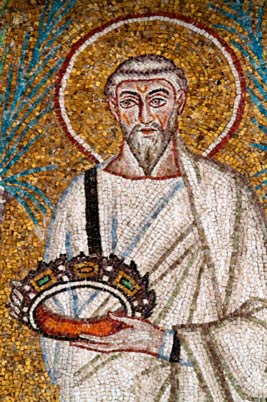
Mosaic of St. Polycarp, Sant’Appollinare Nuovo, in Ravenna, created in the 5th or 6th century.  This is a closeup of the portraits of many male saints mosaiced upon the south wall.

Irenaeus, in the next generation of Christian saints, points his own readers back to Polycarp: “There is also a very powerful Epistle of Polycarp written to the Philippians, from which those who choose to do so, and are anxious about their salvation, can learn the character of his faith, and the preaching of the truth.”  [Ireneaus, Adversus Haereses, bkIII.ch3.p4].  What great truths do we find in this letter, one of the earliest that we have just decades after the Gospels were written and Paul crisscrossed the Mediterranean?  He recalls the words of his friend, St. John, “For whosoever does not confess that Jesus Christ has come in the flesh, is antichrist” [1 John 4:3] and continues:

and whosoever does not confess the testimony of the cross, is of the devil; and whosoever perverts the oracles of the Lord to his own lusts, and says that there is neither a resurrection nor a judgment, he is the first-born of Satan. Wherefore, forsaking the vanity of many, and their false doctrines, let us return to the word which has been handed down to us … “watching unto prayer” [1 Peter 4:7] and persevering in fasting; beseeching in our supplications the all-seeing God not to “lead us into temptation.” [Matthew 6:13]. [St. Polycarp, Epistle to the Philippians, ch7]

Perhaps we should take his teaching to heart as we flee the occasions of sin and falsehood in our own lives?  Is this the saintly invitation to turn away from profane words and conversations this Lent?

– Fr. Dominic Rankin continues to blast through audio books at a rate of one every 2 or 3 days.  With St. Polycarp’s words on his mind, he is going to be more discerning about whether the books are bringing him closer to God, or not.  Popular is not the same as good, beautiful, true, or godly.

Mass Intentions Week of February 22

Monday, February 22

7am – John & Edith Bakalar
(John Busciacco)

12:05pm – Helen Call
(Becky & Woody Woodhull)

5:15pm – Sharon Mester
(Linda Pierceall)

Tuesday, February 23

7am – Anna A. Eleyidath
(Augustine Eleyidath)

12:05pm – Repose of the Soul of Mary Ann Zerrusen
(Cindy Vahling)

5:15pm – Frances Klein 
(Andrew & Cheryl Klein Family)

Wednesday, February 24

7am – Lawrence Jaros
(Emily Walton & Family)

12:05pm – Jean Reno (Greenwald)
(Jim & Sandy Bloom)

5:15pm – Catherine Ponce
(Michael Mecava)

Thursday, February 25

7am – Sophia E. Bartoletti
(Bartoletti Family)

12:05pm – Eugene Nalesnik
(Fr. Augustine Tolton Council16126)

5:15pm – George Friedel
(Richard & Janice Willaredt)

Friday, February 26

7am – Sophia E. Bartoletti
(Bartoletti Family)

12:05pm – Sr. Valeria, OSF
(Becky & Woody Woodhull)

5:15pm – Lawrence Jaros
(Emily Walton & Family)

Saturday, February 27

8am – Patricia Scherrills
(Bill & Sara Metcalf)

4pm – Sarah McGee
(Tom McGee)

Sunday, February 28

7am – Mary Ann Midden
(William Midden)

10am – For the People

5pm – Rita DesMarteau
(Christ the King Staff)

« Previous Page
Next Page »

Liturgy

Sunday Masses (unless noted differently in weekly bulletin)
Saturday Evening Vigil – 4:00PM
Sunday – 7:00AM, 10:00AM and 5:00PM

Weekday Masses (unless noted differently in weekly bulletin)
Monday thru Friday – 7:00AM and 5:15PM
Saturday – 8:00AM

Reconciliation (Confessions)
Monday thru Friday – 4:15PM to 5:00PM
Saturday – 9:00AM to 10:00AM and 2:30PM to 3:30PM
Sunday – 4:00PM to 4:45PM

Adoration
Tuesdays and Thursdays – 4:00PM to 5:00PM


CatholicMassTime.org

Parish Information

Parish Address
524 East Lawrence Avenue
Springfield, Illinois 62703

Parish Office Hours
Monday thru Thursday – 8:00AM to 4:00PM
Fridays – CLOSED

Parish Phone
(217) 522-3342

Parish Fax
(217) 210-0136

Parish Staff

Contact Us

Contact Us

Copyright © 2026 · Log in