Cathedral of the Immaculate Conception

Springfield, IL

  • About
    • Contact Us
    • History of the Cathedral
    • Liturgical Schedules
    • Parish Staff
    • Register with Cathedral
    • Subscribe to the Cathedral eWeekly
  • Sacraments
    • Baptism
    • Becoming Catholic
    • Matrimony
    • Vocations
  • Ministry List
    • Adult Faith Formation
    • Cathedral Meal Train
    • Cathedral Online Prayer Wall
    • Cathedral Concerts
    • Family of Faith
    • Grief Share
    • Health and Wellness
    • Spiritual Resources
  • Stewardship
    • Stewardship: A Disciple’s Response
    • Stewardship Form
  • Support
    • E-Giving Frequently Asked Questions
    • Give Online
  • Sunday News
    • Announcements
    • Cathedral Weekly
    • Livestream Feed
    • Submit a Mass Intention Request
    • Weekly or Announcement Submission

St. Joseph – Patron of a Happy Death

Several years ago, I came across a drawing in an old Catholic book, probably a Catechism of some sort.  One of the pictures in the book depicted a person in the hospital surrounded by a priest and family members.  The person in the bed had a peaceful, joyful look on his face.  The caption for the picture said something about the importance of praying for a happy death.  This might strike us as a little odd today, because we generally do not like to think much about death, and when we do, it does not often evoke a happy response.

But as Christians, we should not fear death, for we believe that we who have been baptized into Christ have been baptized into His death, which grants us a share in His victory over death in the Resurrection.  The funeral liturgy of the Church states it well with these words: “Indeed for your faithful, Lord, life is changed not ended.” (Roman Missal, Preface I for the Dead). We should therefore not fear death, but see it as the doorway through which we pass on our way to our heavenly reward where there will be no more suffering, but only joy and peace in the Lord.  In our last moments, there is a particularly intense battle that goes on where the devil tries one last time to frighten us, to discourage us, and to tempt us to doubt the mercy of God.  The Church offers us many gifts as we face this final struggle, especially the Sacrament of the Anointing of the Sick, which confers a particular gift of the Holy Spirit “who renews trust and faith in God and strengthens against the temptations of the evil one, the temptation to discouragement and anguish in the face of death.” (CCC 1520)

Another gift we have at our disposal is the intercession of St. Joseph, who has among his various titles that of being Patron of a Happy Death.  Tradition tells us that St. Joseph died in the peaceful presence of Jesus and Mary, who would have been a source of great comfort to him in his final moments.  Having experienced this great grace, from his place in Heaven, he desires that we too should have that same opportunity, to be comforted in our final moments by the presence of Jesus and our Blessed Mother, and indeed all of the saints.  The Catechism summarizes this point succinctly and beautifully:

The Church encourages us to prepare ourselves for the hour of our death. In the litany of saints, for instance, the Church has us pray: ‘From a sudden and unforeseen death, deliver us, O Lord’; to ask the Mother of God to intercede for us ‘at the hour of our death’ in the Hail Mary; and to entrust ourselves to St. Joseph, the patron of a happy death.” (CCC 1014)

Another title for St. Joseph is that he is the Terror of Demons.  While that title could justify an entire reflection, we can simply recognize how St. Joseph comes to our aid in a special way at the moment of death, fighting against the demons who try to discourage us.  We can be at peace knowing this holy man is fighting on our behalf, so that we can keep our minds and hearts fixed on the promise of Jesus who is preparing to bring us into glory in the Kingdom.

If you have not already done so, please consider making it a regular practice to ask St. Joseph to obtain for you a Happy Death.  Not only can we count on his protection in those final moments, but he will also help us on this journey no longer to fear death, but to look forward with joy to what awaits us in Heaven.

Father Alford     
Last Rites?!

The Sacrament of the Anointing of the Sick has sometimes been referred to as the “Last Rites.” This means that the Anointing is the last “rite” or ceremony someone would receive before death. While this is true, Anointing is not only for those on the verge of death. Vatican II specifically wanted to correct this understanding of the sacrament. As we learned last week, the Apostle James asked, “Are there any sick among you? Let them call for the priests of the Church…” The Anointing of the Sick is for any baptized Catholic who is facing a serious sickness, not just those on the verge of death. Here is what paragraph 73 of the document on liturgy from Vatican II said about the Anointing of the Sick:

“Extreme unction,” which may also and more fittingly be called “anointing of the sick,” is not a sacrament for those only who are at the point of death. Hence, as soon as any one of the faithful begins to be in danger of death from sickness or old age, the fitting time for him to receive this sacrament has certainly already arrived (Sacrosanctum Concilium 73). 

The Church hopes that every Catholic who is facing a serious physical illness would be Anointed in these times of difficulty. Far too often, Catholics are hesitant to call a priest until their loved one is on the point of death. Unfortunately, there are times when they do wait too long and their loved one passes before the priest can make it. In addition, it is ideal for a person who is nearing death to also receive the sacrament of Reconciliation and the Eucharist at the time of the Anointing. If a person is unconscious, they cannot receive Reconciliation, although they can sometimes still receive a very small particle of the Eucharist. 

It would be helpful if we had a slight shift in our vocabulary regarding Last Rites and the Anointing of the Sick. As the Council said, it is more fitting that we refer to this sacrament as the Anointing of the Sick, rather than Last Rites. This shift in vocabulary would help us as Catholics come to a better understanding and appreciation of this sacrament of healing.  

Some people are too intimated to call a priest and ask him for the Anointing of the Sick. This is understandable, but if you don’t want to call, feel free to approach a priest after Sunday Mass and ask him if he has as few minutes to celebrate the Anointing of the Sick. Usually it is no problem, although sometimes the priest may have to be somewhere shortly after Mass. While priests have the reputation for being busy, we are never too busy to give someone the Anointing of the Sick, especially when the situation is urgent, or a new health complication has arisen. If there is an emergency, such as someone having a heart attack or accident in the evening or night-time, the Cathedral rectory has an emergency extension which rings all of the phones in all of the priests’ offices and residences. Typically, at least one of us is home at any given time after-hours. 

On Christmas day, I received an emergency call to come to somebody’s home and offer them the Anointing of the Sick. The family was apologetic for “bothering” me on Christmas day, but I did not find it to be a bother at all, and I think almost all priests would agree with me. We do not stop being priests when the office closes, and as Catholics, our sacramental needs are not limited to business hours. We don’t mind being called upon after-hours to celebrate the Anointing of the Sick. (Just please do not use the emergency line for everyday business questions!) 

In the coming weeks, I will discuss why it is so good for Catholics to receive the Anointing of the Sick, not only at the point of death, but whenever they are in the face of serious suffering. It is a sacrament of encouragement and healing, which Jesus desires for us to experience! 

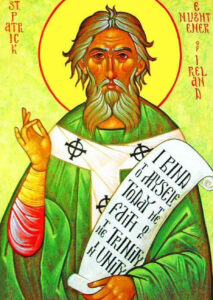
St. Patrick: “He Who loses his life for My sake will save it.”

Feast Day: March 17th  

With Fr. Alford covering the more important saint this week (and year!), St. Joseph, the obvious story for me to tell is that of St. Patrick.  Well, actually, let’s have him tell us the tale.  This is his “Confessio”.

[12: His introduction]So I am first of all a simple country person, a refugee, and unlearned. I do not know how to provide for the future. But this I know for certain, that before I was brought low, I was like a stone lying deep in the mud. Then he who is powerful came and in his mercy pulled me out, and lifted me up and placed me on the very top of the wall. That is why I must shout aloud in return to the Lord for such great good deeds of his, here and now and forever, which the human mind cannot measure.  

[16: Enslavement in Ireland] After I arrived in Ireland, I tended sheep every day, and I prayed frequently during the day. More and more the love of God increased, and my sense of awe before God. Faith grew, and my spirit was moved, so that in one day I would pray up to one hundred times, and at night perhaps the same. I even remained in the woods and on the mountain, and I would rise to pray before dawn in snow and ice and rain. I never felt the worse for it, and I never felt lazy – as I realise now, the spirit was burning in me at that time. 

[19: Making his escape] After three days we made it to land, and then for twenty eight days we travelled through a wilderness. Food ran out, and great hunger came over them. The captain turned to me and said: “What about this, Christian? You tell us that your God is great and all-powerful … I said to them with some confidence: “Turn in faith with all your hearts to the Lord my God, because nothing is impossible for him so that he may put food in your way – even enough to make you fully satisfied! He has an abundance everywhere.” With the help of God, this is actually what happened! A herd of pigs appeared in the way before our eyes! They killed many of them and there they remained for two nights, and were fully restored…

[23] A few years later I was again with my parents in Britain. They welcomed me as a son, and they pleaded with me that, after all the many tribulations I had undergone, I should never leave them again. It was while I was there that I saw, in a vision in the night … They called out as it were with one voice: “We beg you, holy boy, to come and walk again among us.” This touched my heart deeply, and I could not read any further; I woke up then. Thanks be to God, after many years the Lord granted them what they were calling for.

[51: after shepherding the Irish people for decades] I spend myself for you, so that you may have me for yours. I have travelled everywhere among you for your own sake, in many dangers, and even to the furthest parts where nobody lived beyond, and where nobody ever went to baptise and to ordain clerics or to bring people to fulfilment. It is only by God’s gift that I diligently and most willingly did all of this for your good.

[60: His concluding plea] The sun which we see rising for us each day at his command, that sun will never reign nor will its splendour continue forever; and all those who adore that sun will come to a bad, miserable penalty. We, however, believe in and adore the true sun, that is, Christ, who will never perish. Nor will they perish who do his will but they will abide forever just as Christ will abide forever. He lives with God the Father almighty and with the Holy Spirit before the ages began, and now, and for all the ages of ages. Amen … [62] I pray for those who believe in and have reverence for God. Some of them may happen to inspect or come upon this writing which Patrick, a sinner without learning, wrote in Ireland. May none of them ever say that whatever little I did or made known to please God was done through ignorance. Instead, you can judge and believe in all truth that it was a gift of God. This is my confession before I die.

– Fr. Dominic Rankin immensely enjoys corned beef and cabbage, but asks himself this week whether he enjoys prayer as much as the young Patrick?  He has rarely suffered serious hunger, but wonders if he would have faith-enough to ask for food miraculously?  He loves his family and would find it terribly hard to leave them behind for the Gospel.  He has also baptized and preached, but has never been beaten because of it.  What if I were to die this week, or this year?  Would my “Confessio”, my autobiography, be about me, or about Christ?  That might be a good question as I pray St. Patrick’s “Lorica” this week!

Mass Intentions Week of March 15

Monday, March 15

7am – Ben & Luna Unkraut Family
(Cindy Vahling)

12:05pm – Special Intention forBart Rovey
(Mulford Family)

5:15pm – Catherine Ponce
(Al Jenness)

Tuesday, March 16

7am – Stephanie Sandidge
(Sue Sandidge)

12:05pm – Deceased Members ofthe Rocco Piccinino Family
(John Busciacco)

5:15pm – Norman & Eileen Rovey
(Family)

Wednesday, March 17

7am – Helene O’Shea
(Bud O’Shea)

12:05pm – Thomas McGee Family
(Tom McGee)

5:15pm – Mary Dwyer
(Barbara Bitschenauer)

Thursday, March 18

7am – Anna A. Eleyidath
(Augustine Eleyidath)

12:05pm – Joseph A. DelGiorno
(Patricia Kornfield)

5:15pm – Delia Sinn
(Pamela Hargan)

Friday, March 19

7am – Jean Reno
(Greenwald)

(Richard & Joan Rogers)

12:05pm – Special Intention forDeborah Waitkus
(Helen Toney)

5:15pm – George RobertCunningham
(Lou Ann & CarlCorrigan)

Saturday, March 20

8am – Patricia Scherrills
(Family & Friends) 

4pm – Deceased Members of the McGee, Schweska, & Kaufman Families
(Susan Ochoa)

Sunday, March 21

7am – For the People

10am – John & Edith Bakalar
(John Busciacco)

5pm – Special Intention forMichael Kelly
(Chris Sommer)

Prayer Wall – 03/07/2021

Please pray for my brother, Ed, as he is having surgery on Monday.

Prayer Wall – 03/06/2021

Please pray for Bart! He is 31 years old and is in the hospital waiting to undergo heart valve replacement surgery Next week. He’s recently been diagnosed with an autoimmune blood disorder that causes clotting. It complicates things and caused a stroke last fall. Thank you!

Prayer Wall – 03/04/2021

Prayers for Tiffany Rose who is struggling with some physical issues. Thank you!

Month of St. Jospeh in the Year of St. Jospeh

Without a doubt, Lent is a time of the year with which most Catholics, and even many non-Catholics, are familiar.  These are the 40 days before the celebration of Easter, and it is a time during which people give things up or try to do more or something.  Fridays have a particular emphasis during this season, for on those days, we abstain from eating meat.  Just these points give us some appreciation for how the Church invites us to be conscious of the importance of all time, and how each period of time, no matter how long or short, is an opportunity for us to grow in our Catholic faith.

Over the centuries, the Church has encouraged the faithful to be mindful of different aspects of our faith during different liturgical season of the year.  But that is just the beginning, as the Church also invites us to reflect on various themes for each month and each day.  At times, the Church also sets aside certain years to focus on something particular.  It can be an interesting exercise to take some time to learn about the various ways that the Church invites us to celebrate various days, months, seasons, and years.

For our purposes now, I want to call to our attention two of these periods of time that coincide during this month of March in the year 2021.  The month of March has been identified as a month during which the faithful are asked to deepen their devotion to St. Jospeh.  The Solemnity of St. Jospeh is celebrated on March 19 each year, which makes it appropriate for us to set aside March for our special attention to this great figure.  As you also may be aware, this year has been designated by Pope Francis as a Year of St. Joseph, marking the 150th Anniversary of the Proclamation of St. Jospeh as the Universal Patron of the Church by Blessed Pope Pius IX on December 8, 1870.

During this season of Lent, we have been exploring the difference between being a true follower of Christ and mere admirer of Him.  Apart from our Blessed Mother, St. Jospeh give us the best example of how to be a true follower, so we look to him in a special way during this month and year dedicated to him.

St. Joseph also ties in well with our Family of Faith topic for this month, which is the second of the two Sacraments of Healing, the Sacrament of the Anointing of the Sick.  St. Joseph is invoked as the Patron of a Happy Death, and we know that among other things, Anointing of the Sick is a powerful gift to bring peace to those who are approaching the end of their earthly journey.  St. Jospeh is also referred to in the Litany of St. Joseph as “Comfort of the troubled” and “Hope of the sick”, so he intercedes in a special way for those who encounter suffering in any form.

Let us “go to Joseph” regularly during this month and renew our friendship with him, confident that through his example of his intercession, we will grow in our love for Christ, for whom St. Jospeh dedicated his entire life, and as a result of his fidelity, now shares the gift we all hope to attain, eternal life in the Kingdom of Heaven.

Father Alford     

Where is the Anointing of the Sick in Scripture?

This month, we are turning our attention to the sacrament of the Anointing of the Sick. One characteristic of all seven sacraments is that they were instituted by Christ, and not a later innovation of the Church. Similar to Confirmation, the moment when Christ began the celebration of this sacrament is not as clear as baptism or the Eucharist, but there is still plenty of Scriptural evidence for the institution. The main text where we find evidence for this sacrament is found in James 5:14-15.

Is any among you sick? Let him call for the presbyters of the church, and let them pray over him, anointing him with oil in the name of the Lord; and the prayer of faith will save the sick man, and the Lord will raise him up; and if he has committed sins, he will be forgiven. 

Another text which is found in the Gospel of Mark alludes to this sacrament, although not as explicitly as the Apostle James. “Jesus summoned the Twelve and began to send them out two by two and gave them authority over unclean spirits. They drove out many demons, and they anointed with oil many who were sick and cured them” (Mark 6:7, 13). We see a few similarities between these two texts. The first similarity is who is doing the anointing of the sick. The Apostle James instructs the presbyters to pray over the sick person and anoint him. “Presbyter” means elder in the generic sense, but refers specifically to priests in the New Testament. The Apostle Paul appointed presbyters in every town and told the other bishops to do the same thing. The text from Mark shows us that Jesus instructed the Twelve Apostles to do the anointing of the sick. Because the Anointing of the Sick involves the power to forgive sins, only priests and bishops can do this. Jesus has not given this authority to deacons or other members of the Church. 

A second similarity between both Mark and James is that the priests anoint with oil. This oil, called the “Oil of the Sick” is blessed by the diocesan bishop at the annual Chrism Mass, along with the Sacred Chrism (used for Baptism, Confirmation, and Holy Orders), and Oil of Catechumens. In an emergency situation, any priest can bless oil to anoint somebody near death. Although not as common, it is a traditional part of our faith to offer other types of anointings which are not sacraments. Maybe you have heard about a special “oil of St. Joseph” or another oil associated with a saint. This oil is used in a similar way to holy water, as a physical reminder of our faith and a method for expressing devotion. 

The primary fruit of the Anointing of the Sick is strengthening one’s spirit through suffering. I will write more about this in future columns, but I wanted to point out the scriptural connections while we are exploring these two passages. Notice that the Apostle James talks about the prayer of faith saving the sick man, and his sins being forgiven. The Anointing of the Sick does sometimes result in physical healing of a person’s ailment, but this is only a secondary fruit of the sacrament. God will sometimes use Anointing to heal somebody physically if this healing will be fruitful for their spiritual life. 

Jesus came to share in our suffering, and he did so in a concrete way through his passion, death, and resurrection. This sharing in our suffering continues to this day as Jesus comes to comfort us in our darkest moments through the Anointing of the Sick. 

St. John of God: Where can one find Blazes of Glory?

Feast Day: March 10th   

You would think the name John “of God” would set you apart from just your average João (Portuguese version of the name John), but there are at least 5 different famous men who have that tremendous title: a Portuguese actor from the first half of the 20th century; a professional soccer player, now a coach for the Benfica football club in Lisbon; a disgraced Brazilian psychic; an impulsive 14th century runaway who drifted from shepherd, to soldier, to deserter, to adventurer, to book-seller, and capped off all this with a nervous breakdown; and finally one of Portugal’s great, if absent-minded, poets from the 19th century.

Which one do you think was canonized a saint?  

In this case, it was gentleman #4: the rash-boy-turned-shepherd, then soldier-turned-deserter, then African-adventurer-turned-book-seller.  He had abandoned his parents (his mother died of grief; his father sorrowfully entered the Franciscans), and then left behind the shepherd who had adopted him and taught him that trade, even offering his daughter’s hand in marriage to the young John, (who would rather live the life of revelry of a soldier).  He was found guilty of dereliction of duty and was thrown out of the army a few years later (though perhaps he was framed by jealous comrades?  Some accounts say he had some kind of conversion at this time and they did not appreciate his newfound disapproval of drunkenness and profligacy.)  In any case, he went back to shepherding … and then various other military expeditions …  and then back to shepherding again … and then became the servant of a noble family being exiled to Africa.

So, there he was in Morocco, nursing back to health the family that had been disgraced and rejected as they arrived in this far-flung Portuguese colony, watching his fellow servants run off to become Muslim and abandon their faith, and this good family, for glory or riches or something that might await them there.  And then, I suppose, it hit him.  He had done that exact same thing.  He had abandoned his family, and faith in everything but name, jumping from thing to thing, hoping that something would fix the itch he had for adventure, or money, or stability, or nobility, or friendship, or whatever was the latest ambition that crossed his heart.  

And now he was a middle-aged man that had still not figured out what life was about.  He had finally gotten hungry, and disillusioned, and a little bit of repentance sank into that prodigal’s heart, just enough openness that God could intervene.  One day John had a vision of the Infant Jesus, and received from Our Lord the surname “of God” (not unlike calling a fatherless man “Father-of-multitudes”, or an impetuous fisherman “the Rock”, I suppose…), Who also told him “Granada will be your cross.”  He was heading back to Spain!  

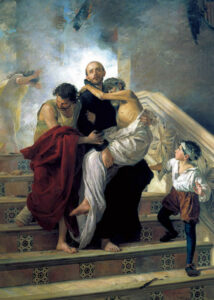
San Juan de Dios salvando a los enfermos de incendio del Hospital Real, Manuel Gómez-Moreno González , 1880. Museo Provincial de Bellas Artes in Granada.  Public Domain.

First, it was a simple call to sell devotional and chivalric books (much different from his earlier interests I suspect, and also different because moveable type had been invented just a handful of decades prior).  But then, after a sermon by St. John of Ávila, John of God had what most would call a mental-breakdown (wild acts of repentance, public self-beatings, complete collapse from grief and sorrow).  He was incarcerated as a mad-man, beaten and chained, and only released when the good John of Ávila advocated for him.  It would take time, but gradually the great saint taught John how to turn his insensitive impulsivity into zeal for charity, his tendency to abandon into self-abandonment and complete availability to the poor, and his self-serving adventuring into the tenacity he needed to continue upon the hard road of learning to love (most avoided him, still seeing him as crazy and dangerous).  It was in this that he finally found peace.  

Some came to slowly to follow him, eventually forming a community who would dedicate their lives not to riches or glamor or adventure or impulsivity, but the simple and humble task of loving those worst off, especially the mentally handicapped.  John would die at the age of 55, teaching us all that no matter what crazy path a life may take, charity can win out in the end, and Christ can convert any heart!  His  order continues the mission to this day, technically called the Hospitaller Order of the Brothers of St. John of God, but more commonly, and fondly, known as the Fatebenefratelli, the Do-Good-Brothers.  

We would all find God in that.

– Fr. Dominic Rankin has never ran into a burning building, or out of one, come to think of it.  Though there was that time when the fire alarms went off in the airport in Rome and no one batted an eye as they blared away for 10 minutes before his flight…  But St. John of God did run straight into a burning hospital, actually the same one where he was beaten and chained those years before, saving all the patients and then beds and whatever else he could throw out the windows.  Turns out, God did not have in mind martyrdom for him because as the building collapsed in an inferno of blazing timber, the gutsy saint walked out just fine. 

« Previous Page
Next Page »

Liturgy

Sunday Masses (unless noted differently in weekly bulletin)
Saturday Evening Vigil – 4:00PM
Sunday – 7:00AM, 10:00AM and 5:00PM

Weekday Masses (unless noted differently in weekly bulletin)
Monday thru Friday – 7:00AM and 5:15PM
Saturday – 8:00AM

Reconciliation (Confessions)
Monday thru Friday – 4:15PM to 5:00PM
Saturday – 9:00AM to 10:00AM and 2:30PM to 3:30PM
Sunday – 4:00PM to 4:45PM

Adoration
Tuesdays and Thursdays – 4:00PM to 5:00PM


CatholicMassTime.org

Parish Information

Parish Address
524 East Lawrence Avenue
Springfield, Illinois 62703

Parish Office Hours
Monday thru Thursday – 8:00AM to 4:00PM
Fridays – CLOSED

Parish Phone
(217) 522-3342

Parish Fax
(217) 210-0136

Parish Staff

Contact Us

Contact Us

Copyright © 2026 · Log in