Cathedral of the Immaculate Conception

Springfield, IL

  • About
    • Contact Us
    • History of the Cathedral
    • Liturgical Schedules
    • Parish Staff
    • Register with Cathedral
    • Subscribe to the Cathedral eWeekly
  • Sacraments
    • Baptism
    • Becoming Catholic
    • Matrimony
    • Vocations
  • Ministry List
    • Adult Faith Formation
    • Cathedral Meal Train
    • Cathedral Online Prayer Wall
    • Cathedral Concerts
    • Family of Faith
    • Grief Share
    • Health and Wellness
    • Spiritual Resources
  • Stewardship
    • Stewardship: A Disciple’s Response
    • Stewardship Form
  • Support
    • E-Giving Frequently Asked Questions
    • Give Online
  • Sunday News
    • Announcements
    • Cathedral Weekly
    • Livestream Feed
    • Submit a Mass Intention Request
    • Weekly or Announcement Submission

Dealing with Temptation

Temptation is real. It is not the stuff of legend and myth nor is it some figure of speech. Temptation is not sin although people sometimes confuse the two. Temptation is an invitation to turn from God and to serve ourselves. If we consent to temptation then the actual act that constitutes the turning from God is what is sinful. We know that temptation itself cannot be sinful because of the Gospel proclaimed to us this weekend from St. Matthew regarding Jesus being tempted by the devil.

Why was Jesus tempted? The Catechism (##538-540) teaches us that Jesus underwent temptation for us, to show us that we are not alone in our struggle to follow God’s will in our lives, and to show us that we can be victorious in the face of temptation. While the devil tempted Jesus through the allurements of pleasure, power, and honor, the basis for this temptation was Jesus’s sonship, to get the Lord to forget who he truly was. Twice in Matthew’s account of the temptation of Jesus the devil premises his temptations with “if you are the Son of God.” The devil tempted Jesus with a perverted notion of Jesus’s sonship, yet Jesus clung to the truth of His sonship which called for perfect obedience to the Father’s will. In the Garden, Adam and Eve lost sight of what it meant to be children of God, of the obedience that was expected of them and the grace that come as the fruit of obedience. Jesus, in His temptation and ultimately in the Cross, shows us that He is the new Adam whereby He completely and perfectly chooses the Father’s will over his own.

When we pray the Lord’s Prayer, we ask the Father to “lead us not into temptation.” Immediately we are faced with the problem of an insufficient translation from the original Greek to English. We do not have to ask God to not lead us into temptation. He won’t, because for him to do so would be contrary to his divine nature; God wants us to be free from the power of evil. However, God does allow us to be tempted. He allows us to be challenged to use the grace the He has given us to discern what is of Him (good) and what is not (evil). Facing temptation and overcoming it leads to spiritual growth. Again, this is why prayer, the sacraments, mediating on the Scriptures, and good works are all so important in our discipleship because these are pathways to the grace that we need.

Let us pray together that these Lenten days may be a time of increased grace for all us through our prayer, fasting, and acts of charity. The grace given to us, which is the fruit of these holy acts, will strengthen us in our struggle against temptation and evil and allow us to stand victorious with the Lord Jesus over the power of sin and death in our lives.

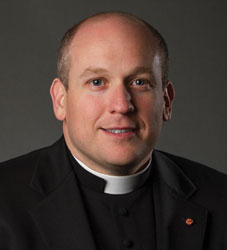
Father Christopher House is the Rector of the Cathedral and serves in various leadership roles within the diocesan curia, namely Chancellor and Vicar Judicial.

Evangelism

The charism of evangelism empowers a Christian to be an effective channel of God’s love by sharing the faith with others – baptized or not – in a way that draws them to intentionally follow Jesus. All Christians have been called to the task of bearing witness to the difference Christ has made in their lives, but some have been empowered in a special way to draw people to Christ. Those with this gift are especially drawn to non-believers or those whose faith has grown lukewarm.

This is a gift that can be suspect in many Catholic parishes where talking about faith has strangely become uncommon. Many disciples with a strong urge to speak of Christ can feel isolated by the culture of silence in a parish that has forgotten its central charge to “go and make disciples”. It is refreshing to be part of parish where evangelism is encouraged through programming like Alpha, which is a regularly occurring opportunity to invite others to faith in Jesus Christ. But we must do more. Every baptized person has to reflect on their own faith and seek opportunities to speak a word of God to others in a way that is inviting.

You may have this charism if you love talking about God and the Church and seek out opportunities to share your faith with the unchurched. This charism allows you to have remarkable results when you share the Good News. People become intrigued and desire to know more. They begin to find the person and love of Jesus compelling. Cathedral offers so many opportunities to support you in accompanying others to faith. If you don’t see what you need in the Weekly, call the office for help – we are anxious to grow disciples and encourage a spirit of evangelization at the Cathedral!

Vicki Compton is the Coordinator of Faith Formation and Mission at the Cathedral of the Immaculate Conceptionin Springfield, Illinois

How Should I Best Share My Faith With Others?

Jesus told his disciples to go out and spread the word of God. We are all disciples of God, and as such, we should be spreading the word of God as well. How would you suggest a normal, everyday person go about sharing our faith with others?

Pope Paul VI and the United States Catholic Bishops addressed this very question in some of their writings. They suggest a threefold process. First, of course, is that you should be “converted” to the gospel yourself; not just being a Christian in name, but in you your deeds as well. Second is to “witness” to the gospel and your faith by how you live your daily life. Love God and your neighbor as yourself. Strive to speak and act with compassion to others. Practice justice and generosity in how you spend your money and your time, being especially attentive to the outcast and those normally invisible to much of society. Put gospel values ahead of secular values of commercialism, over-consumption, and an idolatry of the body. Cultivate quiet time for prayer and simply “being” instead of always “doing.” (John’s gospel is emphatic about the need to “be,” “abide,” and “rest” in Jesus.) Cultivate a community around you that will support you and challenge you in living out this faith. Like Pope Francis, strive to live as a person of hope and joy in a world that is often rife with darkness and despair.

When Christians live like this in a kind of wordless witness, other people will notice, so the third step is to share by explicitly proclaiming your faith. When someone asks you why you seem so peaceful compared to how they feel, or how you manage to remain hopeful, or why it is you seem content living with less than those around you, be ready with your answer (1 Peter 3:15). You can say truthfully that you are trying to live out the gospel. You are trying your best to follow a counter-cultural Jesus.

You can elaborate more about your faith life if they seem interested, or invite them to come to church with you. If they aren’t interested at that time, know that their curiosity has been piqued and keep your eyes and ears open for further opportunities to share about your faith. Depending on your relationship with the person, you may feel comfortable mentioning the role that your faith plays in your life even if they don’t ask about it. Either way, you needn’t be strident or pushy about it because that often has the opposite effect of turning people off of Christianity. Think of sharing your faith and the Bible as an invitation to others, not wielding it as a weapon. Finally, pray that God will use you as a channel of grace to introduce other people to the faith that has proven to be so life-giving for you.

Ann Naffziger is a scripture instructor and spiritual director in the San Francisco Bay area. She has has written articles on spirituality and theology for various national magazines and edited several books on the Hebrew Scriptures.

How Tea Transformed My View of Hospitality

I was exactly 8,491 miles away from home. It had taken me four flights, 16 hours of waiting in airports, 20 hours in the air, and several hours careening around dirt roads in a bus to reach the town of Hosur in India.

I was there as part of a month-long immersion trip and had just finished my first week in country. Given the effort to get here, you might think I am the adventurous type — prone to backpacking solo around Europe, cliff jumping into swimming holes, or taking off on a last-minute trip to Patagonia. The reality is that I am cautious by nature, a careful planner, and not a fan of heights, cliffs, roller coasters, or really anything that involves danger. And yet here I was traipsing through the dusty streets of an Indian village and wondering if I had been slightly possessed when deciding to come here.

The truth is that I had been fascinated with the idea of traveling to India ever since I was a little girl. I had come across pictures of India in the National Geographic magazines that I dragged home from the library and it seemed like a magical place — exotic, mysterious, colorful — a place of adventure. I’m sure my 10-year-old imagination romanticized it quite a bit. My actual experience of India was full of color and beauty, but it was also hot, smelly, noisy, crowded, and confusing. I felt overwhelmed by the differences in culture, and I struggled to communicate even the most basic of questions.

As our group wandered through the town, a local family stopped us and invited us to their home for refreshments. I ducked in through the doorway and was struck by how tidy the house was. Mats covered the carefully swept dirt floor and a few chairs were placed along the wall. There was a small alcove that served as the kitchen and a sheet hanging across a doorway that went into a bedroom.

I removed my sandals at the door and started to sit down on the floor, but the matriarch of the family clucked at me and shooed me toward one of the chairs. I tried to gesture that I was OK with sitting on the floor, but it was obvious that she would not take no for an answer. Her daughter handed me a cup of sweetened coffee, and I noticed that it was in a very beautiful china teacup. The rest of the tea set was nearby and it was obvious that it was one of their prized possessions as there was not a single chip or crack that I could see. I asked the guide to tell them that I thought it was very pretty. As she translated, the mother and daughter glowed with pride. The rest of their family sipped their coffee from tin cups while the guests were given the china teacups.

I felt slightly awkward as we had no gifts or anything that we could offer in exchange. We were dusty, dirty, and probably smelled to high heaven after being on a crowded, hot bus all morning. Our hosts were dressed in what looked like their very best clothes.

Conversation was slow and stilted. We had to use our guide to translate, so much time was simply spent nodding and smiling at each other. Our guide shared with us that the family was very happy we had come to visit them. They were not well liked within their community because they came from a lower caste, and initially they were not sure if we would accept their invitation. They told us they felt honored that we had come to their home and asked us if we would pray for them and keep them in our thoughts after we left. The mother bowed to us and offered a “Namaste” as we readied ourselves to leave. I found myself wishing that there was something of value that I could offer in return but all I had was a smile, a promise to pray for them, and an attempt to say thank you in Hindi.

I was so touched by the hospitality of this family and at the same time felt guilty and unworthy of their gratitude. All I had done was shown up at their home. There was next to no effort on my part whereas they had dressed in their finest, cleaned their home, offered us refreshment and in their treasured tea set, no less! I found myself wondering if I would have gone out of my way quite so much for a group of complete strangers. But then I realized that’s how it is with God’s love sometimes. I show up dirty, tired, with nothing to offer in exchange. I often don’t feel worthy of it and yet it’s still there being offered. Sometimes all I can give is a heart-felt thank you.

As I put my sandals back on and walked out into the sunshine, I felt a new openness to the experience of traveling in India. A simple afternoon tea had touched my heart and helped me to see not only the beauty of the country but also the beauty that was inside the people I was encountering.

Annie Devine is originally from Ohio and currently resides in Wilmington, Delaware, with her husband, baby daughter, and a rescue dog named Lucy. She has a B.A. in English and literature and an M.A. in pastoral ministry and has spent the last 10 years working and volunteering in young adult ministry. Annie likes to cook, read books, and take naps in hammocks.

An Anatomy of Sin

Kichijiro is a supporting figure in Martin Scorsese’s 2016 drama/ history movie, Silence. In the movie, Kichijiro is a Japanese guide who serves and accompanies the French Jesuits, Frs. Rodriguez and Garupe. The Jesuits go to Japan on a mission to find their lost mentor, Fr. Ferreira, who has been rumored to have committed apostasy. Kichijiro is a cowardly drunkard who denies being Christian and betrays his visitors to the Japanese officials, only to return to Fr. Rodriguez, begging to have his confession heard. This cycle happens a number of times throughout the movie.

From Kichijiro’s character in the movie, we can surmise what some might call the “anatomy of sin.” Sin is mysterious and predictable, depending on how you look at it. We can come to understand what the early Church Fathers have described as a four- fold path: Suggestion, Conjunction, Acceptance, and Captivity. In Suggestion, a thought or image, desire or feeling is presented to the soul. (For the sake of clarity, I’ll just use the word “thought” to encompass all these sentiments.) Some of these thoughts draw the soul towards God, but not all. The next step, Conjunction, is the interchange that we have with that thought. We can entertain the thought with delight or repulsion. Up to this point, these thoughts can be temptations towards sin, but we have not yet committed it, either in thought or in action. Acceptance follows, wherein the thought is embraced by the will, and a plan for carrying out a corresponding action ensues. Up until this point, the person — you and I — have the will power to make course corrections on the thoughts which have been presented to us. But if we linger in this acceptance, we become enslaved — or held Captive, the fourth stage — to the thought and its expression, from which there is no escape of our own volition.

Some of you might be thinking to yourself, “Gee, this sounds like a summary of an addiction recovery course.” Well, in a certain sense, yes. This approach does fit in that arena. But it also applies to our spiritual lives, at least I know it does for me! This cycle helps me to understand why it is that when I go to confession, I usually have the same set of sins. I have often reflected at how my life can look like Kichijiro’s: the fears I can have about the loneliness of virtue, the anxieties about wanting to save my reputation among people with conflicting ideas, the need for unconditional acceptance without embracing the consequences of my actions, etc. When external events trigger these thoughts within me, there are predictable outcomes, none of which I am proud.

The wisdom of the Church gives us six weeks to reflect on how we have this tendency to prefer the fleeting pleasure or power of sin over the goodness and mercy of the Father. This is where sin is a mystery to us: why, when given the choice to pursue goodness and virtue, do we instead choose pleasure and vice? Are we even mindful or aware of the diversity of thoughts that we have throughout the day? Are we conscious at how our actions and speech are dictated by those interior thoughts? St. Isaac the Syrian gives us a hope-filled insight here: “the inflamed thoughts are uprooted and turned to flight by constant occupation of the mind with God. This is a sword that puts them to death… Whoever always thinks about God drives the demons away from himself and pulls up the seeds of their malice.”

While we cannot know the interior dimension of a fictitious movie character, we can examine our own interior with the wisdom of the Church during this season. Maybe we can practice being mindful of our thoughts during this time. Maybe we can learn to be more discerning of what we allow our thoughts to entertain. Maybe, during this Lenten season, we can learn to think more about God throughout the day and let His thoughts become our thoughts so our actions and words might better reflect His.

Brother John-Marmion Villa, BSC is an author for Liturgical Publications, Inc. and writes reflections on the Sunday readings.

Prayer Wall – 02/23/2020

Please pray for Sarah and her family as she has an appointment with a pediatric oncologist tomorrow (2/24). A bump was discovered by an older sister on Thursday and by Friday the family knew she had a wilms tumor. The bump is growing and something will need to be done quickly.

Prayer Wall – 02/22/2020

A friend’s mother has been taken to the hospital with very low blood pressure and very high heart rate. She also has a terrible cough. Pray that
God’s will be done and that healing can occur for her.

Prayer Wall – 02/21/2020

Two of my friends’ grandsons are deploying to Afghanistan this month. They will remain there until December of 2020. Please pray for their safety and return.

Prayer Wall – 02/21/2020

Please pray for the healing of a parishioner’s niece who just underwent brain surgery this past week.

Keeping a Holy Lent

The season of Lent begins this year on Ash Wednesday, February 26th, and ends prior to the Mass of the Lord’s Supper on Holy Thursday, April 9th, when the Easter Triduum begins. Lent is the principal penitential season of the Church year. All the Christian faithful are urged to develop and maintain a voluntary program of self-denial (in addition to the Lenten regulations which follow), serious prayer (addition of daily Mass when and if possible, Scripture reading, Stations of the Cross, and receiving the Sacrament of Reconciliation, etc.), and the performing of deeds of charity and mercy, including the giving of alms (increased attention to the needs of our brothers and sisters).

Lenten Regulations
Catholics who have celebrated their 14th birthday are bound to abstain from meat on Ash Wednesday, each Friday in Lent, and on Good Friday. Catholics who have celebrated their 18th birthday, in addition to abstaining from meat, should fast, i.e., eat only one full meal on Ash Wednesday and Good Friday. Small quantities of food may be taken at two other meals but no food should be consumed at any other time during those two days. Liquids do not break the fast and nourishment needed for special needs (such as illness or pregnancy) should always be taken. The obligation of fasting ceases with the celebration of one’s 59th birthday.

Lenten Prayer
Mass Schedule
The Weekday Mass schedule during Lent is as follows:
Monday through Friday – 7:00am, 12:05pm, and 5:15pm; Saturday – 8:00am

Sunday Mass times during Lent are as follows:
Saturdays – 4:00pm; Sundays – 7:00am, 10:00am, and 5:00pm

Reconciliation
The sacrament of Reconciliation is offered daily in the Cathedral church:
Monday through Friday – 4:15pm to 5:00pm
Saturdays – 9:00am to 10:00am and 2:30pm to 3:30pm
Sundays – 4:00pm to 4:45pm

Stations of the Cross
Take the time to walk the Stations of the Cross, the final steps Jesus took to Calvary, each Friday during Lent immediately following the 5:15pm Mass

Lenten Almsgiving Collections
In following our past practice of almsgiving during Lent, a second collection will be taken up each Sunday. Collections this year will be as follows: Ash Wednesday, February 26th – Church in Eastern Europe; March 1st – St. Martin de Porres Center; March 8th – Catholic Charities; March 15th – Helping Hands of Springfield; March 22nd – Catholic Relief Services; March 29th – The Pregnancy Care Center; April 5th – Cathedral Parish Student Assistance for Catholic Education

Easter Triduum Schedule
Holy Thursday Mass of the Lord’s Supper – 6:30pm
The Liturgy of the Lord’s Passion on Good Friday – 3:00pm
The Easter Vigil on Holy Saturday Night – 8:00pm
Easter Sunday Masses – 7:00am and 10:00am

Stations of the Cross will also be held at 12:05pm on Good Friday, and the sacrament of Reconciliation will be offered after the 3:00pm Liturgy of the Lord’s Passion on Good Friday.

More Lenten resources can be found throughout this issue of the Weekly, as well as on the inserts provided. Please continue to watch the Cathedral Weekly and Cathedral website (www.spicathedral.org) throughout this Lenten season for additional resources.

« Previous Page
Next Page »

Liturgy

Sunday Masses (unless noted differently in weekly bulletin)
Saturday Evening Vigil – 4:00PM
Sunday – 7:00AM, 10:00AM and 5:00PM

Weekday Masses (unless noted differently in weekly bulletin)
Monday thru Friday – 7:00AM and 5:15PM
Saturday – 8:00AM

Reconciliation (Confessions)
Monday thru Friday – 4:15PM to 5:00PM
Saturday – 9:00AM to 10:00AM and 2:30PM to 3:30PM
Sunday – 4:00PM to 4:45PM

Adoration
Tuesdays and Thursdays – 4:00PM to 5:00PM


CatholicMassTime.org

Parish Information

Parish Address
524 East Lawrence Avenue
Springfield, Illinois 62703

Parish Office Hours
Monday thru Thursday – 8:00AM to 4:00PM
Fridays – CLOSED

Parish Phone
(217) 522-3342

Parish Fax
(217) 210-0136

Parish Staff

Contact Us

Contact Us

Copyright © 2026 · Log in