Lenten Journey for Friday of the fifth week of Lent
Lenten Journey for Thursday of the fifth week of Lent
Getting Ready for Your Holy Week Journey
When I returned to the Church in my late twenties, one of the things that became very important to me was fully investing in the liturgical year. As a child, any day at church was just the same as another, and though Christmas and Easter had extra trappings, my adolescent apathy didn’t allow for much conviction or interior renewal. So, when I came back I wanted to learn, appreciate and enjoy all the unique aspects of living life according to the liturgical calendar. And there was no time where that commitment to commitment became as significant as during Holy Week.
Holy Week is the apex of our liturgical year. The entire week is one of continued heightening, building and expanding of our faith in and love for Christ, culminating with the celebration of the Resurrection on Easter. There’s so much to do during the week, and the ups and downs of the scriptural events throughout can seem rather chaotic. I’ll admit my first few Holy Weeks upon my return to Catholicism had me feeling frazzled and overwhelmed, because I wanted to have the full-on, no holds barred Holy Week experience. Instead, I wound up finding myself burnt out and exhausted by the time Easter came around. This is a rather common experience amongst the faithful, so I offer some gentle guidance and things to focus on during the week in order to make for a rich and rejuvenating encounter with God.
Palm Sunday
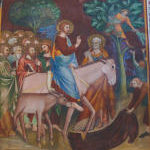 To make things simpler, it might help to look at Holy Week as a journey, one that moves from the interior to the exterior. We begin in an interior space on Palm Sunday — the traditional start of Holy Week — allowing ourselves the opportunity for both anticipation and reflection. In the account of Jesus’ entry into Jerusalem, read during the blessing of the palms at the beginning of Mass, we anticipate the events of the week to come, but in the Gospel reading later, we encounter Christ in his Passion and death.
Palm Sunday holds in tension the suffering and death of Jesus, and the promise of the Resurrection. We hear of the crowds waving palm branches — a symbol of victory — as they greet Jesus entering Jerusalem, riding on the back of a donkey — a symbol of peace — and yet we know that “the son of man must suffer many things and be rejected” (Luke 9:22) as well.
We can look to Palm Sunday as the impetus for the week; it is the invitation by Jesus to accompany him on his most important mission. Jesus is inviting us to be with him in a more intentional way this week, and we might take this time — from Palm Sunday onward — as an opportunity to go back to the scriptural accounts of his entry into Jerusalem, as well as his Passion and death, and reflect on their meaning, for both ourselves individually and humanity on a larger scale. We might want to take the time to sit with these scriptural passages, placing ourselves in the scene, going deeper and strengthening our relationship with Jesus. This time should be one spent primarily within, as we consider the significance of the events that are about to take place, but also consider their necessity. What is it about the world we live in that called for a Savior?
Holy Thursday
Entering into the Triduum — which begins with Holy Thursday and the Feast of the Lord’s Supper — we begin to move from the interior to the exterior, as we commemorate the Last Supper both in the Eucharist and in the ritual washing of the feet. As we partake in and witness the ritual washing amidst our own faith community, it is important for us to heed the instructions Jesus gave his apostles that fateful night: “I have given you a model to follow, so that as I have done for you, you should also do.”
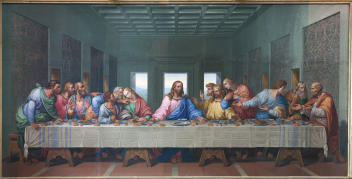 As the Body of Christ, we are called to emulate Jesus, our head, and go out into the world and be a servant for all. Our faith is a communal faith, and having spent the previous few days in reflection and quiet, we are now being awakened and called out of ourselves to serve and sacrifice as Jesus did. When the Feast concludes, and the Eucharist has been brought to the Chapel, we are given the opportunity to reflect on Jesus’ time in the Garden of Gethsemane. Jesus: alone, abandoned and afraid, in his full humanity, cannot escape the reality of suffering and sorrow, a reality that we all must live with. Holy Thursday is a time to be with Jesus in his frailty, while simultaneously recognizing our own.
Good Friday
We leave the Garden, and enter into Good Friday, a time of solemnity and silence, as we listen to the proclamation of Jesus’ Passion and Death according to the Gospel of John. While we’ve been sitting with the crucifixion throughout the week, it now takes center stage, and with it comes the realization of our own sinfulness in the wake of Jesus’ suffering and death on the Cross.
Most parishes offer the Sacrament of Reconciliation as a matter of course, but it is also a good time to consider the evil occurring in the world on a broader scale, and — remembering Jesus’ instruction from the ritual washing of the feet — perhaps take the opportunity to fill part of this day of fasting with spiritual nourishment, through service of some kind. While the day is (and should be) tinged in sorrow, it is also important to remember to never give up hope, to never forget the end of the story.
Easter Vigil
The Exsultet, sung after the lighting of the Paschal candle at the beginning of the Easter Vigil, is the climax of the week, an outpouring of joy and praise for the reality that is our Salvation. The entire week has been moving toward this moment, just as the history of the faithful, as recounted in the nine passages read during the Vigil, had been awaiting the Resurrection.
Now is the moment to celebrate Christ’s victory over death and his invitation to us to join him in new life. All the sorrow we’ve encountered throughout our journey with him is to be forgotten and the time has come to rejoice, through him, with him and in him. It is also the time to remember that with the Resurrection comes our responsibility to proclaim it, in both word and deed. Easter does not end Monday morning. It never ends, and it is our duty to always live in the hope and joy of the Resurrection and bring that hope and joy to all whom we encounter.
Fr. Jake Martin, SJ, is a Jesuit priest, comedian and writer. He is pursuing a Licentiate in Sacred Theology at Heythrop College in London.
Everyday Stewardship
 Jesus warns us in the Gospel of Matthew, “If anyone wishes to come after me, he must deny himself, take up his cross, and follow me.” It is an invitation to a way of life, and a plan that leads to holiness. But make no mistake, it is a warning as well. The cross is a sign of victory, but only in light of the Resurrection. Alone, it is a symbol of ultimate sacrifice: the sacrifice of Jesus Christ for a fallen world, and the sacrifice we are called to make to truly follow him.
The power of this symbol has been diminished in popular culture. It is often used in fashion and simple wall art and on bumper stickers and T-shirts, sometimes with Christian clichés and sometimes not. But the cross is something so much more. It is a reminder of the pain, suffering, and death of one who loved us so much that he would give his very life for us. It is our God on that cross. It is God who cries out in despair, feeling the ultimate depth of human emotion. And there lies the key for us in trying to live this life of carrying our crosses.
For those who suffer the death of a loved one, the Father lost his Son. For those who suffer the ravages of disease, his body was broken, beaten, and pierced. For those who feel they have no way out – whether due to prisons that are physical or prisons that are of the mind – he hung on a cross and cried out, “Why?” For those who feel alone and abandoned, he hung on a tree where no one could comfort him, not even his own mother. He has walked in all our shoes, and now we are called to walk in his. In the cross, we find solidarity with the human condition. In an empty tomb, we find our hope.
Tracy Earl Welliver, MTS is in charge of Stewardship Direction for Parishes at Liturgical Publications, Inc.
Luke’s Passion Narrative
 One of the most striking occurrences for me in Luke’s Passion is early on at the Last Supper, when Jesus speaks to Peter telling him that the devil had demanded to sift Peter like wheat but that Jesus had prayed for Peter’s faith. Peter quickly responds that he will never falter in his faith, in fact that he is prepared to go to prison for the Lord and to even die for him. Yet, in that same moment, Jesus tells Peter that he will deny him three times. Later that evening, the Lord’s prophecy comes to pass, just as he is being mocked by the Temple guards who tell Jesus to prophesy. When Peter denies Jesus, Luke tells us that Peter catches the Lord glancing through the crowd at him in that moment.
What a moment; in fact the thought of that scene always gives me chills. After that moment, realizing what has happened, Peter goes out and weeps bitterly for his betrayal. I have often thought about that glance of Christ towards Peter. What did it look like? I can imagine it being mixed with heart-break and pain but also with love and mercy; in no way do I imagine that glance being one of condemnation. So, what about in our lives, in those moments when we fail the Lord through our sinfulness and human weakness? How is the Lord looking at us? I imagine its quite the same. A look of pain but also one that invites us back, to know again the love that the Lord always has for us. His glance is one that does not illicit fear but that invites us to the fullness of mercy.
The Passion narratives of Matthew, Mark, and Luke rotate on a three-year cycle for Palm Sunday and this year the Church is presented with Luke’s narrative. Throughout Ordinary Time this year we have been presented with Gospel selections from Luke and that will continue after Pentecost but this Lucan year also continues in the upcoming Easter season as Acts of the Apostles is traditionally understood as being authored by Luke too. Luke’s Gospel is divided into four parts: in the garden, before the Sanhedrin, before Pilate and Herod, and finally Jesus’s crucifixion, death and burial. While Mark and Matthew present us with a Jesus surrounded by darkness and impending doom, and John portrays a triumphant Christ, Luke offers us a gentle and merciful healer who has given himself over to the Father’s will and continues his mission to the end.
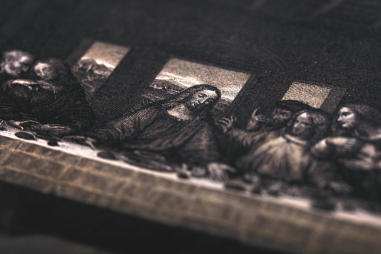
Just as the Lord’s prophecy of Peter’s denial came to pass so did his prayer that Peter would not fail because Peter ultimately turns back to him. Peter humbles himself in contrition and therefore is able to receive the grace and the strength that the Lord wanted him to have. Sinners though we are, the Lord Jesus continues to intercede for us as he did for Peter. Mindful of our sinfulness in these sacred days of Holy Week, and always, let us turn to the Lord with humble and contrite hearts that we might know the fullness of his mercy, the power of his grace, and ultimately share in his victory as St. Peter did.
Father Christopher House is the Rector of the Cathedral and serves in various roles within the diocesan curia, namely Chancellor and Vicar Judicial.
Maintenance vs. Mission
 There are two kinds of Catholic parishes in the US these days. Maintenance parishes and mission parishes. Maintenance parishes are primarily concerned with maintaining the status quo, keeping current parishioners happy and involved, and believing that “if it ain’t broke, don’t fix it”. Parishes driven by a culture of mission, on the other hand, seek to help all people, parishioners and non-parishioners, encounter and fall in love with Jesus so that their lives only make sense when fully committed to Christ. Mission parishes seek to grow disciples who understand their call to make Christ known in the world and transform the culture. Maintenance parishes are shrinking and dying Mission parishes are growing and thriving. Cathedral is a mission-focused parish.
During the past nine months our staff and clergy have combined to offer a dozen short- and long-term adult faith formation courses open to all in the Springfield area. Equipping disciples with an understanding of the faith is essential to living that faith in a world that is frequently hostile to Christianity. But we have also focused on providing opportunities for the un-churched or disengaged to find encouragement and hope. Over 100 guests and team members have renewed their relationship with Jesus through our parish Alpha courses. We are reviving a pro-life ministry that will keep our parish focused on caring for our most vulnerable, and we are seeking to understand how trauma keeps people from realizing their full potential so that we can be part of a healing process.
This is a very exciting time for the Church and for the Cathedral community. The Holy Spirit is moving powerfully in our parish and in the lives of parishioners and guests. Christianity is no longer a spectator sport; indeed, it was never meant to be. Here are three things you can do to be part of the mission focus at the Cathedral.
Smile and make room in the pew.
Next weekend is Easter. There may be many people in the pews who don’t often attend Mass. Instead of secretly resenting them for taking “your” pew or making it difficult to find a parking place, extend to them the love and mercy God has for you and all His children by sitting in the middle of the pew so you are ready to welcome and smile at those who will share it with you.
Attend Alpha and/or invite a friend to attend.
The next Alpha course is starting on June 10. Postcards are available to help you extend an invitation. Alpha can help you connect in a more intimate way with Christ and with the Christian community. And Alpha is an essential tool for a mission-focused parish. But it is only successful if parishioners become an invitational engine.
Pray for help in discovering your own mission.
Your task as a missionary disciple is to proclaim and witness Jesus Christ, and he has given you unique gifts to carry out that mission. If you have not yet discovered how God has equipped you, ask the Holy Spirit for enlightenment, understanding and wisdom.
Cathedral will continue to offer ways for individuals to meet Jesus and experience conversion. We are committed to growing disciples and are interested in your ideas for how we can better facilitate that. Please join us in asking for the Holy Spirit to inspire us that we may discern and follow God’s glorious plan for our parish.
Vicki Compton is the Coordinator for Faith Formation and Mission at the Cathedral. She can be reached at [email protected].