 Every month , the International Catholic Stewardship Council writes about a Saint who lived a stewardship way of life. We will begin to share these examples each month, so we too can lear how to bear witness to the Gospel in our lives. For more information, http://catholicstewardship.com/.
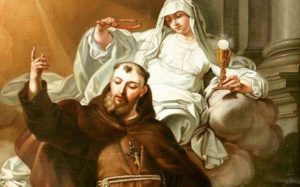
Given the name Mark Rey at his birth in 1577, our stewardship saint for April grew up in Sigmaringen, a town located in presentday Germany. He was the son of the town’s affluent burgomeister (mayor) and studied law and philosophy at the renowned University of Freiburg. As a student, Mark made prayer a priority in his daily life. He also spent time visiting the sick. He embraced a humble, chaste and simple lifestyle.
He earned a doctorate in canon and civil law, became a prominent lawyer and soon gained a reputation for representing those who had no money to pay. Mark was affectionately nicknamed “the poor man´s lawyer.” He was known to be extraordinarily generous, and committed himself to working with the poor.
Dismayed by the greed and corruption he found among his counterparts in the legal profession and in the courts of law, Mark abandoned his law practice and entered the Capuchin religious community. He took the name Fidelis, which is Latin meaning “faithful.” He studied for the priesthood and after ordination, celebrated his first Mass in 1612 on the feast of Saint Francis of Assisi (October 4).
After his ordination, Father Fidelis was assigned to preaching and hearing confessions. It was reported that a large number of converts were accepted into the Church because of his zealous evangelizing efforts. He was devoted to Saint Francis of Assisi and revealed that devotion in his pastoral care of the poor and sick. During a severe epidemic in a city in which his friary was located, he cared for and cured many.
In 1621 Father Fidelis was sent to begin missionary work in Switzerland, a territory that had experienced much bloodshed as a result of growing tensions among a number of religious movements of the expanding Reformed traditions. All of these movements were violently opposed to the Catholic faith at the time. His writings, preaching and pastoral ministry converted many in Switzerland to Catholicism. But many others, enraged by his missionary work, threatened his life. On April 24, 1622, while traveling on the road between preaching missions, Father Fidelis was attacked by a group of armed men, beaten and hacked to death. He was 44 years old. Fidelis once wrote: “It is because of faith that we exchange the present for the future.” He was canonized in 1746 and his feast day is April 24.
Katie Price is the Coordinator of Stewardship at the Cathedral. She has worked in Parish Stewardship for ten years, previously as the Archdiocese of Chicago Parish Stewardship Coordinator. She can be reached at [email protected].
 Sometimes I wonder if we go about it backwards in our catechesis of young people. We tell our young people about the saints, we give them holy cards, we ask them to choose the name of a saint for confirmation – all ways, at least on one level, of hoping that they will be inspired by the saint and come to know more of Jesus and living the Christian faith. Would it not be better, first and foremost, to introduce our young people to Jesus (to truly encounter him as Lord and Savior) and then trust that over time Jesus himself will introduce our young people to his friends, the saints?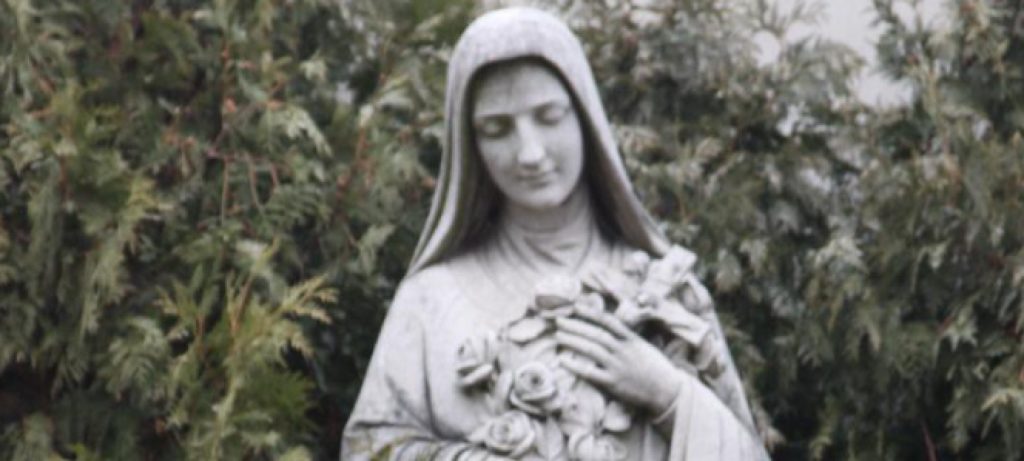
 How did we get here? I mean, literally. Not just you and me, but the whole shebang. How is any kind of life possible? The universe is a hostile place — solar flares, cosmic rays, asteroids flying about. The odds against our existence are truly astronomical.
 When asked about images or personifications of God, many people name the image of the Good Shepherd. It is an image that is familiar to Christians, both Catholic and non-Catholic alike. The image created by Psalm 23 serves as a basis for this and, for Catholics, every year on the Fourth Sunday of Easter, the Gospel speaks of Jesus as the Good Shepherd. The regularity of this image during this season has resulted in this Sunday being nicknamed “Good Shepherd Sunday.”
 The Church Fathers were fond of exploring the relationship between Eve, mother of all the living, and the new Eve, Mary the Mother of God. Where Eve grasped and lost, Mary surrendered and received; where Eve said no to the alluring mystery, Mary said yes.
 When my mother thought the garage would make a nice study, my father—a talented designer, builder and woodsmith—got to work. She eventually took her leisure in a splendid room lined with bookcases and boasting a fireplace with hidden storage, but she’d had to trust him about it, because Dad never drew out a plan. He just kept it all in his head.
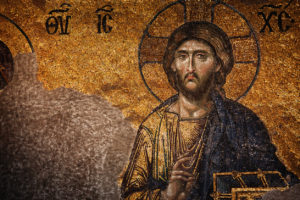
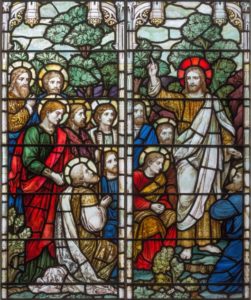 Over the past couple of centuries, many thinkers, both inside and outside of the Christian churches, endeavored to reduce the resurrection message to the level of myth or symbol. Easter, they argued, was one more iteration of the “springtime saga” that can be found, in one form or another, in most cultures, namely, that life triumphs over death in the “resurrection” of nature after the bleak months of winter. Or it was a symbolic way of saying that the cause of Jesus lives on in his followers.
 This Sunday is the final day of the Easter Octave, named Divine Mercy Sunday by Pope John Paul II in 2000, is a “hermeneutical crown” of the eight-day-long celebration of that Eighth and final Day of creation.