Cathedral of the Immaculate Conception

Springfield, IL

  • About
    • Contact Us
    • History of the Cathedral
    • Liturgical Schedules
    • Parish Staff
    • Register with Cathedral
    • Subscribe to the Cathedral eWeekly
  • Sacraments
    • Baptism
    • Becoming Catholic
    • Matrimony
    • Vocations
  • Ministry List
    • Adult Faith Formation
    • Cathedral Meal Train
    • Cathedral Online Prayer Wall
    • Cathedral Concerts
    • Family of Faith
    • Grief Share
    • Health and Wellness
    • Spiritual Resources
  • Stewardship
    • Stewardship: A Disciple’s Response
    • Stewardship Form
  • Support
    • E-Giving Frequently Asked Questions
    • Give Online
  • Sunday News
    • Announcements
    • Cathedral Weekly
    • Livestream Feed
    • Submit a Mass Intention Request
    • Weekly or Announcement Submission

What do we really want?

As Pope Benedict continues his consideration on the topic of eternal life, he brings to our awareness an inner contradiction that so many of us face this side of eternity.  He writes:

On the one hand, we do not want to die; above all, those who love us do not want us to die. Yet on the other hand, neither do we want to continue living indefinitely, nor was the earth created with that in view. So what do we really want? (SS 11)

From that question, the Holy Father asks a deeper question – what is eternity? and what is life?  Then, citing some of the writings of the great St. Augustine, the pope offers this important point:

looking more closely, we have no idea what we ultimately desire, what we would really like. We do not know this reality at all; even in those moments when we think we can reach out and touch it, it eludes us. “We do not know what we should pray for as we ought,” he says, quoting Saint Paul (Rom 8:26). (ibid.)

Perhaps we can find this logic somewhat confusing, and even maybe a little frustrating.  How is it that St. Augustine can suggest that we do not know this reality at all?  Is God in someway hiding the truth from us?  Is that the way a loving Father should treat His children?

I am reminded of an analogy that somebody proposed to me at some point that helps me in grasping this somewhat confusing point made by St. Augustine.  We can consider married couples, and how certain couples cause us to scratch our head.  How can that relationship work?  What do they see in one another?  They seem so opposite!  For us who stand outside of the relationship, it seems to make no sense.  But to the couple, who are inside of the relationship, it makes all the sense in the world.  Their love for one another is special and unique, in a way that those on the outside may never appreciate, but which to them is a source of great joy and peace.

Outside of Heaven, we can never fully appreciate what awaits us.  We are outside of that relationship, in a sense.  Only when we get to Heaven will we fully appreciate its beauty and its goodness, how life there far surpasses any experience of life here.  This is at the heart of St. Paul’s words: “What no eye has seen, nor ear heard, nor the heart of man conceived, what God has prepared for those who love him.” (1 Cor 2:9)

This analogy is not perfect, but I find it helpful when we struggle with looking forward to the unknown of eternal life, wondering if somehow we might be let down, and if it would be better to just remain with what is familiar and comfortable.  As I have said before, when we get to that place, we will not be disappointed.

Thankfully what awaits us in eternal life is not totally hidden from us, for through the gift of our baptism and the life of grace, we already begin to share in the relationship of love with God. After all, Heaven, more than anything else, will be about just that, our resting in the fullness of the Father’s love for eternity.  Let us pray that the Lord will increase our desire for this gift, and while we struggle with not yet seeing what awaits us, be at peace knowing that when we do see Him face to face, we will on longer question, no longer fear, but rest in His peace.
St. Rafqa Pietra Chobok

Feast day: March 23rd 

She was named Boutrossieh at her baptism on July 7th, 1832, that being the feminine form of “Peter” in Arabic (because she had been born on the feast of Ss. Peter and Paul some 8 days before.) The word “butrus” is the Arabic word for rock, not so different from the Greek word, “petros” that we derive the name Peter from, and the endings “-ieh” is like our suffixes “-ite” or “-ian”/“-ine”, an ending that allows a word to used to name something. It does not work quite as well in English, but we do say “petrine” to connect something to Peter, and you could make up a word like “peterite” or “peterian” and we can kind of make sense of it. In any case, she was blessed as a little girl with parents who loved the Lord in many ways, including to the point of naming their only child after the feast day on which she was born.

Sadly, Boutrossieh lost her mother at the tender age of seven and only a few years later with her father experiencing financial difficulties, our young saint-in-the-making went to Damascus to work as a domestic servant. She was blossoming into a lovely and pleasant young lady and at the age of 15 came back home to find her father remarried, and her new step-mother and aunt proposing different men from their families as her future husband. She turned to God to solve the dilemma – as she would many times in the years to come, perhaps the single most important practice that led to her tremendous holiness – and found a tug in her heart towards a religious vocation. Traveling to the convent of Our Lady of Deliverance, she entered their chapel and placed this hope before the Lord. Immediately the quiet voice of God affirmed her – “You will become a nun” echoed in her heart – and His hand opened door after door and shielded her from the arguments from her family to come out and get married. 

Our young postulant, while temporarily assigned to the Jesuit mission at Deir-el-Qamar (on mount Lebanon), saved the life of one of the children in her catechism class by hiding him under her skirts while soldiers massacred thousands in the nearby towns. Most of those early years were less eventful with her working various simple jobs and continuing her formation before receiving the habit and name, Sr. Anissa (Agnes) and taking her temporary vows in 1862. She continued to teach, eventually spending several years in Ma’ad to establish a school for girls. 

It was there, in 1871 (she was now 10 years a sister, about 39 years old), that her own congregation, the “Mariamettes”, merged with another order to form the Order of the Sacred Hearts of Jesus and Mary. It was a time of great upheaval for all the sisters, with the difficult choice before them of joining the new congregation, transferring to another order, or returning to the lay state. She, as always, turned to the Lord. The same voice returned from years before “You will remain a nun.” But where, and how? She again went deep into her own heart to discover what desire and longing was already there – part of her loved the idea of joining a more rigorous, more monastic order. And then the Lord began opening doors as always: the same benefactor who had helped finance the school offered to pay whatever would be necessary if she decided to take that road. Continuing to pray, she had a dream that very night of a bearded man, a solider, and an old man; the first one – she identified him later as St. Anthony of the Desert himself – speaking to her “Join the Lebanese Maronite Order.” Joy flooded her heart as she awoke, a joy undimmed by the challenge, at age 39, of returning to the status of postulant, and now in the arduous (and frigid) Monastery of St. Simon Al-Qarn. It had been founded in the 6th century, and is proximately perched on the horn (“al qarn”) of the mountains at Aito Lebanon. 

There she received another name, Sr. Rafqa (Rebeccah) and began the arduous work of cultivating silkworms and sewing vestments amidst the life of prayer of a nun. Years rolled by and her sanctity increased. In 1885 she refrained from a time of recreation with her sisters to stay back and pray for them. She spontaneously begged the Lord “Why, O my God, have you distance yourself from me and have abandoned me. You have never visited me with sickness! Have you perhaps abandoned me?” It was the courageous prayer of someone who trusted God completely. Shortly thereafter pain erupted behind her eyes, and paralysis began to spread through her limbs. An American doctor was visiting down the mountain and attempted a surgery on one of her eyes (for which she refused anasthesia) and during which the eye was lost. Sr. Rafqa prayed “in communion with Christ’s passion.” She was eventually limited to knitting socks for her sisters, and joining for prayer, and later to just the knitting, on one occasion with her sisters unable to even carry her to the chapel, she received the miraculous grace to crawl there one final time. Another miracle was given her right before her death when her prayer was answered to see again for one more hour. 

Most of the miracles given her by the Lord would come after her death though. She had received the Last Rites and Apostolic Pardon, and on March 23rd 1914 – just months before guns erupted across Europe that August – entered her heavenly reward. Many have been healed from her intercession, and many who are similarly limited in their final years have been inspired by her heroic example of suffering with Christ. 

– Fr. Dominic 

What is Eternal Life?

Beginning in paragraph 10 of Spe Salvi, Pope Benedict begins to explore the question: “Eternal life – what is it?”  In this section, the Holy Father raises a rather provocative question: “do we really want this—to live eternally?” (SS 10) He notes how for many people, their understanding of eternal life is just a continuation of this present life.  Because this life is all that we know, this becomes the focus of our desire.  Only with faith can we look beyond what this present life has to offer.

As he is reflecting on this, he offers the following words that have stuck with me since the first time I read them almost 18 years ago, and I think it is worth quoting them in full:

To continue living for ever —endlessly—appears more like a curse than a gift. Death, admittedly, one would wish to postpone for as long as possible. But to live always, without end—this, all things considered, can only be monotonous and ultimately unbearable. This is precisely the point made, for example, by Saint Ambrose, one of the Church Fathers, in the funeral discourse for his deceased brother Satyrus: “Death was not part of nature; it became part of nature. God did not decree death from the beginning; he prescribed it as a remedy. Human life, because of sin … began to experience the burden of wretchedness in unremitting labour and unbearable sorrow. There had to be a limit to its evils; death had to restore what life had forfeited. Without the assistance of grace, immortality is more of a burden than a blessing”[6]. A little earlier, Ambrose had said: “Death is, then, no cause for mourning, for it is the cause of mankind’s salvation”(ibid.)

While indeed we want to delay death as long as possible to get the most out of this life, there is truth in acknowledging that just to go on living this life without end is not as desirable as it might sound.

For those without faith in the prospect of the gift that eternal life brings, the thought of death can be frightening, and it can prompt us to make efforts to prolong life as much as possible.  There is the thought among some people that if we just figure out the right science, we can extend life indefinitely, without our bodies breaking down, conquering the problem of death.  But such hope is unrealistic.  To this, some might object: “Not yet!”  But as Christians, we know that only in the Lord is death conquered, and in Him alone do we have a hope that has substance, for it has been revealed to us, and we are already sharing in a foretaste of it through the gift of grace.  We know that while in this body we are not fully at home with the Lord.  Only when we are with Him in Heaven will that hope reach is fulfillment.  St. Paul expresses this well: 

So we are always courageous, although we know that while we are at home in the body we are away from the Lord, for we walk by faith, not by sight. Yet we are courageous, and we would rather leave the body and go home to the Lord.
(2 Cor 5:6-8)

Because this life is all that we know, and since what eternal life is remains somewhat a mystery, we can take comfort in knowing that whatever eternal life is like – what we will see, what we will know, how we will feel – all of those questions we ask – we can be assured of this:  we will not be disappointed. (cf. Rom 5:5)

Pope Francis on the Communion of Saints (pt. 2)

Just continuing from Pope Francis’s reflection on the Communion of Saints that we began last week, and he gave in April of 2021:

Saints are still here, not far away from us; and their representations in churches evoke that “cloud of witnesses” that always surrounds us (cf. Heb 12:1). At the beginning, we heard the Reading of the passage from the Letter to the Hebrews. They are witnesses that we do not adore — certainly, we do not adore these saints — but whom we venerate and who, in thousands of different ways, bring us to Jesus Christ, the only Lord and Mediator between God and humanity. A “saint” who does not bring you to Jesus Christ is not a saint, not even a Christian. A saint makes you remember Jesus Christ because he or she journeyed along the path of life as a Christian. Saints remind us that holiness can blossom even in our lives, however weak and marked by sin. In the Gospels we read that the first saint to be “canonized” was a thief, and he was “canonized”, not by a Pope, but by Jesus himself. Holiness is a journey of life, of a long, short or instantaneous encounter with Jesus, but always a witness. A saint is a witness, a man or woman who encountered Jesus and followed Jesus. It is never too late to convert to the Lord who is good and great in love (cf. Ps 103:8). 

The Catechism explains that the saints “contemplate God, praise him and constantly care for those whom they have left on earth.[…] Their intercession is their most exalted service to God’s plan. We can and should ask them to intercede for us and for the whole world” (CCC, 2683). There is a mysterious solidarity in Christ between those who have already passed to the other life and we pilgrims in this one: our deceased loved ones continue to take care of us from Heaven. They pray for us, and we pray for them and we pray with them.

We already experience this connection in prayer here in this earthly life, this connection of prayer between ourselves and the saints, that is, between us and those who have already reached the fullness of life, this bond of prayer: we pray for each other, we ask for and offer prayers… The first way to pray for someone is to speak to God about him or her. If we do this frequently, every day, our hearts are not closed but open to our brothers and sisters. To pray for others is the first way to love them and it moves us toward concretely drawing near. Even in moments of conflict, a way of dissolving the disagreement, of softening it, is to pray for the person with whom I am in conflict. And something changes with prayer. The first thing that changes is my heart, my attitude. The Lord changes it to make an encounter possible, a new encounter, to prevent the conflict from becoming a never-ending war.

The first way to face a time of anguish is to ask our brothers and sisters, the saints above all, to pray for us. The name given to us at Baptism is not a label or a decoration! It is usually the name of the Virgin, or a Saint, who expects nothing other than to “give us a hand” in life, to give us a hand to obtain the grace we need from God. If the trials in our life have not reached breaking point, if we are still capable of persevering, if despite everything we proceed trustingly, perhaps, more than to our own merits, we owe all this to the intercession of many saints, some who are in Heaven, others who are pilgrims like us on earth, who have protected and accompanied us, because we all know there are holy people here on this earth, saintly men and women who live in holiness. They do not know it; nor do we know it. But there are saints, everyday saints, hidden saints, or as I like to say, the “saints next door”, those who share their lives with us, who work with us and live a life of holiness.

Therefore, blessed be Jesus Christ, the only Saviour of the world, together with this immense flowering of saintly men and women who populate the earth and who have made their life a hymn to God. For — as Saint Basil said — “The Spirit is truly the dwelling of the saints since they offer themselves as a dwelling place for God and are called his temple” (Liber de Spiritu Sancto 26, 62: PG 32, 184A; cf. CCC, 2684) 

– Fr. Dominic

Lenten Sacrifices Strengthen Hope

In the next paragraph of Spe Salvi, which concludes this section on “[t]he concept of faith-based hope in the New Testament and the early Church”, Pope Benedict continues to reflect on the “substance” of faith which helps us to have hope in the future.  He looks at the Greek word hypomone which is used in Hebrews 10:36: “You need endurance (hypomone) to do the will of God and receive what he has promised.”  Here is what the Holy Father has to say about that word and its relation to the concept of hope:

Hypo- mone is normally translated as “patience”—perseverance, constancy. Knowing how to wait, while patiently enduring trials, is necessary for the believer to be able to “receive what is promised” (Heb 10:36). (SS 9)

With the coming of Christ, God has “communicated to us the ‘substance’ of things to come, and thus the expectation of God acquires a new certainty.” (ibid) This certainty is based on the fact that what is to come for us in fulness has already come, and we have already begun to share in it through the gift of grace, as I discussed a few weeks ago in the article titled Already but Not Yet.

As I read these words, they strike me as offering a helpful perspective as we begin the Lenten season.  It is customary for us as Catholics to select something additional to do for Lent.  For many, that means giving something up, such as earthly goods like certain foods, drinks, or other pleasurable activities.  Many will also be more intentional about taking up some sort of charitable activity, such as giving alms more frequently or in a larger amount, or volunteering to do some sort of service to others.  Focusing more on our prayer life is also something many Catholics will pursue during this season.  For the purpose of this article, I want to say a few words about fasting (giving something up).

When chosen well, we will generally choose something to give up that will be difficult.  If what we give up is not something that will be hard, why even do it?  Giving something up that will be difficult helps to train our spiritual muscle of restraint, so that when faced with other temptations, we will have greater strength, aided by God’s grace, to remain faithful to the Lord.  But there is another reason why I think it is good to choose a sacrifice that is difficult.  Being deprived of something good can increase our hope of that good being restored in the future.  When we undertake our Lenten sacrifices well, hard though they may be, we look forward to Easter Sunday with greater eagerness.  Though we may have to, for a time, experience the pain of denying ourselves something, we know that when Easter comes, and we can resume our partaking of what we have given up, it is something we enjoy all the more!  This is why I think when we choose what to give up, it can be advisable to choose something that is not in itself bad.  For example, we might really like adding creamer and sugar to our coffee, but having that (in moderation) is not necessarily bad for us.  Therefore giving up something like this can be a good choice.  On the other hand, some people will decide to give up gossiping for Lent.  This is a good thing, but gossiping is not good to begin with, so although it is commendable to give that up, and giving it up might be hard, we would hope that this is something we can root out altogether, not just give up for a time.  I hope that difference makes sense.  By all means, we want to be more attentive to avoiding sinful habits, but that should be an all-year effort, not just restricted to Lent.

Our experience of giving up something good for a period of time, knowing it will be restored on Easter is a small experience of what the Holy Father is talking about, I believe.  If we can build that muscle of knowing how to wait for something in the future, something which will certainly be given to us, we will be able to endure other trails that we face, those we do not choose, and to be at peace knowing that beyond those trials is the promise of eternal peace and joy in the Kingdom of Heaven.

Pope Francis on the Communion of Saints (pt. 1)

In light of Our Holy Father Pope Francis’ serious sickness (as I write this article), I wanted to bring something of his words to you this week and next. On April 7, 2021, while doing an ongoing catechesis on prayer, he spoke on how our prayer brings us into union with the saints. They are prescient words as we embark on deeper and more consistent prayer during this season of Lent. Perhaps one of the ways we can do this is simply to unite and pray with those saints that are especially close to us. They have learned the work, and received the gift, of prayer perfectly; they can be a great help to us!

I was also moved especially by his reflection on prayer in time of suffering, especially as he himself has been carrying a heavy burden on that front these past weeks. Again and again, he has thanked the world for holding him in prayer, AND while hospitalized has given his signature for the further steps towards canonization of multiple saints! (Naming as venerable Fr. Emil Kapaun, military chaplain from Kansas; Italian layman Salvo D’Acquisto; Michele Maura Montaner, a 19th-century Spanish priest; Italian priest Didaco Bessi; and Kunegunda Siwiec, a Polish laywoman who died in 1955.) He is living out the teaching he gave those 4 years ago!

Dear Brothers and Sisters, good morning!

Today, I would like to reflect on the connection between prayer and the communion of saints. In fact, when we pray, we never do so alone: even if we do not think about it, we are immersed in a majestic river of invocations that precedes us and proceeds after us.

Contained in the prayers we find in the Bible, that often resound in the liturgy, are the traces of ancient stories, of prodigious liberations, of deportations and sad exiles, of emotional returns, of praise ringing out before the wonders of creation… And thus, these voices are passed on from generation to generation, in a continual intertwining between personal experience and that of the people and the humanity to which we belong. No one can separate themselves from their own history, the history of their own people. We always carry this inheritance in our attitudes, and also in prayer. In the prayers of praise, especially those that blossom from the hearts of the little ones and the humble, echo parts of the Magnificat that Mary lifted up to God in front of her relative Elizabeth; or of the exclamation of the elderly Simeon who, taking Baby Jesus in his arms, said: “Lord, now lettest thou thy servant depart in peace, according to thy word” (Lk 2:29). 

Prayers — those that are good — are “expansive”, they propagate themselves continuously, with or without being posted on social media: from hospital wards, from moments of festive gatherings to those in which we suffer silently… The suffering of each is the suffering of all, and one’s happiness is transmitted to someone else’s soul. Suffering and happiness are part of a single history: they are stories that create history in one’s own life. This history is relived in one’s own words, but the experience is the same. 

Prayer is always born again: each time we join our hands and open our hearts to God, we find ourselves in the company of anonymous saints and recognized saints who pray with us and who intercede for us as older brothers and sisters who have preceded us on this same human adventure. In the Church there is no grief that is borne in solitude, there are no tears shed in oblivion, because everyone breathes and participates in one common grace. It is no coincidence that in the ancient church people were buried in gardens surrounding a sacred building, as if to say that, in some way, the multitude who preceded us participate in every Eucharist. Our parents and grandparents are there, our godfathers and godmothers are there, our catechists and other teachers are there… That faith that was passed on, transmitted, that we received. Along with faith, the way of praying and prayer were also transmitted.

– Fr. Dominic 

Prayer Wall – 03/03/2025

Rick my store manager Zach told me if I made a mistake on the Marquis he was going to fire me i need prayer for mercy and protection and righteous justice here also open doors for another job thank you and God bless you 🙏

Prayer Wall – 02/28/2025

Please pray for the repose of the soul of David Starrett.

A New Basis for Life

In the next paragraph, the Holy Father returns to the word which he spent time unpacking in the previous paragraph.  I noted that the popular English translations for hypostasis from Hebrews 11:1 are ‘realization’, ‘assurance’, or ‘guarantee.’  But Pope Benedict prefers the more technical and philosophical translation of ‘substance’.  The pope connects his treatment of this passage with one from the previous chapter in the Letter to the Hebrews, which reads: “You even joined in the sufferings of those in prison and joyfully accepted the confiscation of your property, knowing that you had a better and lasting possession.” (Heb. 10:34) The Greek word for possession here has the same root as substance from Heb. 11:1, thus offering even more insights into its usage in this letter, especially as it relates to the topic of hope.

When considering the word ‘possession’, the Holy Father notes that this property “constitutes the means of support, indeed the basis, the ‘substance’ for life, what we depend upon.” (SS 8) As the pope points out, however, “[t]his ‘substance’, life’s normal source of security, has been taken away from Christians in the course of persecution.” (ibid) But being deprived of this earthly support, they stood firm because they realized that they had something far more valuable and long lasting than material support.  Through their faith, “they had found a better ‘basis’ for their existence—a basis that abides, that no one can take away.” (ibid) Commenting on this new basis for life that faith offers us, the pope writes:

Faith gives life a new basis, a new foundation on which we can stand, one which relativizes the habitual foundation, the reliability of material income. A new freedom is created with regard to this habitual foundation of life, which only appears to be capable of providing support, although this is obviously not to deny its normal meaning. (ibid)

As a way of demonstrating the “proof” for this statement, the Holy Father points out the example of how this has been lived out in a compelling way throughout the life of the Church:

Above all, it is seen in the great acts of renunciation, from the monks of ancient times to Saint Francis of Assisi and those of our contemporaries who enter modern religious Institutes and movements and leave everything for love of Christ, so as to bring to men and women the faith and love of Christ, and to help those who are suffering in body and spirit. In their case, the new “substance” has proved to be a genuine “substance”; (ibid)

The pope explains how “from the hope of these people who have been touched by Christ, hope has arisen for others who were living in darkness and without hope.” (ibid) In other words, their example that one can be at peace and joyful despite a lack of worldly possession shows us that the same is possible for us as well.

Most of us are not called to this more radical form of earthly poverty, but all of us are called to the poverty of spirit as seen in the First Beatitude: “blessed are the poor in spirit.” (Mt. 5:3) Another word for ‘blessed’ in the Beatitudes is ‘happy’, or ‘fortunate’.  This state of blessedness is something which we already possess through that poverty of spirit, and Jesus adds the promise of how that blessedness is directed toward the fulfillment of hope that that experience brings: “for theirs is the kingdom of heaven.” (ibid)

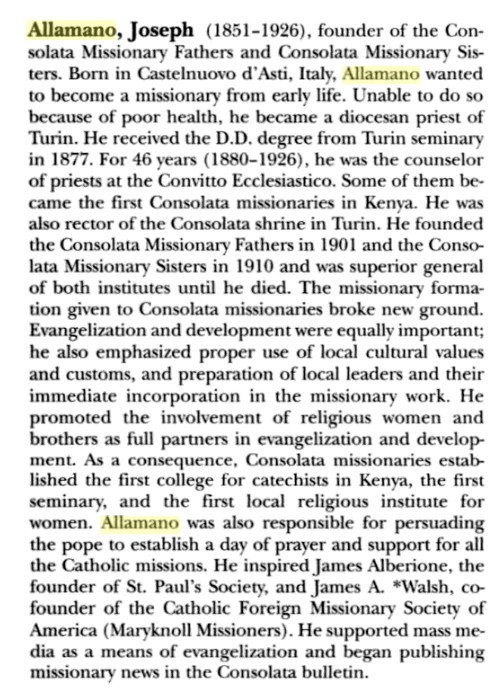
St. Giuseppe Allamano

Feast Day: February 16th

(We finally get to the saint behind the miraculous healing of Sorino Yanomami.) Giuseppe Ottavio Allamano was born in Asti, Italy, in 1851. His uncle was actually the wonderful “saint of the gallows”, Fr. Joseph Cafasso, and in his youth Giuseppe attended the oratory under St. John Bosco in Valdocco. These were influences towards his own entry into seminary in 1866, though at that time he was not at all certain that the Lord was calling him to be a priest, “The Lord is calling me today … I don’t know if he will call me again in two or three years.” So began his lifelong growth in learning to discern God’s will, happily including his ordination as a priest in 1873 for the Diocese of Turin. His first years of priesthood were as a spiritual director in the seminary, and completing his doctorate in theology. In 1876, he was made the rector of the seminary and a few years later (at the age of 29!) the rector of the Sanctuary della Maria della Consolazione (commonly simply called “La Consolata”). It was an ancient site of worship, and the spiritual heart of Turin, and Fr. Allamano was determined to be part of its renewal. He constructed additional chapels, restored the ceiling, and also worked on spiritual initiatives to build up the faith of the city including starting a monthly Catholic newspaper, La Consolata in 1899.

But it was his own brush with death in 1891 that brought him to discern that God was asking him even further off the standard path of a diocesan priest: to found a religious order dedicated to the missions. He had never been on mission, and would never even travel outside of Italy because of his poor health, but he found it “unnatural that in his Church, fertile with so many  charity institutions, one solely dedicated to the missions was lacking”. And so, on January 29th, 1901, the Istituto Missioni Consolata was established. “Not having been able to be a missionary myself, I want those souls who wish to follow that path not to be hindered”. Yet, thinking again it seems, he also said ”the vocation to the missions is essentially the vocation of every holy Priest. All it takes is a greater love for our Lord Jesus Christ, which urges one to make him known and loved by those who do not yet know him and love him.”

It had taken 10 years to get the order off the ground – as he would also say, dioceses were willing to give money, but not men, for the missions. It was another decade later, with his brothers and fathers on mission all over the world, that he realized something deeply lacking in their efforts without women also carrying the Gospel to all those places. He needed not just spiritual fathers, but also mothers, to care for the poor and unevangelized around the world. He met, and received the approval of Pope Pius X to found a female branch of the Institute of the Consolata Missionaries in 1910 … and was not done yet. In 1912 he met the pope again, this time begging him to establish an annual day to proclaim the importance of mission to the whole church. Yes, to encourage those called to be missionaries, but also anticipating by decades the Second Vatican Council’s proclamation of the universal missionary vocation of the whole church.

Then war broke out in the Balkans, and Archduke Franz Ferdinand was assassinated in 1914, and World War I engulfed Europe. Pope Pius X was consumed by the horrors of war, and Fr. Allamano spent his time caring for his order abroad, and the many refugees and draftees from the war in the area around Turin. He died in February 1926. BUT, the great missionary zeal which had marked his life was not to be snuffed out! In 1927, Pope Pius XI instituted World Mission Sunday, which continues to our day to be celebrated every year in October. We happily already have Pope Francis’ words for this upcoming one of October 19, 2025 where he speaks to missionaries, like the Consolata fathers and sisters, and then to all of us:

I thank you most heartily! Your lives are a clear response to the command of the risen Christ, who sent his disciples to evangelize all peoples (cf. Mt 28:18-20). In this way, you are signs of the universal vocation of the baptized to become, by the power of the Spirit and daily effort, missionaries among all peoples and witnesses to the great hope given us by the Lord Jesus.

– Fr. Dominic is amazed at how impactful one diocesan priest can be all over the world a century after his death. Not only the many conversions, but now also the miraculous cure of Sorino Yanomami and the radical openness in the local tribes that was only possible after such a divine intervention.

« Previous Page
Next Page »

Liturgy

Sunday Masses (unless noted differently in weekly bulletin)
Saturday Evening Vigil – 4:00PM
Sunday – 7:00AM, 10:00AM and 5:00PM

Weekday Masses (unless noted differently in weekly bulletin)
Monday thru Friday – 7:00AM and 5:15PM
Saturday – 8:00AM

Reconciliation (Confessions)
Monday thru Friday – 4:15PM to 5:00PM
Saturday – 9:00AM to 10:00AM and 2:30PM to 3:30PM
Sunday – 4:00PM to 4:45PM

Adoration
Tuesdays and Thursdays – 4:00PM to 5:00PM


CatholicMassTime.org

Parish Information

Parish Address
524 East Lawrence Avenue
Springfield, Illinois 62703

Parish Office Hours
Monday thru Thursday – 8:00AM to 4:00PM
Fridays – CLOSED

Parish Phone
(217) 522-3342

Parish Fax
(217) 210-0136

Parish Staff

Contact Us

Contact Us

Copyright © 2025 · Log in