Cathedral of the Immaculate Conception

Springfield, IL

  • About
    • Contact Us
    • History of the Cathedral
    • Liturgical Schedules
    • Parish Staff
    • Register with Cathedral
    • Subscribe to the Cathedral eWeekly
  • Sacraments
    • Baptism
    • Becoming Catholic
    • Matrimony
    • Vocations
  • Ministry List
    • Adult Faith Formation
    • Cathedral Meal Train
    • Cathedral Online Prayer Wall
    • Cathedral Concerts
    • Family of Faith
    • Grief Share
    • Health and Wellness
    • Spiritual Resources
  • Stewardship
    • Stewardship: A Disciple’s Response
    • Stewardship Form
  • Support
    • E-Giving Frequently Asked Questions
    • Give Online
  • Sunday News
    • Announcements
    • Cathedral Weekly
    • Livestream Feed
    • Submit a Mass Intention Request
    • Weekly or Announcement Submission

Christmas Mass Sign Up

Rejoice, the Lord is Near

The Third Sunday of Advent is traditionally known as Gaudete Sunday.  It gets its title from the Entrance Antiphon for Mass: “Rejoice in the Lord always; again I say, rejoice.  Indeed, the Lord is near.” (Philippians 4:4-5). Gaudete is the Latin word for ‘Rejoice’, thus this Sunday being named this way.  To highlight this joyful attitude we are commanded to have, the Church permits her clergy to wear rose vestments on this Sunday. 

Joy is a word that we often associate with Advent and Christmas.  The birth of Jesus was a joyful event.  At the Mass during the Night on Christmas, the Gospel from St. Luke recalls that moment when the angel appeared to the shepherds outside of Bethlehem with these words: “Do not be afraid; for behold, I proclaim to you good news of great joy that will be for all the people. For today in the city of David a savior has been born for you who is Messiah and Lord.” (Lk 2:10-11)

Joy is a gift that we all desire, yet it can often be elusive.  In our attempt to experience joy, we grasp at things that may bring pleasure and happiness, but we often find that those feelings last only for a while, and we go back to the same source, or look somewhere else to find something that we hope will fulfill us.  But true joy is a gift we cannot buy, cannot take, cannot own.  Joy is a gift that can only be received from the one who alone can give it, our Lord.

In his homily last Saturday during our Immaculate Conception Novena, Deacon Larry Smith reminded us that joy is a fruit of the Holy Spirit.  Just as a piece of fruit cannot come about except from a tree or plant, so too can joy only come from the source which is to be found in God.  The more we share in the life of God, living according to His will, following His teachings, and remining in His grace, the more we will experience the true joy for which our hearts long.

The Sacrament of Confirmation increases the Gifts of the Holy Spirit within us, and the more we allow those gifts to guide us, the more plentiful will be all of the fruits of the Spirit, which, in addition to joy, are as follows: charity, peace, patience, kindness, goodness, generosity, gentleness, faithfulness, modesty, self-control, chastity.  As we slowly read that list, do not our hearts burn within us, desiring to have those fruits a part of our lives?  We cannot go to the grocery store to pick up these fruits.  We cannot order them on the Internet.  We cannot create them with anything that we have.  Only God can give this gift.  And the good news is this: He wants to give these fruits to us in abundance!  With that in mind, how can we not rejoice?

As we continue our Advent journey toward Christmas, in addition to praying: “Come, Lord, Jesus”, let us be quick to add: “Come, Holy Spirit”, that our hearts will not put up any resistance to the prompting of the Holy Spirit, which will yield an abundant harvest of His fruits for us to enjoy.

Father Alford     
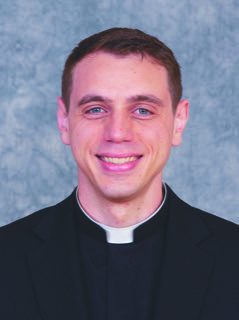
A Sacred Anointing

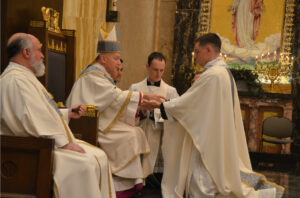
In his article last week, Fr. Alford reflected on the use of the Sacred Chrism in the three of the sacraments: Baptism, Confirmation, and Holy Orders. When I was ordained a priest in June, Bishop Paprocki smeared the Sacred Chrism on the palms of my hands to set them apart for the ministerial priesthood of Jesus, making them holy to consecrate the Eucharist and forgive sins. The Sacred Chrism carries a distinctly beautiful smell, which can often be smelled on a newly baptized baby’s head for the rest of the day after his or her baptism! Unfortunately for me and my classmates, we had to use alcohol-based hand sanitizer before distributing Communion at our ordination Mass, so the smell of Chrism was gone before Mass was even over. But the important part is that our hands were consecrated, and we were ordained priests! There is a tradition that after receiving a priest’s first blessing, the one receiving the blessing kisses the palms of the new priest’s hands. Covid mostly prevented that tradition this time around, but once again, I am grateful to have been ordained a priest even during a pandemic. 

Bishop Paprocki uses Sacred Chrism to anoint the hands of newly-ordained Fr. Dominic Vahling.

Whenever I have the privilege of receiving a new child into the Church through baptism, I anoint the baby on the top of the head with this same Sacred Chrism which was used at my priestly ordination. The smell of the Chrism on my thumb reminds me of my ordination, and I hope it always does. The distinct smell comes from the sweet-smelling balsam perfume which is added to olive or vegetable oil when it is consecrated by the Bishop at the Chrism Mass the week before Easter. It is interesting that this annual Mass, an ancient Christian tradition, draws its name from the Chrism itself. This shows just how important this sacred oil is in the life of the Church. This Mass is the occasion for all the priests of the diocese to renew their promises to the bishop, and the unity of the diocese under one bishop is strengthened and reaffirmed. I’m looking forward to my first Chrism Mass as a priest, which I hope to attend during Holy Week of 2021. 

The scent of Chrism has even worked its way into other parts of our society. It is common to find candles, essential oils, and even beard balm that have been scented with the sweet balsam commonly used for the Sacred Chrism. The Church, in her wisdom, knows how to use beautiful things for the glory of God, even something simple like a sweet perfume. This sweetness signifies the love that God has for each one of us, his children! 

St. John of the Cross

Feast Day: December 13th  

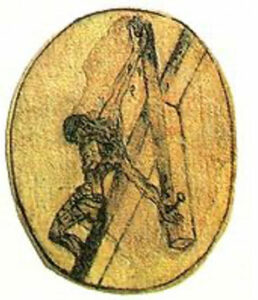
Today I want to tell the story of a sketch.  Of course, it has to do with the saint we celebrate this week – St. John of the Cross – but I think it captures so much of his heart and mysticism and sanctity, that it offers all of us all a chance to follow after him on the road to heaven.

Juan was born in Spain in 1542, which means he entered a divided and violent world.  Martin Luther would die 4 years later, unreconciled to the Catholic Church, and having set in motion the protestant reformation that would fracture Christianity, and insight the bloody religious then starting around Europe.  Of course, much of Luther’s complaints stemmed from real abuses that marred the mystical body of Christ, but, as always, the call of Christians is to assist Our Lord in building up the Church, never in tearing it asunder.  Don’t abandon, assist.  Don’t complain, cleanse.  Don’t reject, reform. Don’t leave, love.  

That call was heard by John of the Cross.  It was heard by many saints that appeared during these trying years.  St. Philip Neri, St. Charles Borromeo, St. Francis Xavier, St. Ignatius of Loyola, St. Thomas More, St. John Fisher, St. Francis de Sales, St. Peter Canisius, Pope St. Pius V, St. Theresa of Avila…  All these and more would be God’s beacons of sanctity in the midst of a terrible century.  God never leaves, He just keeps loving.

But back to St. John, and his drawing.  At the age of 21, John entered the Carmelite Order and began his study of theology and philosophy, culminating in his ordination as a Carmelite priest in 1567.  Seeing the depravity and laxity rampant around him, John seriously considered leaving them to become a Carthusian, but God had other plans.  The young priest encountered a Carmelite nun, Teresa of Ávila, and was captivated by her dream to reform the Carmelite order.  Don’t leave, love.

In their efforts to reform the order, John (now “of the Cross”) would be suppressed, then imprisoned, even tortured, and would travel many thousands of kilometers founding and leading the struggling communities, in the end being completely exhausted by his efforts.  But finally in 1580, the Discalced Carmelites (literally meaning “un-shod”, referring to their taking up the original penance of the Carmelites to not wear shoes) were approved as a new branch of the order by Pope Gregory XIII.  It was during these, his final years that he composed Living Flame of Love, his shortest poem, but hauntingly poignant.  If I might be bold, it could also be summarized: Don’t leave, love.

  1. Oh, living flame of love
    That tenderly woundest my soul in its deepest centre,
    Since thou art no longer oppressive, perfect me now if it be thy will,
    Break the web of this sweet encounter.
  2. Oh, sweet burn! Oh, delectable wound!
    Oh, soft hand! Oh, delicate touch
    That savours of eternal life and pays every debt!
    In slaying, thou hast changed death into life.
  3. Oh, lamps of fire,
    In whose splendours the deep caverns of sense
    Which were dark and blind with strange brightness
    Give heat and light together to their Beloved!
  4. How gently and lovingly thou awakenest in my bosom,
    Where thou dwellest secretly and alone!
    And in thy sweet breathing, full of blessing and glory,
    How delicately thou inspirest my love!

But what about that sketch?  For that we have to go back to those first years after meeting Teresa.  He had just barely decided not to become a Carthusian.  He had yet to be beaten by his own brothers.  He had yet to crisscross Spain.  And yet, as he wedged himself in the choir loft in Ávila, his prayer carried him to the cross, and then up over it, to see it as the Father did. 

Drawing of the Crucifixion, St. John of the Cross, 1574/77.

Christ hangs in darkness and suffering, spurned and provoked … but He did not leave, He loved.

The Father glances down, His greatest gift rejected … but He didn’t leave, He loved.

The Spirit is poured forth, upon a world torn and terrible … but He didn’t leave, He loved.

And so did John, and so must we.

– Fr. Dominic Rankin often simply looks at the crucifix if prayer isn’t easy, and he recently discovered that the Heavenly Father, speaking to St. John, Himself encourages just that: “Fasten your eyes on him alone because in him I have spoken and revealed all, and in him you will discover even more than you ask for and desire … If you desire me to answer with a word of comfort, behold my Son subject to me and to others out of love for me, and afflicted, and you will see how much he answers you.” [Ascent of Mt. Carmel, St. John of the Cross, chapter 22, 5-6]

Mass Intentions for the Week of December 14

Monday, December 14

7am – Ralph Walter, Sr.
(Jean Moss)

5:15pm – Rosemary Patton
(Rob & Jan Sgambelluri)

Tuesday, December 15

7am – Doris Drea
(Missouri AFL-CIO)

5:15pm – Ben Garding
(Family)

Wednesday, December 16

7am – Ryan Williams
(LouAnn & Carl Corrigan)

5:15pm – Helen Ziegler
(William & Debra Stonikas)

Thursday, December 17

7am – Anna A. Eleyidath
(Augustine Eleyidath)

5:15pm – Lemuel Moss
(Jean Moss)

Friday, December 18

7am – Joseph Klein
(Andrew & Cheryl Klein Family)

5:15pm – Victoria Selburg
(Bernie Ely)

Saturday, December 19

8am – Frank Coffey
(Family)

4pm – Barbara J. McGrath
(Family & Friends)

Sunday, December 20

7am – Mary Ann Midden
(William Midden)

10am – For the People

5pm – Presca F. Simbajon
(Lolita F. Klicker)

Prayer Wall – 12/04/2020

please pray for a single mother going through an extremely hard time

Be Sealed with the Gift of the Holy Spirit

With the recent mitigations in place to slow the spread of COVID-19 in our state, we had to make the difficult decision to suspend several of our in-person activities for Faith Formation, including our Family of Faith program for our children.  But we can see God’s Providence working in having our parish switch to this model last year, giving our families the experience to undertake the important work of faith formation in their homes, the domestic church.  Even though we are not gathering physically as a group, we continue to move forward!

As we move into December, the sacrament of the month is the Sacrament of Confirmation.  According to the Catechism of the Catholic Church, Confirmation completes the grace of Baptism, so it is only logical that we focus on this sacrament after having just completed a month with Baptism.  I would like to focus on what is called the “essential rite” of Confirmation, which is what is absolutely necessary for the sacrament to be conferred validly.  Here is what the Catechism says: 

The essential rite of the sacrament follows. In the Latin rite, “the sacrament of Confirmation is conferred through the anointing with chrism on the forehead, which is done by the laying on of the hand, and through the words: ‘Accipe signaculum doni Spiritus Sancti‘ [Be sealed with the Gift of the Holy Spirit.].” (CCC 1300)

The use of Sacred Chrism for this sacrament is worth reflecting on for a moment.  This holy oil is used anytime the Church consecrates somebody for a special mission.  At Baptism, the newly baptized anointed with Sacred Chrism and is set apart as a child of God, called to live a life of holiness and to one day be in Heaven.  Confirmation sets us apart for the spreading and defending of the faith, aided by the new outpouring of the Gifts of the Holy Spirit.  Bishops and Priests are anointed with Sacred Chrism at their ordination, signifying that they are set apart for their participation in the ministerial priesthood of Jesus Christ in service to the people of God, especially though the celebration of the sacraments. 

Sacred Chrism is also used to consecrate things.  In particular, it is used to consecrate churches and altars, for these are set aside for the purpose of offering a sacred place in which to worship God and to offer the sacrifice of the Mass.  Just this past week, on December 2, we celebrated the Anniversary of the Re-Dedication of our Cathedral.  One of the greatest parts of that ceremony was the consecration of the new altar.  I remember vividly that moment of the Mass as Archbishop Lucas spread the Sacred Chrism all over the altar, creating that beautiful aroma that comes from that holy oil.  Since that day, the altar has served its purpose of being a place set apart for God.  May we recall the day of our Confirmation (if we have been confirmed) and ask for the grace to rededicate ourselves to living our vocation to be set apart for the spreading and defending the faith in our daily lives, confident of the power of the Gifts of the Holy Spirit to assist us.

Father Alford     

Who is Confirming Whom?

This month we are focusing on the Sacrament of Confirmation in our bulletin columns. For several years now, the parishes of our diocese have been in the process of implementing the “restored order” of the Sacraments of Initiation. Confirmation is the second sacrament of Initiation, which is why it is more appropriate to receive it before receiving first Holy Communion. 

There is a mistaken understanding that some hold in our Church today, which comes from the meaning of the word “Confirmation.” Confirmation in this sense means a strengthening or fortifying. It’s like putting a spiritual suit of armor on a new Christian! Because Confirmation was given around the time of adolescence for several decades in the United States, the understanding has been flip-flopped. I remember at the time I was Confirmed that my classmates and I understood that we were confirming our belief in Jesus. This is obviously a very good thing to do, and one that we do every day as Christians. However, receiving a sacrament is not about what we do for God, but what God does for us. 

This misunderstanding is not a new idea in the Church, and even the Council of Trent (around 1550) spoke about this. One of the statements of this ecumenical council was, “If anyone says that the Confirmation of those who have been baptized is a catechism whereby those near adolescence give an account of their faith in the face of the Church, let him be anathema.” This is a normal formula used by Church councils to explain that an idea is not in accord with the Catholic Faith. This statement was a response to some Christians who believed that while Baptism was a sacrament, Confirmation was not a true sacrament and was simply a way for youth to express their faith. 

As with all the sacraments, it is important to keep in mind that the sacraments impart God’s divine life to us. Expressing our faith is, of course, an essential part of the Christian life, but sacraments are all about receptivity. Some Christian traditions give babies Confirmation in the same ceremony as Baptism, which really emphasizes the receptive aspect of the sacraments! 

More and more dioceses are moving to implement the restored order of Baptism, Confirmation, and Eucharist around the country. Hopefully younger children receiving this great sacrament will be more receptive than older teenagers who have often already checked out of their faith life or abandoned it altogether. Every day, we should ask the Holy Spirit to be with us and fill with his love which was increased and strengthened in our reception of the sacrament of Confirmation.

Come Holy Spirit, fill the hearts of your faithful, and enkindle in them the fire of your love. Send forth your Spirit, and they shall be created, and you shall renew the face of the earth. 

St. Ambrose: Silence, Scripture, and Song

Feast Day: December 7th  

On April 4th in the year 397, early on Easter Saturday, the Bishop Ambrose of Milan was dying.  His life was marvelous.  He had been elected to the episcopacy by popular acclaim (before he was baptized!  He had to receive all his sacraments on top of each other before being ordained bishop), fought heresies (Arianism especially, which said Jesus was not truly God), stood up to emperors (Theodosius I, for persecuting Jews and massacring the Thessalonians), and brought about the conversion of St. Augustine (of course, with the help of St. Monica’s prayers). 

I could speak on any of those tremendous accomplishments, but today I rejoice to stick to a simpler part of his life.  As he lay on his deathbed, Paulinus, his deacon, who was with him in his final moments, records: “we saw his lips moving … but we could not hear his voice” [St. Paulinus, Life of Ambrose].  It would not be a noticeable comment – perhaps these were Ambrose’s final whispered prayers – except for the fact that St. Augustine had written a similar line about Ambrose, his great mentor and friend, many years before: 

When [Ambrose] read, his eyes scanned the page and his heart sought out the meaning, but his voice was silent and his tongue was still. Anyone could approach him freely and guests were not commonly announced, so that often, when we came to visit him, we found him reading like this in silence, for he never read aloud.
[St. Augustine, Confessions, Book 3, Chapter 6]

At that time, surprisingly enough, it was uncommon for anyone to read silently.  We have a few records of others in the ancient world who did so, but otherwise, the vast majority of everyone who could read, only did so out loud.  Even if someone were just reading by themselves, they would still vocalize the words, or a person would have someone else read to them.

Now, that would remain just an interesting factoid except for the tremendous fact that Christianity is a religion of the Word, and Ambrose’s practice came from his love for the Word of God.  Augustine also tells us that Ambrose, when he was consecrated bishop, immediately sold practically all the possessions he had (as an orator and governor) except for his books.  He was a very literate and studious man, but as a bishop, and saint-in-the-making, this was his choice to prioritize the Word of God over even all the other books that he treasured.  His labor over the books of scripture each day – the Psalms, Isaiah, Jeremiah, Matthew, Luke… – these were His daily sustenance and informed every other aspect of his life.  His courage, eloquence, simplicity, wisdom, hymnody, and generosity … all flowed from his being saturated by the Bible.

We call Ambrose a doctor of the Church because this biblical foundation to his life flowed forth in his teaching, and his composition of some of the greatest hymns the Church has.  Both are splendid tapestries of word, woven from the threads of scripture, and they have given Ambrose the nickname “honey-tongued” (for this reason he is the patron of beekeepers…  Things you learn!)  I will leave you with one of his best hymns, perfect for our continued meditation this Advent.  (The language is even more splendid in its original Latin!)

Mosaic of St. Ambrose, Basilica di Sant’Ambrogio, Milan, Italy, 5th century. http://milanoarcheologia.beniculturali.it/?page_id=4296 

Veni, Redemptor Gentium

1. Come, thou Redeemer of the earth,
and manifest thy virgin-birth:
let every age adoring fall;
such birth befits the God of all.

2. Begotten of no human will,
But of the Spirit, Thou art still
The Word of God in flesh arrayed,
The promised fruit to men displayed.

3. The virgin womb that burden gained
With virgin honor all unstained;
The banners there of virtue glow;
God in His temple dwells below.

4. Forth from His chamber goeth He,
That royal home of purity,
A giant in two-fold substance one,
Rejoicing now His course to run.

5. From God the Father He proceeds,
To God the Father back He speeds;
His course He runs to death and hell,
Returning on God’s throne to dwell.

6. O equal to the Father, Thou!
Gird on Thy fleshly mantle now;
The weakness of our mortal state
With deathless might invigorate.

7. Thy cradle here shall glitter bright
And darkness breathe a newer light,
Where endless faith shall shine serene,
And twilight never intervene.

 – Fr. Dominic Rankin always struggles to answer the question “what kind of music do you like?” I like many classical pieces, especially orchestral works, certainly sacred music and Gregorian chant, Christian singers, some pop pieces, many different vocal groups/individuals, especially acapella and what is unhelpfully described as “easy listening”.  What is a song that you are grateful for?  Let me know, I want to give it a listen!  For now, enjoy a video of Ambrose’s Veni, Redemptor Omnium:

Week of December 7 Mass Intentions

Monday, December 7

7am – William F. Logan
(Lisa Logan & Lori Motyka)

5:15pm – Patria & Rufino Gotanco
(Joe & Hati Uy)

Tuesday, December 8

7am – For the People

12:05pm – Boyd Warner
(Sue Warner & Family)

5:15pm – Bobby House
(Family)

Wednesday, December 9

7am – Betty & Gene Barish
(Family)

5:15pm – Shirley Logan
(Lisa Logan & Lori Motyka)

Thursday, December 10

7am – Steve Hergenrother
(Thomas Hergenrother)

5:15pm – Mathias Bates
(Bates Family)

Friday, December 11

7am – Anna A. Eleyidath
(Augustine Eleyidath)

5:15pm – Special Intention for Bianca
(D.A. Drago)

Saturday, December 12

8am – Helen Zeigler
(William & Debra Stonikas)

4pm – Becky Morgan
(Carol Morgan)

Sunday, December 13

7am – For the People

10am – Fr. Eugene Prindiville, OMI
(Rebecca & Woody Woodhull)

5pm – Anne Gustafon
(Jeannette Giannone)

« Previous Page
Next Page »

Liturgy

Sunday Masses (unless noted differently in weekly bulletin)
Saturday Evening Vigil – 4:00PM
Sunday – 7:00AM, 10:00AM and 5:00PM

Weekday Masses (unless noted differently in weekly bulletin)
Monday thru Friday – 7:00AM and 5:15PM
Saturday – 8:00AM

Reconciliation (Confessions)
Monday thru Friday – 4:15PM to 5:00PM
Saturday – 9:00AM to 10:00AM and 2:30PM to 3:30PM
Sunday – 4:00PM to 4:45PM

Adoration
Tuesdays and Thursdays – 4:00PM to 5:00PM


CatholicMassTime.org

Parish Information

Parish Address
524 East Lawrence Avenue
Springfield, Illinois 62703

Parish Office Hours
Monday thru Thursday – 8:00AM to 4:00PM
Fridays – CLOSED

Parish Phone
(217) 522-3342

Parish Fax
(217) 210-0136

Parish Staff

Contact Us

Contact Us

Copyright © 2026 · Log in