Dear God, Please let my son in law , Will Carpender, be cured of his cancer.
Prayer Wall – 02/01/2020
My daughter is mentally ill. Her disease has landed her in jail. Please pray the system gets her treatment, and she accepts it.
Prayer Wall – 02/01/2020
Please pray for my friend who is in great pain with testing to determine cause. She’s a wonderful friend, teacher, and nurse. May Jesus, our ultimate physician, guide her and her care team to real answers.
Prayer Wall – 01/31/2020
Please pray for my mom Rita. Cancer cells were found in fluid drained from her lung. She has a pet scan on Mon February 3. We won’t have any answers for awhile. She turns 90 on Feb 21.
Prayer Wall – 01/31/2020
Please pray for my son John who is 17 and is very angry with God. Please pray that the lord blesses him with a spirit of strength and assurance and replaces his spirit of anxiety and fear. Please pray that God blesses John with a peace that surpasses all understanding and that he would come to know
Prayer Wall – 01/31/2020
Please pray for the repose of the soul of Trent Barnard and for his family.
The Light That Never Fades
Punxsutawney Phil can thank Catholic culture and tradition for his notoriety. In national lore, Phil, America’s favorite rodent, has been prognosticating longer winters or early springs since the late 19th century. The tradition of Groundhog Day comes from a German tradition, via the Pennsylvania Deutsch, of a badger being the weather predictor. Both are secularizations of an old Candlemas tradition, a feast that goes back to the 4th century. There is an old rhyme that says: If Candlemas be fair and bright, come winter, have another flight; if Candlemas bring clouds and rain, go winter, and come not again.
This Sunday, February 2nd, we celebrate the 40th day since Christmas with the Feast of the Presentation of the Lord. The Church remembers that, in fulfillment of the Levitical law (Lev. 12:1-8), having circumcised Jesus on the 8th day, the Holy Family came into the Temple to complete Mary’s purification as commanded by the law and to offer the proper sacrifice because of the newborn Jesus. The Feast of the Presentation’s more traditional name is Candlemas, literally meaning the Mass of Candles, because this is also the day when the Church traditionally blesses all her candles for the coming year. Candles are blessed on this feast because Jesus is the light that has come into the world, a light even for the Gentiles, as Simeon states and is recorded for us in the second chapter of the Gospel of Luke.
Luke’s narrative of the Presentation introduces us to Simeon and Anna. We are told that Anna was eighty-four years old, was a prophetess, and remained in the Temple constantly. Luke does not recount an encounter between her and the Holy Family but we can deduce that it happened because tells us that Anna “spoke about the child to all who were awaiting the redemption of Jerusalem,” and this encounter must have brought her great joy. Luke does recount for us Simeon’s encounter with the infant Jesus and the mystery that God had made a personal promise to Simeon that he would not die until he had seen the Messiah. After many years of waiting, God’s promise to Simeon is fulfilled and Simeon’s response is one of a prayer of praise that heralds who this child is and what this child shall be. This prayer or Canticle of Simeon, known in Latin as the Nunc Dimittis, is central to the Church’s life of prayer in the Liturgy of the Hours and is prayed at the end of every day in the Church’s night prayer.
From whether or not winter will end early, to Simeon’s heralding of the infant Jesus as a light of revelation, to the blessing of candles, the Feast of the Presentation is a feast of light; not just any light, but Christ who is the light who has come to scatter the darkness. Unlike Simeon, we don’t have to wait for the light to appear. The Lord Jesus remains. He is always present to us, especially in our darkest times, but we, as disciples, must make the conscious choice to walk with Him who is Light from Light.
 The light of Christmas in the crèche and the poinsettias and the trees, all these things now finally fade away at the end of these forty days, but not our Lord Jesus Christ. He is the true light of Christmas that knows no season, in whom there is no darkness, and who seeks to show us the way each and every day. May we cooperate with the grace of God given to us so that we might follow the Light wherever He leads us, ultimately home to the Father.
Father Christopher House is the Rector of the Cathedral and serves in various leadership roles within the diocesan curia, namely Chancellor and Vicar Judicial.
Noisy Children at Mass Are Part of Our Catholic Community
 I once sat behind an older man who was angry because our then-3-year-old was talking in church. The man spent the entire Mass huffing and puffing, visibly rolling his eyes, and shooting dirty looks at us. As if that didn’t make me feel bad enough, at the sign of peace, he refused to shake any of our hands, or even make eye contact. Embarrassment turned into anger as we left, and I let his attitude of disapproval get the best of me for the rest of the day.
Whenever I write about kids being distracting at Mass, someone always comments that it’s because parents don’t discipline or teach kids how to behave.
Their kids behaved in Mass.
Their grandkids do.
Their neighbor’s friend’s second cousin has a 3-year-old who is so pious, they canonized her right after Mass at doughnuts and coffee in the hall!
For years, I dreaded Sunday mornings. I tried to talk myself out of going to Mass so we wouldn’t have to bother with any of it. Each week, my husband reminded me that we needed to go, and our very normal kids were just being kids.
Sometimes, people were thoughtful and kind. We once had an older couple ask to hold our son. We let them, and he sat and quietly played with the woman’s necklace for the remainder of Mass. Another woman stopped us to say she enjoys watching our family every Sunday. We’ve had people lean over and tell us we’re doing a great job even if our family had been one elephant short of a circus (we have plenty of clowns). But, I can probably count on one hand the times I’ve felt affirmed for bringing my kids to Mass compared to the times we’ve visibly bothered other people.
I think I speak for a lot of parents when I say that I wish people were more patient and understanding. Our kids have a right to be at Mass. As baptized members of the faith, they are part of the Catholic community, and they’re the future of the Church.
Families are not trying to be disruptive. We don’t want to take away from the Mass, but we also don’t want to teach our kids that all they have to do is be loud and we’ll take them out of the church. I understand many parishes have cry rooms, but by sitting in the chapel, most of us want to set an example for our kids of how to behave. We want them to see what goes on, be a part of the congregation, and understand what’s expected of them so they can learn the routine. Our kids can’t learn how to behave in Mass if they are never in Mass.
I liken this season of life with small kids to a test of patience and perseverance. Like a dark night of the soul, I’m often left feeling blah about attending Mass. I get nothing from the readings and homilies most weeks because I’m interfering with my child to stop dropping the hymnal, or telling him to be quiet so people around him can pray. I’m faced with the choice to give up on Mass because it feels like going through the motions: I can surrender to the temptation of just staying home (because it’s easier), or persevere (despite the dry feeling I often have).
Sometimes all we have when it comes to our faith is perseverance, especially when it’s hard. If I stop going to Mass because my kids are little and loud, or busy and distracting, I set an example for them that church isn’t important. If I quit, I will have failed God, who entrusted my children to me so that I could love them and raise them to love him.
When we baptized our children, we promised we would raise them in the faith. I have come to understand that motherhood is my vocation and a huge part of that is to make sure my kids have a foundation in their Christian faith. Even though they don’t seem to be doing much praying during Mass, they are immersed in prayer. (I know because our 5-year-old sometimes recites snippets of the creed when he plays with his trucks.)
I, like many parents, have discovered that children learn by continual repetition. They don’t learn to walk the first time you stand them up. They don’t learn how to eat from a spoon after the first feeding. It all takes practice and patience. So, of course they don’t learn how to be silently still in Mass just because they are there.
My hope is that people will grow to make families with little kids feel more welcome. We should not only embrace young families at Mass, but celebrate them. We have to nurture our community or there won’t be one.
My hope is the next time someone finds themselves getting annoyed by someone’s child, they ask God to show them how they can serve these people. Maybe a friendly smile is all it takes to keep that family coming back and not giving up on their faith because they’re made to feel like an annoyance. I often think back to the kind couple who held our son at Mass. I don’t think they realized how meaningful their gesture was. For the rest of that Mass, we felt like we were part of a community of people who embraced our family. It was refreshing.
So, you never know, maybe your gesture really is the first step in the future canonization of one of these little ones. Or, maybe you’ll just befriend the family and have new friends to eat doughnuts with in the hall after Mass.
Christina Antus lives with her husband and her three cute, but noisy, kids. When she’s not writing, she’s running, reading, folding forever-piles of laundry, and probably burning dinner. You can read more of Christina’s writing at www.heykristeenuh.com/
Lessons From The Night Sky
 New York City isn’t known for its stars (of the celestial variety, at least). It may be one of the world’s greatest cities — boasting of culture, theater, restaurants, and museums—but one thing it doesn’t have is a clear night sky. As much as my fellow New York transplants lament visiting our hometowns where restaurants are barely open past 10 p.m., we equally despise the claustrophobia that comes from spending too many hours in the city underground. Sometimes, quite simply, it can be hard to catch your breath.
So while the city lights can dazzle, they tend to drown out the lights sparkling in the night sky. Recently a friend and I were in Central Park at dusk, and while critiquing the one “tall, horrible” building peeking up above the tree line and ruining the illusion of our wooded haven, we spotted a noticeably bright star. We were transfixed. Could a star be that bright? Maybe it was just a plane? Perhaps it was a planet? “Yeah, I see that, too!” a stranger chimed in, unashamedly eavesdropping as we murmured our theories to each other.
In reality, it mostly looked so bright to us because we aren’t used to seeing twinkling lights that aren’t on theater marquees or in fancy lounges. But this moment of wonder transported me from the bustle of the city back to one of my favorite vacation memories. My family had rented a small beach house in a relatively remote section of North Carolina. A local resident informed us one night that there was going to be a meteor shower, and I was instantly intrigued. So because we were on vacation — and when you’re on vacation, there are no rules — I stayed awake past my usual bedtime to see the shower. I remember lying on the deck on my beach towel (still dotted with grains of sand and damp in some spots) surrounded by my family. Even though a day well spent running around in the sun meant that sleep was tugging at my eyes, I kept them wide open and aimed at the sky and waited.
The meteors were spectacular. I remember seeing about a dozen, my family and me shouting out the count and pointing at each little spark. Just these tiny streaks of light deciding in turn when to make themselves known, hardly seeming any bigger than a firefly passing by my nose but a million times more thrilling.
Stars and the sky evoke a lot of images — usually all wishes and romance — but I most remember how the meteor shower made me feel both big and small … and a little bit unsettled. This beautiful vastness has helped me come to better understand the spiritual gift of Fear of the Lord. I first learned about this “gift” in religious education classes in middle school, and I was immediately skeptical. It’s jarring to think of fear as a gift (I’d much rather get a gift card or something from Etsy). And it couldn’t possibly be true that we’re supposed to be afraid of God … right?
And we’re not, really. This type of fear is a humility that empowers and nourishes us. It’s experiencing a world — and a God — so big we can never fully understand it, yet letting it blanket us with comfort. It’s perhaps more easily thought of as awe: that sometimes indescribable feeling of being in the presence of something that feels much greater than us. Feeling small can be scary, and the antidote is recognizing that there is something much bigger that can reassure us. It’s why as children we climb into our parents’ beds during a thunderstorm, and it’s why we have the instinct to turn to God in prayer when we’re feeling troubled. It’s why, even though the meteors were farther away than my 7-year-old mind could conceive, they also made me feel as though I were a part of something, a spectacular show just for my family of four. I still feel a peaceful wonder to think about this meteor shower now, almost 20 years later.
Once I was able to recognize this fear as a kind of awe, I understood it was a gift I actually wanted. Fear often preserves, and this is the type of fear that unlocks the humility that keeps us yearning for God and looking for opportunities to grow closer to and trust Him. Vacation itself helps unlock this very yearning; it helps us break from our routine and experience something new, cloaked in the comfort of a renewed spirit. It’s why we go seek the places we do: the crashing ocean waves that also soothe, the wondrous mountaintops we try to summit, exotic foreign cities teeming with culture. We want to feel refreshed and awed — and also humbled — by what’s out there.
That evening in Central Park, it was wonderful to ponder the one sole speck of light in the night sky above the city. So bright we couldn’t define what it was. Granting a small respite from the typical gray skyline and background static of honking cars, the moment brought back the memories of my childlike wonder … not unlike that of a few New Yorkers remembering to look up at the night sky.
Natalie Vielkind lives in Brooklyn and works in children’s book publishing. She has a degree in English from the University of Pennsylvania.
Carry the Light of Faith
 St. Luke tells us that Mary and Joseph, in keeping with the Law of Moses, presented the Child Jesus to God in the Temple in Jerusalem 40 days after his birth. This would also have been the time of Mary’s ritual purification following the birth of her child. We read that they offered to God the sacrifice of poor people: a pair of turtledoves or young pigeons. Simeon and Anna, elderly prophets, received the grace of seeing the longawaited Messiah. All of these mysteries are woven together in the Feast of the Presentation, which is a sort of “little Christmas” marking the end of our reflections on the Nativity and Epiphany of the Lord.
There are three elements of this feast that are worth considering: On the Feast of the Presentation of the Lord, we reflect on the unique way God chose to free the world from sin and death. The texts of the Mass weave together themes and images from the Old and New Testaments to help us enter more fully into mystery of this child who has been born for us. The second reading of the Mass reminds us that by sending His Son, God has given His new chosen people (i.e., the Church) a high priest who is able to complete and perfect the sacrifices of the old covenant by offering his very self.
So firstly, on this day the Church celebrates the entrance of Christ, the new high priest, into his Temple. The sacrifice of this priest will be offered on a cross, and the gifts that he’ll offer will be his own flesh and blood.
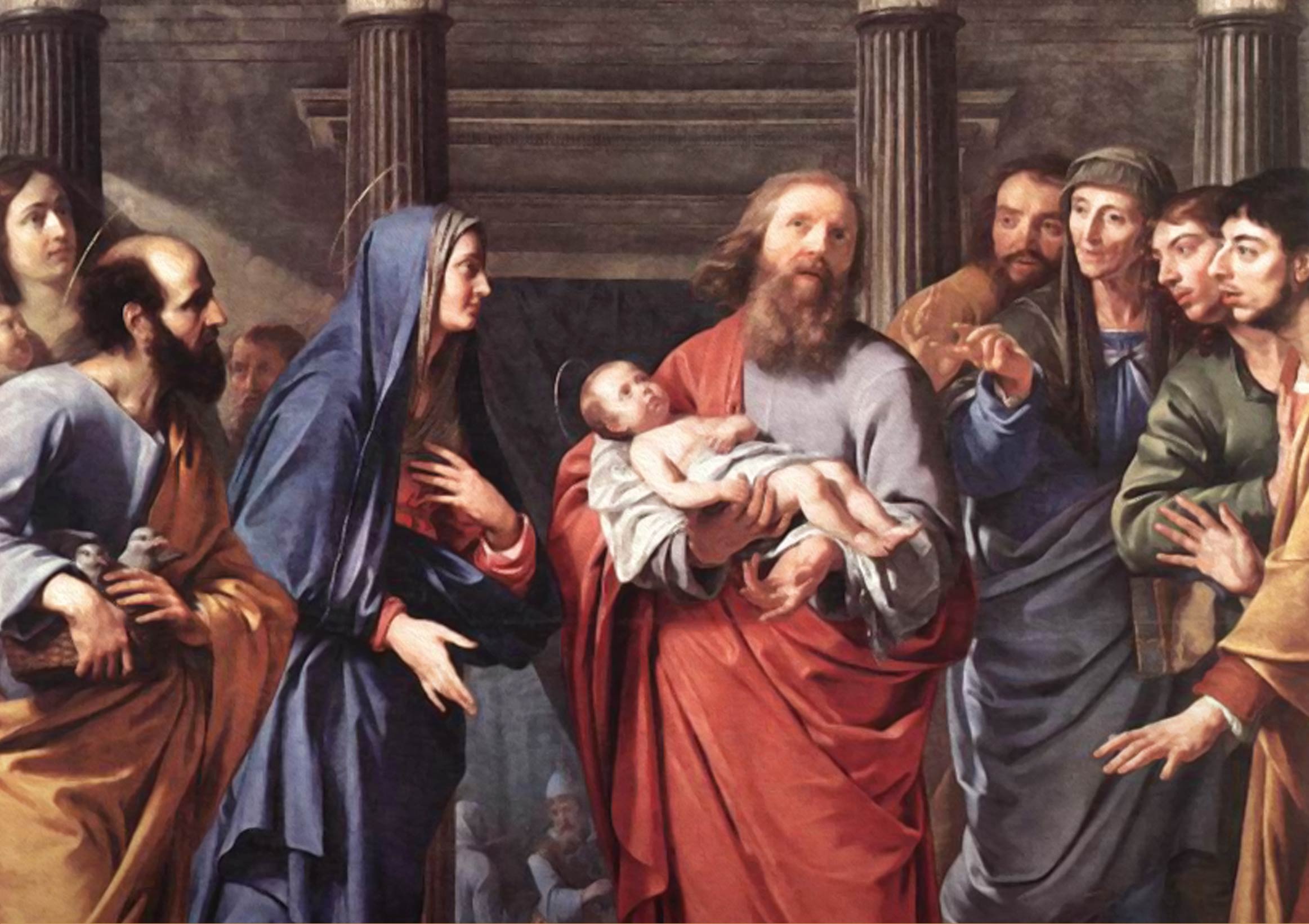
Secondly, we are invited to take part in an ancient tradition that comes to us from the Eastern churches. Early on, this feast was known as the meeting of Jesus and Simeon, and it was marked by a procession with lights to celebrate “the light of revelation to the nations.” This custom was adopted by the Roman Church, and the blessing of candles remains an important ritual for this day. We find this image of light in both the first reading and the Gospel.
The Canticle of Simeon, which we hear proclaimed in the Gospel and which is at the heart of the Church’s prayer on this feast, is prayed each evening during Compline, the church’s official night prayer. In this hymn, we join the old man, Simeon, in recognizing that the infant he held in his arms is the light and the Promised One who would bring true and lasting freedom to God’s people.
Simeon stands as a symbol of Israel’s watching and waiting in a time when God’s chosen people were being oppressed by the conquering Romans. In Simeon’s song of praise, we find a faith that speaks to us of a Presence that is stronger than death and darkness. When we may feel the emptiness that comes when hope seems far away, Henri Nouwen looks to Simeon as a witness:
“In that emptiness, God’s unconditional love could be sensed and we could say what the old Simeon said when he took the Christ child in his arms: ‘Now, Master, you can let your servant go in peace as you have promised.’ There, in the midst of dreadful emptiness, was complete trust, complete peace, and complete joy. Death no longer was the enemy. Love was victorious.” (from “The Return of the Prodigal Son”)
Thirdly, we are invited to stand with Mary in praise and adoration. As St. Sophronius of Jerusalem reminds us,
“The Mother of God, the most pure Virgin, carried the true light in her arms and brought him to those who lay in darkness. We too should carry a light for all to see and reflect the radiance of true light as we hasten to meet him.”(from the “Office of Readings for the Presentation of the Lord”)
The example of Mary “carrying a light” is an invitation for each of us to carry the light of faith that burns within our hearts and minds into a darkened world where so many are still looking for the light and warmth of hope and love that can only come from this Holy Child.
In the end, the Feast of the Presentation of the Lord is an invitation for us to reflect on who this Child is and to help us make a connection between the mystery of Christmas and the saving work of Jesus embodied in the fullness of the Paschal Mystery. As the preface for the feast reminds us, this Child is truly “the glory of Israel and the light of the nations.”
A Benedictine monk for nearly 11 years, Br. Silas Henderson, SDS, is an author, retreat leader, and catechist, and former managing editor of Deacon Digest Magazine and Abbey Press Publications. You can find more of Br. Henderson’s blogs at www.fromseason2season.blogspot.com.