Cathedral of the Immaculate Conception

Springfield, IL

  • About
    • Contact Us
    • History of the Cathedral
    • Liturgical Schedules
    • Parish Staff
    • Register with Cathedral
    • Subscribe to the Cathedral eWeekly
  • Sacraments
    • Baptism
    • Becoming Catholic
    • Matrimony
    • Vocations
  • Ministry List
    • Adult Faith Formation
    • Cathedral Meal Train
    • Cathedral Online Prayer Wall
    • Cathedral Concerts
    • Family of Faith
    • Grief Share
    • Health and Wellness
    • Spiritual Resources
  • Stewardship
    • Stewardship: A Disciple’s Response
    • Stewardship Form
  • Support
    • E-Giving Frequently Asked Questions
    • Give Online
  • Sunday News
    • Announcements
    • Cathedral Weekly
    • Livestream Feed
    • Submit a Mass Intention Request
    • Weekly or Announcement Submission

Groaning Earth Awaits Our Surrender

You rocked the earth, split it open;

 Repair the cracks, for it totters.
(Psalm 60:4)

Neither the lava flowing from Hawaii’s Kilauea volcano nor the National Guard helping people out are asking anyone about their politics or their religion as the magma rolls.

Volcanoes, destructive earthquakes and storms have a way of reminding us that— despite the roiling headlines—our divisions are both embraceable, and releasable as circumstances warrant. Catastrophe has a way of subduing our prejudices until “theys” and “thems” become only “us”—creatures living within a creation that shudders and quakes and shouts out in pain thanks to the actions of a broken humanity.

Wait, what? Human sin contributes to natural disasters?

Well, yes. Pope Francis actually makes that point in the second paragraph of his 2015 encyclical, Laudato Si’ in seldom-quoted lines that seem more relevant every day:

The violence present in our hearts, wounded by sin, is also reflected in the symptoms of sickness evident in the soil, in the water, in the air and in all forms of life. This is why the earth herself, burdened and laid waste, is among the most abandoned and maltreated of our poor; she “groans in travail” (Rom 8:22).

We have forgotten that we ourselves are dust of the earth (cf. Gen 2:7); our very bodies are made up of her elements, we breathe her air and we receive life and refreshment from her waters.

Weird events in nature tend to cue a debate as to wehther they are occurring naturally or are the fault of an anthropogenic (“man-made”) injury to creation. Science is usually at the crux of either argument, but religion can bring a perspective that even the “spiritual but not religious” may be able to get behind.

Nature co-operates with itself and its laws. In so doing, nature sustains, preserves, and perpetuates itself in a way that co-creates with the intention of the Creator. A bird pecks for food and the action aerates the ground, keeping it alive and receptive; the waters evaporate up to the heavens and return to us fresh and clean, and the earth is softened and seedlings grow. Nature operates within its sphere, lives as it is intended to live. There is no conflict.

Humanity came to consciousness possessing free will, and with a co-creative aspect as well. Like the rest of nature—like the blue jay and the soil and the rain —we sustain, preserve, and perpetuate ourselves through cooperation with the design of nature. That is, when we are not in conflict with the great ongoing intention of life, born of the very mind of the Creator.

Nature cannot say it is not what it is. A tree cannot insist that it is a flower; a squirrel cannot declare itself a bird and then try to outthink and outsmart nature, in order to compel its co-operation in that direction. Nature, rightly-ordered, asserts nothing of itself, because it simply is.

Humanity, however, precisely because it is endowed beyond natural instinct and gifted with consciousness, creativity, reason, and free will, is in near-constant conflict with itself. If the birds and worms and earth co-operate easily within the great wholeness of creation, human beings simply cannot. Created in the image and likeness of God, imbued with the spark of God, humanity longs for more; it longs to reunite with that spark, to be forever enclosed within the wholeness of God.

Materially, such an action is—like the hand of Adam, outstretched to the Father—forever beyond the reach of even the strongest human will, and that being the case, humanity fills the empty space of its exile with its own reason and gifts.

The very character of human giftedness, with its conscious observation and sense of self, immediately distinguishes the human animal from the instinct of nature, which—once, more— simply, objectively is; humanity continually prompts an assertion of itself, which is, “I Am.” This assertion initiates an ever renewed, and deluded, quest for meaning as humanity seeks to become the god of its own generation and creation, an ambition that brings human beings, again and again, first into conflict with the self, and then with others, and finally with the rest of creation.

And yet, humankind is most beloved of the Creator, who condescended to incarnate, and set a tent with humanity, in order to save it from a redundantly enthusiastic pursuit of its own demise.

Creation is alive; we wound it with the sins of greed, sloth, pride, gluttony, envy, wrath, and lust, which are embodied in commerce and industry, and also within ourselves, for these sins lie at the core of our insistence that not only may we move beyond the logic of nature, but—in honor of our Godspark, which is reason— we must.

God looked at the perfection of created nature and pronounced it “good.” Into perfect nature, mankind, through the agency of ego and conceit, introduces what is unnatural—and pronounces it “better.”

And when what is natural and perfect must endure what is unnatural and imperfect—whether delivered through chemistry or by explosive brute force, or by social convention—there is a tragic reckoning. Scripture tells us the earth groans; it objects, as it must, because what is natural and pure cannot live in harmony with what is unnatural and impure. The earth roils to be rid of the sin that intrudes upon perfection, and there are the floods and earthquakes and volcanoes, the pestilences and unusual signs and tremors that Christ Jesus himself spoke of.

The earth trembles on its axis because of the human heart and mind, which is bored by exile, unsatisfied with the reality of the natural, and endlessly attempting to play at godhood for its own gratification. This is what Pope Francis means when he asserts that community cannot exist in the unreality of the ether (LS, 103-110), that rejection of God-willed life cannot affirm the very nature we seek to assist (LS, 118-121), and that a confused and conflicted misunderstanding of our own bodies and the dignity inherent within them—ours and everyone else’s—entertains an illusion of power that is in fact an admission of great weakness (LS, 154-159).

As we see within our own church, what is holy and what is profane may exist within close proximity of each other, but they can never be fully one; there will always be the battle between what is deadly and corrupt coming against what is life-giving and good. The Church is even now expressing its anguished moans over the conflict and the destruction that such friction has wrought.

So too, the earth. As long as humanity, serving the muse of gifted reason and ego, insists upon the introduction of unnatural means to achieve its insatiable ends—be they personal or commercial or some amalgam of both—creation will continue to writhe in objection.

If we truly want to be a balm to creation, we must first be humbled to its orderliness, which does abide within us, as well as apart from us. We must cast off the deadly sins which urge us forward, a n d s e e k t h e interior restoration that comes from reconciliation to w h a t i s G o d – ordained, God created, and God sustained.

T h e e a r t h i s perfect; if we are to live in harmony with it, we too must be perfect, as Christ Jesus urged us: “Be perfect, as my Father is perfect.” Then we will be holy, and our outreach to God might finally bring us nearer— lifting the hand of Adam ever-so-slightly forward, toward the All- Holy.

We know that for the Incarnation to form, a pristine vessel in the form of Mary, the Immaculate Conception, was needed to contain and bring forth the All-Purity. Laudato Si’ is an admonishment away from all of our sin, all of our hatreds, all of our conceits, all of our pridefulness, all of our greed, all of our lust and gluttony, all of our self-indulgent wrath, and toward what is holy, good, and pure.

It is an invitation toward Incarnation.

Elizabeth Scalia is a Benedictine Oblate and author of several books including the award-winning Strange Gods: Unmasking the Idols in Everyday Life (Ave Maria Press) and Little Sins Mean a Lot (OSV).

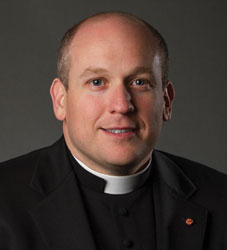
Thank you Father Braden

It was Chrism Mass 2008, the last one before t h e Cathedral restoration. I had finished my six month term as administrator of the Cathedral but had remained in residence in the parish to give sacramental help while serving as the bishop’s master of ceremonies and as the newly-minted diocesan vocations director since the previous January. Being the MC and the director of vocations were both new jobs for me. This was my first Chrism Mass to oversee and I was working on what would be the first class of seminarians that I would shepherd-in for the following fall term. As I was running around before Mass, getting things ready, I was introduced to a senior from St . Anthony High School in Effingham. After meeting him, I went back into the sacristy and realized that I was short one reader for the presentation of the oils that were to be blessed. I walked back into the Cathedral, where this young man was still standing and visiting with those he had come to the Cathedral with, and I pointed at him and told him to come with me. That is how I first met our Father Braden.

Long before he came to us as priest, Father Braden was already familiar with the Cathedral Parish. Though you may not have noticed him then, Father Braden lived with us for two summers (’09 and ’10) while having other responsibilities those summers. It is amazing how fast those ten years passed, from his formation in college seminary to major seminary to ordination and finally to his time with us. I am grateful to him for the ministry that he has provided during his time here in the parish, especially for his faithful care of our sick and homebound.

Father Braden is leaving us to assume some large responsibilities. As you know, he has been assigned as parochial vicar to Our Saviour Parish in Jacksonville, which has its own grade school, Routt High School, and the chaplaincy of Illinois College. The clergy at Our Saviour also serve as the clergy for the parishes in Beardstown, Arenzville, and Virginia. Father Braden will also begin his studies for a degree in canon law at the Catholic University of America in our nation’s capital, spending June and July there before arriving in his new assignment. To say that Father Braden is going to be busy is understatement; he is going to be stretched but he is up to the challenge and he will do well.

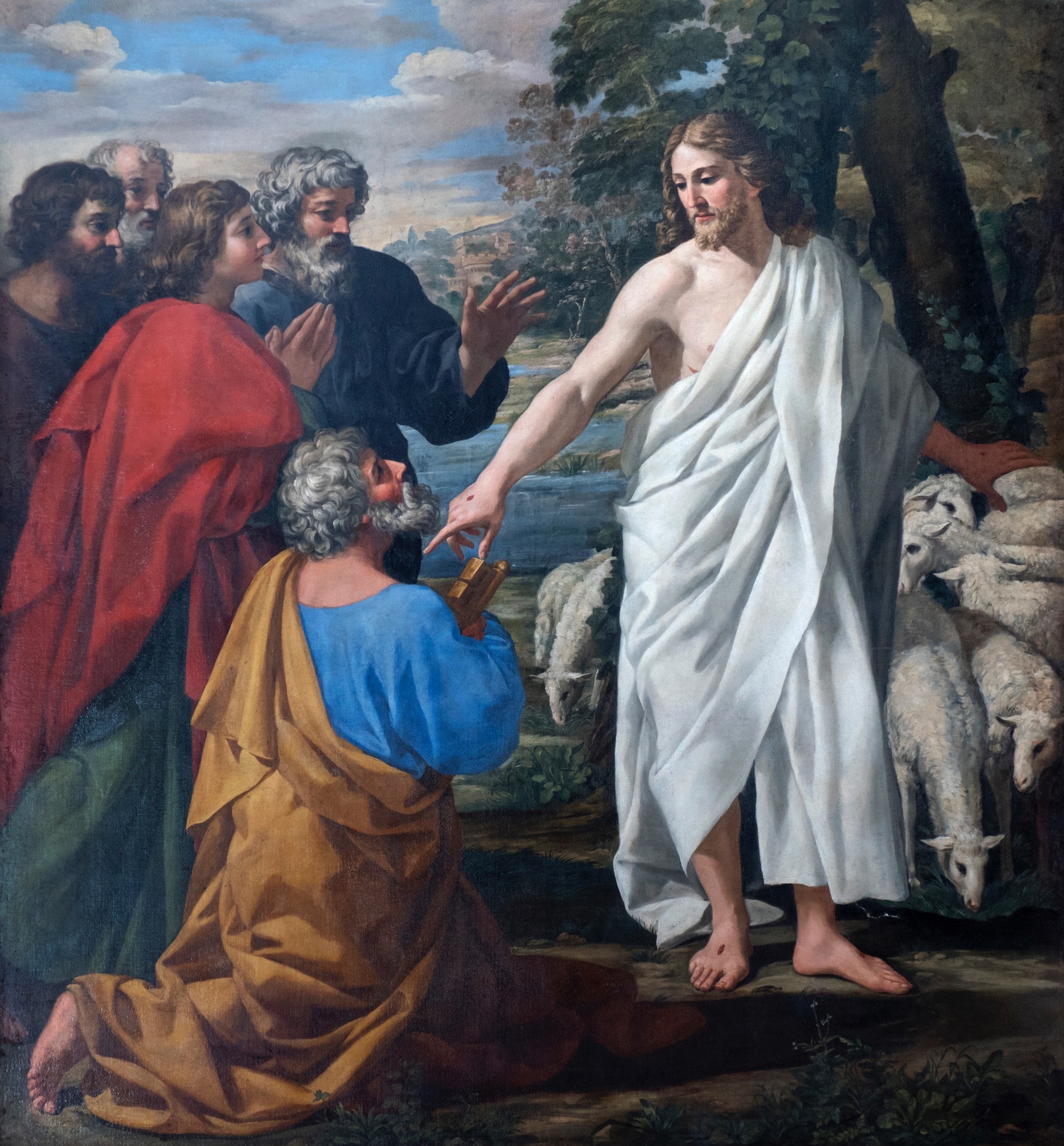
He leaves with our love, gratitude, and prayerful support as he continues to model Christ the Good Shepherd for our sisters and brothers in his new parishes.

As Father Braden takes his leave, we have much to be grateful for in these days. We give thanks to God for Father Braden’s ministry and for the ministries of the many other priests who have served this parish.

We give thanks for Father Michael Friedel who will be joining Father Wayne and myself here at the beginning of July.

 We also give thanks for the five new priests who were ordained this weekend for our diocese and we pray that God will lavish them with his grace at the beginning of their priestly lives. Among them is Father Dominic Rankin who spent the summer of 2016 with us here at the parish. Father Dominic will offer a Mass of Thanksgiving here at the regular 5PM Mass on Sunday, June 3rd. Please come and celebrate with us at that Mass next Sunday evening.

Finally, I wish to offer my thanks to you, our parishioners and friends of the Cathedral. I thank you for the love and goodness that you show the seminarians and newly ordained priests who come to our parish.

They are sent here for a reason: Bishop Paprocki knows that they will find good people here who will receive them and love them. I pray that the Lord will grant all of you the reward of your goodness. God bless you!

 Father Christopher House is the Rector-Pastor of the Cathedral and serves in various leadership roles within the diocesan curia, specifically Chancellor and Vicar Judicial.

In Response to God’s Silence

Silence. It can be a reservoir of flowing peace and nourishing grace. It can call to mind our cherished identity, compelling us to respond to God and others with that same, first love he has shown us. Or it can be cold and sterile, a state of abandonment, loss, frustration and sorrow. It’s in the silence that we can choose to trust in his loving presence or his aching absence. We all know of people—maybe even ourselves at times—who turn away from God because in a time of great need they were met with the cold, bitter sound of only their own cries and tears. It’s an experience, I imagine, we can all relate to on some level.

Submitting to God, and the mystery of his sometimes peculiar and painful ways is a sobering challenge, one we can’t escape as we journey back toward the Kingdom of God in this life. God gives us enough grace and light to have a reasonable, firm and joyful belief in him, but so much of our lives remain unclear—we’re asked to trust in his plan even when it appears chaotic, unfair, or meaningless. When the eyes of our bodies are darkened, we are called to rely evermore on the eyes of our faith. This trusting in his will gradually and —at least on our worse days, suspiciously—throughout our lives is hard. And we experience moments in our lives when we cast a full-throated cry to God in words that echo those same ones from Job himself:

 I cry to you, but you do not answer me;
I stand, but you take no notice.
You have turned into my tormentor,
and with your strong hand you attack me.
You raise me up and drive me before the wind;
I am tossed about by the tempest.

 – Job 30:20-22

 I heard a revealing parable once about a solitary monk dwelling in an ancient monastery. The monastery rests on top of a rocky cliff overlooking a small village. For many years, a man from the village wonders about the monastery and the life of the solitary monk. Finally, he decides to scale the cliff to meet the monk. When he arrives at the top, he spots the wizened monk sitting in prayer. The young man calls out to him, “Hello Father, do you still wrestle with the Devil?” The old monk, stirred from his meditative state, replies, “No, I don’t wrestle with the Devil any more. I’m too old now and the devil is too foolish. We’re tired of each other.” Surprised, the young man says, “So your life must be easy now.” The monk responds, “No, it’s much harder. Now I wrestle with God.”

Like the wise monk, as we grow closer to God we find ourselves in seemingly more compromising positions with him. We can choose to relent, allowing God to shape the hardened clay of our lives, or stand firm, not only refusing ground, but even taking the offensive in overcoming God’s will with our own. Yet, when this proves, well, impossible, we can be tempted to leave the ring altogether—to dismiss him from our lives for not heeding our egotistical demands. There can often be an underlying desire to force God’s hand, to test him and charge him to make a convincing and impervious account of himself: of why things are the way they are, of his intentions, and of course, of his and our own existence. Such a desire to be god over God can devolve into a type of violence against God—a warring of the creature against the Creator.

In Raymond Bradbury’s short story collection, The Illustrated Man, one of his stories tells of a handful of travellers from Earth who land on a distant planet. The captain of the ship, giddy with excitement to feed his own insatiable vanity, looks forward to appearing before the inhabi tants of the planet , which he anticipates will cause them to marvel at them. However, he is disappointed when he hears from one of his envoys that another far-off stranger has already visited, one who arrived only yesterday. The language remains somewhat vague at first, but it becomes clear that this strange visitor is Christ. In the story, Christ has come to the alien world to do what he did for us: teach, heal and point us toward eternal life. The captain, an avowed atheist, goes into the town and demands that the inhabitants bring the man to him, whose whereabouts they claim they do not now know. In response, the captain turns to violence against one of the inhabitants, the mayor of the town:

On the floor, holding his wounded arm, the mayor looked up. ‘Put down your gun. You’re hurting yourself. You’ve never believed, and now that you think you believe, you hurt people because of it.’

 ‘I don’t need you,’ said [the captain], standing over him. ‘If I missed him by one day here, I’ll go on to another world. And another and another…one day I’ll catch up with him! Do you hear that?’ He was shouting now, leaning wearily over the man on the floor.

 The captain eventually leaves the planet by himself in search for the mysterious man—in search for God.

 “Yes, poor man, he’s gone,” said the mayor. “And he’ll go on, planet after planet, seeking and seeking, and always and always he will be an hour late….And finally he will miss out by only a few seconds. And when he has visited three hundred worlds and is seventy or eighty years old he will miss out by only a fraction of a second. And he will go on and on, thinking to find that very thing which he left behind here, on this planet, in this city—”

And like the obdurate captain, we can be tempted to try and force God to manifest in our lives according to our demands, at the whim of half-hearted prayers. We cry out to God expecting an answer, and when one isn’t given in the form we desire, we can allow our pride and frustration to turn our backs to him.

And isn’t that what many have done? Many have set about building a world without God in response to his seeming absence, a world that is still filled with horrible poverty, violence, a lack of respect for life, and spiritual unrest, to name only a few of the harrowing realities of our time.

 “The question is whether you choose for God or for your own doubting self. You know what the right choice is, but your emotions, passions, and feelings keep suggesting you choose the self-rejecting way.”

 – Henri Nouwen, The Inner Voice of Love

 God continues to wait in the silence, loving us and calling us back to him. It’s in the silence, in the heart of an honest prayer to him, that we come to witness his presence. Christ remained silent, swaddled in a scarlet robe and crowned with thorns, in response to being mocked and abused—offering only love when the world hated him, when it killed him. God’s silence is never a refusal of our pleas for his love or a lack of concern—it’s an invitation to enter more deeply into his presence.

We have to be willing to enter into the silence on our own—no one can do it for us—and meet God there in sincere prayer. It may not come overnight, and it may not mean we still won’t struggle with our own sufferings and difficulties in life, but if we keep asking for God’s presence in the silence, we begin to see that he is really there—that he always was. And in the silence, beneath the doubts and emotional turmoil, the objections and lies of the world and our own fears and insecurities, we hear God responding not with words, but with an inner, inexhaustible flame that sheds lights on who we really are—his beloved.

 “I know now, Lord, why you utter no answer. You are yourself the answer. Before your face questions die away. What other answer would suffice?”

 – C.S. Lewis, Till We Have Faces

 Chris Hazell is the founder of The Call Collective, a blog exploring the intersection between faith, culture and creativity.He holds bachelors’ degrees in English and Economics from UCLA and currently works as a Lead Content Strategist for Point Loma Nazarene University. With a passion for sports, good food and drink, deep conversations with friends, funny stories, writing and seeking to know and love Christ, he attributes all of the blessings in his life—health, family and friends—to nothing but God’s overabundant grace.

Parishioner News

We want to keep the School staff and families in your prayers as the graduates prepare for their next steps, and as the families and staff finish out the school year. Also, please keep in your prayers the families and staff members of schools around the Springfield area, which our parishioners attend.

Have some news you would like to share? Please email Katie Price at [email protected].

Stewardship Activity

Stewardship of Time & Talent
Time in prayer is a great practice for discerning your talents and what you may be able to share with the Parish!

Stewardship of Treasure

Weekly Collections: May 12th & 13th
Envelopes: $3,247.22
Loose: $5,641.00
Maintenance: $155.00
__________________________
TOTAL: $9,043.22
Needed to operate weekly: $15,907.89
Difference: $6,864.67
April EFT: $18,486.10
These are recurring electronic donations over the month.
**We will publish the collection from May 19th & 20th next week.

Happy Birthday to the Church!

Following the Lord’s Ascension into heaven, the Apostles were gathered once again in the Upper Room where the Lord had instituted both the Eucharist and the Priesthood at the Last Supper. It was also the place where he first appeared to them following the Resurrection. Tradition tells us that the Apostles were not alone on this particular day and that Mary, the Mother of the Lord, was with them. Jerusalem was filled with Jews who had come to the holy city for the feast of Pentecost. Pentecost was a feast celebrating the wheat harvest that was celebrated seven weeks and one day (50 days) following Passover. That day was the day that would forever change the face of the earth.

Before hi s Ascension, the Lord promised the Apostles that he would send a paraclete, an advocate to be with them always until he returned in glory. It was precisely this advocate for whom the Apostles waited in the Upper Room, when on that Pentecost day, the Lord Jesus fulfilled his promise and the Holy Spirit came upon the Apostles and Mary, appearing as tongues of fire. It was precisely in this moment that the Good News, the Gospel of Jesus Christ, was preparing to break forth into the greater world.

From the Upper Room, the Apostles went forth as new men, as new creations. The grace of the Holy Spirit had forever changed them, transforming their fear and trepidation into courage and zeal. With this gift of the Holy Spirit, they went out and fulfilled the Lord’s command to preach the forgiveness of sins, beginning first in Jerusalem. The Acts of the Apostles recounts that some 3,000 people that very day heard the preaching of the Apostles, believed, were baptized, and thus the Church was born.

Today, we who are the Church, who have been claimed by Christ in baptism and anointed with the Holy Spirit through confirmation, and who are strengthened by the Lord’s Body and Blood in the Eucharist, are called to carry on this mission begun by the Apostles some 2,000 years ago. We who profess the name of Christ are his disciples because we have come to believe in him, but our discipleship must be transformed into apostleship. The word apostle means “one who is sent.” The Apostles were the first to be sent but we are called by Christ, and strengthened by the Spirit, to continue their mission. On this Pentecost Sunday and always, let us open our hearts to the gift of the Holy Spirit who continues to guide the Church. Let us cooperate with the grace of the Spirit that seeks to make us witnesses of the crucified and risen Lord so that through our lives others may come to know and believe in the Lord Jesus.

 Father Christopher House is the Rector-Pastor of the Cathedral and serves in various leadership roles within the diocesan curia, specifically Chancellor and Vicar Judicial.

How Do I Know What God Wants Me to Do?

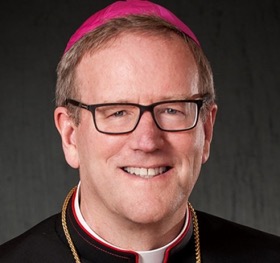
I was watching a video from Bishop Barron recently that was speaking on the Holy Spirit and he made a point that I found interesting, “The Holy Spirit is dangerous.” With only two minutes into the video, now he had me intrigued. Often we think about God, our loving Father and His Son, in terms of merciful, understanding, and providers of unconditional love. While we might think of the Holy Spirit similarly, what Bishop Barron was addressing were the symbols of the Holy Spirit and their destructive power.

The symbols, water, fire, and wind, in our everyday life can be quite destructive. Water can ravish a town after a Hurricane. I had first hand experience in rebuilding after Hurricane Katrina and returning five years later and still witnessing the devastation and damaged caused by simply, water. Many of us saw the destruction of homes and natural preserves through brushfires. We witness wind destruction in central Illinois and closer to my hometown, Peoria, when Washington, IL was devastated by a tornado just a few years ago. These terms and symbols are not weak or soft by any means, but rather are engaging, active, and forceful.

shining dove with rays on a dark golden background

As I reflected more about what he was saying and how I can interpret this, I started to draw the comparison to my own discernment process years ago. Frankly, I needed to go through destruction to build anew. I don’t find it a coincidence that many of the opportunities I have had in my work life have led me to Springfield, Il and to a Diocese that wants to pursue stewardship as a way of life. Unfortunately, there are not many of us in my field of Catholic stewardship and to land in a Diocese who is taking on this radical challenge is not just perfect timing, but the work of the Holy Spirit.

But, how do we know what God wants us to do? When I think my to my journey and the first Parish I worked for in Catholic stewardship 10 years ago, I can honestly say that I was quite hesitant at the time. I have recently been in a bad relationship, I was going to graduate school at night, I had no experience working at a Catholic Parish and lastly had no idea what Catholic Stewardship was. To say that those two and a half years were a growing experience is an understatement. Not only was it growth professionally, but before I had moved on to my next role, I realized I was no longer working. I had accepted this as a calling, a vocation. This was more to me than a job, it was the movement of the Holy Spirit and I was just saying, “Yes.”

Despite feeling pulled in other directions, with an open heart and mind, we too can look at our lives and realize the active role of the Holy Spirit. I am sure many of you have similar stories of hesitancy or anxiety about a decision, only to find strength, comfort, and conviction of faith in the process. It is the work of the Holy Spirit in my life that I realize the destructive power of those symbols. I was at a point where I needed to be plowed down, changed, and renewed. Sometimes a little destruction in our life is what we need, despite trying to push it away. Listening to the Holy Spirit in your life, allowing the spirit to be an agent of change in your daily decisions, will draw you closer to doing exactly what God wants in your life. When you live a life with the Holy Spirit, you are living the life God wants you to live.

 Katie Price is the Cathedral Coordinator of Stewardship. She received her Bachelor’s from Loyola University- Chicago and her Master’s Degree in Public Service Management from DePaul University. Her research focus was on Catholic stewardship. She can be contacted at [email protected].

Stewardship Activity

Stewardship of Time & Talent
Time in prayer is a great practice for discerning your talents and what you may be able to share with the Parish!

Stewardship of Treasure
Weekly Collections: May 12th & 13th
Envelopes: $3,247.22
Loose: $5,641.00
Maintenance: $155.00
__________________________
TOTAL: $9,043.22
Needed to operate weekly: $15,907.89
Difference: $6,864.67
April EFT: $18,486.10
These are recurring electronic donations over the month.

Parishioner News

We want to keep the School staff and families in your prayers as the graduates prepare for their next steps, and as the families and staff finish out the school year. Also, please keep in your prayers the families and staff members of schools around the Springfield area, which our parishioners attend.

Have some news you would like to share? Please email Katie Price at [email protected].

Being Radical: Choosing to Live with in the Context of Creation

It is said that old heresies never die; they just keep coming back in different forms. There is truth to this and I find it revealed in the pervasive spirit of Gnosticism present in our culture and time – specifically, Gnosticism’s denial of nature and creation. Historically, Gnosticism was a blending of aspects of Christianity, philosophy, and Eastern mystery religions that challenged the orthodox faith in its first centuries. Gnosticism highlighted secret knowledge as key to salvation as well as denigrating what it saw as the shackle or prison of creation and the physical body. The early Church had to answer the distortions of Gnosticism and it did so by maintaining the continuity of the same God revealed in the Old and New Testaments and holding to the profound truth of the incarnation.

Now, jump ahead to America in 2017. It seems a contradiction and an irony that in a time that prides itself on being increasingly “ecologically conscious” we find the re-emergence of the gnostic temptation of denigrating and fleeing creation but this, I would propose, is exactly what is happening. We find this temptation to flee the “confines” of creation all around us. For example, we see trends in body modification from large tattoos to the extremes of plastic surgery and body building. There’s also the felt need for a plethora of distinctions in gender identification (apparently the biological stamp of “male” and “female” no longer suffices and gender can be determined distinct from biology and creation). In addition, we see the temptation to play God and use advances in technology and scientific understanding to craft babies to our liking. What is common in all of these (and many more) seeming disparate social trends? I would argue that one element held in common is the gnostic trend to seek to flee the confines of creation.

In this context what then is the Christian to do? Be radical; make the choice to live within the reality of nature. Here is a point to reflect upon: for those who participate and pray the Liturgy of the Hours, look through your Breviary and notice how many of the opening songs of morning and evening prayer refer to creation and grace. You’ll discover that the two are not opposed. This is the genius of Christianity on display and the prayer of the Church is teaching us an essential truth. Grace does not abolish creation nor does it overcome it; grace sustains creation, peacefully enters within it to heal and work with it. Creation is not to be fled from but rather embraced because within the very “confines” of creation, God’s grace is at work and to be found. Any attempt to flee creation is based on error and confusion.

With all that said, what does it mean to be radical and actually seek to live within the reality of creation? Here are some suggestions: Accept yourself for who you are and others for who they are. Throughout Scripture we are reminded again and again that God is the creator and that God loves his creation.

That includes you, me, and every other person. Yes, there is the reality of sin and our need for a savior but the savior has come and his healing grace is offered. Allow God’s gentle grace to work in your life. Part of living with this gentle grace, I believe, is to not give in to the common temptation to affix a label to oneself or others. The human person is an ever-dynamic mystery; labels cut off mystery. Be willing to live in this mystery and trust that God is at work.

 Celebrate the sacraments. Sacraments reveal in an utterly unique way the reality of grace working through creation and not opposed to creation. Learn the wisdom of the sacraments not in an attempt to “figure it out” but rather to live in the mystery and through them to be brought to deeper understanding. Develop a mature understanding of Scripture, especially the Gospels. Gone are the days when Christians could get by on leaving the Scriptures to the “professionals”. A part of every day should be spent with the Scriptures, particularly the Gospels. Notice how creation plays a major part throughout the Gospel story, i.e. Jesus walking on water, the star of Bethlehem, Jesus teaching on the lilies of the field, Jesus and the disciples walking on the road, the bread and wine used for the last supper – the list could go on and on.

 Fast. Hunger has a way of clarifying priorities and through fasting we are quickly reminded that we are embodied beings.

 Develop healthy friendships. True and healthy friendships, though rare, are a gift from God. Friendship helps to anchor us in ourselves and in our world. Turn off the TV and social media. Entertainment and social media certainly have their place and can be beneficial tools in helping to enlighten and educate the human spirit, but my experience has shown when not used in a measured and balanced way they quickly lead to isolation, superficial relationships, and a chronic cynicism which stunts maturity and can become a besetting sin.

 Enjoy nature. Creation gives glory to the Creator. Creation also teaches, gives insight, and enables us to gain perspective. Practice humility and through this practice realize that we are part of something much bigger than ourselves.

Not long ago I was out for a walk in the mountains, coming over a rise I was met by a herd of at least eight deer peacefully and calmly grazing in a field and drinking water from a stream. They noticed me but rather than seeming startled and bounding away they calmly moved off into the woods. It was a beautiful sight and a gift. Like the deer that yearns for running streams so my soul thirsts for you my God.

Creation is not to be fled from. Be radical and choose to live within the context of creation.

 Fr. Michael Cummins is a priest of the Diocese of Knoxville, TN. Ordained in 1995, he has served in a variety of roles within his diocese. Currently he is serving as pastor of St. Dominic Church in Kingsport, TN.

« Previous Page
Next Page »

Liturgy

Sunday Masses (unless noted differently in weekly bulletin)
Saturday Evening Vigil – 4:00PM
Sunday – 7:00AM, 10:00AM and 5:00PM

Weekday Masses (unless noted differently in weekly bulletin)
Monday thru Friday – 7:00AM and 5:15PM
Saturday – 8:00AM

Reconciliation (Confessions)
Monday thru Friday – 4:15PM to 5:00PM
Saturday – 9:00AM to 10:00AM and 2:30PM to 3:30PM
Sunday – 4:00PM to 4:45PM

Adoration
Tuesdays and Thursdays – 4:00PM to 5:00PM


CatholicMassTime.org

Parish Information

Parish Address
524 East Lawrence Avenue
Springfield, Illinois 62703

Parish Office Hours
Monday thru Thursday – 8:00AM to 4:00PM
Fridays – CLOSED

Parish Phone
(217) 522-3342

Parish Fax
(217) 210-0136

Parish Staff

Contact Us

Contact Us

Copyright © 2026 · Log in