Cathedral of the Immaculate Conception

Springfield, IL

  • About
    • Contact Us
    • History of the Cathedral
    • Liturgical Schedules
    • Parish Staff
    • Register with Cathedral
    • Subscribe to the Cathedral eWeekly
  • Sacraments
    • Baptism
    • Becoming Catholic
    • Matrimony
    • Vocations
  • Ministry List
    • Adult Faith Formation
    • Cathedral Meal Train
    • Cathedral Online Prayer Wall
    • Cathedral Concerts
    • Family of Faith
    • Grief Share
    • Health and Wellness
    • Spiritual Resources
  • Stewardship
    • Stewardship: A Disciple’s Response
    • Stewardship Form
  • Support
    • E-Giving Frequently Asked Questions
    • Give Online
  • Sunday News
    • Announcements
    • Cathedral Weekly
    • Livestream Feed
    • Submit a Mass Intention Request
    • Weekly or Announcement Submission

Mysterium Fidei

I distinctly remember the first time I went on a retreat. It was my first year of seminary and during Christmas break all of us seminarians at Bishop Bruté (the college seminary our diocese uses in Indianapolis) spent a few days before returning to “the Castle” in prayer and recollection at St. Meinrad Seminary (actually, one of the theology seminaries our diocese also uses). It is a picturesque place – looking out over the rolling, tree-covered, hills of rural Indiana; a peaceful one – away from the busy-ness of the world, the excitements of Christmas back with family, and the efforts and fraternity of seminary life; and one permeated with the prayers of the monks who live there – marked by the hourly chiming of their bell tower prominently standing over the town. But it is not so much those delights that I recall here, but the power of that place to draw me into prayer.

There is something about changing one’s location – physically and spiritually – that invites you into a deeper, more trusting, more profound, more total kind of prayer. With different stone walls to contain my adoration and different colors streaming through the windows to illuminate my meditation, I saw the scriptures and encountered the Eucharist in a renewed way. Drawn out of my “usual” prayer, as I rested with God in the various chapels there, all those graces and gifts of those first months in seminary, and those past weeks around Christmas, flowed through my mind and heart, newly opened to remember them again.

In today’s Gospel, Jesus quotes from the Prophet Isaiah as he responds to the disciples of John the Baptist: “Go and tell John what you hear and see: the blind receive their sight and the lame walk, lepers are cleansed and the deaf hear, and the dead are raised up, and the poor have good news preached to them. And blessed is he who takes no offense at me.” This is a radical new moment in God’s offer of salvation; it’s meant to catch their attention and open their hearts. Advent is the season that takes us back through the utterly worldchanging coming of Jesus Christ. It tugs our hearts and mind into a different place, a different location. If we had gotten accustomed to the readings and prayers of ordinary time, now we have been thrown abruptly back to the tremendous truths of creation, through the saga of salvation history, towards the breathtaking birth of the Savior, and also forward to His resplendent return at the end of everything. The lights, wreaths, smells, and even the change in weather and light outside all similarly draw us into this renewal of our relationship with Christ. They are all meant to dispose us for that meeting, approaching, and kneeling before our baby Lord.

Here at Cathedral, among plenty of other things certainly, we also have begun again for the season to use the Latin responses at the Sanctus, Mysterium Fidei, and Agnus Dei. It is one simple way to re-open our hearts to the Lord. How deeply language touches us. That’s the power that we’re trying to capture with this change. These are parts of the Mass that the Church, as she has for centuries, encourages us to know in Latin. Why? Because the world does know them! I mean that! I’ve seen it! It is the most incredible, universal, catholic, thing ever to be able to go to Mass anywhere on the planet, and at those points of the Mass realize we can sing together those very same prayers. The Sanctus, the great song of the angels sung above Bethlehem at Christ’s birth, and the Agnus Dei, that central prayer of every Christian begging the Lamb of God, Who takes away the sins of the world, to have mercy on us, now and at our deaths, are probably familiar.

But that central one, the Mysterium Fidei, though it is a bit more of a mouthful, is just as central to our faith! The words are as follows: Mortem tuam annuntiamus, Domine, et tuam resurrectionem confitemur, donec venias. This is the same phrase we know well in English: “We proclaim your Death, O Lord and profess your Resurrection until you come again,” but in Latin, these exact words have been said directly following the consecration for 1500 years! When we sing them, at that most central moment of the Mass, we sing with all those centuries of worshipping Christians! I’d like to invite us all to meditate on these words anew and sing them with heart! They truly capture the essence what we believe: that Christ died for us, rose from the dead, and will return in glory. Furthermore, they are our first prayer to Christ newly present in the Eucharist on the altar. He gives us His Body and Blood, participation in His death and resurrection and prepares us for His coming. Let us allow this prayer to fill our hearts as we continue to pray this Advent: “come, Lord Jesus”.

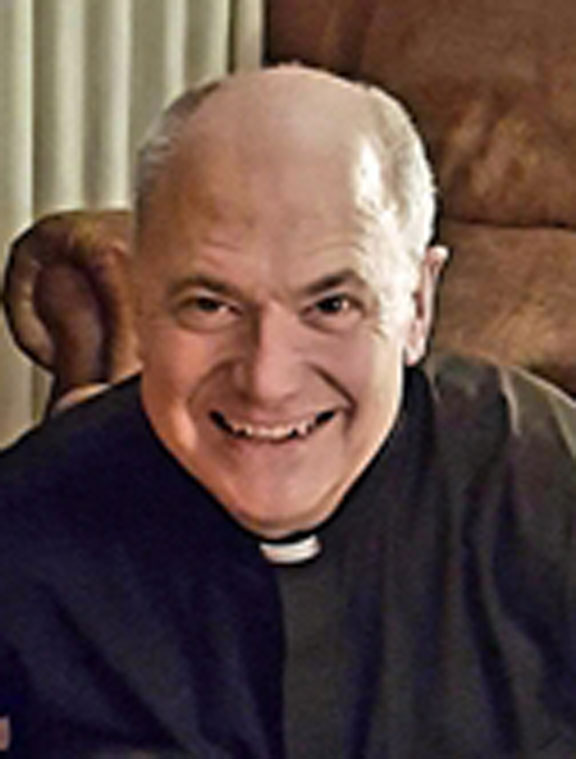
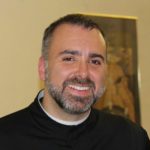
Fr. Dominic Rankin is a Parochial Vicar at the Cathedral of the Immaculate Conception.

What If We Made Our Advent Penitential?

Around this time of year, people from a variety of cultures across the world are running around trying to prepare for Christmas. Some are getting their homes ready for guests. Some are getting stressed out with shopping. How do Christians, specifically Catholic Christians, prepare for Christmas? To many Catholics, the obvious answer is Advent.

However, if we were to ask the average Catholic on the street what this preparation for Christmas entailed, we might find the entire season reduced to lighting four candles, one of which is pink. Clearly, though, with two thousand years of tradition and development, the Catholic Church recognizes that this pre- Christmas season means much more than an Advent wreath. What we forget, often enough, is that the season of Advent is penitential in nature.

Now this is a bit different than saying that Advent is strictly a penitential season, like Lent, but we’ll see soon that this is about much more than semantics. While some would totally bury the penitential nature of the pre-Christmas season, it would do us well to explore what the universal Church, through her different liturgical rites, actually prescribes for the faithful. Preparation often entails penance, but in the season of Advent we experience a joyful penance and expectation of our Lord Jesus.

Drawing Closer to Christ’s Birth

It’s probably true that only a Christian could call penance joyful. Nevertheless, as we explore the history and rationale behind the pre-Christmas seasons of the Church, it will become quite clear how this can be so, and how we are able to merge a penitential nature with a cheerful expectation of our Lord’s First Coming in the manger.

It’s natural for Christians to surmise that what Lent is to Easter, Advent is to Christmas. This is true to an extent. For instance, the liturgical color for both seasons is purple, or violet. This is not insignificant. When a priest is hearing confessions, the stole that he wears is always purple. This is because, as Fr. William Saunders puts it, violet is “a sign of penance, sacrifice and preparation.” The violet color symbolizes that we are trying to get somewhere, that we are anticipating something. And in the case of both Lent and Advent, we are anticipating someone.

We joyfully expect the birth of the Savior for Christmas, and his Resurrection and triumph over death for Easter. Also, when it comes to liturgical colors, priests wear rose (or what we might call pink) vestments for Gaudete Sunday in Advent or Laetare Sunday in Lent. These come into play at the halfway point of each season, and the pinkish color represents a sign of joy as each holy day draws ever closer.

Is Advent Penitential in Nature?

So those are at least the surface level similarities between the Advent and Lenten seasons. But can we really call Advent a penitential season? It may be more accurate to say that Advent, or at least the time leading up to the celebration of Christmas, is penitential in nature. Here’s why. According to the Code of Canon Law:

“The penitential days and times in the universal Church are every Friday of the whole year and the season of Lent” (Canon 1250).

Advent is obviously absent from this mention of “penitential times”. Very strictly speaking, Advent is not a penitential season. However, also note that Ember Days are not included here. Ember Days serve as a sort of quarterly “checkup” for Catholics of the Latin Rite, calling us to penitence at certain points throughout the year. Following the Second Vatican Council, the fasting and abstinence during Ember Days no longer was obligatory, and sadly it fell out of use by many Catholics all over the world.

There has been a revival of this penitential practice recently, particularly in the wake of the most recent sex abuse scandals, with the bishops of Pittsburgh and Madison both explicitly calling their flock to make it a point in observing the Ember Days this year. So, clearly, we can see that there are instances in the liturgical year, beyond that which is laid out in Canon 1250, that take on a penitential feature. As Gregory DiPippo, the editor of New Liturgical Movement, points out:

“The Church’s traditions are not comprehensively determined by or summed up in any Code of Canon Law, nor in any Missal or other liturgical book.”

In Anticipation of the Full Joy

We can look to the Sacred Liturgy for even more clues showing the penitential nature of Advent through our traditions. When going to Holy Mass on Sundays of Advent, you’ll notice that the Gloria is not said at all, just as it is in the Lenten season. Also, we see that the decoration of churches during Advent is strikingly similar to how churches are decorated during Lent. According to the General Instruction of the Roman Missal (GIRM), we see that the atmosphere is more subdued in Advent as it is in Lent:

“During Advent the floral decoration of the altar should be marked by a moderation suited to the character of this time of year, without expressing in anticipation the full joy of the Nativity of the Lord. During Lent it is forbidden for the altar to be decorated with flowers. Exceptions, however, are Laetare Sunday (Fourth Sunday of Lent), Solemnities, and Feasts” (GIRM 305).

Just a bit further below in the GIRM, it is also noted that:

“In Advent the use of the organ and other musical instruments should be marked by a moderation suited to the character of this time of year, without expressing in anticipation the full joy of the Nativity of the Lord” (GIRM 313).

Downplaying the Value of Fasting

Given all this, there isn’t really anything wrong with calling Advent a penitential season, because historically, throughout the various rites of the Church, the penitential practices of prayer, fasting, and almsgiving have all been present in the days leading up to Christmas Day. As we see in the Catholic Encyclopedia, popes and synods before the Council of Trent preached about the need for fasting during this time before Christmas. Pope Innocent III (r. 1198-1216) even declared that black vestments should be used during Advent.

The preparation that the Christian undertook during the days before Christmas was to, at least in part, make the faithful “ready for [Jesus’] final coming as judge, at death and at the end of the world.” What better way to do this than through the three pillars of repentance? Prayer, fasting, and almsgiving are all integral parts of Christian living every day of the year. But as we prepare for major feasts, such as Easter and Christmas, Christians rightly find themselves “pommeling and subduing their bodies” as St. Paul did (1 Corinthians 9:27), lest they be disqualified of the beatific vision. For whatever reason, though, fasting during Advent has been greatly downplayed in the Latin Rite over the last several decades.

Traditions Outside the Latin Rite

On that note, it’s important to observe that we’ve thus far only mentioned the traditions of the Latin Rite of the Catholic Church. The universal Church is made up of a variety of liturgical traditions, all fully Catholic, which we call “rites”, and among these rites we see that there are many parallels to the Advent season. In looking at these parallel periods of time, it becomes clear that the preparation before Christmas has had a penitential dimension across cultures nearly from the start.

The Armenian Rite
For instance, in the Armenian Rite, the time before Christmas is called Heesnag. While this period does not function as a proper liturgical season, Heesnag does feature several days of fasting in the weeks leading up to Christmas.

The Antiochene Rite
Similarly, in the Antiochene Rite (also known as the West Syrian Rite), we see the Fast of the Nativity. For Maronite Catholics, there are actually four periods of fasting, all of varying lengths. The Nativity Fast used to be one of the longest, starting on November 15, around the same time as the Armenians’ and Byzantines’. But as time went on, the fast became shorter, yet still an important part of the Maronite Catholic liturgical tradition.

Differing a bit from how Latin Catholics fast, Maronite Catholics traditionally do not eat anything from midnight until noon. Despite the differences between liturgical rites, we see an emerging pattern of the great emphasis put on penitential practices before Christmas.

The Byzantine Rite
Perhaps the clearest sign of this comes from the Pylypivka of the Byzantine Rite, more commonly known as “Philip’s Fast”. The fast is so named for St. Philip the Evangelist, on whose feast (November 14) the Pylypivka starts.

Instead of being a distinct liturgical season, the Philip’s Fast is exactly what it sounds like: a fast of forty days which prepares the soul to be open to God working through our lives. While each particular Church (i.e., Ukrainian Catholic, Romanian Catholic, Melkite Catholic, etc.) has their own custom, “the traditional Christmas fast [generally] calls for the faithful to observe strict abstinence (no meat, fish, dairy, or other animal product, wine or oil) on Mondays, Wednesday, and Fridays; and a lesser abstinence (no meat, fish, dairy or animal products) on Tuesdays and Thursdays. Fish is allowed on Saturdays and Sundays, but no other animal products.”

We Christians Live Differently

To us Roman Catholics, this might strike us as a bit intense. But if we step back for a moment, getting out of our comfort zones, we’ll see that there is some real merit in how Eastern Christians approach fasting. One Byzantine Catholic priest puts it like this:

“I know, I know. What kind of crazy religion asks you to fast for six weeks before Christmas? Why, with all the parties that we have to go to, all the presents to buy… why should the Church give us one more thing to worry about…

“But… imagine that we Christians lived differently. Imagine what would happen if we Christians spent the Nativity season becoming more deeply attached to reality rather than trying to escape it by indulging artificial desires? What if, instead of running away from the world we spent this time loving the world more deeply?”

A Way of Imploring Forgiveness

Fasting allows us to put things in perspective. It’s a real sacrifice to give up meals, meat, or other foods. It’s also a real sacrifice to give up other things like long showers, TV shows, or music in the car. All these things help us to share in the sufferings of Christ, making it readily apparent why all the various liturgical traditions of the Catholic Church embrace these practices. But as Latin Catholics, looking at what many of our Eastern Catholic and Orthodox brethren do during this time, we should have reason to put things into perspective.

Even though we are not required to fast or abstain from meat or other things during Advent, what’s keeping us from doing so? Why shouldn’t we make this Advent penitential? In light of the recent scandals in the Church, asking for God’s mercy, particularly in reparation for the sins committed, is something that should be at the forefront of our minds. In his Letter of His Holiness Pope Francis to the People of God, Pope Francis made the following exhortation:

“Without the active participation of all the Church’s members, everything being done to uproot the culture of abuse in our communities will not be successful in generating the necessary dynamics for sound and realistic change. The penitential dimension of fasting and prayer will help us as God’s People to come before the Lord and our wounded brothers and sisters as sinners imploring forgiveness and the grace of shame and conversion.”

Let’s Prepare Our Hearts

So let’s not stop at lighting our Advent wreaths this season. It’s time to get deep into the trenches. If we here on earth make up the Church Militant, it’s time to prepare for battle. We have many tools in our arsenal as we walk toward greater perfection, and prayer and fasting are first among those tools.

When Satan is on the prowl for souls, as he certainly is now, we need to redouble our efforts. If Advent hasn’t had a penitential connotation for you in past years, make an effort to change that this year, even if it’s something small like not eating in between meals. Before you know it, Christmas will be here. Let’s use this time wisely, and truly prepare our hearts for the coming of the Savior in the best way possible.

Nicholas is a twenty-something cradle Catholic who wears many hats, (husband, father, tradesman, religious education catechist, liberal arts college graduate, et al.) and hopes to give a unique perspective on life in the Church as a millennial. His favorite saints include his patron St. Nicholas, St. Ignatius of Loyola, St. Thomas Aquinas, St. John Mary Vianney and St. Athanasius of Alexandria. He currently writes for the Diocese of Joliet’s monthly magazine, Christ Is Our Hope.

6 Simple Ways to Enrich Your Advent Season

When I was a nominal Catholic, I liked to pretend that I knew a lot about Catholicism. Realistically, I knew slightly less than the average 7-year-old knows about the workings of a combustible steam engine. Back then, for me, Advent was the Catholic word for Christmas. I was, for a lack of a better term, a theological idiot.

Webster’s Dictionary gives three meanings for the word Advent:

  1. The arrival of a notable person, thing, or event. The advent of Christ. The advent of television. The advent of the day my husband will finally pick up the pair of socks that have been in the same spot on the floor for six weeks.
  2. The first season of the Christian church year, leading up to Christmas and including the four preceding Sundays. So, all of December.
  3. The coming or second coming of Christ.

If you knew this, you’re doing better than I was most of my life. One of the many drawbacks of being a lukewarm Catholic is blindly going through life thinking you know enough about the faith, yet really knowing very little, including the why and how behind most of the Church’s teachings. For a number of years, I was part of the misinformation problem.

Advent is a trifecta of celebrations:

  • Celebrating Christ’s birth.
  • Waiting for Christ to return to Earth again.
  • Waiting for Christ to come into our hearts.

In a culture where everything is instant, we most certainly have lost the art of waiting. I blame Amazon because faith has no Prime shipping. We’ve lost the wonder and contemplation needed to appreciate the beauty and mystery of Advent. How can we find Christ at Christmas if we aren’t watching and waiting for him? How can we appreciate the time we have to wait when we can’t even wait two minutes for a slow Wi-Fi confection?

Advent gives us a chance to really put our minds where it matters most, on the next life. Here’s how:

Quit being too busy to be spiritual

I know you have to do the thing with the thing before the thing and then you have to rush off to the other thing, and in the words of INXS, “There’s not enough time…” If you wait for the time, it’ll never come. So, make room. Turn off your phone. Set aside your to-do list. Light a candle. Say a prayer. Sit in the chapel.

Sacrifice all of the things

Then, substitute them with Jesus. Give up some part of your daily routine to fit in 20-30 minutes for Christ:

  • Pray on your afternoon run.
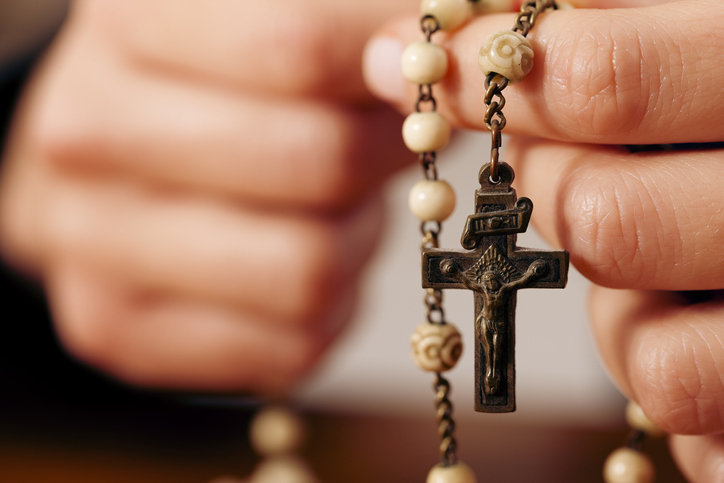
  • Dedicate a decade of the Rosary to someone you don’t know who needs prayers. No Rosary? No problem. God gave you 10 fingers.
  • Listen to Scripture or faith-based books/podcasts on your commute.
  • Grab a Bible and pick a psalm. Find a sentence and make it your daily meditation. Apply those words to your day and try to uncover their meaning in your life.

Take your Christmas playlist to a higher level

Traditional Christmas music is one of my favorite things about Thanksgiving through Epiphany. There’s a rumor going around that I even indulge in summer. Once or twice a week, or an hour before bed, listen to some spiritual songs, like a Gregorian chant or (my favorite) “Advent in Ephesus” by the Benedictines of Mary Queen of Apostles. They are prayers that feel as traditional as Bing Crosby’s “White Christmas” but are spiritually uplifting, calming, and peaceful.

Give, give, give

You don’t always have to give away money. Give your time, talent, and friendship. Be kind to an enemy. Pay someone a compliment who doesn’t deserve it—bonus points if you do it after they’re rude to you. Hold open a door for a stranger. Offer to help someone carry their groceries. Write inspirational quotes on cards that serve as compliments to people and randomly place them on car windshields. Remember that the smallest act of kindness is still a huge act of love.

Have Sunday Advent dinners

If the good Lord gave you the gift of culinary skills then by all means, give Glory to God with traditional Advent meals. I was given no such skills. I am a terrible cook. Use these meal ideas to spark conversation and invite talk about Advent, God, prayer, and, of course, to eat. Obviously, feasts are important to Catholics, since we celebrate one every day. End these meals by lighting the candle on your Advent wreath for the week.

Go to Confession

Advent is diet Lent. Cough it up, fess up, spill it out. Get into Confession because if Advent is the time to celebrate the Second Coming, we should be ready at all times. No one wants to greet Jesus with a dirty soul. I know. Gah. Bleh. Confession. Eye roll. I get it. No one who ever rolled their eyes at the idea of going to Confession did harder than I did once upon a time. I’d even toss in a “pfffft” with the eye roll because I was a terrible person. The truth is, without Confession we really can’t allow Christ into our hearts, which is needed for deeper conversion, and that is what this is all about. That’s what it’s always been about. If you do nothing else during Advent, consider, at least, Confession.

Let’s celebrate Advent this year as Catholics ready and willing to serve our God. Let’s be humbled and filled with everlasting love for each other so we can show the world what true Christianity is all about. Let us find this season the path of peace and the ability to let Christ enter our hearts so that one day when he comes, we can kneel in reverence, bow our heads, and know that we served our purpose in this life: serving and loving. You can’t find either of those on Amazon.

Christina Antus lives with her husband and her three cute, but noisy, kids. When she’s not writing, she’s running, reading, folding forever-piles of laundry, and probably burning dinner. You can read more of Christina’s writing here: http://www.heykristeenuh.com/.

New Year’s Resolutions

Last weekend, as I was greeting people and shaking hands after Mass, I said to a few parishioners, “Happy New Year!” Some of the glances and puzzled looks that I received in return gave me the impression that for a few, I really took them off guard—and someone even warned me that I was a bit early for ushering in the new year.

What I meant, of course, was to wish people a happy beginning to the Church’s new year, which commences every year with this season of Advent. As of last Sunday, we began a new liturgical cycle, reliving anew the mysteries of our salvation ‘from the top,’ starting appropriately with this season of postured anticipation of a Savior who will be born among us at Christmas. We move from studying Luke on most Sundays to Matthew in this coming year. In all of our liturgical books, we made what the seminarians I studied with used to call the “big flip,” which was when we moved the ribbons from the very back of the books to the very front. All in all, there’s just something satisfying about knowing we’ve completed another year in the Lord’s grace, and so we begin again.

While I’m not sure it’s ever necessarily been the practice to make resolutions at the beginning of a liturgical year, I think this ‘new beginning’ does present us with a perfect opportunity: to examine our spiritual lives with fresh eyes; to ask the Lord to illumine those ways in which He is calling us to grow deeper in the mystery and in the practice of our faith; and to resolve to adhere to some simple and achievable practices in this coming year. Ask yourself in prayer this week,

“How is God calling me deeper? What can I do to recommit myself to this life of discipleship and prayer? What is a small resolution that I can make to God in this coming year?”

Here are a few ideas to get you started:

  • If you haven’t gone to confession in years (yeah, you!), there’s no time like the present!
  • Start praying before meals with your family, if you don’t already. Kneel by your beside every night and thank God for the beauty of another day.
  • Commit to reading the Scriptures every day. Read a single chapter of one of the Gospels or start with the Book of Psalms. If you want something systematic, the Augustine Institute published a Bible in a Year that I find helpful, and it only takes about 20-30 minutes per day. (For the more technologically inclined, there are apps for this as well.)
  • Spend a weekly or monthly hour in adoration. Start coming to Cathedral’s offerings of adoration on Tuesday and Thursday afternoons. Come see what our Late Advent Holy Hour is about!
  • Resolve to pray the Rosary daily or weekly or to spend your commute offering a Divine Mercy Chaplet.
  • Look through this Weekly and pick one of the plethora of Advent Offerings and go. Invite a friend! Go to some of the many adult faith formation opportunities we host. Discover the beauty of prayer and song at Lessons and Carols. Come see what a Rorate Coeli Mass is.
  • Ever tried going to a daily Mass? Try going one extra day a week. See what grace the Lord has in store for you.
  • Pick a different thing to fast from every week (coffee, snacking, salt, dessert, social media/internet, etc.). Offer the little suffering for someone you know who is sick or in need of your prayers.
  • Explore the world of Catholic podcasts. I’m a fan of Catholic Stuff You Should Know. The Diocese started a podcast called Dive Deep. There’s even a podcast for praying the Liturgy of the Hours (called Pray Station Portable).
  • Follow the Diocese of Springfield in Illinois on Facebook or Instagram. Share a post every once in a while. Be that person.
  • Up your weekly contribution by $5. Pick a charity that you know and trust—local or global—and send them a donation. Commit to living discipleship in your financial life as well.
  • Pick up a book for spiritual reading. Learn about the saints. Dive in deeper with some theology or spiritual classics. If you need suggestions, call me!

The options are endless. Pick something you can accomplish. Like our other New Year’s resolutions, we don’t want these to be a distant memory in just a couple weeks from now. Don’t try and do everything; but as a spiritual director once told me, “Don’t let the perfect be the enemy of the good.” Resolve to do something good, even if we’re never going to implement in perfectly. One thing I know is that our Lord can never be outdone in generosity—if you commit to growing with the Lord, even a small effort can be met with great reward!

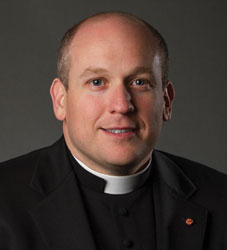
Father Michael Friedel is a Parochial Vicar at the Cathedral and Chaplain at Sacred Heart Griffin High School.

Important Announcements!

December 14th 8AM Mass Change

The 8 AM Saturday Mass on December 14th is cancelled. We will have Mass on Saturday, December 14th at 7 AM for our special Rorate Coeli Mass. All are welcome to attend!

Novena Closing Mass

The last night and closing Mass for the Novena this year is Monday, December 9th at 5:15 PM. The novena is moved one day this year because December 8th falls on the Second Sunday of Advent resulting in the transfer of the Solemnity of the Immaculate Conception to December 9th.

CCCW Cookie Walk Help

Are you interested in helping bake cookies or candies for our guests at the upcoming Cathedral Cookie Walk? The ladies of the Cathedral Council of Catholic Women would love to offer a variety of festive goodies and your help would be greatly appreciated. We will be accepting cookies and candies December 12th and December 13th from 10 AM to 7 PM. Please enclose the name of your cookies or candies and any special ingredients of note (for example, nuts, peanut butter, etc.). Thank you!

3 Saints Preach about Advent and Hope

For much of the world the Christmas season has arrived; or I suppose one could say, it arrived several weeks ago!

While the secular celebration of Christmas begins earlier and earlier each year, we as Christians are asked to reel things back in a bit, in order to prepare for the actual Feast of our Lord Jesus’ Nativity. Whereas the world finds itself on a roller coaster, beginning around the night of October 31, slowly climbing up the tall mountain over the next two months only to find itself on the steepest of declines every December 26, the Christian is asked to prepare with the Advent season. No roller coasters in sight here, as we find ourselves on a much more serene bell curve.

The liturgical new year begins on the Feast of Christ the King, between November 20 and November 26 each year. We then begin the buildup for Christmas on the following weekend with the First Sunday of Advent, which then crescendos with Christmas Day, with a bell curve leading us slowly back down into Ordinary Time with the true twelve days of Christmas. The pacing of the Christian calendar helps us orient our focus on Christ much easier than the hustle and bustle of the commercialized Christmas season. And as we find ourselves just beginning our journey into Advent and Christmas, we would do well to look to the wisdom of the saints, both from times past and of more recent times. This way, we can refocus during this solemn time of Advent, in preparation for the awesome celebration of the Savior’s birth.

Josemaría Escrivá

St. Josemaría Escrivá, the founder of Opus Dei in the midtwentieth century, has left us with voluminous writings on the Christian life, particularly in regards to this season of Advent. In one sermon, St. Josemaría exhorts us to turn away from the evils of pride and sensuality, and to focus on our true vocation:

“On this first Sunday of Advent, when we begin to count the days separating us from the birth of the Savior … we have considered the reality of our Christian vocation: how our Lord has entrusted us with the mission of attracting other souls to sanctity, encouraging them to get close to him, to feel united to the Church, to extend the kingdom of God to all hearts. Jesus wants to see us dedicated, faithful, responsive. He wants us to love him. It is his desire that we be holy, very much his own.”

St. Josemaría’s words remind me of something I recently heard in a homily. During these weeks that lead up to Christmas, our culture seems to engage more in sensual pleasures. Company parties, feasts, shopping sprees. All these things cause distraction, taking our sights off what we’ve been called to do in the world, which is to be a contradiction of this current age. This is why Advent is such a perfect time to “extend the kingdom of God” to our friends and peers. Instead of indulging in all the various things that surround us in the commercialized Christmas season, we can live a bit more simply through increased fasting and prayer. Or if we must attend such functions before the true Christmas season begins, we can do more penitential acts during other days of the week. This way, our Lord will hopefully see us as dedicated, faithful and responsive to his will. St. Josemaría continues:

“This time of Advent is a time for hope. These great horizons of our Christian vocation, this unity of life built on the presence of God our Father, can and ought to be a daily reality. Ask our Lady, along with me, to make it come true. Try to imagine how she spent these months, waiting for her Son to be born. And our Lady, Holy Mary, will make of you alter Christus, ipse Christus: another Christ, Christ himself!”

Here we have the perfect example, and single boast of our human race, in the blessed Mother. Her life was certainly built on the presence of God, and we can experience that as well when we are oriented toward heavenly matters as opposed to the worldly matters of “the holiday season”. This time of Advent will afford us a great opportunity to be “another Christ” to the world. But before we can be another Christ to the world, we must first let our Lord transform our very beings.

St. Bernard of Clairvaux

This is something that the great Doctor of the Church, St. Bernard of Clairvaux, spoke about. Living during the twelfth century, St. Bernard wrote a series of sermons for Advent. Often called the last “Father of the Church” in the Christian West, his words are still relevant even as we experience the Advent season in the twenty-first century. He reminds us that we are in actuality preparing for “two advents”:

“It is fitting, my brethren, that we should celebrate this season of Advent with all possible devotion, rejoicing in so great a consolation, marveling at so great a condescension, inflamed with love by so great a manifestation of charity. But let us not think of that advent only whereby the Son of man has ‘come to seek and to save that which was lost,’ but also of that other by which He will come again and will take us to Himself. Would to God you kept these two advents constantly in your thoughts, revolving them in assiduous meditation, pondering in your hearts how much we have received by the first, how much we are promised at the second!”

The Advent season, then, helps us to bear in mind our ultimate destiny. It causes us to call to mind that, God-willing, we will at the end of our earthly lives be in union with our Lord for eternity. God came into the world to redeem the entire human race, but he will also come again as he promised us. To think about the Second Coming as we prepare to remember his First Coming brings everything full circle. Christ came into the world so that sin would have no reign over us. And when he returns again at the end of the world, he will bring all those that follow him into heaven, where only his love reigns supreme and where the effects of sin will be non-existent. This is what the season of Advent looks forward to in the truest sense. In the first Advent, God became man. But in the second Advent, when our Lord reunites our souls with our bodies, we as men will become like God. Truly, we must always ponder these two types of “advents”, especially at this time of the year.

Pope St. John Paul II

But even if we turn our attention just to this “first Advent”, we’ll see that the Lord’s Nativity, which Advent anticipates, is not merely confined to one point in time, or to one culture in the past. Pope St. John Paul II explains in a beautiful homily he gave in 1988:

“In Advent we await an event which occurs in history and at the same time transcends it. As it does every year, this event will take place on the night of the Lord’s Birth. The shepherds will hasten to the stable in Bethlehem; later the Magi will arrive from the East. Both the one and the other in a certain sense symbolize the entire human family. The exhortation that rings out in today’s liturgy: ‘Let us go joyfully to meet the Lord spreads to all countries, to all continents, among every people and nation.”

The birth of our Lord and Savior is to be transmitted to all peoples across all points of time. This confirms exactly what St. Josemaría had mentioned above, that we “extend the kingdom of God” into the hearts of all those we encounter. St. John Paul has this in mind when he talks of the Nativity transcending time itself. Our own personal meeting with the Lord, and cultivating that relationship with him, causes us to preach the Good News to the world in our words and actions. Once we have found solace in Christ, how could we not want to share it? As he continues, St. John Paul II also finds himself in agreement with St. Bernard:

“In today’s Gospel we heard the Lord’s invitation to be watchful: ‘[Watch, therefore, for you do not know on what day your Lord is coming’ (Matthew 24:42) … The exhortation to be watchful resounds many times in the liturgy, especially in Advent, a season of preparation not only for Christmas, but also for Christ’s definitive and glorious coming at the end of time. It therefore has a distinctly eschatological meaning and invites the believer to spend every day and every moment in the presence of the One ‘who is and who was and who is come’ (Revelation 1:4), to whom the future of the world and of man belongs. This is Christian hope!”

We proclaim this hope every Sunday in the Nicene Creed. We look forward with a hopeful view to the resurrection of the dead, and that wonderful life of the world to come. We prepare for that in a very special way during Advent, being watchful for our Lord just as the shepherds and wise men were as they anticipated the Lord’s birth. This eschatological dimension of the Advent season must always be at the forefront of our minds. So instead of celebrating Christmas early this year, let’s think in sync with the great saints, and let Advent be Advent so we may more fruitfully contemplate that triumphant moment when we will be face to face with our Lord Jesus at the end of time in the heavenly kingdom.

Nicholas LaBanca is a cradle Catholic and hopes to give a unique perspective on living life in the Catholic Church as a millennial. His favorite saints include his patron St. Nicholas, St. Ignatius of Loyola, St. Thomas Aquinas, St. John Mary Vianney, and St. Athanasius of Alexandria.

Symbols and Customs of Advent Explained

The Advent Wreath and Candles

  • The evergreen circle is a symbol of eternal life. Green from the evergreen is considered a symbol of hope. Started as a domestic tradition that entered into churches in the twentieth century.
  • As a Christian tradition, the wreath holds the four Advent candles. The candles represent Jesus coming as the light in darkness. One candle is lit each Sunday until all four candles are lit, and sometimes a fifth candle is lit on Christmas. As Christmas draws nearer, each candle brings a little more light into the darkness.
  • Each of the candles represents an aspect of preparation during the season of Advent:
    • The Candle of Hope
      Color: Purple
      Purple is the primary color associated with Advent. Within the Catholic Church it symbolizes penance, preparation, and sacrifice.
      During the first week of Advent, we look forward to Jesus’ coming with hope.
    • The Candle of Peace
      Color: Purple
      During this second week of Advent, we reflect on our lives and work on becoming better-versions-of-ourselves in preparation for Jesus’ coming.
    • The Candle of Joy
      Color: Pink
      This third candle is pink, symbolizing anticipation and rejoicing. During the third week of Advent, we are filled with joy for the near arrival of Jesus on Christmas day.
    • The Candle of Love
      Color: Purple
      During this final week of Advent we rejoice in the endless love that God has for us, which is made apparent in the birth of his Son.

 Nativity Scene or Creche

  • Nativity scene or Creche is used to commemorate the humble birth of Christ.
  • Created by St. Francis of Assisi in the 13th Century to emphasize the humility of the Savior of the World coming as a poor child.
  • There are many different designs and themes used, including stone or wax figurines, as well as human and animal actors.
  • In some locations a variation is included that has the manger empty until Christmas Eve as a celebration of Christ’s arrival as a child.
  • Culturally, certain countries will change the look of the Creche, including more towers, houses, mountains, than what was traditionally used during the 13th Century.

For more information on Advent traditions or symbols and for the original articles referenced in this article, please go to Dynamic Catholic: https://dynamiccatholic.com/best-advent-ever/about-advent and USCCB: http://www.usccb.org/prayer-and-worship/liturgical-year/advent/about-advent-wreaths.cfm

Watch and Pray

This weekend the church year begins anew as we begin the holy season of Advent, a name derived from the Latin word adventus, which means “the coming.” This holy season looks to the two comings of Christ; first, we look forward to our Lord’s return in glory at the end of time, and second, beginning December 17th, we look back, remembering that our Lord came to us in time to be one with us in all things but sin. While it may not have the same depth of austerity as Lent, Advent is also a penitential season where the words of the Prophets echo to us from ages past to prepare a way for the Lord in our hearts and lives.

Even though the readings of Advent follow a three-year cycle, with Matthew now being this year’s primary Gospel, each of the four Sundays have their own consistent theme with their own readings. This first Sunday always has the theme of “Watch and Pray.” This year we hear from Paul’s Letter to the Romans where we are told to “wake from sleep.” Why? The answer follows in this Sunday’s Gospel from Matthew: “you do not know on which day your Lord will come.” This Gospel is not one of doom and gloom but an admonition for us to be ready every day and always for the Lord’s appearance; for those who will be ready to receive him, greater things will follow.

This time of year is a busy time for many of us, but I encourage you to not get swept away in the commotion. Advent is a beautiful season and even though it is penitential (thus the use of the color violet), it also possesses a subdued joy and peace. I encourage you to make use of this season and set aside some time for yourself with the Lord.

As we being our Advent journey, three important celebrations are coming in the next week. First, we begin our annual novena in honor of the Immaculate Conception this Sunday evening, December 1st, and this will continue every evening through December 8th at 7PM. The novena will end on December 9th at the 5:15PM Mass. Second, this Monday, December 2nd, is the anniversary of the rededication of our Cathedral Church and is a solemnity in our parish and a feast day in every other parish in the diocese. I find it hard to believe that this will mark ten years since that beautiful celebration in 2009. Third and final, this coming Sunday, December 8th, would normally be the Solemnity of Mary, the Immaculate Conception, but it is transferred to Monday, December 9th because it cannot land on the Second Sunday of Advent, thus why the novena begins and ends a day later this year. This is the only circumstance when the obligation to attend Mass for the Immaculate Conception is lifted. While this year it is not a holy day of obligation, I still encourage you to come and honor our Blessed Mother who is patroness of our nation, diocese, and parish under the title of the Immaculate Conception. Masses that day will be at the regular daily times of 7AM and 5:15PM.

For me, this Sunday begins my favorite time of year, now through the end of the Church’s celebration of Christmas in mid-January. For some, this season can be stressful or sad; for all of us, the Lord wants us to know his peace, now and in every season. Open your heart to the Lord, watch and pray, and you will find him, his grace, and his peace.

Father Christopher House is the Rector of the Cathedral and serves in various leadership roles within the diocesan curia, namely Chancellor and Vicar Judicial.

The Advent Season is approaching!

We hope to provide you with resources and prayerful opportunities to help grow your relationship with Christ. Advent is a time of waiting and anticipation. It is a season that reminds us to slow down and to spend time in prayer and reflection. As you journey through the Advent season, please know you and your guests are welcome at any of the offerings listed. If you have any questions, please contact the Parish Offices at 522-3342.

Novena in Honor of the Immaculate Conception
Beginning December 1st thru December 9th, the Cathedral will host the annual diocesan novena in honor of the Immaculate Conception, patroness of the United States, our diocese, and the Cathedral Parish. Each night a different preacher will offer a homily on a different aspect of Marian theology and devotion. The novena is moved one day this year because December 8th falls on the Second Sunday of Advent resulting in the transfer of the Solemnity of the Immaculate Conception to December 9th. December 1st thru 8th – 7:00PM; Last Night and Closing Mass, December 9th – 5:15PM @ Cathedral

Advent Lunch and Learn
St Joseph Worker parish in Chatham hosts an Advent Lunch & Learn that consists of a simple soup/bread/etc. lunch followed by a series of Advent reflections on the Tuesdays prior to Christmas. This year, Fr. Dominic Rankin will speak about the three gifts of the magi; gold, frankincense, and myrrh December 3, 10, 17 – 12:05, O’Hara Hall

Rorate Coeli Mass
Join us on Saturday, December 14th at 7am for Cathedral’s first Rorate Coeli candlelit Mass in honor of Our Lady during Advent. The Rorate Mass is lit only by candlelight. In the dimly lit setting, priests and faithful prepare to honor the light of the world who is soon to be born, and offer praise to God for the gift of Our Lady. As the Mass proceeds and sunrise approaches, the church becomes progressively brighter, illuminated by the sun as our Faith is illuminated by Christ. All are welcome to join us for this special Mass!

Springfield Choral Society Presents “Messiah”*
The Cathedral is thrilled to once again host the Springfield Choral Society’s presentation of Handel’s “Messiah.” This is a ticketed event. Tickets are available through the Springfield Choral Society or at the door the evening of the performance. Saturday, December 14th – 7:30PM @ Cathedral

Advent Lessons and Carols
On the evening of Gaudete Sunday, in the holy season of Advent, join Mark Gifford and the Cathedral Choir for an evening of Scripture, music, and prayer as we reflect on the two promised comings of Christ. Sunday, December 15th – 7:00PM @ Cathedral

Late Advent Holy Hour
Enjoy the peace and quiet during this prayerful hour spent before the Lord. Tuesday, December 17th – 7:00pm @ Cathedral

ONLINE RESOURCES

The Adventure of Discipleship
Sacred Heart Major Seminary is offering a free, short, interactive online course based on Dr. Daniel Keating’s new book, “The Adventure of Discipleship.” Dr. Keating invites you to look at your Christian journey as an adventure that far surpasses other adventure stories. Dynamic and engaging, each week of the course features short videos, film clips from epic adventures such as Lord of the Rings, scriptural meditations, interactive learning activities and online discussion. Starting December 1st, register at shms.edu

Rejoice! Advent Preparations with Joseph or Rejoice! Advent Preparations with Mary
Rejoice! Advent Meditations with Joseph is a prayer resource with daily meditations that will enrich your Advent by inviting you to experience the first Advent with Joseph and Mary, as they await the birth of their son, the Savior of the world. Together with the guided meditation videos, this journal calls you daily to see through Joseph’s eyes, feel what is in Joseph’s heart, and read the Scripture that Joseph read, so you can fully prepare to welcome Jesus into your heart this Christmas. Presented by Fr. Toups, Sister Miriam Heidland, and Fr. Josh Johnson. The Rejoice! Advent Meditations with Mary Journal not only lets you walk beside Mary during the first Advent, but also lets you get to know her in a way you haven’t before. Rejoice! offers more than insights and information about Mary’s life—it offers an opportunity for you to encounter Mary in the quiet of your heart. Go to ascentionpress.com for more information and to watch an introductory video and order the book or journal.

Advent Gospel Reflections
This year’s Advent Gospel Reflection booklets contain brand new reflections from Bishop Barron, the full Gospel reading for each day, questions for reflection and even journal pages. It’s short, simple, but extremely powerful. It’s like getting a mini-homily each morning from Bishop Barron. Go to bishopbarronbooks.com to purchase a booklet.

Best Advent Ever
A great Christmas begins with an incredible Advent. Every day during Advent, you’ll receive an email with a short video from Matthew Kelly and the Dynamic Catholic team. It’s free and easy to sign up. Go to dynamiccatholic.com to sign up

Finding God in Unexpected Places
A free daily email featuring a short and inspiring Advent video reflection on a work of art from the Detroit Institute of Arts by Fr. John Bartunek, LC. Each daily 1-minute video is designed to help you know the happiness and joy of discovering the presence of God in unexpected places of your daily life and to help others around you do the same. Go to rcspirituality.org/advent-2019/

DAILY PRAYER BOOKS – Paper copy and Online versions

Give Us This Day– Request a free copy at giveusthisday.org
Magnificat– Subscribe at: bookstore.magnificat.net
The Word Among Us– Subscribe or get a free online trial at wau.org/subscribe/

ADVENT BOOKS

Jesus of Nazareth, the Infancy Narratives by Pope Benedict XVI
Pope benedict focuses exclusively on the Gospel accounts of Jesus’ life as a child. The root of these stories is the experience of hope found in the birth of Jesus and the affirmations of surrender and service embodied in his parents, Joseph and Mary.

Joy to the World: How Christ’s Coming Changed Everything (and Still Does) by Scott Hahn
What could be more familiar than the Christmas story — and yet what could be more extraordinary? The cast of characters is strange and exotic: shepherds and magicians, an emperor and a despot, angels, and a baby who is Almighty God. The strangeness calls for an explanation, and this book provides it by examining the characters and the story in light of the biblical and historical context.

Advent and Christmas; Wisdom from Henri J.M. Nouwen
This book is designed to be used during the entire period from the First Sunday of Advent to the end of the Christmas season. Reflections begin with the words of Nouwen, followed by an excerpt from scripture related to the quote and then a prayer timing both together. Finally, an activity is suggested for applying the message.

Advent Meditations with Fulton J Sheen
Drawn from Archbishop’s best-selling books, theses reflections are eloquent quotes paired with beautiful Scriptures on the themes of the season; patience, waiting, gift, hope, humility, joy and more.

Advent and Christmas: Wisdom from Pope John Paul II
Designed like the Nouwen book, we read and reflect on selections from the Holy Father’s talks and statements followed by scripture, prayer and a suggestion for an appropriate seasonal activity

Start Now for a Happier, Wholly Holier, Advent and Christmas

In Death on a Friday Afternoon, the late Fr. Richard John Neuhaus cautions us to take Lent slowly, to not rush to Easter. A similar thought comes to mind when approaching Advent: we should not rush to the stable. Advent, the time of great expectation, should be a time when we can linger awhile with Mary and Joseph in their time of anticipation.

But what has become of Advent? Or the days before Advent, for that matter? I went shopping on November 1, All Saints Day, also known as the day after Halloween. What to my wondering eyes should appear but peppermint sticks, ornaments and a battalion of reindeer. On November 1. It is little wonder that those of us who wish to keep Advent feel not only a bit overwhelmed but just a little like Charlie Brown on his Trick or Treat rounds. OK, I didn’t get a rock in my treat bag – just a holiday surprise that was less than charming.

Yes, there is no need to rush to Christmas. And, with a little advance planning now, Advent can find its proper place on the calendar and in our hearts.

THANKSGIVING
A major stumbling block for those of us who live in the U.S. is the way the Thanksgiving holiday has been almost totally subsumed into the secular celebration of Christmas. Keeping Thanksgiving as its own holiday – before Advent – is a good start. Thanksgiving is about gratitude; not the opportunity for jump starting our shopping. Decide now to bring a grateful heart into the days of Advent.

PRAYING
Having a prayer plan is the most important Advent planning. Whether it be a personal choice from the many wonderful resources for Advent or a plan for prayer as a family, planning ahead can lead to a more peaceful, prayerful Advent. Parents of older children may want to include them in the planning for Advent devotions. (This is a lesson I had to learn the hard way. And I quickly learned that the first day of Advent is not a good time to be casting about for prayers and reflections for the season.)

PLANNING
Panic is a peace thief of the blessed days of Advent. Good advance planning – be it for celebrations religious and secular, shopping, cooking, cleaning – helps prevent panic. Keeping all of those plates of plans spinning in one’s head is a definite distraction. Putting plans down on paper (or electronically if that is your preference) gets things organized and out of your head. Whether you chose to use a special planner or create your own, start now with the planning that can free up your mind during the days of Advent.

CELEBRATING
Don’t forget the feast days that come in December. Among the many days for celebration, we have the feasts of St. Nicholas, St. Juan Diego, St. Lucy, Our Lady of Guadalupe as well as the feast of the Immaculate Conception of the Blessed Virgin Mary. Spending some days in Advent celebrating the feasts of these holy men and women is not just a teachable moment for the family. These are tangible celebrations – not random days of the vague ‘holidays’ season. Not only are these days faith-filled and fun days, but they are also great moments for evangelization as we share the reason for our celebrations. Of course, St. Nicholas was the first of the December feast days that I remember from a very young age during my German Lutheran upbringing. Naturally, this was the first Advent feast day that we celebrated as a family and then, as time passed, more family feast day celebrations were added to our calendar.

PLANNING A FULL CHRISTMAS SEASON
Remember that Christmas is more than one day and plan accordingly. While secular media pulls the Christmas rug out from under us on the 24th of December, we know that the 25th of December is just the beginning of our Christmas celebration. Just as we should not rush to Christmas, we should ignore the cultural influences that try to rush us past this holy season.

Ellyn von Huben is a native of Wisconsin, and has never lived more than five miles from the shores of Lake Michigan. She has a degree in art history from Barat College in Lake Forest, Illinois. Fascinated with the Catholic faith since her childhood, Ellyn, her husband, four children (plus one in utero) were received into the Catholic Church in May of 1988. Ellyn lives in the suburbs of Chicago, and still has her ‘day job’ as an administrative assistant in a large Catholic parish on Chicago’s North Shore.

« Previous Page
Next Page »

Liturgy

Sunday Masses (unless noted differently in weekly bulletin)
Saturday Evening Vigil – 4:00PM
Sunday – 7:00AM, 10:00AM and 5:00PM

Weekday Masses (unless noted differently in weekly bulletin)
Monday thru Friday – 7:00AM and 5:15PM
Saturday – 8:00AM

Reconciliation (Confessions)
Monday thru Friday – 4:15PM to 5:00PM
Saturday – 9:00AM to 10:00AM and 2:30PM to 3:30PM
Sunday – 4:00PM to 4:45PM

Adoration
Tuesdays and Thursdays – 4:00PM to 5:00PM


CatholicMassTime.org

Parish Information

Parish Address
524 East Lawrence Avenue
Springfield, Illinois 62703

Parish Office Hours
Monday thru Thursday – 8:00AM to 4:00PM
Fridays – CLOSED

Parish Phone
(217) 522-3342

Parish Fax
(217) 210-0136

Parish Staff

Contact Us

Contact Us

Copyright © 2025 · Log in