Cathedral of the Immaculate Conception

Springfield, IL

  • About
    • Contact Us
    • History of the Cathedral
    • Liturgical Schedules
    • Parish Staff
    • Register with Cathedral
    • Subscribe to the Cathedral eWeekly
  • Sacraments
    • Baptism
    • Becoming Catholic
    • Matrimony
    • Vocations
  • Ministry List
    • Adult Faith Formation
    • Cathedral Meal Train
    • Cathedral Online Prayer Wall
    • Cathedral Concerts
    • Family of Faith
    • Grief Share
    • Health and Wellness
    • Spiritual Resources
  • Stewardship
    • Stewardship: A Disciple’s Response
    • Stewardship Form
  • Support
    • E-Giving Frequently Asked Questions
    • Give Online
  • Sunday News
    • Announcements
    • Cathedral Weekly
    • Livestream Feed
    • Submit a Mass Intention Request
    • Weekly or Announcement Submission

Embracing a Stewardship Way of Life

Mother and daughter enjoy in sunset together.

In preparation for the Season of Stewardship this fall, let’s reflect on stewardship as a way of life. The four pillars: Prayer, Formation, Hospitality, and Service create the framework and model for our Parish mission. We support prayer through offering daily Mass, Confessions, regular Adoration hours, and celebrating the Eucharist together each weekend. We support formation through our adult faith formation series, welcoming not only Cathedral parishioners, but guests from throughout the Diocese. We offer hospitality through our Alpha series, from welcoming our guests to providing a home-cooked meal. We share in service through the year-long efforts of ministries like the Cathedral Council of Catholic Women or the Knights of Columbus, Father Augustine Tolton Council. In so many ways the Cathedral is supporting the four pillars of stewardship to help in answering the call to discipleship.

What does that calling look like for you? When the offertory takes place at Mass are you only concerned about an envelope or something deeper? The Offertory is a time for prayerful discernment on one’s commitment to a stewardship way of life. Ask yourself these three questions:

  • Who can I pray for this week?
  • How can I serve this week?
  • What can I generously give this week?

Most importantly…why does this matter or what is the value of stewardship? I think that is a fair question to ask. In today’s culture we are always seeking answers, validation, or reasoning behind where we spend our time and money. For example, recently the most common question about the REBOOT event is the ticket price; “Well, what do I get?” It is common to seek the value in something. However, value is really in the eye of the beholder. What one person might see as value added, might be lost on another. At the REBOOT event each person will have the opportunity to leave with three books, resources, and more swag. That might be valuable to some, while others would find Chris Stefanick’s inspirational words the real value. How about the value in time? Ultimately, if you join us at REBOOT, or when you join us for a faith formation program, or if you join us for Mass…you are saying it is worth your time. Time is not renewable. We never get it back and that is why it is so valuable. Where and with whom you spend your time is often a reflection of what you value.

So, where do you spend your time? When we learn about individual stewardship we commonly hear the phrases, “time, talent and treasure” or “prayer, service, and giving” used. Why is “time” and “prayer” listed first every time in the sequence? Because your time with God is the most important. It is fundamental in a stewards life. It is ultimately the most important relationship we should be nurturing with our time. Spending time at a faith formation event is time with God. Spending time serving with a ministry is time with God. Spending time in our sacred space at Adoration or Mass is spending time with God. It is the source and spirit behind all activities of steward. It is rare I come in contact with someone who has an active faith life, but doesn’t contribute their service or gifts to the church.

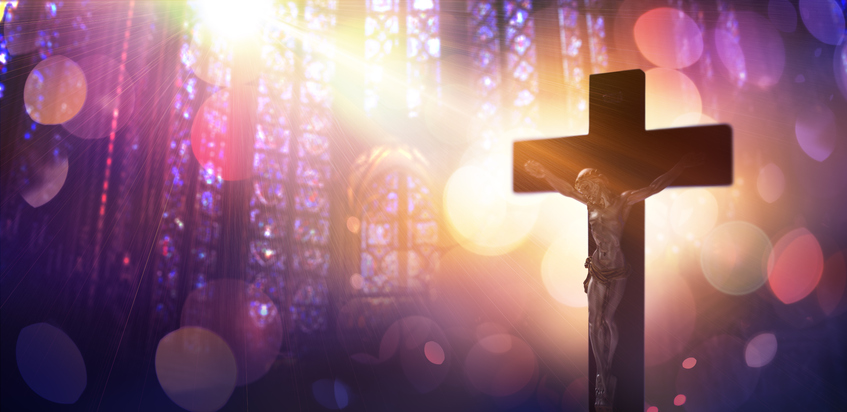
I remember one Sunday while I was staying after Mass and doing the “Catholic loitering” thing, I noticed my daughter across the room staring at the Crucifix in the Cathedral Atrium. Now, if you have met my daughter you would quickly agree that she is a high-energy gal (geez, I wonder where she gets that from!) and doesn’t always stand still. But, as she was standing there fixed upon the Crucifix, she stood still…for 30 seconds…a minute…now, two minutes in…and I am curious. I approach her and said, “Gracey, everything okay?” She responded, “Why would anyone hurt Jesus?” At that moment, I stood still, frozen in place and time. In that moment I realized that these God-sized questions were going to be coming my way as a mother. Some I would be able to answer easily, some would be far more difficult. How does one prepare for these questions? Easy. It takes God-sized time with Him in order to answer the God sized questions. The time I set aside in my daily routine for God, is a positive return on my relationships as a mom, wife, friend, sister, daughter. If I truly care for these relationships, I would need to consider the importance of nurturing my relationship with God. He is the source and summit that flows through me and into all of these other relationships I value.

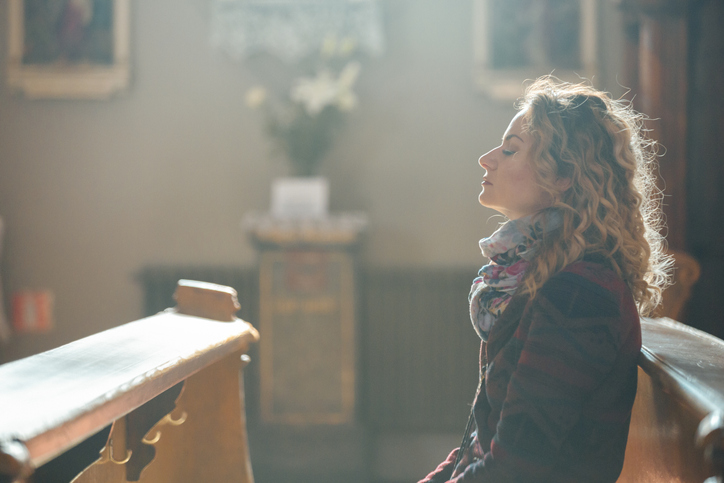
Consider where you spend your time this week. How can we support you in finding time to pray? How can we help you in your prayer life?

Katie Price is the stewardship coordinator for the Cathedral of the Immaculate Conception and the Director of Discipleship and Stewardship for the Diocese of Illinois.

Around the Parish

We were supposed to be bidding farewell to Grant Wilson about this time, but things have changed. Grant will be spending the next year with us at the Cathedral parish. Grant has had some knee trouble and had some medical procedures done at the beginning of the summer in response to those challenges. Grant requested to remain home to continue his care before returning to his studies in Rome and Bishop Paprocki has agreed to Grant’s request. Grant’s ministry presence in the parish will be expanding as a result. As always, I am grateful for the hospitality that the parish had shown him.

I wish to thank everyone who supported the Cathedral Council of Catholic Women’s clothing sale and annual garage sale, both of which took place at the beginning of the month. The ladies of the CCCW do a tremendous job of bringing order to chaos from the time they start receiving items to the time of the actual sale. The ladies do many forms of service in our parish and many of their efforts are unseen; I thank them for their continued generosity to the shared life of our Cathedral parish.

Thursday September 19th will see the parish welcome Chris Stefanick and the REBOOT! program. Chris is a very popular lay evangelist in the American Church , speaking to over 85,000 people a year, and he is known for his deep faith, energy, and enthusiasm and it’s a great thing that we are able to bring him to the Cathedral. The evening program starts at 7PM and the cost is $25 per person. The evening is a presentation of the Gospel and practical, everyday ways than everyone can apply it his or her daily living. This is a great opportunity and I hope to see you there.

We have published a list of upcoming faith formation/enrichment activities for the coming 2019/2020 year. I am very happy with the variety of events that we are planning to offer and I hope that you will take advantage of these opportunities. Making use of these activities help us to grow deeper in our discipleship and the better disciples we are, the better our parish will be, and the better the world will be.

This past Thursday we celebrated the great Solemnity of Mary’s Assumption into Heaven. For me, that is always the signal that summertime is over and things start ramping up again. As we enter into the back half of August, with Labor Day and the unofficial start of Fall fast approaching, I wish you and yours the fullness of the Lord’s grace and peace. God bless you!

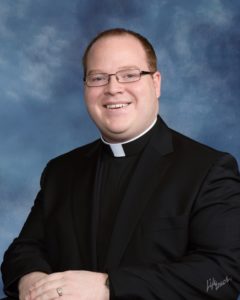
 Father Christopher House is the Rector of the Cathedral and serves in various leadership roles within the diocesan curia, namely Chancellor and Vicar Judicial.

How to Create a Prayer Toolkit for All Your Prayer Needs

I’m hopeless when it comes to most home improvement projects. In fact, all it takes for me to go from zero to a full-on panic attack is the sight of a piece of furniture that needs to be assembled or a leaky kitchen sink in need of repair. Many years ago, my husband made me promise I would never again attempt such a project alone because my DIY endeavors always ended up costing us more money in the long run than hiring a professional to complete the task ever would. But after watching more than a few popular HGTV shows, I discovered my critical home improvement error: I never used the correct tools. Eventually, I realized that even someone who is all thumbs like me can be downright handy if I just had the right tools to work with.

The same is true in my prayer life. Just as a socket wrench won’t do the trick when a screwdriver is needed, I find that certain types of prayer are better for specific times in my life. Sometimes I need prayer to be a moment of peaceful reflection and quiet gratitude. But at other times, I need prayer to help me deal with anger, hurt, or sadness. Sometimes my prayer is made up exclusively of words, either spoken or read, but at other times, my prayer is all about silence. So, I created my own prayer tool kit to help me set the stage for any kind of prayer experience I need.

To begin, I have a dedicated prayer space in my home where I always have a few things handy:

  • A candle to symbolize God’s presence.
  • My Bible to help ground me in a centuries-old faith tradition. I’ve also bookmarked the Book of Psalms on my phone to have these poetic, heartfelt prayers readily available.
  • Books of prayers and reflections because sometimes my own words fail me, and I need to use someone else’s. I’ve found Joyce Rupp’s books to be perfect for this.
  • Images that have significance for me — framed photos of both my parents and another friend of mine who are all deceased, meaningful art, like images from nature, evocative sculptures, or even abstract paintings to set an appropriate tone for my prayer. I also use a specific set of tools depending on what’s on my mind and in my heart when I begin to pray: If I come to prayer feeling happy or grateful …
  • I count my blessings in my journal. Some people use a gratitude journal specifically for this purpose, but I have a section in my personal journal earmarked just for this.
  • Believe it or not, I also have my to-do list with me during my prayer time. When I’m feeling particularly blessed, I want to share that appreciation with others. I make a note, right alongside the budget report that’s due to my boss on Monday and the dry cleaning I need to pick up, to thank someone in the next day or so, even if it’s for something very small. If I come to prayer feeling upset or angry …
  • I begin by listening to soothing music. When I’m feeling great frustration or hurt, I need something to slow down my pounding heart and racing thoughts. The gentle rhythms of a relaxing piece of music usually help to calm me.
  • I also make sure to have paper and pen at the ready. I’m an introvert and have a strong need to get my concerns or grievances down on paper. I find that this helps me gain perspective on what’s bothering me, and it helps me get to a more peaceful place where I can open myself to God’s presence.
  • I also have a Rosary nearby. Sometimes, I’m too upset to think straight, even after I’ve written in my journal. In those moments, the rote repetition of praying the Rosary calms my nerves. I don’t worry about meditating on the meaning of each word in the “Hail Mary” and “Our Father.” Instead, I just let the words pour over me. If I come to prayer feeling anxious or scattered …
  • I turn to my meditation cushion or a straight-back chair. At times like these, sitting in silence is my tool of choice.
  • I also light scented candles or incense to create a contemplative environment. Sometimes, the more senses we use during prayer, the deeper our experience can be. If I come to prayer concerned for another person …
  • I turn to my “heart basket,” simply a basket with small pieces of paper next to it. I write down who and what I want to pray for with the date on a slip of paper, fold it, and place it reverently into the basket as a symbolic way of placing the intention in God’s hands. I often hold my heart basket in my hands while praying the Memorare or just sitting in prayerful silence.
  • I like to listen to contemporary Christian music along with my heart basket. I have several go-to songs about faith bookmarked on YouTube that I listen to while I pray.
  • I’ve found that having a prayer tool kit at the ready helps me bring my whole self to God and opens me fully to the unfolding of God’s grace.

Mary Ann Steutermann is currently the director of campus ministry at Assumption High School, an all-girls Catholic high school in Louisville, Kentucky. A career educator, she has more than 20 years experience as an English teacher, assistant principal, and principal and does freelance writing on the side. She holds a bachelor’s degree in English and two master’s degrees in education. Mary Ann lives in Louisville with her husband and son.

With an Eye Towards Heaven

With an Eye Towards Heaven This Sunday’s first reading offers us a passage from the Book of Ecclesiastes. The book tells us that its author is named Qoheleth. We do not know anything about this Qoheleth except one thing: he is not happy. While Ecclesiastes offers us many beautiful passages, its overall tone is one of gloom, skepticism, and frustration. That is not necessarily a bad thing because, if we read Ecclesiastes in light of the world’s fixation on materialism, especially in conjunction with today’s Gospel reading, then it makes perfect sense for any true disciple that Jesus Christ makes all the difference.

Ecclesiastes gives us the famous phrase “there is nothing new under the sun.” This is proven true in that the root of Qoheleth’s frustration over some twenty-three hundred years ago is the same for many people today: every thing, every person, every labor and its fruit, all of these things are finite and will pass away. This doesn’t mean that we just shrug our shoulders and give up, but this reality invites the disciple to ask his or herself a vital question:

“why do I do what I do” or, put another way, “what motivates me in life?”

In the end, what do you want? Do you want to be like the man in this Sunday’s Gospel who labored for the things of this world but who did not live long to enjoy them or do you want labor for the things of heaven, the things that “matter to God” as Jesus says in today’s Gospel passage?

Everything that a disciple does, be it word or deed, is to be done with an eye towards heaven or, more aptly, with an eye towards God.

God alone is eternal and the good news for us is that he wants us to share eternity with him in heaven. This does not mean that we cannot enjoy the fruits of our labors or the “good things” of this life, but if our ultimate desires are for comfort and wealth or the things of this world then we will be sorely disappointed in the end.

The tragedy for Qoheleth is that he did not know Jesus Christ, being that he lived in a time before the Lord’s coming. This is not the case for us. We are invited to grow deeper each day in our knowledge of and relationship with Jesus and to derive our hope and comfort from his true promise of everlasting life with him in heaven.

The more we come to know the Lord and value the life he freely offers, the easier it is to live our lives each day with an eye towards heaven.

Look at what the world will ultimately offers us. Look at what Jesus Christ will ultimately offer us. The choice should be obvious.

Father Christopher House is the Rector of the Cathedral and serves in various leadership roles within the diocesan curia, namely Chancellor and Vicar Judicial.

Covering the Bases of Prayer

This Sunday’s Gospel reminds us of the wonderful truth that we have a God who is accessible, a God who wants us to come to him with our cares, concerns, sorrows, joys, everything. This underscores the importance of prayer for our lives, the fact that God wants to be in relationship with us, that God wants to be in constant contact with us.

Why do we pray? I ask that question seeking an honest, personal answer. For most of us, we find ourselves motivated to pray by a sense of need either for ourselves or for someone else. There is nothing wrong with that as, again, the Lord invites us to cast our needs on him. However, petition is only one form of prayer and as disciples we need to make sure that we are rounding all the bases of prayer in our life of faith.

There are four basic types of prayer. The one that we are most familiar with is petition, but in asking the Lord for something we must be careful to not mistake God for Santa Claus in that we only go to him with our wants. The other forms of prayer are adoration, contrition, and thanksgiving. Offering prayers of all forms will serve to make us stronger in our discipleship.

In looking to the other three types of prayer, we need only ask ourselves three simple questions each day to make sure that we are not lacking in these other forms:

Adoration: have I praised God today for his greatness and glory?

Contrition: have I acknowledged the ways in which I have sinned and offended God and asked

for his forgiveness?

Thanksgiving: have I thanked God for the richness of his graces and blessings this day?

The disciple is a person of prayer and our daily prayer should encompass all four forms: praising God for his greatness, acknowledging our sins and seeking his forgiveness, asking the Lord for whatever we need of grace, and thanking him for all his goodness and blessings.

Father Christopher House is the Rector of the Cathedral and serves in various leadership roles within the diocesan curia, namely Chancellor and Vicar Judicial.

Prayer and Work

This past July 11th, as every year, the Church celebrated the memory of St. Benedict, the man who is called the “father of western monasticism” and from whom the Benedictine Order takes its name. Benedict was born in 480 and lived in central Italy. As a young man, Benedict was sent to Rome to study. While there, he became disillusioned with Roman life, abandoned his studies, and left the city to find peace away from it, eventually becoming a hermit in Subiaco. It was there that Benedict wrote his famous Rule which has been the guiding force of Benedictine life, and reference for religious life in general, for 1500 years. 

At the heart of the Benedictine life is the rhythm of prayer and work, in Latin ora et labora. A balance between contemplation and activity is key to balance in the Benedictine way of life. In reading the Rule, it may appear that work takes more time than prayer, but ultimately prayer should permeate every aspect of the monk or nun’s life, work included. The Rule’s prologue begins with listen carefully, my son, to the master’s instructions, and attend to them with the ear of your heart. This is the advice from a father who loves you; welcome it, and faithfully put it into practice. The monk or nun’s life is all about listening, about making sure that one can hear the voice of God over the voices of the world. 

This Sunday’s Gospel tells us of the welcome that Jesus received from his friends Martha and Mary. Martha is dutiful in her responsibilities towards hospitality, but she becomes lost in her efforts, and is angered by her sister Mary who has chosen to sit and listen to the Lord. Martha attempts to win the Lord’s backing to rebuke Mary but it is Martha who finds herself gently corrected by Jesus. In his response to Martha, Jesus does not dismiss her efforts nor downplay the importance of hospitality, but invites her, like Mary, to see what is most important, in this case it is the Lord, who simply wants to be with the two sisters. 

All of us have things going on in our lives, some of which are very important. As disciples we must be sure, in things large or small, that we do not become distracted from the Lord. The monk or nun goes about their work with God before their eyes as they complete their labors, but mastering that awareness takes time and discipline for anyone; even the most “experienced” monastic takes time from the their labors to sit at the Lord’s feet. In going about our daily living, we must keep the Lord before our eyes in all things; learning how to do this takes time at his feet to listen. Excelling in our discipleship will only be possible, and sustained, through taking the time to be with the Lord, to listen, to love, and to be loved. 

Martha’s labors were important but she lost sight of why, or rather for whom, she was doing them. Each day, as we go about our living, as we are faced with choices and decisions, may everything be for the Lord. For us to have the grace to make those choices for him, we must first to take time with him.

Love the Lord Your God AND…

The scholar of the law in this Sunday’s Gospel asks the ultimate question of Jesus: “what must I do to inherit eternal life?” First, Jesus quotes part of the Shema found in the Book of Deuteronomy. The Shema is a foundational prayer for the Jewish people: “you shall love the Lord, your God, with all your heart, with all your being, with all your strength, and with all your mind.” In short, we are called to love God with the totality of who we are; however, Jesus adds something to it.

What Jesus adds is nothing new and, while it is not a part of the Shema, it is a part of the law found in the Old Testament. In reciting the Shema and how we are to love God, Jesus adds at the end “and your neighbor as yourself.” He joins this commandment to the Shema and places it at the heart of the law. Total love of God is a hard enough, but I have to love my neighbor too? Yes, and this is what the Lord says is required for eternal life. Our Lord then adds a further twist to drive the point home.

Saint Luke recounts for us that the scholar of the law seeks further clarification. Most likely this scholar was a scribe who was an expert in the law and why he presses Jesus on the issue of “who is my neighbor” is unclear, but the answer that Jesus gives would have been hard for most of his listeners to bear. In response to the scholar’s question, Jesus tells the crowd a parable, the one that we know as the story of the Good Samaritan.

The journey down from Jerusalem to Jericho is not down in the sense of heading south. Jericho is actually east/northeast of Jerusalem, but “going down” refers to the descent in elevation and this descent is through a very hot, barren, and rugged terrain. It is here that the story’s victim, a Jew, falls prey to robbers. The two who first come upon the man are religious figures, a priest and a Levite. Both of them pass him by with the likely excuse that to help this man, who would have been bloodied by the robbers, would have left them defiled and unable to fulfill their duties in the Temple in Jerusalem. Here, Jesus demonstrates for us the danger of extreme religiosity where the law becomes idolatrous; true duty to God would never demand the dismissal of someone in dire need.

Then comes the third person, a Samaritan. In the history of warring peoples in the Middle East, the conflict between the Jews and the Samaritans was classic; their hatred for each other was total and absolute. Imagine yourself in the place of the Jewish man who has been attacked. The person who is approaching him is a Samaritan and the thought of “now he is going to finish me off” could have very likely crossed his mind. However, the Samaritan is moved with compassion when he comes upon this man who is his “enemy” by societal norms. In his compassion, the Samaritan tends to his needs and goes above and beyond to ensure the victim’s well-being. This is a

Pier Giorgio Frassati as a Model of Freedom

July 4th is for many a day of fireworks, cold beer, and barbeque. As a national holiday, we remember the founding of our nation in a revolution against tyranny. Most often we impose a surface level meaning of authentic independence. Just because we are allowed to vote and our voice still matters in the voice of this country does not mean that we are free. True, authentic freedom is a matter of heart and soul. Physical sovereignty can always be taken away; however, the conscience is governed by a higher power and thus, even though the body be chained, the interiority of a person can still remain free.

As the Reverend Jacques Philippe wrote in his phenomenal work Interior Freedom, “To achieve true interior freedom we must train ourselves to accept, peacefully and willingly, plenty of things that seem to contradict our freedom. This means consenting to our personal limitations, our weaknesses, our powerlessness, this or that situation that life imposes on us, and so on…the situations that really make us grow are precisely those that we do not control.” While many might pledge that freedom is the absence of external coercion, proper independence is a matter of the soul. No matter who or what entity might try to enforce its own beliefs and principles, the soul cannot be forced to do something it doesn’t want to do, unless the individual consents. This is the real axiom as to why the Church upholds its tradition of honoring the saints: men and women who had so much gall that, no matter the overwhelming falsehoods, they stayed strong in the face of hardship. This is why I find it very interesting that July 4th is shared with one of the most influential young men of the twentieth century. Blessed Pier Giorgio Frassati, the man of the beatitudes, was a model of interior freedom and the power of grace in the life of a man willing to surrender what was God’s.

Pier Giorgio lived his life by a code, an interior decision that in all matters of life, his soul belongs to his Creator. He joined many political causes as he was vehemently anti-fascist and did not fear the backlash of standing strong in his views. There are manyt stories which prove this man’s lionhearted struggle to do what must be done, and see that the Church’s morality not only survive, but thrive within a culture. One such tale occurred while Pier Giorgio was partaking in a protest in Rome; Frassati weathered police violence and rallied the other young people by grabbing the banner, which the police had knocked out of someone else’s hands. He waved the flag with pride and an interior anger of what humanity was resolving to do to one another. During the protest, he even used the pole to defend himself against the blows of the police officers. When several of his fellow activists were arrested by the police, he refused special treatment that he might have received because of his father’s political position, preferring to stay with his friends.

Another story revolves around a personal attack from the fascist regime. One night, a group of fascist soldiers broke into his family’s home, throwing valuables on the floor and ransacking the place. As the soldiers began to try physically assaulting Pier Giorgio and his father, Pier Giorgio rose to his father’s defense and chased their attackers down the street. Even though he could very well have lost his life, Pier Giorgio understood that Truth was more important than himself.

Pier Giorgio lived out Philippe’s philosophy that “we must be ready to do in an instant just what we hadn’t expected, to live in total self-abandonment, with no other concern than to do God’s will and being fully available to people and events.” Habitually, we fall into a sore concept of selfabandonment. It seems opposite to human reason to believe that freedom is less about what we can do as opposed to what we ought to do. However, when we acknowledge a higher power, a loving and all-knowing God who only wants what’s best for us, the relinquishing of our wills to the will of God is not an enemy of freedom; it is instead a shield of sovereignty.

There are two types of interior slavery: the chains and pains of sin or the will of God. One is a slavery in which your will is in danger of being circumscribed; the other is where your will is given the necessary grace to act in accord with what is good and believe what is true. Pier Giorgio’s witness testifies that while the world might smack you around, your soul is a living dynamism that, when infused with the freedom of the love of God in Christ, no one can hold back. I believe Pier Giorgio sums up the feeling of true freedom when he said, “Our life, in order to be Christian, has to be a continual renunciation, a continual sacrifice. But this is not difficult, if one thinks what these few years passed in suffering are, compared with eternal happiness where joy will have no measure or end, and where we shall have unimaginable peace.”

Jared is a Catholic author, speaker, blogger, husband and father of 6 and the Director of the Word on Fire Institute. He also holds a Master’s Degree in Theology from Holy Apostles College and Seminary.

Hello and Good-bye

This coming Thursday will see the arrival of Father Dominic Rankin who will serve our parish as a parochial vicar. I look forward to welcoming him and all the energy and enthusiasm that he will bring to us, but welcoming him also means saying good-bye to our Father Stock.

This summer will mark five years that I have been at the Cathedral this second time and Father Stock is the fourth vicar that we have sent out. I had the privilege of working with all of our vicars these past five years when they were seminarians while I was serving as vocation director for the diocese. It has been my great honor to witness the grace of God manifest itself in their lives and to serve with them as they grow in their own priesthood. One might think that these good-byes would be routine by now, but I find that to not be the case and I am grateful for that because it shows that each priest doesn’t just pass through, but, rather, he leaves his mark on our shared parish life.

Each priest who has served us here has brought his own unique gifts and persona. Father Stock is no exception to that norm. His many gifts, including his sense of humor and joie de vie, made him welcome not only here but also in the halls of Sacred Heart- Griffin High School, where I know he will be sorely missed. Living with him, he can be as quiet as a church mouse or as loud as the 4th of July; Father Friedel and I will miss both of these facets of Father Stock’s personality.

Over these five years, Father Rankin will be the sixth parochial vicar that we have welcomed and he will join the ranks of the good men who have preceded him. He brings with him his own gifts and I invite you to get to know him, his zeal, and his gentle heart. I also invite you to send your prayers with Father Stock as he takes up the mantle of being a pastor now. I pray that he will always know our gratitude for God’s goodness in allowing him to have shared these past two years with us and to know that, wherever he is sent, that the Cathedral parish will always be a home for him.

Father Christopher House is the Rector of the Cathedral and serves in various leadership roles within the diocesan curia, namely Chancellor and Vicar Judicial.

Corpus Christi

A few weeks ago, thirty-seven of us on the Cathedral pilgrimage to the Holy Land were able to visit Capernaum on the north shore of the Sea of Galilee. Capernaum was the home town of St. Peter and St. Andrew and became an adopted home of Jesus. We were blessed to stand in the ruins of an ancient church built on the foundation of Capernaum’s ancient synagogue. It was in this synagogue that Jesus gave one of his most famous teachings which is found in the sixth chapter of John’s Gospel and known as The Bread of Life Discourse. Jesus repeats himself several times in this discourse, commanding us to feed on him, to literally eat his flesh and drink his blood. This is not figurative language; this is John’s exposition on the Eucharist.

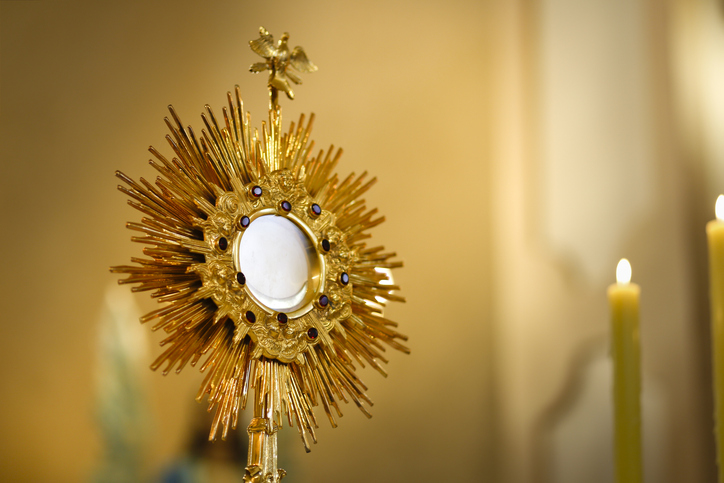
This weekend we celebrate the feast formally titled the Solemnity of the Body and Blood of Christ, but popularly known as Corpus Christi. Every time the Church gathers to celebrate the Mass, the Eucharist, which is the body, blood, soul, and divinity of our Lord, is at the center of our worship. We must avoid the danger of growing lax in our reverence and awe due to our familiarity with this great and wonderful sacrament, which is one reason why the Church dedicates a particular day of solemnity to focus solely on this mystery. The Eucharist is the life source of the Church, the ultimate manifestation of Christ’s presence among us, and it has been the strength of the faithful for the Church’s entire history.

It is not a sign or symbol, because a sign or symbol points to another reality; the Eucharist is the reality of Jesus’s real presence among us.

In this Sunday’s Gospel, Jesus’s feeding of the five-thousand is recounted for us which happened at another site a few miles from Capernaum called Tabgha and that the pilgrims were able to visit The transformation of those five loaves and two fish, meager as they were, reminds us that our simple gifts of bread and wine, when changed by the power of the Holy Spirit, become something new and wonderful in the Eucharist. In the Church of the Multiplication at Tabgha, there is a famous mosaic on the floor of two fish but only four loaves. The absence of the fifth loaf in the mosaic invites us to raise our eyes to the Blessed Sacrament present either on the altar or the tabernacle and to see that it is Jesus who is the true bread who continually comes down from heaven in the Eucharist.

This past winter, Father Stock offered a three-part series on the 20th century American Catholic writer Flannery O’Connor. Amongst her writings is a letter where Flannery recounted being invited to a dinner party and feeling out of place in a group of she termed “intellectuals.” She went on to say that she said nothing all night until the conversation turned to the Church and the Eucharist and that her hostess talked about that, even though she had left the practice of the faith, she still thought that the Eucharist was a wonderful “symbol.” Having heard enough, Flannery recounted: I then said, in a very shaky voice, ‘Well, if it’s a symbol, to hell with it.’ That was all the defense I was capable of but I realize now that this is all I will ever be able to say about it, outside of a story, except that it is the center of existence for me; all the rest of life is expendable.

May we have the same grace that Flannery O’Connor did to recognize just how vital the Eucharist is for us. The Eucharist has been the strength of martyrs, it has comforted the faithful over the centuries in the face of adversity, it is the source and summit of our life of faith, and the remedy for our mortality that will lead us to everlasting life. May we always approach the altar to receive this most precious gift with worthy hearts and lives.

Father Christopher House is the Rector of the Cathedral and serves in various leadership roles within the diocesan curia, namely Chancellor and Vicar Judicial.

« Previous Page
Next Page »

Liturgy

Sunday Masses (unless noted differently in weekly bulletin)
Saturday Evening Vigil – 4:00PM
Sunday – 7:00AM, 10:00AM and 5:00PM

Weekday Masses (unless noted differently in weekly bulletin)
Monday thru Friday – 7:00AM and 5:15PM
Saturday – 8:00AM

Reconciliation (Confessions)
Monday thru Friday – 4:15PM to 5:00PM
Saturday – 9:00AM to 10:00AM and 2:30PM to 3:30PM
Sunday – 4:00PM to 4:45PM

Adoration
Tuesdays and Thursdays – 4:00PM to 5:00PM


CatholicMassTime.org

Parish Information

Parish Address
524 East Lawrence Avenue
Springfield, Illinois 62703

Parish Office Hours
Monday thru Thursday – 8:00AM to 4:00PM
Fridays – CLOSED

Parish Phone
(217) 522-3342

Parish Fax
(217) 210-0136

Parish Staff

Contact Us

Contact Us

Copyright © 2025 · Log in