First the Son of God took on flesh and was born to the Blessed Virgin. Then his coming and his true identity had to be made known to the world. In a general way, that’s what the Solemnity of the Epiphany commemorates—the start of proclaiming the good news to every creature. More specifically, the solemnity commemorates Christ’s manifestation to the wise men, the first Gentiles to believe in him and worship him. The practices of the early Church and the teachings of Pope Leo the Great shed light on the meaning of the Epiphany.
St. Paul writes in his Second Letter to Timothy that God’s plan was “made manifest through the appearance of our savior Christ Jesus” (2 Timothy 1:10, emphasis added). The Greek for “appearance” comes into our language as “epiphany.” The word “epiphany” is defined as “an illuminating discovery, realization, or disclosure” (Merriam- Webster Dictionary). Now in the work of the New Evangelization, we continue to participate in the wonder of those first epiphanies by making Christ known.
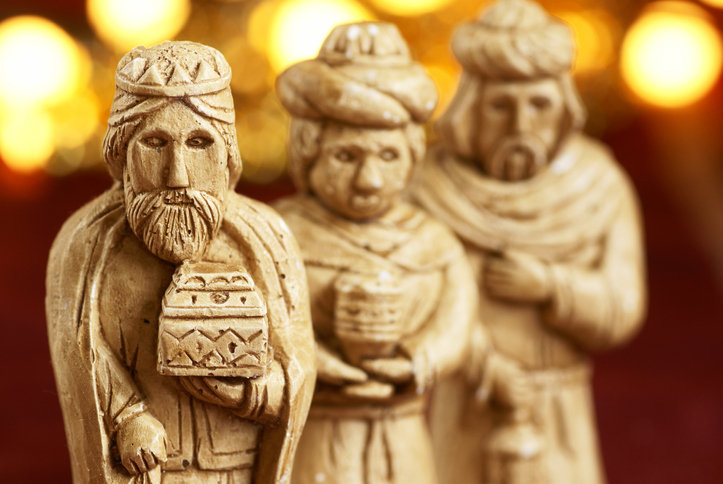
Celebrating Christ Being Made Known If you were to attend a celebration of the Epiphany in the early local churches in the East, the gospel event actually celebrated would have differed from church to church. Some celebrated the birth of the Lord as the Epiphany. Others celebrated the message to the shepherds and the visit of the wise men. Many associated the Epiphany with the baptism of the Lord and some with his first public miracle at Cana. Some churches celebrated several of these events together as part of the Epiphany.
By the fifth century, the Church in the West had settled on the visit of the Wise Men as the main theme for the Solemnity of the Epiphany, since it is the first manifestation of Christ to the nations. The Epiphany was celebrated twelve days after Christmas on January 6, the date carried over from certain local churches in the East. The solemnity was celebrated for eight days, in what was called the Octave of the Epiphany. Various cultures developed customs surrounding the Epiphany. In some countries, the Epiphany, rather than Christmas became the day children received their gifts, and they received them from the wise men rather than from Santa Claus. Some cultures developed traditions involving “kings’ cake” that had a figurine of the Baby Jesus inside it. Others marked the solemnity by inscribing the traditional initials of the Wise Men together with the numerals of the new year with blessed chalk over the entrance door of the house. Today, following Pope Paul VI’s revised calendar, the Epiphany is celebrated on the Sunday that falls between January 2 and January 8, toward the end of the Christmas Season.
Pope Leo the Great on the Epiphany of the Wise Men Now let’s look exclusively at the Solemnity of the Epiphany as celebrated in the early western Church, in continuity with our own celebration of it. Pope St. Leo the Great, who reigned from 440 to 461 as Bishop of Rome, wrote an insightful series of sermons on the Solemnity of the Epiphany. Pointing out that the Gospel of the day told the story of the Wise Men’s visit, the Epiphany for Pope Leo was clearly on that theme and was a necessary follow-up to Christmas. Christ is not only born but revealed, and revealed not only to Israel but to the ends of the earth.
Like Leo, most of us are not in the bloodline of Abraham, the patriarch. The epiphany of the Wise Men, so early in Matthew’s Gospel, shows that we too have become part of God’s plan. God has fulfilled his word to the prophet Isaiah:
“The Lord has laid bare His holy arm in the sight of all the nations, and all the nations upon earth have seen the salvation which is from the Lord our God” (Isaiah 52:10, as quoted in Leo’s Sermon 36 on NewAdvent.org).
In the visit of the Wise Men, Pope Leo also sees the fulfillment of God’s covenant promises to Abraham. God promised Abraham that all peoples would be blessed through him (Genesis 12:3), that his descendants would be as numerous as the stars in the sky (Genesis 15:5), that he would be a father of many nations (Genesis 17:4), and that kings would come from him (Genesis 17:6).
For the Wise Men, the appearance of the great star meant the birth of a king, and this king was a descendent of Abraham. Further, this great star was the mode of invitation to the first Gentile believers, opening the door to countless peoples to join the covenant family of Abraham. For Pope Leo, these countless believers—ourselves included—are called to likewise be a multitude of guiding stars to others. By the witness of a holy life, we are called to point the way to Christ for others (Sermon 33). Pope Leo teaches that such a great grace and wonder behooves us to come together to praise God in a special solemnity (Sermon 34).
This great star was an invitation to the first Gentile believers, opening the door to countless peoples to join the covenant family of Abraham.
Pope Leo was famous in history for his Tome, delivered by his emissary at the Council of Chalcedon in 451. Upon hearing his words upholding the natures and person of Christ, the bishops at the council exclaimed, “Peter has spoken through Leo.” In his sermons on the Epiphany, Pope Leo shows confidence that the Holy Spirit revealed even to the Wise Men the truth of Christ being fully human and fully divine while united in (what future theologians would describe as) one divine person. Pope Leo teaches that we can perceive this from the gifts the Wise Men offered (Sermon 31).
The epiphany of the Wise Men shows God’s faithfulness to his promises of old and also prompts us to share his love with others. Pope Leo’s sermons are very conscious of God’s action in history. He connects the gospel both with the past and the present and teaches for transformation and conversion in Christ. He also stands with the Wise Men in awe of God’s power, love, mercy, and fidelity.
His approach must be ours as well for the Epiphany:
“Today those joys must be entertained in our hearts which existed in the breasts of the three magi, when, aroused by the sign and leading of a new star, which they believed to have been promised, they fell down in presence of the King of heaven and earth” (Sermon 36).
Michael J. Ruszala is the author of several religious books, including Lives of the Saints: Volume I and Who Created God? A Teacher’s Guidebook for Answering Children’s Tough Questions about God. He holds a master of arts degree in theology & Christian ministry from Franciscan University of Steubenville. He has served for a number of years as a parish director of religious education, parish music director in the Diocese of Buffalo, and adjunct lecturer in religious studies at Niagara University in Lewiston, NY. For more information about Michael and his books, visit michaeljruszala.com.
 How we do something is just as important as why we do it. As Christians, we are well aware of the injunction to serve the poorest and the most vulnerable. The prophets of Israel continually challenged the Hebrew people with this message and berated them for ignoring it. Our Lord Jesus himself makes it the criteria for judgment and distinction between the “sheep” and the “goats” in the twenty-fifth chapter of Matthew’s Gospel. “…when I was hungry … thirsty … a stranger … naked … sick … in prison …”
 As far as I know, Jesus never sent any person out alone on mission. When disciples went out on mission, sent by our Lord, they went out as at least two. There is value in community and there is value in serving the poor as a community. When I serve with others I have someone to share my thoughts with, I have someone to share a word or an insight when I might be lacking, I have another to share concern with and think new possibilities – other sets of eyes and ears, other hearts to care and minds to imagine. When I am alone in my service I have none of this. Recognizing how our Lord himself sent out his disciples in community, Sant’Egidio encourages service and friendship with the poor to be lived as community and not alone and individual. On our own we are too easily lost and too easily disillusioned. Service can easily become rigid and perfunctory. My experience is that a moment with the poor often has an Emmaus dynamic to it – the Lord is present but we often only recognize him in hindsight as our hearts burn within us and as we share together. It is good for disciples to serve together and it is good for disciples to share together. Apparently, Jesus thought so.
 I confess: I’ve never been particularly successful at keeping New Year’s resolutions because I’m more successful at finding excuses to ignore them. In years past I’ve been sidetracked by crowded gyms, the sniffles, and my general inability to resist temptation. This year, I decided I need some extra help, so I’m turning to the saints. I’m used to asking for the intercession of saints for big concerns, for example, laying my parenting woes at the feet of St. Monica, or asking for St. Peregrine’s support for a friend battling cancer. But what about intercession for life’s more mundane issues? Studies show we are more successful reaching goals when we enlist the help of a friend, and who better than our saint friends? Here are a few of my resolutions with the saints who will help me stay on track in 2019.
 We continue our journey through the Octave of Christmas this weekend with the celebration of the Feast of the Holy Family. This feast reminds us that Jesus was raised in a home, that he grew in age, wisdom, and in knowledge of God’s will for his life. He also grew in grace and obedience under the care of Mary and Joseph.
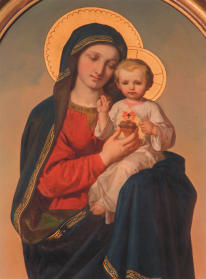 The Solemnity of Mary, Mother of God follows the Feast of the Holy Family on New Year’s Day. This solemnity marks the end of the Octave of Christmas by celebrating the motherhood of Mary, remembering that it was from her that Jesus took his human nature, becoming one with us in all things but sin. This solemnity is a holy day of obligation and Mass will be offered on Tuesday evening at 5:15PM and on Wednesday morning, New Year’s Day, at 9AM.
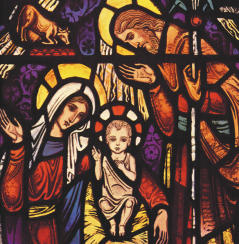 With the ushering in of the new year, we will be making a change in office personnel. For just about three years now, Katie Price has served our parish as Director of Discipleship and Stewardship. She was instrumental in the refashioning of the bulletin into the Weekly and she helped to move us in a new and better direction in the area of stewardship and discipleship. Katie will be going full time in the diocesan curia in this area of ministry beginning January 1. While she will no longer be a member of our parish staff, we will still benefit from Katie’s expertise and energy. I thank Katie for all that she has done to help us to be better disciples. Please join me in wishing her the best and asking God to bless all her future endeavors.
 You’ve probably seen it already. Your neighbors no longer have lights twinkling outside their houses. Large trees are strewn across front lawns in preparation for garbage day. The radio station that had been playing Christmas music twenty-four hours a day since November 1 suddenly stopped playing all their carols at 12:01 AM on December 26.
 Yesterday, I experienced something of a “Saint Joseph Synergy,” finding a copy of Fr. Donald H. Calloway’s Consecration to St. Joseph in my mailbox, and on the very same day that we read at Mass:
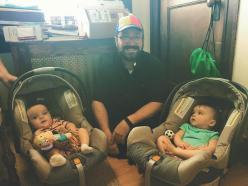 I remember the first few conversations about changing the traditional Cathedral Bulletin into a Weekly magazine-style format. It was contentious and just about anyone you had spoken too had an opinion on the matter. Of course, people were worried about getting the news and upcoming events or programs, while others were concerned about the cost or the additional time necessary to compile a weekly magazine. To be frank, I was initially concerned myself. At the time, I had worked in Catholic organizations and parishes, coast to coast, and never, ever, seen a Cathedral parish endeavor to change the layout of the traditional bulletin into an evangelization piece. We don’t change traditions in the Catholic church all too often and that goes for our administrative tasks, especially bulletins! So the question was, what if we could create a faith formative piece to nourish and sustain our parishioners, while encouraging them to share it with others? Wouldn’t that help us move toward discipleship and stewardship?
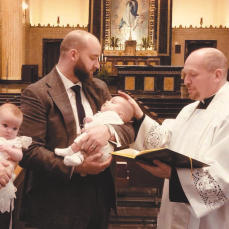 It is not just change the Cathedral has gone through since my time here, but a deeper conversion process. The way we message and communicate is different, the way we learn through enriched adult faith formation programs is different, the way we pass along the faith through Family Faith is different, the way we commit as stewards through the Season of Stewardship is different. This is not just about embracing change, but allowing ourselves to dive into a deeper conversion process toward discipleship. Change is incredibly hard. Conversion is incredibly hard, but is change through the lens of holiness.
 It has been a pleasure getting to know so many of you and working alongside you! This community is a special place, a spiritual home unlike any other. Be proud of the Cathedral community you have been a part of shaping. Be evangelizers for the Cathedral and our faith. Be disciples through ministry, service, hospitality, and spirit. Get uncomfortable! Never tire of this journey. We need you!
 May we open our hearts to the grace of God that allows us to see him drawing near to us, especially in our sisters and brothers.
 Terry Mattingly of GetReligion has a great column about the “two Christmases.” As he notes, for the Church, the Christmas season runs from Christmas Day (December 25) to Epiphany (January 6). These are the famous Twelve Days of Christmas. But in secular society, the Christmas season runs from around Thanksgiving until December 25. So this Sunday marks either the end of the Christmas season (for secular culture), or the First Day of Christmas (for the Church).

 Swaddled tightly beneath a starblanketed Bethlehem sky, God breathed with gentle power. The acceptable time had come. The prophecies were now—at last—fulfilled. The Creator had “entered” creation on a mission of love, and for the next three decades, peace and joy were inhaled and received in tangible new ways.