Cathedral of the Immaculate Conception

Springfield, IL

  • About
    • Contact Us
    • History of the Cathedral
    • Liturgical Schedules
    • Parish Staff
    • Register with Cathedral
    • Subscribe to the Cathedral eWeekly
  • Sacraments
    • Baptism
    • Becoming Catholic
    • Matrimony
    • Vocations
  • Ministry List
    • Adult Faith Formation
    • Cathedral Meal Train
    • Cathedral Online Prayer Wall
    • Cathedral Concerts
    • Family of Faith
    • Grief Share
    • Health and Wellness
    • Spiritual Resources
  • Stewardship
    • Stewardship: A Disciple’s Response
    • Stewardship Form
  • Support
    • E-Giving Frequently Asked Questions
    • Give Online
  • Sunday News
    • Announcements
    • Cathedral Weekly
    • Livestream Feed
    • Submit a Mass Intention Request
    • Weekly or Announcement Submission

Where is Confirmation in the Scriptures?

One of the trademarks of the seven sacraments is that they were all “instituted by Christ.” This is a fancy way of saying that Jesus began all of the seven sacraments, and they were not a later development of the Church. The Church has developed many forms of devotion over the centuries such as the Rosary and the different expressions of our liturgy. Even our frequency of the celebration of the seven sacraments has changed, but the sacraments themselves have been the same since the beginning. 

Since we are studying the sacrament of Confirmation during December, I thought it would be helpful to look into the scriptural foundations of this sacrament of the Holy Spirit. Admittedly, Jesus’ institution of Confirmation is not as clear as his institution of baptism. However, the Church has always seen Jesus’ promise to send the Holy Spirit as the institution of Confirmation. He said, “I will ask the Father, and he will give you another Advocate, to be with you always, the Spirit of truth, which the world cannot accept, because it neither sees nor knows it.” This promise was fulfilled on the day of Pentecost, when the small but mighty Church received the gift of the Holy Spirit to be sent out on mission. 

The Apostles clearly understood the necessity of administering Confirmation after a Christian was baptized. During a persecution of Christians in Jerusalem, Philip (one of the original seven deacons), found himself in Samaria and began to preach the Gospel of Jesus Christ. Great crowds of people were converted, and Philip the Deacon baptized many of them. However, when the Apostles heard about the success of Philip’s preaching, they sent Peter and John to pray that the new Christians would receive the Holy Spirit. We read in the Acts of the Apostles, “Peter and John went down and prayed for them, that they might receive the Holy Spirit, for it had not yet fallen upon any of them; they had only been baptized in the name of the Lord Jesus. Then they laid hands on them and they received the Holy Spirit” (Acts 8:15-17). 

It’s a bit odd to think that these Christians were baptized in the name of the Father, and of the Son, and of the Holy Spirit, yet our scriptures say that they had not yet received the Holy Spirit! This needs to be properly understood, because we know that when we receive the gift of baptism, the Holy Trinity begins to dwell within us through the gift of sanctifying grace. Baptism is only a beginning, whereas Confirmation is a sacrament of Christian maturity and the gift of the fullness of the Holy Spirit. Christian life is all about growing in God’s love, and until we die, our goal should be to receive more and more of this love every day! Confirmation gives an increase of God’s love and a strengthening of his gifts within us so that we can more effectively practice our charisms to build up the Church and use the seven gifts of the Holy Spirit to grow in holiness. Let us lean on the strength of God, knowing that he has strengthened us in Confirmation! 

St. John of Kenty

Feast Day: December 23rd   

Today we take ourselves back more than 600 years ago to the village of Kenty, in southern Poland (actually, only a handful of miles from where St. John Paul II grew up, though also very near to where the Nazi’s would establish the Auschwitz concentration camp).  It is one of the oldest established cities in Poland, tracing its founding back to 1277, but a century later, when Jan (John) was born, it was still a fairly small place, with little to indicate all that would come from the new little boy.  

As always, perhaps the first thing that strikes us about any saint is the famous things they did or characteristics that marked them.  John was an intelligent young man, and ended up attending university at the Academy of Krakow (later to become the Jagiellonian University), which is the second oldest university in Europe, and would over the course of 6+ centuries of teaching, graduate countless prestigious alumni.  A few highlights include figures such as Nicolas Copernicus (discovered heliocentrism), St. Stanislaus Kazimierz (tremendous, saintly priest), King John Sobieski (who is depicted in one of our stained glass windows in the Cathedral), Karol Wojtyla (who became Pope John Paul II), as well as our own Bishop Paprocki.

Back to Jan though, he showed his mettle as a student in philosophy, theology, scripture, spirituality, and all the sorts of things you might expect a soon-to-be-ordained young man to.  He also became known for his generosity and compassion towards the poor, especially, as he became a professor soon at that same university, for the students who attended his classes, for their spiritual, academic, and physical needs.  His patience and holiness were shown in a different light when he was jealously ousted from the university and sent off to be a parish priest, where the famous scholar happily cared for a little flock until restored to his place at the Jagiellonian.  And, of course, a bit of poverty and simplicity also marked his life: he was known to eat very simply, went on pilgrimage to Rome and Jerusalem (carrying everything he needed on his back, though he didn’t have a whole lot since he gave away most of his possessions to those who needed them more than he.)  He’s, not surprisingly, the patron Saint of Teachers, Students, Priests and Pilgrims, which means he’s a patron for almost all of us!

But I want to direct our attention here to a different interest of his life: he helped develop further Fr. Jean Buridan’s theory of impetus.  Now, I suspect none of us have heard of Kenty, perhaps not John of Kenty either, and most probably not Jean Buridan and his theory of impetus.  But, this philosopher and physicist and priest developed a revision of the long-held Aristotelian understanding of motion (which assumed that the air/atmosphere somehow kept things moving because something had to), and instead proposed that an object’s motion is imparted to it by some mover, and is proportional to the speed, and mass, that the object has (minus the resistance that air imparts).  John of Kenty (I should mention, also known as St. John Cantius, the patron of the order of priests who are our nearest neighbors over at Sacred Heart), a priest, a pilgrim, a professor, and a pauper, was also a physicist, and made significant contributions to a theory that would later develop into Newton’s understanding of inertia, and all the way into the classical physics we all learn in school.

What’s the takeaway?  Holiness doesn’t mean you have to be boring.  The interests, ideas, inspirations, and other things that fill your heart have a place in heaven.  Give thanks to the giver of those gifts today, and use them for His glory!

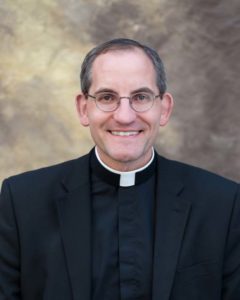
– Fr. Dominic Rankin spent a lot of hours growing up with lego’s, erector sets, k’nex, and other such construction/mechanical-creation sorts of toys.  He does not have as much time as then to tinker with things, but continues to be entranced by physics, astronomy, aeronautics, electricity, robotics, etc.   He hasn’t yet made a major scientific breakthrough, but wouldn’t mind if that became a small part of his walk towards holiness one day.

Week of Dec. 21 Mass Intentions

Monday, December 21

7am – Mary Kay Buller Harrelson
(Bev & Larry Hoffman)

5:15pm – Richiua & Leo Families

Tuesday, December 22

7am – Helene O’Shea
(Bud O’Shea)

5:15pm – Margaret Graham
(Tom McGee)

Wednesday, December 23

7am – Deceased Members of theCCCW
(CCCW)

5:15pm – Kristin King
(Dick & Kay King)

Thursday, December 24

4pm – John D. Sullivan
(Jan Norris)

7pm – Rita DesMarteau
(Family)

9pm – Diana J. Schumacher
(Daniel J. Schumacher)

Friday, December 25

12am – John Montgomery
(John Busciacco)

7am – Sophia E. Bartoletti
(Family)

9am – Barbara McGee
(Tom McGee)

Saturday, December 26

8am – Irene Doellman
(Blessed Sacrament Parish)

4pm – Thomas Rapps
(Carolyn Yoggerst)

Sunday, December 27

7am – Honor of the Holy Family
(John Busciacco)

10am – George Zeigler
(William & Debra Stonikas)

5pm – For the People

Prayer Wall – 12/11/2020

Please pray for my 2 year old grandson who was a NICU baby, who recently received a life-changing diagnosis.

Christmas Mass Sign Up

Rejoice, the Lord is Near

The Third Sunday of Advent is traditionally known as Gaudete Sunday.  It gets its title from the Entrance Antiphon for Mass: “Rejoice in the Lord always; again I say, rejoice.  Indeed, the Lord is near.” (Philippians 4:4-5). Gaudete is the Latin word for ‘Rejoice’, thus this Sunday being named this way.  To highlight this joyful attitude we are commanded to have, the Church permits her clergy to wear rose vestments on this Sunday. 

Joy is a word that we often associate with Advent and Christmas.  The birth of Jesus was a joyful event.  At the Mass during the Night on Christmas, the Gospel from St. Luke recalls that moment when the angel appeared to the shepherds outside of Bethlehem with these words: “Do not be afraid; for behold, I proclaim to you good news of great joy that will be for all the people. For today in the city of David a savior has been born for you who is Messiah and Lord.” (Lk 2:10-11)

Joy is a gift that we all desire, yet it can often be elusive.  In our attempt to experience joy, we grasp at things that may bring pleasure and happiness, but we often find that those feelings last only for a while, and we go back to the same source, or look somewhere else to find something that we hope will fulfill us.  But true joy is a gift we cannot buy, cannot take, cannot own.  Joy is a gift that can only be received from the one who alone can give it, our Lord.

In his homily last Saturday during our Immaculate Conception Novena, Deacon Larry Smith reminded us that joy is a fruit of the Holy Spirit.  Just as a piece of fruit cannot come about except from a tree or plant, so too can joy only come from the source which is to be found in God.  The more we share in the life of God, living according to His will, following His teachings, and remining in His grace, the more we will experience the true joy for which our hearts long.

The Sacrament of Confirmation increases the Gifts of the Holy Spirit within us, and the more we allow those gifts to guide us, the more plentiful will be all of the fruits of the Spirit, which, in addition to joy, are as follows: charity, peace, patience, kindness, goodness, generosity, gentleness, faithfulness, modesty, self-control, chastity.  As we slowly read that list, do not our hearts burn within us, desiring to have those fruits a part of our lives?  We cannot go to the grocery store to pick up these fruits.  We cannot order them on the Internet.  We cannot create them with anything that we have.  Only God can give this gift.  And the good news is this: He wants to give these fruits to us in abundance!  With that in mind, how can we not rejoice?

As we continue our Advent journey toward Christmas, in addition to praying: “Come, Lord, Jesus”, let us be quick to add: “Come, Holy Spirit”, that our hearts will not put up any resistance to the prompting of the Holy Spirit, which will yield an abundant harvest of His fruits for us to enjoy.

Father Alford     

A Sacred Anointing

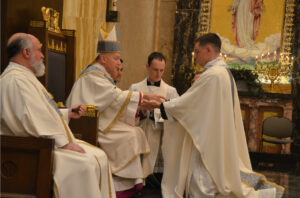
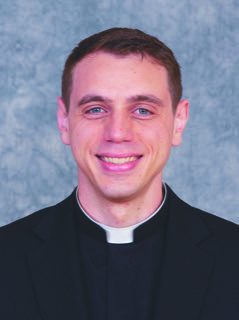
In his article last week, Fr. Alford reflected on the use of the Sacred Chrism in the three of the sacraments: Baptism, Confirmation, and Holy Orders. When I was ordained a priest in June, Bishop Paprocki smeared the Sacred Chrism on the palms of my hands to set them apart for the ministerial priesthood of Jesus, making them holy to consecrate the Eucharist and forgive sins. The Sacred Chrism carries a distinctly beautiful smell, which can often be smelled on a newly baptized baby’s head for the rest of the day after his or her baptism! Unfortunately for me and my classmates, we had to use alcohol-based hand sanitizer before distributing Communion at our ordination Mass, so the smell of Chrism was gone before Mass was even over. But the important part is that our hands were consecrated, and we were ordained priests! There is a tradition that after receiving a priest’s first blessing, the one receiving the blessing kisses the palms of the new priest’s hands. Covid mostly prevented that tradition this time around, but once again, I am grateful to have been ordained a priest even during a pandemic. 

Bishop Paprocki uses Sacred Chrism to anoint the hands of newly-ordained Fr. Dominic Vahling.

Whenever I have the privilege of receiving a new child into the Church through baptism, I anoint the baby on the top of the head with this same Sacred Chrism which was used at my priestly ordination. The smell of the Chrism on my thumb reminds me of my ordination, and I hope it always does. The distinct smell comes from the sweet-smelling balsam perfume which is added to olive or vegetable oil when it is consecrated by the Bishop at the Chrism Mass the week before Easter. It is interesting that this annual Mass, an ancient Christian tradition, draws its name from the Chrism itself. This shows just how important this sacred oil is in the life of the Church. This Mass is the occasion for all the priests of the diocese to renew their promises to the bishop, and the unity of the diocese under one bishop is strengthened and reaffirmed. I’m looking forward to my first Chrism Mass as a priest, which I hope to attend during Holy Week of 2021. 

The scent of Chrism has even worked its way into other parts of our society. It is common to find candles, essential oils, and even beard balm that have been scented with the sweet balsam commonly used for the Sacred Chrism. The Church, in her wisdom, knows how to use beautiful things for the glory of God, even something simple like a sweet perfume. This sweetness signifies the love that God has for each one of us, his children! 

St. John of the Cross

Feast Day: December 13th  

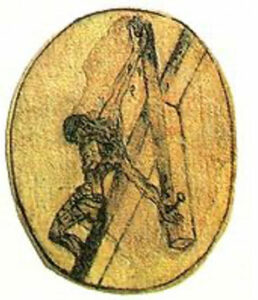
Today I want to tell the story of a sketch.  Of course, it has to do with the saint we celebrate this week – St. John of the Cross – but I think it captures so much of his heart and mysticism and sanctity, that it offers all of us all a chance to follow after him on the road to heaven.

Juan was born in Spain in 1542, which means he entered a divided and violent world.  Martin Luther would die 4 years later, unreconciled to the Catholic Church, and having set in motion the protestant reformation that would fracture Christianity, and insight the bloody religious then starting around Europe.  Of course, much of Luther’s complaints stemmed from real abuses that marred the mystical body of Christ, but, as always, the call of Christians is to assist Our Lord in building up the Church, never in tearing it asunder.  Don’t abandon, assist.  Don’t complain, cleanse.  Don’t reject, reform. Don’t leave, love.  

That call was heard by John of the Cross.  It was heard by many saints that appeared during these trying years.  St. Philip Neri, St. Charles Borromeo, St. Francis Xavier, St. Ignatius of Loyola, St. Thomas More, St. John Fisher, St. Francis de Sales, St. Peter Canisius, Pope St. Pius V, St. Theresa of Avila…  All these and more would be God’s beacons of sanctity in the midst of a terrible century.  God never leaves, He just keeps loving.

But back to St. John, and his drawing.  At the age of 21, John entered the Carmelite Order and began his study of theology and philosophy, culminating in his ordination as a Carmelite priest in 1567.  Seeing the depravity and laxity rampant around him, John seriously considered leaving them to become a Carthusian, but God had other plans.  The young priest encountered a Carmelite nun, Teresa of Ávila, and was captivated by her dream to reform the Carmelite order.  Don’t leave, love.

In their efforts to reform the order, John (now “of the Cross”) would be suppressed, then imprisoned, even tortured, and would travel many thousands of kilometers founding and leading the struggling communities, in the end being completely exhausted by his efforts.  But finally in 1580, the Discalced Carmelites (literally meaning “un-shod”, referring to their taking up the original penance of the Carmelites to not wear shoes) were approved as a new branch of the order by Pope Gregory XIII.  It was during these, his final years that he composed Living Flame of Love, his shortest poem, but hauntingly poignant.  If I might be bold, it could also be summarized: Don’t leave, love.

  1. Oh, living flame of love
    That tenderly woundest my soul in its deepest centre,
    Since thou art no longer oppressive, perfect me now if it be thy will,
    Break the web of this sweet encounter.
  2. Oh, sweet burn! Oh, delectable wound!
    Oh, soft hand! Oh, delicate touch
    That savours of eternal life and pays every debt!
    In slaying, thou hast changed death into life.
  3. Oh, lamps of fire,
    In whose splendours the deep caverns of sense
    Which were dark and blind with strange brightness
    Give heat and light together to their Beloved!
  4. How gently and lovingly thou awakenest in my bosom,
    Where thou dwellest secretly and alone!
    And in thy sweet breathing, full of blessing and glory,
    How delicately thou inspirest my love!

But what about that sketch?  For that we have to go back to those first years after meeting Teresa.  He had just barely decided not to become a Carthusian.  He had yet to be beaten by his own brothers.  He had yet to crisscross Spain.  And yet, as he wedged himself in the choir loft in Ávila, his prayer carried him to the cross, and then up over it, to see it as the Father did. 

Drawing of the Crucifixion, St. John of the Cross, 1574/77.

Christ hangs in darkness and suffering, spurned and provoked … but He did not leave, He loved.

The Father glances down, His greatest gift rejected … but He didn’t leave, He loved.

The Spirit is poured forth, upon a world torn and terrible … but He didn’t leave, He loved.

And so did John, and so must we.

– Fr. Dominic Rankin often simply looks at the crucifix if prayer isn’t easy, and he recently discovered that the Heavenly Father, speaking to St. John, Himself encourages just that: “Fasten your eyes on him alone because in him I have spoken and revealed all, and in him you will discover even more than you ask for and desire … If you desire me to answer with a word of comfort, behold my Son subject to me and to others out of love for me, and afflicted, and you will see how much he answers you.” [Ascent of Mt. Carmel, St. John of the Cross, chapter 22, 5-6]

Mass Intentions for the Week of December 14

Monday, December 14

7am – Ralph Walter, Sr.
(Jean Moss)

5:15pm – Rosemary Patton
(Rob & Jan Sgambelluri)

Tuesday, December 15

7am – Doris Drea
(Missouri AFL-CIO)

5:15pm – Ben Garding
(Family)

Wednesday, December 16

7am – Ryan Williams
(LouAnn & Carl Corrigan)

5:15pm – Helen Ziegler
(William & Debra Stonikas)

Thursday, December 17

7am – Anna A. Eleyidath
(Augustine Eleyidath)

5:15pm – Lemuel Moss
(Jean Moss)

Friday, December 18

7am – Joseph Klein
(Andrew & Cheryl Klein Family)

5:15pm – Victoria Selburg
(Bernie Ely)

Saturday, December 19

8am – Frank Coffey
(Family)

4pm – Barbara J. McGrath
(Family & Friends)

Sunday, December 20

7am – Mary Ann Midden
(William Midden)

10am – For the People

5pm – Presca F. Simbajon
(Lolita F. Klicker)

Prayer Wall – 12/04/2020

please pray for a single mother going through an extremely hard time

« Previous Page
Next Page »

Liturgy

Sunday Masses (unless noted differently in weekly bulletin)
Saturday Evening Vigil – 4:00PM
Sunday – 7:00AM, 10:00AM and 5:00PM

Weekday Masses (unless noted differently in weekly bulletin)
Monday thru Friday – 7:00AM and 5:15PM
Saturday – 8:00AM

Reconciliation (Confessions)
Monday thru Friday – 4:15PM to 5:00PM
Saturday – 9:00AM to 10:00AM and 2:30PM to 3:30PM
Sunday – 4:00PM to 4:45PM

Adoration
Tuesdays and Thursdays – 4:00PM to 5:00PM


CatholicMassTime.org

Parish Information

Parish Address
524 East Lawrence Avenue
Springfield, Illinois 62703

Parish Office Hours
Monday thru Thursday – 8:00AM to 4:00PM
Fridays – CLOSED

Parish Phone
(217) 522-3342

Parish Fax
(217) 210-0136

Parish Staff

Contact Us

Contact Us

Copyright © 2026 · Log in