Cathedral of the Immaculate Conception

Springfield, IL

  • About
    • Contact Us
    • History of the Cathedral
    • Liturgical Schedules
    • Parish Staff
    • Register with Cathedral
    • Subscribe to the Cathedral eWeekly
  • Sacraments
    • Baptism
    • Becoming Catholic
    • Matrimony
    • Vocations
  • Ministry List
    • Adult Faith Formation
    • Cathedral Meal Train
    • Cathedral Online Prayer Wall
    • Cathedral Concerts
    • Family of Faith
    • Grief Share
    • Health and Wellness
    • Spiritual Resources
  • Stewardship
    • Stewardship: A Disciple’s Response
    • Stewardship Form
  • Support
    • E-Giving Frequently Asked Questions
    • Give Online
  • Sunday News
    • Announcements
    • Cathedral Weekly
    • Livestream Feed
    • Submit a Mass Intention Request
    • Weekly or Announcement Submission

Be Sealed with the Gift of the Holy Spirit

With the recent mitigations in place to slow the spread of COVID-19 in our state, we had to make the difficult decision to suspend several of our in-person activities for Faith Formation, including our Family of Faith program for our children.  But we can see God’s Providence working in having our parish switch to this model last year, giving our families the experience to undertake the important work of faith formation in their homes, the domestic church.  Even though we are not gathering physically as a group, we continue to move forward!

As we move into December, the sacrament of the month is the Sacrament of Confirmation.  According to the Catechism of the Catholic Church, Confirmation completes the grace of Baptism, so it is only logical that we focus on this sacrament after having just completed a month with Baptism.  I would like to focus on what is called the “essential rite” of Confirmation, which is what is absolutely necessary for the sacrament to be conferred validly.  Here is what the Catechism says: 

The essential rite of the sacrament follows. In the Latin rite, “the sacrament of Confirmation is conferred through the anointing with chrism on the forehead, which is done by the laying on of the hand, and through the words: ‘Accipe signaculum doni Spiritus Sancti‘ [Be sealed with the Gift of the Holy Spirit.].” (CCC 1300)

The use of Sacred Chrism for this sacrament is worth reflecting on for a moment.  This holy oil is used anytime the Church consecrates somebody for a special mission.  At Baptism, the newly baptized anointed with Sacred Chrism and is set apart as a child of God, called to live a life of holiness and to one day be in Heaven.  Confirmation sets us apart for the spreading and defending of the faith, aided by the new outpouring of the Gifts of the Holy Spirit.  Bishops and Priests are anointed with Sacred Chrism at their ordination, signifying that they are set apart for their participation in the ministerial priesthood of Jesus Christ in service to the people of God, especially though the celebration of the sacraments. 

Sacred Chrism is also used to consecrate things.  In particular, it is used to consecrate churches and altars, for these are set aside for the purpose of offering a sacred place in which to worship God and to offer the sacrifice of the Mass.  Just this past week, on December 2, we celebrated the Anniversary of the Re-Dedication of our Cathedral.  One of the greatest parts of that ceremony was the consecration of the new altar.  I remember vividly that moment of the Mass as Archbishop Lucas spread the Sacred Chrism all over the altar, creating that beautiful aroma that comes from that holy oil.  Since that day, the altar has served its purpose of being a place set apart for God.  May we recall the day of our Confirmation (if we have been confirmed) and ask for the grace to rededicate ourselves to living our vocation to be set apart for the spreading and defending the faith in our daily lives, confident of the power of the Gifts of the Holy Spirit to assist us.

Father Alford     
Who is Confirming Whom?

This month we are focusing on the Sacrament of Confirmation in our bulletin columns. For several years now, the parishes of our diocese have been in the process of implementing the “restored order” of the Sacraments of Initiation. Confirmation is the second sacrament of Initiation, which is why it is more appropriate to receive it before receiving first Holy Communion. 

There is a mistaken understanding that some hold in our Church today, which comes from the meaning of the word “Confirmation.” Confirmation in this sense means a strengthening or fortifying. It’s like putting a spiritual suit of armor on a new Christian! Because Confirmation was given around the time of adolescence for several decades in the United States, the understanding has been flip-flopped. I remember at the time I was Confirmed that my classmates and I understood that we were confirming our belief in Jesus. This is obviously a very good thing to do, and one that we do every day as Christians. However, receiving a sacrament is not about what we do for God, but what God does for us. 

This misunderstanding is not a new idea in the Church, and even the Council of Trent (around 1550) spoke about this. One of the statements of this ecumenical council was, “If anyone says that the Confirmation of those who have been baptized is a catechism whereby those near adolescence give an account of their faith in the face of the Church, let him be anathema.” This is a normal formula used by Church councils to explain that an idea is not in accord with the Catholic Faith. This statement was a response to some Christians who believed that while Baptism was a sacrament, Confirmation was not a true sacrament and was simply a way for youth to express their faith. 

As with all the sacraments, it is important to keep in mind that the sacraments impart God’s divine life to us. Expressing our faith is, of course, an essential part of the Christian life, but sacraments are all about receptivity. Some Christian traditions give babies Confirmation in the same ceremony as Baptism, which really emphasizes the receptive aspect of the sacraments! 

More and more dioceses are moving to implement the restored order of Baptism, Confirmation, and Eucharist around the country. Hopefully younger children receiving this great sacrament will be more receptive than older teenagers who have often already checked out of their faith life or abandoned it altogether. Every day, we should ask the Holy Spirit to be with us and fill with his love which was increased and strengthened in our reception of the sacrament of Confirmation.

Come Holy Spirit, fill the hearts of your faithful, and enkindle in them the fire of your love. Send forth your Spirit, and they shall be created, and you shall renew the face of the earth. 

St. Ambrose: Silence, Scripture, and Song

Feast Day: December 7th  

On April 4th in the year 397, early on Easter Saturday, the Bishop Ambrose of Milan was dying.  His life was marvelous.  He had been elected to the episcopacy by popular acclaim (before he was baptized!  He had to receive all his sacraments on top of each other before being ordained bishop), fought heresies (Arianism especially, which said Jesus was not truly God), stood up to emperors (Theodosius I, for persecuting Jews and massacring the Thessalonians), and brought about the conversion of St. Augustine (of course, with the help of St. Monica’s prayers). 

I could speak on any of those tremendous accomplishments, but today I rejoice to stick to a simpler part of his life.  As he lay on his deathbed, Paulinus, his deacon, who was with him in his final moments, records: “we saw his lips moving … but we could not hear his voice” [St. Paulinus, Life of Ambrose].  It would not be a noticeable comment – perhaps these were Ambrose’s final whispered prayers – except for the fact that St. Augustine had written a similar line about Ambrose, his great mentor and friend, many years before: 

When [Ambrose] read, his eyes scanned the page and his heart sought out the meaning, but his voice was silent and his tongue was still. Anyone could approach him freely and guests were not commonly announced, so that often, when we came to visit him, we found him reading like this in silence, for he never read aloud.
[St. Augustine, Confessions, Book 3, Chapter 6]

At that time, surprisingly enough, it was uncommon for anyone to read silently.  We have a few records of others in the ancient world who did so, but otherwise, the vast majority of everyone who could read, only did so out loud.  Even if someone were just reading by themselves, they would still vocalize the words, or a person would have someone else read to them.

Now, that would remain just an interesting factoid except for the tremendous fact that Christianity is a religion of the Word, and Ambrose’s practice came from his love for the Word of God.  Augustine also tells us that Ambrose, when he was consecrated bishop, immediately sold practically all the possessions he had (as an orator and governor) except for his books.  He was a very literate and studious man, but as a bishop, and saint-in-the-making, this was his choice to prioritize the Word of God over even all the other books that he treasured.  His labor over the books of scripture each day – the Psalms, Isaiah, Jeremiah, Matthew, Luke… – these were His daily sustenance and informed every other aspect of his life.  His courage, eloquence, simplicity, wisdom, hymnody, and generosity … all flowed from his being saturated by the Bible.

We call Ambrose a doctor of the Church because this biblical foundation to his life flowed forth in his teaching, and his composition of some of the greatest hymns the Church has.  Both are splendid tapestries of word, woven from the threads of scripture, and they have given Ambrose the nickname “honey-tongued” (for this reason he is the patron of beekeepers…  Things you learn!)  I will leave you with one of his best hymns, perfect for our continued meditation this Advent.  (The language is even more splendid in its original Latin!)

Mosaic of St. Ambrose, Basilica di Sant’Ambrogio, Milan, Italy, 5th century. http://milanoarcheologia.beniculturali.it/?page_id=4296 

Veni, Redemptor Gentium

1. Come, thou Redeemer of the earth,
and manifest thy virgin-birth:
let every age adoring fall;
such birth befits the God of all.

2. Begotten of no human will,
But of the Spirit, Thou art still
The Word of God in flesh arrayed,
The promised fruit to men displayed.

3. The virgin womb that burden gained
With virgin honor all unstained;
The banners there of virtue glow;
God in His temple dwells below.

4. Forth from His chamber goeth He,
That royal home of purity,
A giant in two-fold substance one,
Rejoicing now His course to run.

5. From God the Father He proceeds,
To God the Father back He speeds;
His course He runs to death and hell,
Returning on God’s throne to dwell.

6. O equal to the Father, Thou!
Gird on Thy fleshly mantle now;
The weakness of our mortal state
With deathless might invigorate.

7. Thy cradle here shall glitter bright
And darkness breathe a newer light,
Where endless faith shall shine serene,
And twilight never intervene.

 – Fr. Dominic Rankin always struggles to answer the question “what kind of music do you like?” I like many classical pieces, especially orchestral works, certainly sacred music and Gregorian chant, Christian singers, some pop pieces, many different vocal groups/individuals, especially acapella and what is unhelpfully described as “easy listening”.  What is a song that you are grateful for?  Let me know, I want to give it a listen!  For now, enjoy a video of Ambrose’s Veni, Redemptor Omnium:

Week of December 7 Mass Intentions

Monday, December 7

7am – William F. Logan
(Lisa Logan & Lori Motyka)

5:15pm – Patria & Rufino Gotanco
(Joe & Hati Uy)

Tuesday, December 8

7am – For the People

12:05pm – Boyd Warner
(Sue Warner & Family)

5:15pm – Bobby House
(Family)

Wednesday, December 9

7am – Betty & Gene Barish
(Family)

5:15pm – Shirley Logan
(Lisa Logan & Lori Motyka)

Thursday, December 10

7am – Steve Hergenrother
(Thomas Hergenrother)

5:15pm – Mathias Bates
(Bates Family)

Friday, December 11

7am – Anna A. Eleyidath
(Augustine Eleyidath)

5:15pm – Special Intention for Bianca
(D.A. Drago)

Saturday, December 12

8am – Helen Zeigler
(William & Debra Stonikas)

4pm – Becky Morgan
(Carol Morgan)

Sunday, December 13

7am – For the People

10am – Fr. Eugene Prindiville, OMI
(Rebecca & Woody Woodhull)

5pm – Anne Gustafon
(Jeannette Giannone)

Come, Lord Jesus

Happy New Year!  I always look forward to sharing this greeting with fellow Catholics at the beginning of Advent, which marks the beginning of a new liturgical year for us.  With this greeting, whether we do it now or with the rest of society at the beginning of January, it is expressed with hope.  With the new year just beginning, we express our hope that it will be a good year ahead.  I think it is safe to say that this past year has not exactly been what we had hoped.  Is there any reason to think that the coming year will be any better?

As Christians, our answer to that question is an overwhelming “yes.”  Why?  Because the hope that we hold onto is a hope that is different from the worldly hope that always seems to come up short.  I was recently reading Pope Benedict’s encyclical on hope (Spe salvi), and he commented on the traditional dialog that takes place between the minister and the parents at the beginning of the Sacrament of Baptism.  Here is how the dialog goes:

  • Minister:  What do you ask of the Church?
  • Parents: Faith
  • Minister: And what does faith give you?
  • Parents: Eternal life

And so from the very beginning of our lives in Christ, we have planted within us, through the gift of faith, the hope for eternal life.  With each passing day and each passing year, we take one step closer to the realization of that hope.  

The Season of Advent is a great time to renew that sense of hope within us.  This season invites us to be joyful as we remember the coming of Christ in history nearly 2000 years ago.  His birth brought hope to a people who had been walking in darkness for generations.  His birth was a preparation for His death, when He destroyed death forever and unlocked the gates of Heaven to believers.  That victory is the reason for our hope.  Advent therefore is also a time to look forward in hope to Christ’s return when all who are in communion with Him in life and in death will share in His victory fully.

In the meantime, however, Advent invites us to recall that Jesus comes to us here and now in the mystery of His grace, present to us in a special way in the sacraments.  He brings light to us in the midst of the darkness that surrounds us, reminding us that we are not alone.  He is near to us, renewing our hope that at the end of this earthly journey, no matter how bumpy that journey may be, our hope in eternal life, given on the day of our Baptism, will be fulfilled.

May I therefore encourage you to pray the following traditional Advent prayer regularly: “Come, Lord Jesus.”  We pray for His coming in glory at the end of time, but we pray for Him to come in mystery into our lives anew in this new year, so that no matter what this year may bring, our hope in Him will not waver, and as St. Paul reminds us, this “hope does not disappoint.” (Rom 5:5)

Father Alford     

Week of Nov. 20

Monday, November 30

7am – Anna A. Eleyidath
(Augustine Eleyidath)

5:15pm – Cynthia Crispi
(John Busciacco)

Tuesday, December 1

7am – Barbara J. McGrath
(Family & Friends)

5:15pm – Delia Sinn
(Genny Severino)

Wednesday, December 2

7am – Special Intention for Sheree Graves
(Sheree Graves)

5:15pm – Barbara Hansen
(Family & Friends)

Thursday, December 3

7am – Irene Doellman
(Blessed Sacrament Parish)

5:15pm – Puring Garde
(Family)

Friday, December 4

7am – Mary Priester
(Family)

5:15pm – Andrew McGee
(Tom McGee)

Saturday, December 5

8am – Dr. Eugene Stonikas
(William & Debra Stonikas)

4pm – For the People

Sunday, December 6

7am – Mary Ann Midden
(William Midden)

10am – Charles & Mercedes
Nesbitt (Kathy Frank)

5pm – Deceased Members of the CCCW
(CCCW)

New Beginnings

It’s hard to believe that we are already into the season of Advent. We can all agree that time flies too quickly, and each year just seems to go by more quickly. Advent is the beginning of our new liturgical year, and fittingly so as we prepare for the celebration of Christmas. 

This Sunday concludes our reflections on the sacrament of baptism. I wanted to dive into a very special baptism that can be found in our gospels – the baptism of Jesus himself. This baptism was the beginning of his public ministry, when it was manifested to the world that he was the Son of God. Let’s take a look at Matthew 3:13-17: “Then Jesus came from Galilee to John at the Jordan to be baptized by him. John tried to prevent him, saying, ‘I need to be baptized by you, and yet you are coming to me?’ Jesus said to him in reply, ‘Allow it now, for thus it is fitting for us to fulfill all righteousness.’ Then he allowed him. After Jesus was baptized, he came up from the water and behold, the heavens were opened for him, and he saw the spirit of God descending like a dove and coming upon him. And a voice came from the heavens, saying, ‘This is my beloved Son, with whom I am well pleased.’”

The baptism of Jesus has baffled many throughout the centuries, first of all John the Baptist himself! John states the obvious when he says that it should be the other way around, with Jesus baptizing him, and he’s right! At the time of Jesus, before baptism was a sacrament of the New Covenant, the Jews had many ritual washings as part of their religious practice. Ritual washings were used to regain ritual purity as the body experienced things that were “unclean.” This is a somewhat hard concept for us to grasp, because unclean did not necessarily mean immoral or sinful. For example, after a woman gave birth, she was considered unclean for several weeks, although there was clearly no sin involved in having a baby! Similarly, soldiers would undergo a ritual washing after battle, and priests would undergo a washing before offering sacrifice. We can see how Jesus used the Jewish concept of ritual washing as a foundation for his institution of the sacrament of baptism. 

John was baptizing people in the Jordan in response to his call to conversion. He apparently had a successful following of people who understood the need for repentance and expressed this through the reception of a baptism in the river. Jesus had no need for this, which both he and John both recognized. However, we understand that Jesus was baptized for our sake. Jesus said that it is fitting for him to be baptized. In doing so, he sets the model for all of us and undergoes the same treatment as everyone else. This follows the pattern of Jesus always offering himself for our sake. 

Jesus’ baptism was a sort of reversal of roles. Typically, the water is clean and would wash the body of the unclean person. However, with Jesus it was opposite. Since Jesus is God himself and the source of all holiness, when he was baptized, he in turn sanctified the waters for our baptism. In Jesus’ baptism, he was revealed to the world as the Son of God, when God the Father spoke from the heavens saying, “This is my beloved Son, with whom I am well pleased.” God the Father spoke the same words to us in each of our baptisms, and what a beautiful beginning we each had! May our Advent season be filled with the graces of our baptism as we prepare to once again receive the Son of God into our hearts. 

St. Francis Xavier: A Madman for Christ

Feast Day: December 3rd 

We have one more saint to meet during our investigation of baptism.  This week we celebrate the saint who was baptized Francisco, and grew up in Javier [Xavier] of the Kingdom of Navarre (nowadays in North East Spain), with a prosperous farmer for a father and a mother claiming noble blood.  The prosperity was tenuous at best, his homeland being invaded by King Ferdinand of Aragon (who you might know as the husband of Isabella, and sponsor of Christopher Columbus) when Francisco was 6.  During the next 18 years of war, Francisco would lose his father, and most of his family’s castle would be demolished.

Still, at the age of 19, he was able to begin his studies at the University of Paris, where, in God’s good providence, he fell in with Pierre Favre (a long time friend) and Ignatius of Loyola (a new friend, and far older than both other men, himself a convert-by-cannonball, which is a story for another day…).  These friends sought to convince the vivacious Francisco that to follow God would offer him a far more exciting life than to spend his life seeking worldly fame.  As he studied philosophy (and then taught it), and then studied theology, Xavier gradually was won over by the earnest Ignatius and in 1534, chose with 5 other men to go through the Spiritual Exercises and definitively join together in poverty, chastity, and obedience (specifically, individually, in service to the Pope) and to go on pilgrimage to Jerusalem to see where God wanted them to offer their labors for the salvation of souls.  Not dissimilar from 11 apostles 1500 years before, the 10 men (as it grew to a year later), praying in a nondescript chapel on a hill of Paris, would bear fruit far beyond their human abilities.

Francisco offered his services as secretary of the new order, daringly named the Society of Jesus, though Francis’ role would remain mundane for 6 more years.  But then, in 1540, Pope Paul III (the one who called the Council of Trent first supported Michelangelo’s efforts as an artist, and also given the go ahead for the Jesuits to form) now requested that they offer their services as missionaries to the new Portuguese discoveries in the East Indies.  Two other early Jesuits were tapped for the (presumably one-way) trip, but one came down sick just before they were to leave, and Ignatius asked Francis to take his spot.  

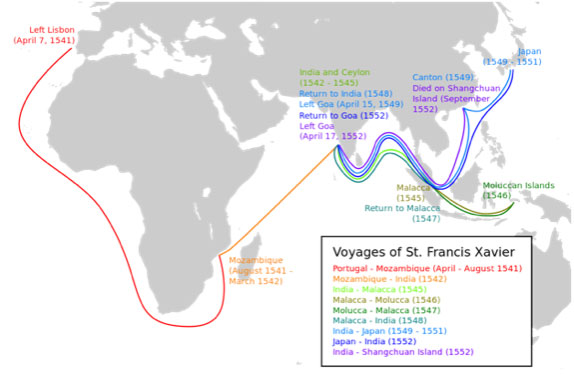
The eager 34-year-old left Rome in March, arrived in Portugal in June, and spent 8 months preparing for the voyage.  The pair departed Europe in April of 1541, arrived in Mozambique in August, and Goa, India, by May, 1542.  The following three years would be packed with caring for the natives of Southern India, building and working in hospitals, educating the peasant population, and baptizing tens of thousands every month.  He repeated this feat in Malacca (now Malaysia, in 1545), Maluku (now Indonesia, in 1546), Japan (in 1549), and China (in 1551, dying just before arriving on the mainland) facing countless deprivations, immense struggle to learn the native languages, and hostility by the cultic leaders who had previously sustained themselves off the lesser castes.  His body was returned to Goa, India, where it remains to this day, though, as only Catholic are apt to do, his arm, the same one that baptized hundreds of thousands, was eventually taken all the way back to the Jesuit headquarters in Rome, where it has stayed ever since (except a few excursions “on tour” around Canada, Australia, and other countries that even this legendary missionary couldn’t reach in this life).  

Perhaps what we are meant to learn from this saint is a simple truth: Christianity is an incarnate religion.  Everything we believe is founded upon our God becoming man.  Continuing this humility: today God depends on human lips, and limbs, and learning to preach, and baptize, and teach for Him.  And, for the very same reason, it is Christianity, and Christian saints, that relentlessly cherish the incarnate persons we encounter in every culture the world over, and none the less, desire ardently to bring them that incarnate love given to the Church in her scripture and sacraments.  May we have the gumption to do the same!

Many, many people hereabouts are not becoming Christians for one reason: there is nobody to make them Christians. Again and again I have thought of going round the universities of Europe, especially Paris, and everywhere crying out like a madman. Riveting the attention of those with more learning than charity: What a tragedy:  how many souls are being shut out of heaven and falling into hell, thanks to you!

– Fr. Dominic Rankin keeps waiting for the growth spurt that is sure to send him above his current height of 5’6” (on a good day), but he was happy to realize that sanctity does not depend on stature, for Francis Xavier never surpassed 5’4”, yet his youthful skill at running and high-jumping were surpassed one-hundred-fold by the grace with which he ran the Christian race and reached the heights of glorifying God.

Thousands of miles, and millions encountered.  You and I will do the same in our lives.  But do we as strongly desire to bring Christ to every parsec, and every person?. 

Prayer Wall – 11/19/2020

Please pray for my 38 yr old son Billy he’s addicted to alcohol just got his 3rd dwi also is bi polar very depressed lost job needs rehab pray for God’s deliverance from alcohol

Christ, Our King

I recently completed reading the book Conversion: Spiritual Insights into an Essential Encounter with God by Father Donald Haggerty, a priest of the Archdiocese of New York.  As I read it, I called to mind the many conversions I have undergone in my life, large and small.  But I was also challenged to see that the Lord invites me to continue to follow the path of conversion each and every day so that I can be a better instrument in His hands as I serve the people of God.

This call to continual conversion is one that the Church invites all Christians to embrace.  When addressing the role of the laity in the Church, the fathers of the Second Vatican Council wrote the following words about the laity:

They conduct themselves as children of the promise, and thus strong in faith and in hope they make the most of the present, and with patience await the glory that is to come. Let them not, then, hide this hope in the depths of their hearts, but even in the program of their secular life let them express it by a continual conversion and by wrestling “against the world-rulers of this darkness, against the spiritual forces of wickedness.”(Eph. 6:12)   Lumen Gentium, 35.

Notice the mention of the wrestling against the world-rulers of this darkness, referring not so much to human opponents, but our spiritual opponent the devil and his minions.  On the day of our Baptism, while the Heavens rejoiced at the gift of a new soul claimed for the Kingdom, our enemy lamented at his loss.  He is a sore loser, so he will not cease to try to tempt us to take our attention away from following Christ, our King.  The enemy tries to attract us by artificial lights that promise peace and fulfillment, but they only lead to darkness.  In the end, the enemy is a liar, and he will do everything possible to try to convince us of the truth of his lies.  Only by following Christ, who alone is “the way, and the truth, and the life” (Jn 14:6) can we be assured of final victory, of true peace and true happiness.  And because of our Baptism, we are God’s dearly beloved children, and He will never cease to fight on our behalf, so long as we give Him permission by submitting ourselves to His rule.

As the Church comes to the end of the liturgical year, this can be a good time to thank Christ, our King, for the areas of darkness in our lives that He has conquered through our acceptance of His reign.  But we are all well aware that there remain areas where we still need to let Him reign.  We pray that we may not resist Him when He comes and invites us to that next conversion.  While it may be uncomfortable, and even downright painful, we submit ourselves with humble trust, knowing that His reign in our souls is never one that brings slavery, but always leads to freedom.  

Father Alford     

« Previous Page
Next Page »

Liturgy

Sunday Masses (unless noted differently in weekly bulletin)
Saturday Evening Vigil – 4:00PM
Sunday – 7:00AM, 10:00AM and 5:00PM

Weekday Masses (unless noted differently in weekly bulletin)
Monday thru Friday – 7:00AM and 5:15PM
Saturday – 8:00AM

Reconciliation (Confessions)
Monday thru Friday – 4:15PM to 5:00PM
Saturday – 9:00AM to 10:00AM and 2:30PM to 3:30PM
Sunday – 4:00PM to 4:45PM

Adoration
Tuesdays and Thursdays – 4:00PM to 5:00PM


CatholicMassTime.org

Parish Information

Parish Address
524 East Lawrence Avenue
Springfield, Illinois 62703

Parish Office Hours
Monday thru Thursday – 8:00AM to 4:00PM
Fridays – CLOSED

Parish Phone
(217) 522-3342

Parish Fax
(217) 210-0136

Parish Staff

Contact Us

Contact Us

Copyright © 2026 · Log in