Cathedral of the Immaculate Conception

Springfield, IL

  • About
    • Contact Us
    • History of the Cathedral
    • Liturgical Schedules
    • Parish Staff
    • Register with Cathedral
    • Subscribe to the Cathedral eWeekly
  • Sacraments
    • Baptism
    • Becoming Catholic
    • Matrimony
    • Vocations
  • Ministry List
    • Adult Faith Formation
    • Cathedral Meal Train
    • Cathedral Online Prayer Wall
    • Cathedral Concerts
    • Family of Faith
    • Grief Share
    • Health and Wellness
    • Spiritual Resources
  • Stewardship
    • Stewardship: A Disciple’s Response
    • Stewardship Form
  • Support
    • E-Giving Frequently Asked Questions
    • Give Online
  • Sunday News
    • Announcements
    • Cathedral Weekly
    • Livestream Feed
    • Submit a Mass Intention Request
    • Weekly or Announcement Submission

Baptism Foreshadowed by the Exodus

In my column last week, I explored how the story of Noah’s Ark prefigured the sacrament of Baptism. St. Peter was the first one to make this connection explicit in one of his scriptural letters. Another clear image of Baptism from the Old Testament is the Exodus story. The “Exodus” is the term used to refer to the Hebrews’ miraculous escape from the enslaving Egyptians.  The  Exodus was the foundational event for the nation of the Hebrews. Abraham was the first one called by God, and after a couple generations, there were several dozen members of his family. Abraham’s great-grandson Joseph was sold to slavers and made his way to Egypt. This story of Joseph takes up a good portion of the book of Genesis and is one of the most wonderful stories in the Bible. However, this story is only building up to the foundational event of the Exodus. 

Joseph was able to save the nation of Egypt and eventually his own family through the prudent storage of food before a famine. Joseph brought his whole family to Egypt where they lived in prosperity for a number of years. However, the Hebrews were such strong people that the Egyptians began to fear them and thus made them slaves. For 430 years, the Hebrews worked under the Egyptians, but their family which was so small was still becoming a great nation. The stage was set for the most dramatic event in history up to that point, when God called Moses to lead his chosen people out of slavery into freedom. In this event, the evil of the Egyptians was destroyed when they were drowned by the sea closing in on them. And here we have a great connection to Baptism. Baptism frees us from the slavery of sin into the freedom of God’s love. The evil oppressors, sin and the devil, are cast off and destroyed. (The devil still exists after baptism but he no longer has authority over God’s people.)

In crossing the Red Sea, God miraculously led his people out of oppression, through water, towards the Promised Land. It took forty years of wandering before God finally led the Hebrews to the “land of milk and honey,” as it was called. The Exodus was only the beginning of freedom from slavery. In the same way, Baptism is only the beginning for a Christian. Baptism is the doorway, and thankfully we have six other sacraments to help us along as we also wander in the desert. During the Hebrews’ wandering, God taught them and gave them the law through the Ten Commandments and other laws such as those found in the book of Leviticus. 

The celebration of the Easter Vigil wonderfully dives into the mystery of Baptism through the Exodus. It is required that the story of the Exodus be read at the Easter Vigil, and those who are baptized are saved by passing through the water. If you have never attended an Easter Vigil, I highly encourage you to do so this year! It is sometimes called the “Mother of All Vigils” because it is the most solemn celebration of the entire church year. Simply experiencing this celebration can be a great way to come to a better appreciation of baptism, which is a great gift of freedom from God! 

Bl. Miguel Pro, a Knight in Heavenly Armor

November 23rd

Our story this week follows a little boy nicknamed Cocol, growing up as the 1800s became the 1900s, right at the center of Mexico, in the city of Guadalupe, Zacatecas, in a mining family.  He joined the Society of Jesus at the age of 20, but just 3 years into his formation, his tremendously Catholic homeland, in 1914, after a rigged election, and subsequent power struggle, decended into revolution, and the new government supressed and then persecuted the Catholic Church.  First, no Catholic schools, then no religious orders, then the Church couldn’t have property at all, and finally, priests were told not to wear their clerical garb, could no longer vote, and were forbidden to speak about the political situation … or else death.  Miguel and his classmates were forced to flee the country to continue their formation and when he was ordained far from home (in Belgium at that point), he could not even offer his first blessings to his family, who remained in Mexico, persecuted and hiding, but could only beg God’s grace down upon the photographs that he cherished of them.

Fr. Pro surrepticiously returned to Mexico one year later.  His life emulated so many thousands of priests down through the Church’s history who endured persercution and risked death to bring the sacraments to the faithful: from the persecutions of the 200s in Rome, the 700s in Arabia, the 1500s in England, the 1600s in Japan, the 1900s in Europe, … to those currently in North Korea, Afganistan, India, Colombia and so many other countries.  Within 3 months, a warrant was out for his arrest, and by the fall of 1927, he was captured, and then executed without trial.  It was crime enough that he was a priest.

So much for God’s Kingdom coming, huh?

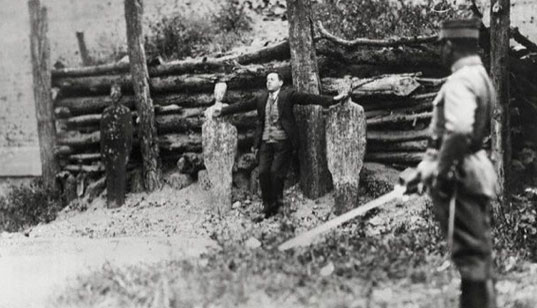
But then the voice of Christ resounds down through the ages: “My Kingdom is not of this world.”  Our Lord spoke that truth, beleagered and beaten and berefit of any power or influence before the might of the Roman Empire, and was promptly crucified and killed outside the city meant to be the place where God reigned … but as Miguel extended his arms in the shape of the cross, the firing squad raised their rifles, and the priest shouted “Viva Christo Rey!”, Christ’s Kingdom won another victory, because one more life had been captured by their carrying the cross after Him.

Padre Cocol, as he humbly signed his letters, received the martyr’s crown that day, but lest we think that his death was still a loss for everybody else, perhaps even earthly results can give us an indication of the fruit born by his sacrifice.  President Calles ordered the photographs capturing Pro’s execution distributed around the country to cow any remaining Christians.  But, as always, “the blood of the martyrs is the seed of the Church”, and those very images – an icon of the thousands of lives lost in those years, and during the continued persecutions in spots that lasted until the anti-Catholic laws were taken off the books in the 1990s – only invigorated and inspired the remaining followers of Christ to stay faithful to Him.  60,000 of those Christians came to Fr. Pro’s funeral!

We are not, right now, torn from our family and friends, to follow God’s call, but when the day comes, will we be willing to “sell everything” in order to purchase the Kingdom of God?  We are not, yet, destined for the firing-squad by professing that our King is Christ, but if we are not willing today to “suffer for the sake of the Name”, when that price is put on our faith, will we be willing to pay it?  We were traced with the sign of the cross at our baptism, and most of the time it doesn’t hurt too much, but do we act now in such a way to make that sign evident?  If not, will we have the courage when our last day comes to extend our own arms, and still profess Jesus’ victory within our own death?

Bl. Miguel Pro, Photograph of his martyrdom, as He holds crucifix, and rosary, and shouts “Viva Christo Rey!” 

“Cocol” is actually a simple, sweet bread found around Mexico, and loved by Miguel Pro.  Perhaps it is a fitting image for his own life – the wheat flour, mixed with a little salt, a little sugar, butter, yeast, eggs, and anise – all very normal ingredients, but transformed into something wonderful by grinding and kneading and baking.  Our lives are captured for Christ’s Kingdom, when we allow His cross to be imprinted on us … when we allow ourselves to be ground, and kneaded, and baked by the trials of this life, in order to become God’s holy bread as we join His victory in the next.

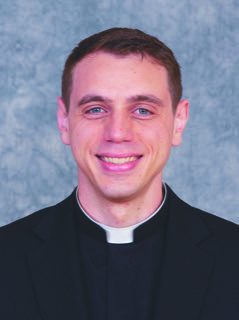
– Fr. Dominic Rankin has celebrated approximately 1000 Masses as this goes to print.  That is probably more than Bl. Miguel Pro would have celebrated in his short 2 years of priesthood, yet he was ready for martyrdom when the time came.  Do we allow ourselves to be conformed to Christ, crucified, when we receive His Body and Blood poured out at the Mass?

Week of Nov. 23

Monday, November 23

7am – Ralph Walter, Sr.
(Jean Moss)

5:15pm – Dave Loebach
(Rebecca & Woody Woodhull)

Tuesday, November 24

7am – Anna A. Eleyidath
(Augustine Eleyidath)

5:15pm – Norman & Eileen Rovey
(Family)

Wednesday, November 25

7am – Bernice Lauduskie
(Jim & Sandy Bloom)

5:15pm – Polly Keen
(Rob & Jan Sgambelluri)

Thursday, November 26

9am – John & Edith Bakalar
(John Busciacco)

Friday, November 27

7am – Deceased Members of the CCCW
(CCCW)

5:15pm – NO MASS

Saturday, November 28

8am – Richiusa & Leo Families
(Family)

4pm – George Zeigler
(William & Debra Stonikas)

Sunday, November 29

7am – Patricia Craig
(Family)

10am – For the People

5pm – Victoria Selburg
(Bernie Ely)

Our Citizenship is in Heaven

For the past several weeks, as we have experienced the roller coaster of the recent elections, the words of St. Paul have been ever present in my mind: “our citizenship is in Heaven, and from it we also await a savior, the Lord Jesus Christ.” (Phil 3:20)  Those words have brought me great peace in the midst of the uncertainty of what lies ahead for our country.  Because of our baptism, we have been made members of the Body of Christ, the Church, which makes us citizens of His Heavenly city, the New Jerusalem.  As opposed to the uncertainty we will always face when we focus on our earthly journey, there is no uncertainty or worry about what lies ahead for us as citizens of Heaven.  As St. Paul reminds us, the hope for the final, eternal, perfect peace of Heaven will never leave us disappointed.  (cf Rom. 5:5)   On the contrary, when our hope is placed here, we are bound to be disappointed.

Please do not hear in the above words something I am not saying.  Just because we are bound to be disappointed here on earth does not mean that we are not concerned about our lives here and our citizenship in the country and society in which we find ourselves.  In that regard, I came across a helpful commentary on this passage that I would like to share:

The Christian community, too, included both citizens and noncitizens. Therefore, when Paul asserts that the citizenship of Christians truly is in heaven, he is not saying they do not have a life in Philippi, but rather that the source of their security and identity is the risen Messiah, whom they worship as Lord and Savior. If Jesus is Lord and Savior in the most absolute sense, then Caesar is not. So the point is not that the Philippian Christians are in exile but that, as members of the church, they live as a colony of heaven, not of the Roman Empire; their ultimate allegiance is to the Lord Christ, not to Lord Caesar. And they await a visitation not from the Roman savior but from the Savior Christ.

Dennis Hamm, Philippians, Colossians, Philemon, ed. Peter S. Williamson and Mary Healy, Catholic Commentary on Sacred Scripture (Grand Rapids, MI: Baker Academic, 2013), 136.

Jesus never told us to withdraw from society, burying our heads in the sand.  No, He uses images such as “salt”, “light”, and “leaven” to speak of the effect that we should have in the world around us.  We are called to be instruments who draw people to Christ and His truth, so that they too can see in Him the sole hope for peace and lasting happiness.  Again, because of our baptism, we can live with a real sense of joy, knowing that our security lies in Christ the King, who has already won the victory and we know that if we persevere in our faith in Him, we will share fully in that victory as well in Heaven.  Let us recommit ourselves to being good citizens of Heaven, even here as we await the final victory that awaits.

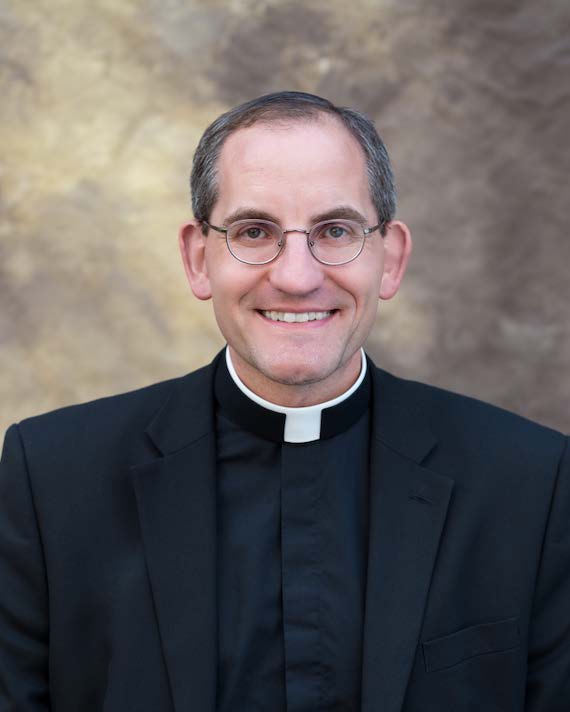
Father Alford     

Baptism Foreshadowed by Noah’s Ark

Bishop Paprocki has confirmed hundreds, probably thousands of young Catholics in our diocese since he arrived in Springfield nearly a decade ago. He always has the Confirmandi (those to be confirmed) fill out a short survey asking questions about their faith life which he often integrates into the homily. One of the questions on this survey is, “What is your favorite Bible passage and why?” Bishop Paprocki has told me that one of the most popular responses to this question is “Noah’s ark is my favorite story because it shows that God loves animals.” While this is technically true, and God does indeed love animals because he made them, it seems to miss the point of the overall story of Noah’s ark. 

The reason that Noah made the ark, which was needed to save the animals and a handful of humans, was because the world was full of wickedness. This is actually a pretty terrifying story to read in full, because it shows the depths of the sinfulness in our human race, but also offers a great sense of hope. The book of Genesis even goes so far as to say that God “regretted that he had made man on the earth, and his heart was grieved” (Genesis 6:6). As always, this passage needs to be properly understood in light of the whole Bible, and it brings my mind to the scene in the gospels when Jesus wept over Jerusalem because nobody recognized God among them. 

St. Peter, the first pope, made the connection between the story of Noah’s Ark and the sacrament of Baptism in his first letter. Peter focused on the cleansing action of the flood over the entire world, which wiped out most of creation, including all but eight people. This gave Noah’s family and the whole human race a fresh start. “God patiently waited in the days of Noah during the building of the ark, in which a few persons, eight in all, were saved through water. This prefigured baptism, which saves you now. It is not a removal of dirt from the body but an appeal to God for a clear conscience, through the resurrection of Jesus Christ” (1 Peter 3:20-21). Water had the power of destruction at the time of Noah, as it does today. Every spring, the rivers in our part of the country rise and sometimes even overflow their banks, with destructive consequences for the communities involved.

In Baptism, water is given the power of cleansing from sin as it was at the time of Noah, but without being destructive at the same time. Water clearly has a central place in the baptismal liturgy, and the blessing of the water to be used during the baptism is actually a couple pages long. This beautiful prayer traces the history of how God has used water throughout the history of salvation. In creation, the Holy Spirit hovered over the water and made it holy. In flood, the water symbolized the end of sin. In the great Exodus story, the Israelites walked through the water, making it a symbol of freedom from the tyranny of sin. In Jesus’ own baptism, he sanctified all the waters of the world, and on the cross, water came out from his side along with blood to wash the whole world of its sins. Water is beautiful in its simplicity, but even in this simplicity, God has given it a great power – to wash away sin! 

St. Rose Philippine Duchesne

November 18th 

It was the 35th Holy Thursday that she had lived through.  Most of them were far more difficult that this one.  The still-youthful sister, baptized with the names of a great apostle, St. Philip, and the lovely first saint of the Americas, St. Rose of Lima, had overcome the refusal of her family to enter religious life at the age of 18.  But soon after, she would endure the disbanding of her monastery during, and in the aftermath, of the French Revolution.  The year was now 1804, and though Christianity was no longer blatantly destroyed once Napoleon reigned over France, her beloved community of St. Marie, was just as obliterated as the remnants that remained of their convent.  

Rose was bent in adoration on that Holy Thursday evening, in prayer with the few sisters that remained, all of them remaining before the Blessed Sacrament.  And then, in the midst of that contemplation that had so captured her heart when she first found this this monastery, she writes that Christ drew her gaze beyond the monstrance, out of that dilapidated chapel, across the cold waves of the Atlantic to a far-away continent called America.  “I spent the entire night in the new World … carrying the Blessed Sacrament to all parts of the land … I had all my sacrifices to offer: a mother, sisters, family, my mountain! When you say to me ‘now I send you’, I will respond quickly ‘I go.’”

She wrote those words to a Mother Madeleine Sophie Barat, the foundress of a new congregation, the Society of the Sacred Heart of Jesus, an active order of sisters, who were bent on the task of bringing the Gospel to the world.  This letter would bring together the two groups, melding not only their communities, but also their mission: adoring Christ, but also carrying that Adoration out to the world.  As she put it so well “carrying the Blessed Sacrament to all parts of the land”.  

It would take 12 more Holy Thursday’s before that dream became reality.  Only in 1818 was Philippine finally invited to take a group of sisters across to America, and after a brief stint in New Orleans, they took the steamboat up the Mississippi, and set up shop just north of St. Louis, which had recently been made the capital of the Missouri Territory (created after the return of Louis and Clark’s exploration of the Louisiana Purchase just 12 years before).  They passed up the bustling town of almost 4000 people, soon to request statehood from the United States government, and settled in St. Charles.  

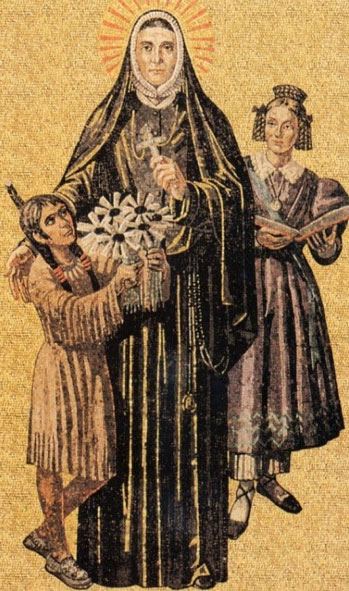
Mosaic of St. Rose Philippine Duchesne, from Saints Who Spread Catholicism in America, at the Cathedral Basilica of St. Louis, Hildreth Meière, 1949.

The log cabin that acted as convent and school was miserably cold in the winter; they had no funds yet provided the schooling for free; and Rose could barely speak English.  Yet she toiled on, founding 5 more houses in the next 10 years, and then in the 1840s, was finally was able to open a school for the Potawatomi tribe in Sugar Creek, Kansas.  The struggles redoubled as she grew older, yet perhaps her energy was spent well: she received the nickname Quah-kah-ka-num-ad, “the woman who prays always”. Her life, and death, maintained that tremendous balance of both adoration and action, worship and work, contemplation and construction…  

And perhaps that is what we should learn from her life.  We’ve been baptized into the same duality: grace and nature, spirit and water, love of God and love of neighbor.  Whatever vocation we have been entrusted with, can we engage it with the same passion that Rose did in hers?  “We cultivate a very small field for Christ, but we love it, knowing that God does not require great achievements but a heart that holds back nothing for self.”

– Fr. Dominic Rankin traveled one third of the way around the globe to visit the tombs of Sts. Peter and Paul (as well as to study theology and become a priest…), and the other third of the way around to visit the tomb of St. Thomas (as well as to work in Calcutta with the Missionaries of Charity…), but he has lived approximately 100 miles from the tomb of St. Rose Philippine Duchesne most of his life, yet has never visited her.  Anybody want to go?

Mass Intentions Week of Nov. 16

Monday, November 16

7am – Anna A. Eleyidath
(Augustine Eleyidath)

5:15pm – Delbert Fairweather
(Andrew & Cheryl Klein Family)

Tuesday, November 17

7am – Deceased Members of the CCCW
(CCCW)

5:15pm – Cathy Furkin
(Amber Cerveny)

Wednesday, November 18

7am – Dannie Roe
(LouAnn & Carl Corrigan)

5:15pm – Irene Doellman
(Blessed Sacrament Parish)

Thursday, November 19

7am – Ron Richards
(Donna Berte)

5:15pm – Special Intention for Bianca
(D. A. Drago)

Friday, November 20

7am – Dr. William Coughlin
(Linda Pierceall)

5:15pm – Lenn Family
(Lenn Family)

Saturday, November 21

8am – Helen Zeigler
(William & Debra Stonikas)

4pm – Madison Joy Rhoads
(Carol Morgan)

Sunday, November 22

7am – For the People

10am – Larry DeWitt
(10AM Ushers)

5pm – Kyle Buckman
(Mom)

Praying for the Dead

When a loved one passes away, it is not uncommon for us to lament not having spent enough time with that person, or not telling them that we loved them enough.  We can carry a guilt around that we have missed the opportunity to love them while they were with us, but now the time has passed.  But as Catholics, we believe that our chances for doing good is not over after our loved ones have died.  In fact, one of the greatest things we could ever do for them is to pray for the repose of their soul.

During the month of November, the Church earnestly encourages the faithful to pray for the souls of the faithful departed who are in Purgatory as they await their entrance into their heavenly reward.  Those souls depend on our prayers to help them, and so the Church considers praying for our beloved dead as a spiritual work of mercy.

Our initial reaction to that suggestion might be to cringe.  Why should we pray for them?  Does that suggest that we think they might not be in Heaven?  We can look to how the Church prays in her funeral liturgy for the dead.  The language is beautiful as it expresses our hope in the Resurrection, that those who have died in Christ will rise with Him.  But we also pray that the Lord will cleanse any stain of sin that might remain on them so that they can be fully prepared to enter into Heaven.  Based on this, it seems pretty clear that the Church presumes that many (if not most) souls go to Purgatory for that purification before going to Heaven.  Our prayers help them very much, as those prayers are used by the Lord to help our loved ones undergo this cleansing.  If they are in Purgatory, it is only temporary – they will be in Heaven.  And to think that we have the opportunity to help our loved ones get there quicker by praying for them, it seems like a no-brainer that we should be enthusiastic and generous in our prayers for the dead.  How could we deny them that gift?

I sometimes think of the joyful reception we will receive when we get to Heaven, especially from those for whom we prayed and therefore helped to get to Heaven.  We will see clearly how those acts of charity surpassed every good that we had done (or hoped to have done) for them while they were on earth.  So during this month of November, call to mind those people in your life who had passed away, and instead of feeling sadness about not doing enough for them, not spending enough time with them, or whatever weighs heavy on you – pray for their soul, knowing that by doing so, we express our love for them in the most beautiful way possible.

Eternal rest grant unto them, O Lord, and let perpetual light shine upon them.  May their souls, and the souls of all the faithful departed, through the mercy of God, rest in peace!  Amen.

Father Alford     

Prayer Wall – 11/05/2020

I was born with a Rare, severe Dry skin disorder diagnosed as #ICHTHYOSIS. I had it since birth (1996) and now im 24 (2020). It affected me from Head to Toe. Constantly uncomfortable physically, mentally and emotionally.Dry, flaking, red and inflamed all the time. please help me

Who can baptize?

In our faith formation discussions for the month of November, we are taking a closer look at Baptism. Baptism is so simple, often celebrated with a small group of family and friends after a Sunday Mass. Don’t let this simplicity fool you! Baptism is the first of all sacraments received, and is thus described as the “basis of the whole Christian life” because of this (Catechism of the Catholic Church, #1213). 

Baptism is unique among the sacraments because it can be administered by anybody – that’s right – anybody! In an ideal situation, an official minister of the Church such as a priest or deacon typically presides over the celebration of baptism. However, we all know that we do not live in an ideal world, and with surprising frequency, others may perform baptisms. The most common occurrence of this would be in hospitals when children are born with a health risk or prematurely. In that case, one of the parents, a chaplain, or even a nurse has the duty to baptize the baby as soon as possible to ensure that he or she enters through this doorway into God’s saving love. 

Since Baptism is the normal way by which Original Sin is forgiven, Jesus has made this sacrament extremely accessible. All we need is some water and the knowledge of what the Church expects regarding the formula to be said during the pouring of the water. Although rare, it is possible even for non-Christians to be the minister of baptism. Nurses and doctors in Catholic hospitals could be trained to do this, in the event that a chaplain is not available for an emergency baptism. When I found this out, I was surprised that even somebody with no belief in Jesus could be the celebrant of this sacrament. After all, why would a non-Christian care about somebody else receiving Baptism? I’m sure we all know people of good will who understand how much faith means to us as Christians, and out of respect for our beliefs, would not be opposed to helping to facilitate a celebration of baptism. This is possible because the baptizing minister does not pass along his or her own faith to the child. Nor is the child baptized into the faith of the parents. It’s obviously better if both parents are people of great faith, but if one or both parents do not believe or practice their faith, this does not invalidate the baptism of the child. We are all baptized into the faith of the Church, which draws its life from Jesus Christ. 

Sometimes children die shortly after receiving an emergency baptism. While nothing can compare to the pain of losing a child, the parents and family can be comforted in knowing that their child received the great gift of God’s life through baptism and is now a saint in heaven. If the child does survive after an emergency baptism, we can give thanks to God and still have a ceremony at the parish church in which a priest or deacon would perform the rest of the ritual surrounding the baptism, such as the presentation of the candle, white garment, and anointing with Chrism. Baptism is such a gift from God and I am very grateful that Jesus commanded us to “go and make disciples of all nations, baptizing them in the name of the Father, and of the Son, and of the Holy Spirit.” 

« Previous Page
Next Page »

Liturgy

Sunday Masses (unless noted differently in weekly bulletin)
Saturday Evening Vigil – 4:00PM
Sunday – 7:00AM, 10:00AM and 5:00PM

Weekday Masses (unless noted differently in weekly bulletin)
Monday thru Friday – 7:00AM and 5:15PM
Saturday – 8:00AM

Reconciliation (Confessions)
Monday thru Friday – 4:15PM to 5:00PM
Saturday – 9:00AM to 10:00AM and 2:30PM to 3:30PM
Sunday – 4:00PM to 4:45PM

Adoration
Tuesdays and Thursdays – 4:00PM to 5:00PM


CatholicMassTime.org

Parish Information

Parish Address
524 East Lawrence Avenue
Springfield, Illinois 62703

Parish Office Hours
Monday thru Thursday – 8:00AM to 4:00PM
Fridays – CLOSED

Parish Phone
(217) 522-3342

Parish Fax
(217) 210-0136

Parish Staff

Contact Us

Contact Us

Copyright © 2026 · Log in