Reflection on the Readings: July 29, 2018
II Kings 4:42-44; Psalm 145:10-11, 15-16, 17-18; Ephesians 4:1-6; John 6:1-15
Today’s Gospel reading is familiar to most of us; it is one of only a few miracles narrated in all four Gospels; it is the only one narrated with similar details. Today is also a departure for this year’s liturgical cycle; the last few weeks have brought us the first part of Chapter 6 in Mark’s Gospel, and Mark’s version of the feeding of the 5,000 would have followed. However, in this cycle, we jump into John’s Gospel; over the next few Sundays, we will go through the entire sixth chapter of John, reflecting on Jesus’ discourse on the Bread of Life.
Several thoughts can be drawn from today’s Gospel text; I would like to focus on one of John’s major themes – abundance.
Just as in the miracle of the wedding at Cana, today’s Gospel shows us a clear contrast of before and after – before Jesus acts, and after Jesus acts. There is a contrast between a state of emptiness, a state of chaos, and a state of abundance and order. At Cana, there was emptiness – no wine, six empty water jars, and a celebration that could potentially have drawn to a standstill. When Jesus acts, and his hour dawns, the jars were filled to the brim with the choicest of wines, and joy and celebration continued.
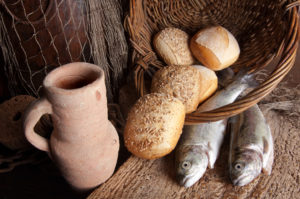 Today’s story begins with the crowd following Jesus and the disciples to a deserted place. A practical problem begins to unfold: How are we going to feed all these people? Philip is focused purely on the problem and the lack of money. Where can we buy enough bread? It will take 200 days wages at a minimum. Philip suffers from a scarcity mentality, as do many of us. He thinks the only solution is money. This may be a realistic approach, but Philip misses just what Jesus’ question was. Not “How much will it cost?”, but “Where will we get enough?” Philip is focused on problem, impossibility, and scarcity; he is unable to focus on the possibilities in and with the presence of Jesus.
We also should appreciate the initiative of Andrew in bringing people to Jesus; he brought his brother Simon; he and Philip brought the Greeks; and today, we read of him bringing a little boy with food. But, even as he brings the young boy, he too is questioning. What good are these for so many?
It is here that Jesus begins to act. He wants the disciples to understand he will not be bogged down by seeming impossibilities. He takes the five loaves and two fish (a perfect total, with seven being the number of perfection and completeness) and provides for all. There is abundance in what God provides.
The theme of abundance continues. We hear that not only had everyone present eaten enough, but there was enough left over to fill 12 large baskets. What a contrast to the questions and imagery from Philip and Andrew from earlier in the day!
Are we ready to be satisfied by the loving abundance of God? Are we ready to abandon fears of scarcity and look instead toward the fullness of God’s grace and mercy? How then are we to live in accordance with this Good News?
I would ask you to think about three things:
1) The Lord provides in abundance;
2) Introduce others to Jesus and watch what happens; and
3) Offer what you have, and be amazed at what the Lord can do with it.
The Lord provides in abundance. In the first reading today, the story of Elisha, we hear the Lord say, “They will eat and have some left over.” In the Gospel, we hear of the abundance remaining after all had been satisfied. For us, this means trusting that the Lord knows what we need and will provide for us, not just the minimum, but in abundance. It may be food; it may be friends; it may be spiritual support. As followers of Christ, we are not promised an easy life in this world; likewise, we do not pray for abundance of wealth, but for what is needed to bring about the kingdom of God in our lives and the lives of others. When we do the work of the Lord, he will support us; he will give us the gifts to do that work, and he will give them in abundance.
Second, introducing others to Jesus. Andrew has to be a favorite disciple for many because he is always introducing people to Jesus. Why did he bring the young boy with the food to Jesus? Would everyone else laugh at him for even thinking this child could help? Or did he think that Jesus would turn that small meal into enough for everyone? Probably not, but he took that risk. And look at what happened.
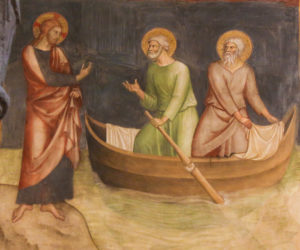
Renaissance Fresco depicting Jesus calling of Saint Peter and Andrew, in the Collegiata of San Gimignano, Italy.
It is because of people like Andrew that I was able to find a faith in Christ; it can be because of people like you that others will find that way. I hear multiple stories from people attending the Alpha gatherings of how they are discovering new ways to look at not only Christ, but at his Church, at the community, and at the love that is our God. We all should be thankful that we have so many Andrews reaching out from our simple community to those who are searching for a source of life and love.
Finally, offer what you have. Did the boy say, “No, this is mine and I’m not sharing. Get your own!”? No, he gave from what he had, and Jesus gave it back five thousand fold and more.
Charity is one of the great pillars of our faith. Watch what happens when you give without question when God asks you to give, be it your time, your skills, your treasure, or simply of yourself. Trust in God that he will take your gift and do great and wonderful things with it.
As we come forward to receive from the abundant love of God the gift of him who gave his entire self for our salvation, think about what you can do in the days to come to live your faith, to give a little, and to rejoice in the abundance of good things given to us by our Lord. And when you go forth after Mass, remember to share your faith in him who provides abundance, to invite others to share in that abundance, and pray that we may each become the stewards and disciples we are called to be. The hand of the Lord feeds us; he answers all our needs.
 Fr. Okoye is the Director of the Center for Spiritan Studies at Duquesne University in Pittsburgh, PA. His ministry as a priest has included congregational leadership as Provincial of the Nigerian Congregation of Spiritans and General Assistant in the Congregation’s headquarters in Rome.
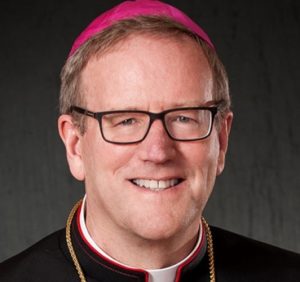 I recently granted an interview to the National Catholic Reporter concerning the upcoming Synod on Young People, the Faith, and Vocational Discernment, to which I was elected a delegate. We discussed a number of topics, including the rise of the “nones,” the purpose of the Synod, and creative ways of listening to the concerns of young people. In the course of the conversation, I also stated that I would bring the issue of apologetics before the Synod, since so many young people have questions about, and objections to, the faith. But when the interview appeared, the author expressed her puzzlement that I would mention apologetics, though it is clear that the working document calls for “accompaniment” of young people. It seems many think doing apologetics and accompaniment are mutually exclusive. To my mind, they’re mutually implicative. Of course, especially in our context today, a brow-beating, “I’ve got all the answers” approach is counterindicated. But apologetics as such is needed more than ever—and more to the point, is perfectly congruent with Pope Francis’ insistence on walking with those who struggle with the faith.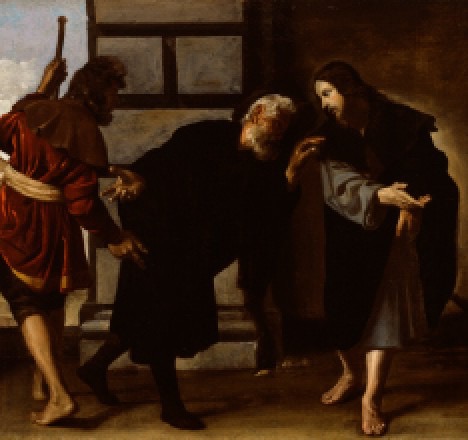
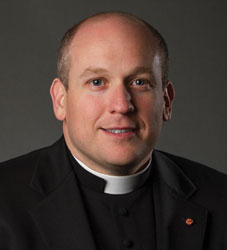
 I sat down with Fr. Michael Friedel to get to know him and his ministry. We are excited to welcome him to our community!
 This past week we said goodbye to Dominic Vahling, a seminarian for our diocese who has spent the past eight weeks with us here at the Cathedral. I know that the vast majority of you did not get to know Dominic more than just a handshake after Mass, but his time here has been one more piece of hi s format ion for priesthood which, God-willing, is in just under two years’ time.
 After some time with his family, Dominic will be returning to Kenrick- Glennon Seminary in St. Louis to finish his last two years of seminary formation and preparations for his Diaconate ordination this coming spring. I am grateful for the goodness that Dominic shared with us in his short time in the parish. Please join me in keeping him in prayer that God will continue to bless Dominic with every grace that he needs to continue to both hear and answer the Lord’s call in his life.
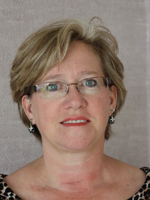 At the same time, I am very happy to welcome a new member of staff to the Cathedral Parish. Vicki Compton is joining the Cathedral staff, having most recently served as the director of the Office for the Missions for our diocese. Vicki will be serving as the parish’s Coordinator for Faith Formation and Mission. Her ministry will be very broad in that she will help the Cathedral clergy in many aspects of parish life, from faith formation and catechesis to ministry formation to helping us constantly examine how we are responding to the call of the Gospel as a parish. One major area of assistance that she will be assisting with is our parish implementation of the goals the Fourth Diocesan Synod that was held this past year.
 During the weekend of August 4-5, 2018, Rev. Dr. James Okoye, CSSp, will visit our parish to speak at the Masses about the missionary work of the Church and in particular that of the Spartans (Congregation of the Holy Spirit, previously known as the Holy Ghost Fathers). To learn more about the Spiritans, please visit their website at http://spiritans.org.
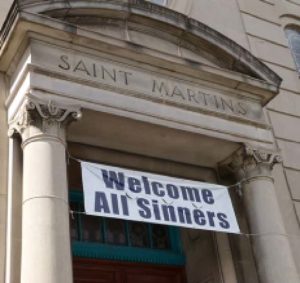 With this basic distinction in mind, let us consider membership in the Church of Jesus Christ. Are all people welcome to the Church? Yes of course! Everyone and his brother cites James Joyce to the effect that the Catholic Church’s motto is “here comes everybody,” and this is fundamentally right. Jesus means to bring everyone to union with the Triune God, or to state the same thing, to become a member of his Mystical Body the Church. In John’s Gospel, Jesus declares, “When the Son of Man is lifted up, he will draw all people to himself.” Bernini’s colonnade, reaching out like great in-gathering arms from St. Peter’s Basilica, is meant to symbolize this universally inclusive welcome offered by Christ. Is the Church, as Pope Francis says, a field hospital where even the most gravely wounded are invited for treatment? Is the Lord’s mercy available to everyone, even to the most hardened of sinners? Yes! And does the Church even go out from itself to care for those who are not explicitly joined to Christ? Yes! In fact, this was one of the reasons the Church was so attractive in the ancient world: when Roman society left the sick to fend for themselves and often cast away the newly-born who were deemed unworthy, the Church included these victims of the “throwaway culture” of that time and place.
 Think about your day yesterday. Did you lead with your heart? Okay, I understand, that is a tough question. But, what would the day look like if we had led every decision, every action, every encounter only through the way our heart would respond?
 A cathedral being the “mother church” means that, generally, certain special events happen within its walls; this is true of our Cathedral church. Important Masses and celebrations throughout the year occur here such as the Chrism Mass during Holy Week when the new holy oils are blessed for the year and the priests of the diocese renew their priestly commitment to God and the Church. The ordination of deacons and priests takes place in the Cathedral as well as the ordination and/or installation of a new diocesan bishop. Other special events in the life of the diocese happen in the Cathedral as well, such as the yearly Mass for couples celebrating 50+ years of marriage, the annual Mission Mass celebrated with school children throughout the diocese, and the Rite of Election for Catechumens and the Call to On-Going Conversion for those who seek to be received into the Church at Easter.
 In almost every case, the diocesan bishop celebrates these special celebrations in a cathedral. Having received the sacrament of Holy Orders three-fold, a bishop in his own person is the fullness of the priesthood, being deacon, priest, and bishop. The bishops are the successors of the Apostles and they are the guardians of what is termed “Apostolic Succession,” meaning that they hand on from generation to generation the sacrament of Holy Orders to deacons, priests, and other bishops assuring the on-going sacramental life of the Church. The bishops are also the body of authoritative teachers in the Church called the Magisterium. Collegially and individually, they are to strive to protect and preserve the truth of the Faith as given by the Lord Jesus and revealed by the Holy Spirit.
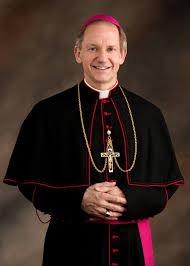 Most bishops are given the ministry of being a diocesan bishop, meaning that they are charged with shepherding a section of the people of God known as a diocese. As our diocesan bishop, Bishop Paprocki is not the pope’s representative here, but rather, he is the representative of Christ himself. As a successor of the Apostles and as our diocesan bishop, Bishop Paprocki unites us to the greater Church in his obedience to and communion with the Bishop of Rome, Pope Francis, who is the successor of St. Peter, the apostolic head of the Church as designated by the Lord Jesus.
 It is the special ministry of the diocesan bishop, combined with his special relationship with the cathedral church, that gives a cathedral its unique place among other churches, making a cathedral truly the mother church of a diocese
 You might think it strange that, here in the height of the summer and baseball seasons that I would be writing about football. Why? Because I love football! The fall season is arguably my favorite time of the year not just because the seasons are changing and the weather gets a little cooler. More importantly, the fall season brings us football season as well, one of my favorite activities!