Cathedral of the Immaculate Conception

Springfield, IL

  • About
    • Contact Us
    • History of the Cathedral
    • Liturgical Schedules
    • Parish Staff
    • Register with Cathedral
    • Subscribe to the Cathedral eWeekly
  • Sacraments
    • Baptism
    • Becoming Catholic
    • Matrimony
    • Vocations
  • Ministry List
    • Adult Faith Formation
    • Cathedral Meal Train
    • Cathedral Online Prayer Wall
    • Cathedral Concerts
    • Family of Faith
    • Grief Share
    • Health and Wellness
    • Spiritual Resources
  • Stewardship
    • Stewardship: A Disciple’s Response
    • Stewardship Form
  • Support
    • E-Giving Frequently Asked Questions
    • Give Online
  • Sunday News
    • Announcements
    • Cathedral Weekly
    • Livestream Feed
    • Submit a Mass Intention Request
    • Weekly or Announcement Submission

Baptism Foreshadowed by Noah’s Ark

Bishop Paprocki has confirmed hundreds, probably thousands of young Catholics in our diocese since he arrived in Springfield nearly a decade ago. He always has the Confirmandi (those to be confirmed) fill out a short survey asking questions about their faith life which he often integrates into the homily. One of the questions on this survey is, “What is your favorite Bible passage and why?” Bishop Paprocki has told me that one of the most popular responses to this question is “Noah’s ark is my favorite story because it shows that God loves animals.” While this is technically true, and God does indeed love animals because he made them, it seems to miss the point of the overall story of Noah’s ark. 

The reason that Noah made the ark, which was needed to save the animals and a handful of humans, was because the world was full of wickedness. This is actually a pretty terrifying story to read in full, because it shows the depths of the sinfulness in our human race, but also offers a great sense of hope. The book of Genesis even goes so far as to say that God “regretted that he had made man on the earth, and his heart was grieved” (Genesis 6:6). As always, this passage needs to be properly understood in light of the whole Bible, and it brings my mind to the scene in the gospels when Jesus wept over Jerusalem because nobody recognized God among them. 

St. Peter, the first pope, made the connection between the story of Noah’s Ark and the sacrament of Baptism in his first letter. Peter focused on the cleansing action of the flood over the entire world, which wiped out most of creation, including all but eight people. This gave Noah’s family and the whole human race a fresh start. “God patiently waited in the days of Noah during the building of the ark, in which a few persons, eight in all, were saved through water. This prefigured baptism, which saves you now. It is not a removal of dirt from the body but an appeal to God for a clear conscience, through the resurrection of Jesus Christ” (1 Peter 3:20-21). Water had the power of destruction at the time of Noah, as it does today. Every spring, the rivers in our part of the country rise and sometimes even overflow their banks, with destructive consequences for the communities involved.

In Baptism, water is given the power of cleansing from sin as it was at the time of Noah, but without being destructive at the same time. Water clearly has a central place in the baptismal liturgy, and the blessing of the water to be used during the baptism is actually a couple pages long. This beautiful prayer traces the history of how God has used water throughout the history of salvation. In creation, the Holy Spirit hovered over the water and made it holy. In flood, the water symbolized the end of sin. In the great Exodus story, the Israelites walked through the water, making it a symbol of freedom from the tyranny of sin. In Jesus’ own baptism, he sanctified all the waters of the world, and on the cross, water came out from his side along with blood to wash the whole world of its sins. Water is beautiful in its simplicity, but even in this simplicity, God has given it a great power – to wash away sin! 

St. Rose Philippine Duchesne

November 18th 

It was the 35th Holy Thursday that she had lived through.  Most of them were far more difficult that this one.  The still-youthful sister, baptized with the names of a great apostle, St. Philip, and the lovely first saint of the Americas, St. Rose of Lima, had overcome the refusal of her family to enter religious life at the age of 18.  But soon after, she would endure the disbanding of her monastery during, and in the aftermath, of the French Revolution.  The year was now 1804, and though Christianity was no longer blatantly destroyed once Napoleon reigned over France, her beloved community of St. Marie, was just as obliterated as the remnants that remained of their convent.  

Rose was bent in adoration on that Holy Thursday evening, in prayer with the few sisters that remained, all of them remaining before the Blessed Sacrament.  And then, in the midst of that contemplation that had so captured her heart when she first found this this monastery, she writes that Christ drew her gaze beyond the monstrance, out of that dilapidated chapel, across the cold waves of the Atlantic to a far-away continent called America.  “I spent the entire night in the new World … carrying the Blessed Sacrament to all parts of the land … I had all my sacrifices to offer: a mother, sisters, family, my mountain! When you say to me ‘now I send you’, I will respond quickly ‘I go.’”

She wrote those words to a Mother Madeleine Sophie Barat, the foundress of a new congregation, the Society of the Sacred Heart of Jesus, an active order of sisters, who were bent on the task of bringing the Gospel to the world.  This letter would bring together the two groups, melding not only their communities, but also their mission: adoring Christ, but also carrying that Adoration out to the world.  As she put it so well “carrying the Blessed Sacrament to all parts of the land”.  

It would take 12 more Holy Thursday’s before that dream became reality.  Only in 1818 was Philippine finally invited to take a group of sisters across to America, and after a brief stint in New Orleans, they took the steamboat up the Mississippi, and set up shop just north of St. Louis, which had recently been made the capital of the Missouri Territory (created after the return of Louis and Clark’s exploration of the Louisiana Purchase just 12 years before).  They passed up the bustling town of almost 4000 people, soon to request statehood from the United States government, and settled in St. Charles.  

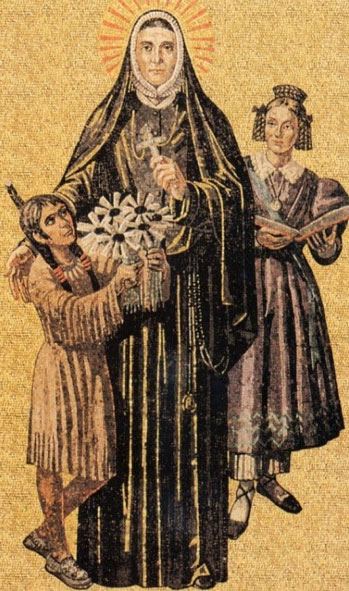
Mosaic of St. Rose Philippine Duchesne, from Saints Who Spread Catholicism in America, at the Cathedral Basilica of St. Louis, Hildreth Meière, 1949.

The log cabin that acted as convent and school was miserably cold in the winter; they had no funds yet provided the schooling for free; and Rose could barely speak English.  Yet she toiled on, founding 5 more houses in the next 10 years, and then in the 1840s, was finally was able to open a school for the Potawatomi tribe in Sugar Creek, Kansas.  The struggles redoubled as she grew older, yet perhaps her energy was spent well: she received the nickname Quah-kah-ka-num-ad, “the woman who prays always”. Her life, and death, maintained that tremendous balance of both adoration and action, worship and work, contemplation and construction…  

And perhaps that is what we should learn from her life.  We’ve been baptized into the same duality: grace and nature, spirit and water, love of God and love of neighbor.  Whatever vocation we have been entrusted with, can we engage it with the same passion that Rose did in hers?  “We cultivate a very small field for Christ, but we love it, knowing that God does not require great achievements but a heart that holds back nothing for self.”

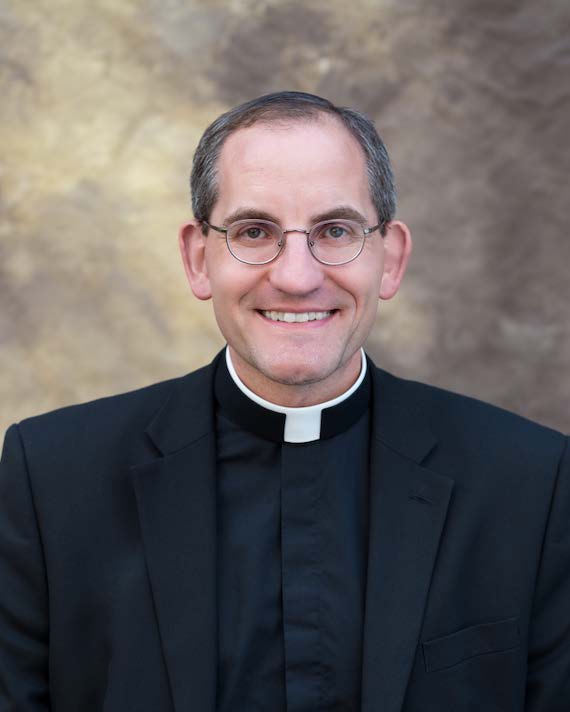
– Fr. Dominic Rankin traveled one third of the way around the globe to visit the tombs of Sts. Peter and Paul (as well as to study theology and become a priest…), and the other third of the way around to visit the tomb of St. Thomas (as well as to work in Calcutta with the Missionaries of Charity…), but he has lived approximately 100 miles from the tomb of St. Rose Philippine Duchesne most of his life, yet has never visited her.  Anybody want to go?

Mass Intentions Week of Nov. 16

Monday, November 16

7am – Anna A. Eleyidath
(Augustine Eleyidath)

5:15pm – Delbert Fairweather
(Andrew & Cheryl Klein Family)

Tuesday, November 17

7am – Deceased Members of the CCCW
(CCCW)

5:15pm – Cathy Furkin
(Amber Cerveny)

Wednesday, November 18

7am – Dannie Roe
(LouAnn & Carl Corrigan)

5:15pm – Irene Doellman
(Blessed Sacrament Parish)

Thursday, November 19

7am – Ron Richards
(Donna Berte)

5:15pm – Special Intention for Bianca
(D. A. Drago)

Friday, November 20

7am – Dr. William Coughlin
(Linda Pierceall)

5:15pm – Lenn Family
(Lenn Family)

Saturday, November 21

8am – Helen Zeigler
(William & Debra Stonikas)

4pm – Madison Joy Rhoads
(Carol Morgan)

Sunday, November 22

7am – For the People

10am – Larry DeWitt
(10AM Ushers)

5pm – Kyle Buckman
(Mom)

Praying for the Dead

When a loved one passes away, it is not uncommon for us to lament not having spent enough time with that person, or not telling them that we loved them enough.  We can carry a guilt around that we have missed the opportunity to love them while they were with us, but now the time has passed.  But as Catholics, we believe that our chances for doing good is not over after our loved ones have died.  In fact, one of the greatest things we could ever do for them is to pray for the repose of their soul.

During the month of November, the Church earnestly encourages the faithful to pray for the souls of the faithful departed who are in Purgatory as they await their entrance into their heavenly reward.  Those souls depend on our prayers to help them, and so the Church considers praying for our beloved dead as a spiritual work of mercy.

Our initial reaction to that suggestion might be to cringe.  Why should we pray for them?  Does that suggest that we think they might not be in Heaven?  We can look to how the Church prays in her funeral liturgy for the dead.  The language is beautiful as it expresses our hope in the Resurrection, that those who have died in Christ will rise with Him.  But we also pray that the Lord will cleanse any stain of sin that might remain on them so that they can be fully prepared to enter into Heaven.  Based on this, it seems pretty clear that the Church presumes that many (if not most) souls go to Purgatory for that purification before going to Heaven.  Our prayers help them very much, as those prayers are used by the Lord to help our loved ones undergo this cleansing.  If they are in Purgatory, it is only temporary – they will be in Heaven.  And to think that we have the opportunity to help our loved ones get there quicker by praying for them, it seems like a no-brainer that we should be enthusiastic and generous in our prayers for the dead.  How could we deny them that gift?

I sometimes think of the joyful reception we will receive when we get to Heaven, especially from those for whom we prayed and therefore helped to get to Heaven.  We will see clearly how those acts of charity surpassed every good that we had done (or hoped to have done) for them while they were on earth.  So during this month of November, call to mind those people in your life who had passed away, and instead of feeling sadness about not doing enough for them, not spending enough time with them, or whatever weighs heavy on you – pray for their soul, knowing that by doing so, we express our love for them in the most beautiful way possible.

Eternal rest grant unto them, O Lord, and let perpetual light shine upon them.  May their souls, and the souls of all the faithful departed, through the mercy of God, rest in peace!  Amen.

Father Alford     

Prayer Wall – 11/05/2020

I was born with a Rare, severe Dry skin disorder diagnosed as #ICHTHYOSIS. I had it since birth (1996) and now im 24 (2020). It affected me from Head to Toe. Constantly uncomfortable physically, mentally and emotionally.Dry, flaking, red and inflamed all the time. please help me

Who can baptize?

In our faith formation discussions for the month of November, we are taking a closer look at Baptism. Baptism is so simple, often celebrated with a small group of family and friends after a Sunday Mass. Don’t let this simplicity fool you! Baptism is the first of all sacraments received, and is thus described as the “basis of the whole Christian life” because of this (Catechism of the Catholic Church, #1213). 

Baptism is unique among the sacraments because it can be administered by anybody – that’s right – anybody! In an ideal situation, an official minister of the Church such as a priest or deacon typically presides over the celebration of baptism. However, we all know that we do not live in an ideal world, and with surprising frequency, others may perform baptisms. The most common occurrence of this would be in hospitals when children are born with a health risk or prematurely. In that case, one of the parents, a chaplain, or even a nurse has the duty to baptize the baby as soon as possible to ensure that he or she enters through this doorway into God’s saving love. 

Since Baptism is the normal way by which Original Sin is forgiven, Jesus has made this sacrament extremely accessible. All we need is some water and the knowledge of what the Church expects regarding the formula to be said during the pouring of the water. Although rare, it is possible even for non-Christians to be the minister of baptism. Nurses and doctors in Catholic hospitals could be trained to do this, in the event that a chaplain is not available for an emergency baptism. When I found this out, I was surprised that even somebody with no belief in Jesus could be the celebrant of this sacrament. After all, why would a non-Christian care about somebody else receiving Baptism? I’m sure we all know people of good will who understand how much faith means to us as Christians, and out of respect for our beliefs, would not be opposed to helping to facilitate a celebration of baptism. This is possible because the baptizing minister does not pass along his or her own faith to the child. Nor is the child baptized into the faith of the parents. It’s obviously better if both parents are people of great faith, but if one or both parents do not believe or practice their faith, this does not invalidate the baptism of the child. We are all baptized into the faith of the Church, which draws its life from Jesus Christ. 

Sometimes children die shortly after receiving an emergency baptism. While nothing can compare to the pain of losing a child, the parents and family can be comforted in knowing that their child received the great gift of God’s life through baptism and is now a saint in heaven. If the child does survive after an emergency baptism, we can give thanks to God and still have a ceremony at the parish church in which a priest or deacon would perform the rest of the ritual surrounding the baptism, such as the presentation of the candle, white garment, and anointing with Chrism. Baptism is such a gift from God and I am very grateful that Jesus commanded us to “go and make disciples of all nations, baptizing them in the name of the Father, and of the Son, and of the Holy Spirit.” 

To all God’s beloved … who are called to be saints.

Feast Day: No particular day, and every particular day.

The best analogy for Baptism that I have ever heard, and one that captivates confirmandi’s around the diocese when I ask it of them starts “if your mom and dad were to give you any car of your choice, what would it be?”  I have gotten a lot of Lamborghinis and Ferraris in response, as well as a few Teslas, Mustangs, Ford F150s, … and one tractor.  It is a good image because a free car would be a tremendous gift, and so is the grace of baptism.  I am sure that Fr. Alford and Fr. Vahling will explain more of the nuts and bolts of the graces of this first and fundamental sacrament, but I want instead for you to sit in your ‘car’ and take a minute to look around.

Cars do a lot for us.  They carry us from place to place, they protect us in a cocoon of metal and glass and plastic, they make it possible for us to go places that would be far more arduous and dangerous without them.  They have lights to illuminate dark roads; air-conditioning to keep us comfortable; seats and belts to keep us secure; screens to tell us where, how fast, and how far we are along the way; speakers to entertain us; mirrors to amplify our vision; and cupholders to keep us hydrated.

Baptism does more for us.  It is the supernatural gift of divine life that pervades and transfigures every moment of our lives.  It is the first dose of God’s protection against the Evil One, and a continuous promise of His watching over us and protecting us.  It allows us to receive graces, insights, and truths of faith that we could not acquire without it.  It illuminates and transforms the dark days of life into encounters with the Crucified One.  It strengthens and supernaturalizes our ability to look within, and without, seeing ourselves as God sees us, and loving others as God loves them.  It makes every other adventure in the Christian life possible: watching our sins get demolished by God’s mercy, receiving the influx of the Holy Spirit Himself, approaching the Wedding Feast of the Lamb, giving ourselves absolutely to a spouse and family, or God’s holy church, and allowing the hardest days of life be transformed by the divine physician.

How’s your car looking right now?  Does it give you a thrill every time you use it, to know that Someone loves you that much?  Do you know, and celebrate, the day when it was given to you?  When is the last time you vacuumed out the cheerios and blasted off the clumps of mud?  Have you engaged it to its fullest, or just gone back and forth to work?  If a free car was available to everyone, would you tell a friend if they were still traipsing through life on foot?  If somebody else was lost, broke-down, and smashed-up, would you point them in the right direction, and mention that it only costs humility to get everything fixed up?

This week’s saint is all of us.  That is, all who are baptized, and everybody that could be baptized … so all y’all (that’d be “you lot” in the UK, “yous” in Ireland, Scotland, and Australia, “you-uns” in Pennsylvania, and “yees” in Ireland…), and me as well.  This month we celebrate all the saints, and pray for all those who have died already, but what remains to be done is to choose today to live well the graces we were given at our baptism.  We have been given a great gift, let us not neglect it!

– Fr. Dominic Rankin was baptized the same day that he was born.  Eyewitnesses claim that this was because he and his twin were born a few months early, and for evidence point to the few more months that he, his sister, and mom, and dad, and the rest of the anxious family spent in the hospital after that emergency baptism.  He would like to think that really it was because of all the zeal he had to get those graces early.

Week of November 9

Monday, November 9

7am – Mary Ann Midden
(William Midden)

5:15pm – Mary & Stanley Posnack
(Rebecca & Woody Woodhull)

Tuesday, November 10

7am – Anna A. Eleyidath
(Augustine Eleyidath)

5:15pm – Joseph & Mary Schweska
(Tom McGee)

Wednesday, November 11

7am – Special Intention for Sheree Graves
(Sheree Graves)

5:15pm – William F. Logan
(Lisa Logan & Lori Motyka)

Thursday, November 12

7am – Irene Doellman
(Blessed Sacrament Parish)

5:15pm – Shirley Logan
(Lisa Logan & Lori Motyka)

Friday, November 13

7am – George Stonikas
(William & Debra Stonikas)

5:15pm – Lemuel Moss
(Jean Moss)

Saturday, November 14

8am – Richiusa & Leo Families
(Family)

4pm – Doris Drea
(Asher, Gittler, & D’Alba Ltd.)

Sunday, November 15

7am – Mary Ann Midden
(William Midden)

10am – Nancy Shea
(Jim & Barb Stelte)

5pm – For the People

The Most Important Day of our Life

Earlier this week, I was listening to a podcast from Father Mike Schmitz, and in his homily, he referenced a Mark Twain quote that I heard once, but had forgotten.  The quote goes like this: “The two most important days in your life are the day you are born and the day you find out why.”  As I thought about that quote a little bit, it became clear how insightful it is, for to know our purpose in life is a great gift, as it helps us set a direction and follow it.

But as a Christian, I would like to respectfully propose a different answer to the most important day question, and that would be the day of our Baptism.  On that day, we are freed from Original Sin and made adopted sons and daughters of God, destined to share eternal life in Heaven.  That new birth, while dependent on our natural birth, is far more significant for us because of the gifts of God’s grace and that promise of our inheritance with the saints in the Kingdom.  If all of that is true (and the Lord promises that it is), then I might propose as the other most important day of our life is the day that we die.  Our initial reaction is to maybe reject that proposal, but stay with me.  The end of our life here on earth is not an end at all.  As one of the prayers of the funeral liturgy of the Church proclaims so beautifully: “Indeed for your faithful, Lord, life is changed not ended.”  The faithful are those who have received that new life in Baptism and who, at the time of their death, are in relationship with Christ in the state of grace.  It is our sure and certain hope that those who die in this state will receive their inheritance of being welcomed to the eternal wedding banquet of Heaven.  This makes death the doorway to that life for which we have been created, perfect union with God for eternity.

When we become aware of the gift of our Baptism, we become aware of why we were born.  In that same podcast, Father Mike Schmitz pointed back to the Baltimore Catechism which asked the simple question: “Why did God make me?”  Many of you don’t even need to read the answer, because you have it memorized: “God made me to know Him, to love Him, and to serve Him in this life, so that I can be forever happy with Him in Heaven.”  Our Baptism gives us our why, and it points to our final goal of being happy with Him in Heaven.

As we begin this month of November, our Family of Faith topic is the Sacrament of Baptism.  November is also a month when we recall the souls of the faithful departed, prompting us to pray for them, but also calling us to be aware of our end as well.  And because of the gift of our Baptism, that day is not something to be feared, but to look forward to, for it means the fulfillment of the new life received in Baptism.  As Christians, then, let us be convinced that the two most important days in our lives are the day of our Baptism and the day of the end of our earthly journey which will mark our entrance into Heaven.

Father Alford     

All Souls: Resting in the Hands of God

Feast Day: November 2nd 

How can one tell the stories of all the souls at once?  I would like to borrow from a tale told by C.S. Lewis in his book depicting a soul’s departing this life and approaching heaven, The Great Divorce.  Midway through the book we witness a ghost debating about whether to make his long way towards the heavenly mountains in the distance, or to just head home.  He encounters a flaming angel as he debates, realizing that the devious red lizard on his shoulder doesn’t have a place in the presence of God.

“Yes. I’m off,” said the Ghost. “Thanks for all your hospitality. But it’s no good, you see. I told this little chap,” (here he indicated the lizard), “that he’d have to be quiet if he came -which he insisted on doing. Of course his stuff won’t do here: I realise that. But he won’t stop. I shall just have to go home.”

‘Would you like me to make him quiet?” said the flaming Spirit-an angel, as I now understood.

“Of course I would,” said the Ghost.

“Then I will kill him,” said the Angel, taking a step forward.

“Oh-ah-look out! You’re burning me. Keep away,” said the Ghost, retreating.

“Don’t you want him killed?”

“You didn’t say anything about killing him at first. I hardly meant to bother you with anything so drastic as that.”

“It’s the only way,” said the Angel, whose burning hands were now very close to the lizard. “Shall I kill it?”

“Well, that’s a further question. I’m quite open to consider it, but it’s a new point, isn’t it? I mean, for the moment I was only thinking about silencing it because up here-well, it’s so damned embarrassing.”

“May I kill it?”

“Well, there’s time to discuss that later.”

“There is no time. May I kill it?”

“Please, I never meant to be such a nuisance. Please-really-don’t bother. Look! It’s gone to sleep of its own accord. I’m sure it’ll be all right now. Thanks ever so much.”

“May I kill it?”

“Honestly, I don’t think there’s the slightest necessity for that. I’m sure I shall be able to keep it in order now. I think the gradual process would be far better than killing it.”

“The gradual process is of no use at all.”

“Don’t you think so? Well, I’ll think over what you’ve said very carefully. I honestly will. In fact I’d let you kill it now, but as a matter of fact I’m not feeling frightfully well to-day. It would be silly to do it now. I’d need to be in good health for the operation. Some other day, perhaps.”

“There is no other day. All days are present now.”

“Get back! You’re burning me. How can I tell you to kill it? You’d kill me if you did.”

“It is not so.”

“Why, you’re hurting me now.”

“I never said it wouldn’t hurt you. I said it wouldn’t kill you.”

“Oh, I know. You think I’m a coward. But it isn’t that. Really it isn’t. I say! Let me run back by tonight’s bus and get an opinion from my own doctor. I’ll come again the first moment I can.”

“This moment contains all moments.”

“Why are you torturing me? You are jeering at me. How can I let you tear me to pieces? If you wanted to help me, why didn’t you kill the damned thing without asking me–before I knew? It would be all over by now if you had.”

“I cannot kill it against your will. It is impossible. Have I your permission?”

The Angel’s hands were almost closed on the Lizard, but not quite. Then the Lizard began chattering to the Ghost so loud that even I could hear what it was saying.

“Be careful,” it said. “He can do what he says. He can kill me. One fatal word from you and he will! Then you’ll be without me for ever and ever. It’s not natural. How could you live? You’d be only a sort of ghost, not a real man as you are now. He doesn’t understand. He’s only a cold, bloodless abstract thing. It may be natural for him, but it isn’t for us. Yes, yes. I know there are no real pleasures now, only dreams. But aren’t they better than nothing? And I’ll be so good. I admit I’ve sometimes gone too far in the past, but I promise I won’t do it again. I’ll give you nothing but really nice dreams–all sweet and fresh and almost innocent. You might say, quite innocent …. ”

“Have I your permission?” said the Angel to the Ghost.

“I know it will kill me.”

“It won’t. But supposing it did?”

“You’re right. It would be better to be dead than to live with this creature.”

“Then I may?”

“…blast you! Go on can’t you? Get it over. Do what you like,” bellowed the Ghost: but ended, whimpering, “God help me. God help me.”

Next moment the Ghost gave a scream of agony such as I never heard on Earth. The Burning One closed his crimson grip on the reptile: twisted it, while it bit and writhed, and then flung it, broken backed, on the turf.

“Ow! That’s done for me,” gasped the Ghost, reeling backwards.

For a moment I could make out nothing distinctly. Then I saw, between me and the nearest bush, unmistakably solid but growing every moment solider, the upper arm and the shoulder of a man. Then, brighter still and stronger, the legs and hands. The neck and golden head materialised while I watched, and if my attention had not wavered I should have seen the actual completing of a man–an immense man, naked, not much smaller than the Angel. What distracted me was the fact that at the same moment something seemed to be happening to the Lizard. At first I thought the operation had failed. So far from dying, the creature was still struggling and even growing bigger as it struggled. And as it grew it changed. Its hinder parts grew rounder. The tail, still flickering, became a tail of hair that flickered between huge and glossy buttocks. Suddenly I started back, rubbing my eyes. What stood before me was the greatest stallion I have ever seen, silvery white but with mane and tail of gold. It was smooth and shining, rippled with swells of flesh and muscle, whinneying and stamping with its hoofs. At each stamp the land shook and the trees dindled.

The new-made man turned and clapped the new horse’s neck. It nosed his bright body. Horse and master breathed each into the other’s nostrils. The man turned from it, flung himself at the feet of the Burning One, and embraced them. When he rose I thought his face shone with tears, but it may have been only the liquid love and brightness (one cannot distinguish them in that country) which flowed from him. I had not long to think about it. In joyous haste the young man leaped upon the horse’s back. Turning in his seat he waved a farewell, then nudged the stallion with his heels. They were off before I well knew what was happening. There was riding if you like! I came out as quickly as I could from among the bushes to follow them with my eyes; but already they were only like a shooting star far off on the green plain, and soon among the foothills of the mountains. Then, still like a star, I saw them winding up, scaling what seemed impossible steeps, and quicker every moment, till near the dim brow of the landscape, so high that I must strain my neck to see them, they vanished, bright themselves, into the rose-brightness of that everlasting morning.”

God made us for perfection, for glory, for greatness, do not settle for anything less!  Let no trial go by without allowing it to purify you: “this slight momentary affliction is preparing for us an eternal weight of glory beyond all comparison.” (2 Corinthians 4:17)  And let us redouble our prayers this month for all those that have already gone ahead into eternity, that they may enter fully into the purifying fire of God’s love.

– Fr. Dominic Rankin encounters eternity every time he holds the Blessed Sacrament, but also every time he crosses paths with another human person.  Both are aflame with the fire of God’s love, both are full of the glory of God, and both will visibly shine with His splendor in the Heavenly Kingdom.  Only we need purification before we get there. 

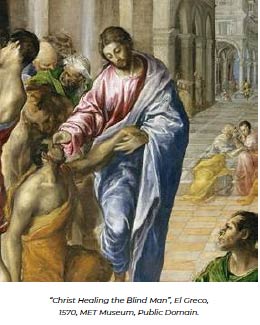
“Christ Healing the Blind Man”, El Greco, 1570, MET Museum, Public Domain.

« Previous Page
Next Page »

Liturgy

Sunday Masses (unless noted differently in weekly bulletin)
Saturday Evening Vigil – 4:00PM
Sunday – 7:00AM, 10:00AM and 5:00PM

Weekday Masses (unless noted differently in weekly bulletin)
Monday thru Friday – 7:00AM and 5:15PM
Saturday – 8:00AM

Reconciliation (Confessions)
Monday thru Friday – 4:15PM to 5:00PM
Saturday – 9:00AM to 10:00AM and 2:30PM to 3:30PM
Sunday – 4:00PM to 4:45PM

Adoration
Tuesdays and Thursdays – 4:00PM to 5:00PM


CatholicMassTime.org

Parish Information

Parish Address
524 East Lawrence Avenue
Springfield, Illinois 62703

Parish Office Hours
Monday thru Thursday – 8:00AM to 4:00PM
Fridays – CLOSED

Parish Phone
(217) 522-3342

Parish Fax
(217) 210-0136

Parish Staff

Contact Us

Contact Us

Copyright © 2026 · Log in