 It looks like many of us will be spending more time at home for a few weeks, whether for selfquarantine, lockdown, or social distancing. What can we do to keep ourselves spiritually engaged and even grow during this time, rather than stagnate or fall away from our spiritual disciplines? Here are a few suggestions.
Why Has God Given You This Time?
Your initial impulse might be to get more yard work done or to tackle certain home improvement projects. Maybe you are excited about catching up on some television shows, movies or novels.
But what does God want from you with this time? One of the most consistent themes of spiritual writings is that all things are ordained for our holiness. For example, in her fantastic work The Spiritual Life and Prayer, Cécile Bruyerè observes:
“All God’s designs over us in this world are intended to bring about our supernatural perfection.”

Begin and end each day asking God what he wants from you during this time. Pay attention to what’s happening in your life. How is God using this disruption to direct your attention to what he’s trying to accomplish in you? You may have numerous plans for what you want to accomplish. But to what do you see God calling your attention? Maybe the Lord wants you to slow down, spend more time in leisure. Or maybe he wants you to devote more time to prayer. Or maybe he’s asking you to trust him and stop relying on yourself so much. Come back to the question of what this time is for repeatedly. The Lord is calling you to grow!
Jesus, I Trust in You!
There are many things to fret about at this time. Even if you are not worried about getting seriously ill, you can worry about friends and family members getting ill. Or you can worry about your job, the economy, and your retirement account. If your mind is like mine, there will be numerous moments throughout the day when it takes a hard turn toward worryville. When you start doom dreaming, make a habit of saying, whether aloud or internally, “Jesus, I trust in you!”
Study
Instead of binge-watching shows, challenge yourself and exercise rather than relax your mind. Grow in your understanding of your Faith. The deeper your understanding of your faith, the greater the personal connection and engagement. Don’t let this opportunity pass by.
There are so many excellent online resources available that you don’t even have to worry about shipping delays. Ascension has numerous “instant access” study programs at affordable prices. Could you do any better than to think about the life of Jesus Christ through Jesus: The Way, the Truth, and the Life? Or, why not spend these weeks learning about the history of the Church through the excellent program, Epic? You can explore the biblical roots of the Catholic Faith through Sonja Corbitt’s Fulfilled. If you are a mother, you can think more about your vocation to motherhood with Danielle Bean’s cleverly named Momnipotent program. Perhaps you want to use this time to go deeper in prayer? Check our Fr. Mark Toups’ Oremus: A Guide to Catholic Prayer or Lenten Companion. Finally, you could master Scripture by working through Ascension’s excellent Great Adventure Bible study series. Or why not work through Romans?
Prepare for Massless
Sunday Worship More and more dioceses are canceling public Mass. But canceling Mass or dispensation for the Sunday obligation doesn’t mean you don’t have to worship God. The worship of the Lord is mandated in the first three commandments and it is our first duty. How are you going to worship the Lord outside of Mass? You can spend a couple of days during the week preparing a home service.
Why not have your family process to a place dedicated to prayer (see #8) while singing a hymn. You can find some hymns online that you could sing. Then you could make a general confession and sing the Kyrie. Read the Mass readings. In place of the homily, listen to the Mass readings explained by Dr. Brant Pitre, Dr. Scott Hahn, or Jeff Cavins. Or listen to some homilies that are posted online, like those from St. Mary’s Cathedral in Aberdeen. Take a crucifix or icon of Christ and spend some time in mental prayer. Include an Act of Spiritual Communion.
Read or Listen to Stories of the Saints
The saints faced much adversity but did so virtuously. They have much to teach us in these uncertain times. You can pick up dramatized audio stories of St. Francis, St. Cecilia, and St. Patrick from the Augustine Institute. If you have children who are home from school, check out the series of saint stories from Holy Heroes. Or read about St. Albert the Great, St. Colette, St. Robert Bellarmine, St. Teresa of Avila, St. Francis de Sales, St. John Henry Newman, St. John Paul II, St. Therese, or her saintly family. If you want to read a novel about a saint, look into the novels by Louis de Wohl.
Pray Compline
If you don’t already, end the day with Compline or “night prayer.” This is the last hour of prayer for the day. It is meant not only to prepare you for rest, but to prepare you for death. It includes a time for examination of conscience. You can view the “night office” through Universalis, which offers an excellent app if you’d like to have all the offices. Magnificat also has a version of Compline, and during the Coronavirus outbreak, they are offering complimentary access to an online version of their monthly book.
Spiritual and Corporal Works of Mercy
In times like these, we can fall into the trap of thinking only about ourselves and taking care of our needs. We can see our fellow human beings as threats. But the hallmark of our devotion to God is our concern for those in need. What can you do to help others during this time? Consider the Corporal and Spiritual Works of Mercy and ask yourself what you might do to help.
Build a Home Shrine
Why not get crafty during this time? If you don’t have one, build a little home altar or shrine. There is a great book that can help you called The Little Oratory: A Beginner’s Guide to Praying in the Home by David Clayton and Leila Marie Lawler.
Dr. James R. A. Merrick is a lecturer at Franciscan University of Steubenville, Senior Fellow at the St. Paul Center for Biblical Theology, and a theology and Latin teacher at St. Joseph’s Catholic Academy in Boalsburg, Pennsylvania. Follow Dr. Merrick on Twitter: @JamesRAMerrick.
 Such is the case with Thomas and the other apostles in today’s gospel. They had set all their hope on Jesus. And it all came to a horrifying and humiliating end with the crucifixion. Now, they were reduced to hiding behind a locked door for fear that the authorities would do to them what they had done to Jesus.
 I wonder what those holy women were feeling early in the morning on that first day of the week, as the Scriptures teach us, when Mary Magdalene and the others came to the tomb only to find it void of the one whom they sought, when in their amazement they were told:
 On behalf of Bishop Paprocki and the Cathedral clergy and staff, I pray that the Lord will bless you and yours this Easter with the fullness of His grace and the joy that comes from Him alone. With every cross may we remember that the cross is never an end unto itself. In moments of sacrifice and desolation may we know that we are not alone or forsaken. May we always be mindful that Easter teaches us that God always gets the last word, and in the case of the cross and the tomb, His last word is life. All honor, praise, and glory to the risen Christ, who, by His death and resurrection, has gained for us the rewards of everlasting life! Happy Easter (and I hope to be able to wish that in person at some point during the fifty days of this holy season)!
 This ancient hymn, the Victimae Paschali Laudes, is one of only a few “sequences” still in use in the Catholic Church today. A sequence— for your Catholic trivia file—is a hymn traditionally sung just before the Gospel proclamation. Before the reforms of the Mass in 1570, there were many such hymns on feast days and solemnities throughout the Church year. The current Roman Missal has only three: the above sequence for Easter, the Veni Sancte Spiritus for Pentecost, and the recommended (i.e. optional) Lauda Sion for the Solemnity of Corpus Christi.
 He’s. Not. Here.
 We can learn a lot about evangelization from the World War One film 1917. On imdb.com, a reviewer, calling himself “grantss” (no relation to me) summarized 1917’s plot with these words: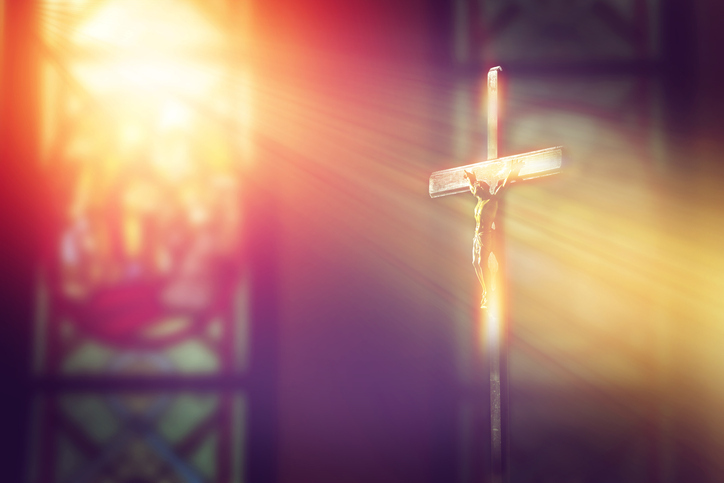
 What does sacrifice look like?